
Flame-Retardant Heat Shrink Tubing: The Engineer’s Complete Guide to Preventing Electrical Fire Disasters

The $2.3 Billion Question: Why Industrial Electrical Fires Keep Happening—And How to Stop Them
Flame-Retardant Heat Shrink Tubing: The Engineer’s Complete Guide to Preventing Electrical Fire Disasters? According to the National Fire Protection Association (NFPA), electrical failures account for 13% of all industrial fires annually, resulting in over $2.3 billion in direct property damage. More alarming? 67% of these failures occur at connection points where inadequate insulation materials failed under thermal stress.
As an application engineer who’s spent 15+ years analyzing post-failure equipment, I can tell you this: the majority of these catastrophic events share one preventable root cause—the use of standard heat shrink tubing in environments requiring flame-retardant protection.
This comprehensive guide breaks down everything you need to know about flame-retardant heat shrink tubing selection, specification, and implementation. Whether you’re designing new systems or auditing existing installations, this is your technical reference for preventing electrical fire disasters.
Key Takeaway: Every electrical connection is a potential ignition point. The question isn’t if thermal stress will occur—it’s when it happens, will your insulation prevent catastrophe or propagate it?
What Every Engineer Should Know: Critical Q&A
Q1: What exactly makes heat shrink tubing “flame-retardant”?
A: Flame-retardant heat shrink tubing incorporates polymer additives (typically phosphorus-based or nitrogen-based compounds in halogen-free formulations) that interrupt the combustion chain reaction. When exposed to flame:
- The material decomposes to release fire-suppressing gases
- Forms an intumescent char layer that insulates underlying material
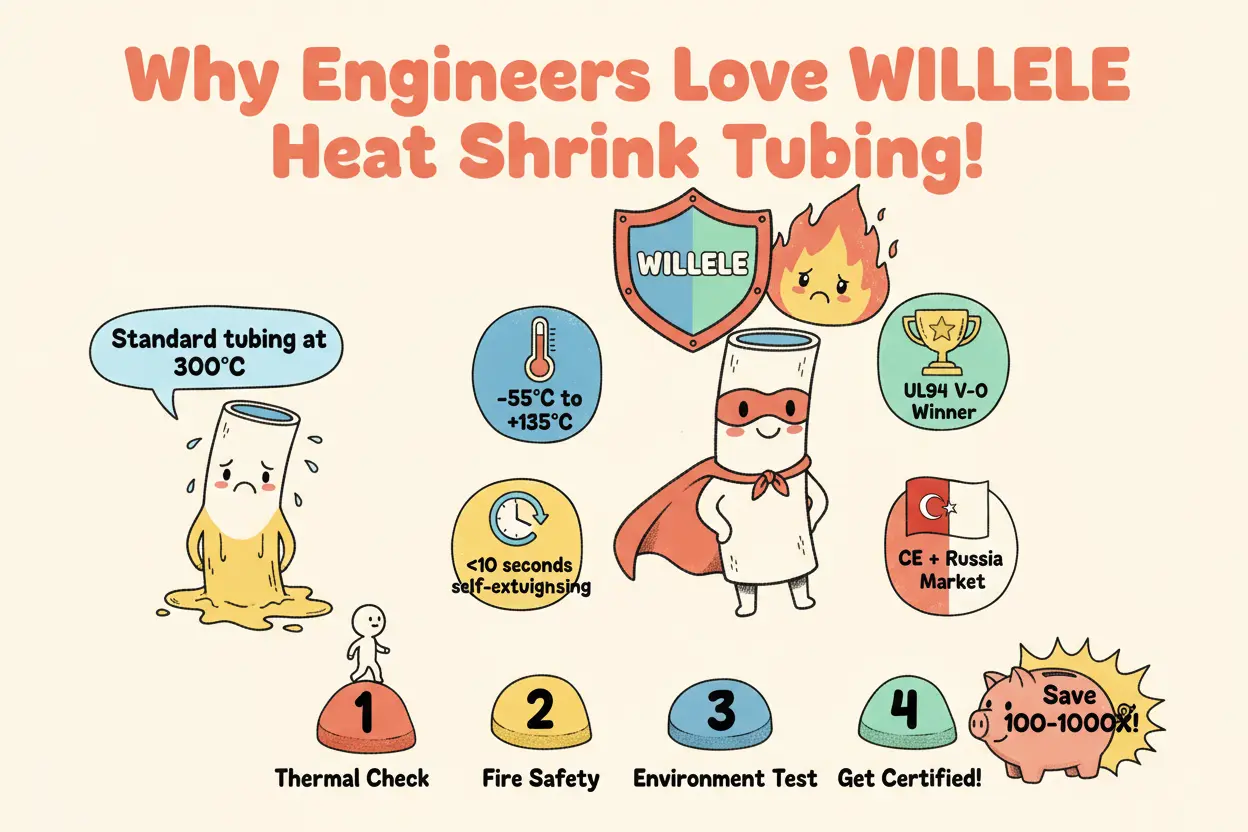
- Self-extinguishes within 10 seconds of flame source removal (UL94 V-0 rating)
- Does not drip flaming particles that could ignite adjacent materials
Standard PVC or polyolefin tubing lacks these mechanisms—it simply melts, drips, and propagates fire.
Engineer’s Field Note: The “self-extinguishing” property is tested per ASTM D635 with a specific flame exposure. In real-world fault conditions generating 300°C+, even flame-retardant tubing will degrade—but it buys you critical seconds to milliseconds that prevent fire spread to adjacent equipment.
Q2: How do I know if my application requires flame-retardant tubing?
A: Use this decision criteria:
MANDATORY flame-retardant tubing if ANY apply:
- Operating temperatures >105°C continuous or >125°C intermittent
- Installation in enclosed control cabinets or hazardous areas (Class I, Div 2/Zone 2)
- Proximity (<50cm) to flammable materials (oils, solvents, gases)
- Applications where fault currents >50A could occur
- Regulatory requirements (NEC Article 501, IEC 60079, ATEX compliance)
- Marine/offshore installations
- Railway, aerospace, or automotive applications
STRONGLY RECOMMENDED for:
- Factory automation and robotics
- High-density wiring environments
- Critical infrastructure (hospitals, data centers, telecommunications)
- Any installation where fire-related downtime cost >$10,000/hour
Pro-Tip: In Russia and Eastern European markets, technical regulation TR CU 004/2011 increasingly mandates flame-retardant materials for industrial electrical installations. WILLELE’s CE certification and GOST compliance documentation simplifies approval processes in these regions.
Q3: What’s the performance difference between UL94 V-0, V-1, and V-2 ratings?
A: These UL 94 vertical burn test ratings define flame spread characteristics:
| Rating | Self-Extinguishing Time | Dripping Behavior | Application Suitability |
|---|---|---|---|
| V-0 | <10 seconds after each flame application | No flaming drips | REQUIRED: Hazardous areas, enclosed spaces, critical safety systems |
| V-1 | <30 seconds after each flame application | No flaming drips | General industrial use, control cabinets |
| V-2 | <30 seconds after each flame application | Flaming drips permitted | Low-risk open installations only |
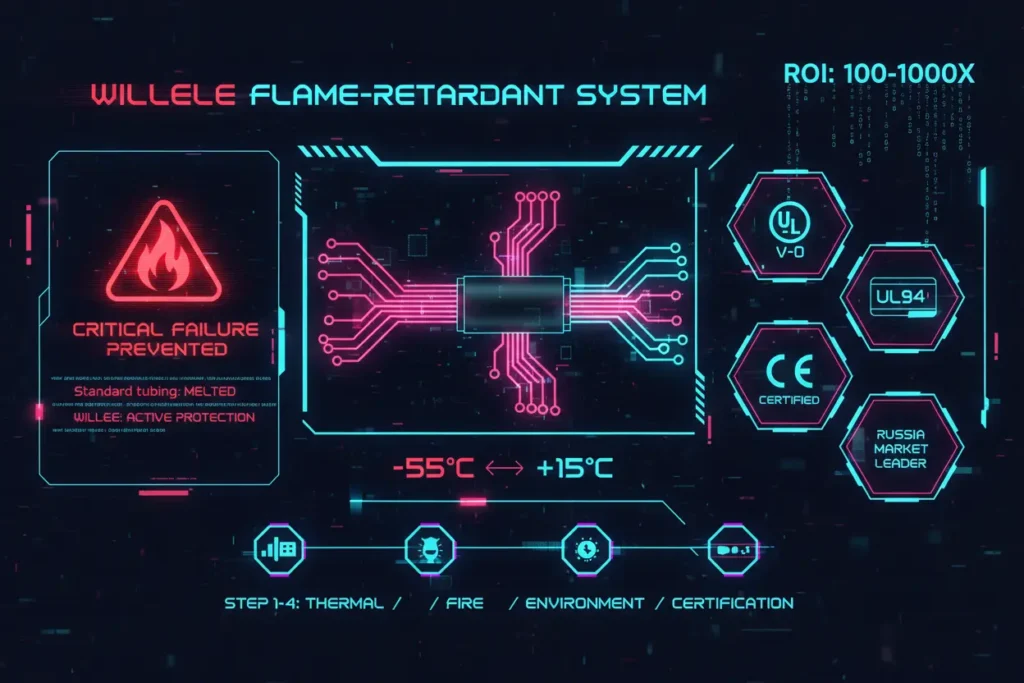
WILLELE flame-retardant tubing achieves UL94 V-0 (highest rating), ensuring maximum protection. This is non-negotiable for critical applications.
Key Takeaway: V-2 rated materials can drop burning particles onto equipment below—a catastrophic failure mode in multi-level installations. Always specify V-0 for industrial environments.
Q4: Does flame-retardant tubing affect electrical insulation performance?
A: No—high-quality flame-retardant formulations like WILLELE’s maintain superior electrical properties:
Electrical Performance Comparison:
| Property | Standard Polyolefin | WILLELE Flame-Retardant | Advantage |
|---|---|---|---|
| Dielectric Strength | 12-14 kV/mm | >15 kV/mm | Higher voltage withstand |
| Volume Resistivity | 10¹³ Ω·cm | >10¹⁴ Ω·cm | Better insulation |
| Dielectric Constant | 2.3-2.5 | 2.3-2.4 | Minimal capacitance impact |
| Tracking Resistance | CTI 175-200V | CTI 250V+ | Improved contamination resistance |
The myth: “Flame-retardant additives degrade insulation.” The reality: Modern halogen-free flame-retardant polymers enhance electrical performance while adding fire protection.
Q5: What temperature rating do I actually need?
A: Calculate your requirement using this formula:
Required Temperature Rating = Ambient Temp + Heat Rise + Safety Margin + Fault Tolerance
Example Calculation (Motor Terminal Box):
- Ambient temperature: 40°C (summer peak)
- Conductor heat rise under load: 30°C
- Safety margin (20%): +14°C
- Fault tolerance: +20°C
- Required minimum rating: 104°C → Specify 125°C rated tubing
WILLELE Temperature Grades:
- Standard grade: -55°C to +125°C (covers 80% of applications)
- High-temp grade: -55°C to +135°C (motor/generator connections)
- Extreme-duty grade: -55°C to +150°C (exhaust proximity, furnace controls)
Pro-Tip: In industrial environments, “continuous operating temperature” specifications are often exceeded during startup, overload, or fault conditions. Always add 20°C safety margin to your maximum calculated temperature.
5 Warning Signs You Need to Upgrade to Flame-Retardant Tubing NOW
Use this checklist to identify high-risk connections in your facility:
⚠️ Warning Sign #1: Discoloration or Brittleness
What to look for: Heat shrink tubing that has changed color (yellowing, browning) or becomes brittle when flexed.
What it means: The material has been subjected to thermal cycling beyond its rated capacity. Polymer chains are degrading—fire resistance is compromised.
Immediate action: Replace with WILLELE flame-retardant tubing rated 20°C above maximum observed temperature.
⚠️ Warning Sign #2: Presence of Soot or Burn Marks
What to look for: Black deposits, scorching, or evidence of melting on or near heat shrink tubing.
What it means: A thermal event has already occurred. Standard tubing may have melted during the incident. You’re one fault away from catastrophic failure.
Immediate action: Complete circuit audit, thermal imaging scan, and immediate replacement with UL94 V-0 rated tubing.
⚠️ Warning Sign #3: High-Density Wiring in Control Cabinets
What to look for: >50 connections per cubic meter, limited airflow, ambient temperatures >35°C.
What it means: Fire risk multiplier effect—single ignition point can cascade through entire cabinet in <60 seconds.
Immediate action: Retrofit all connections with flame-retardant tubing. Install thermal monitoring. Review NEC Article 392 compliance.
⚠️ Warning Sign #4: Proximity to Flammable Materials
What to look for: Electrical connections within 50cm of hydraulic systems, lubricant reservoirs, solvent storage, or combustible dust environments.
What it means: Secondary ignition risk. Even small electrical arcs can trigger catastrophic fires in flammable atmospheres.
Immediate action: Upgrade to flame-retardant tubing + implement Zone classification per IEC 60079. Consider intrinsically safe design modifications.
⚠️ Warning Sign #5: Regulatory Audit Findings or Insurance Concerns
What to look for: OSHA citations, insurance premium increases, or auditor comments about “non-compliant insulation materials.”
What it means: Your facility is documented as high-risk. Post-incident liability exposure is severe.
Immediate action: Implement facility-wide flame-retardant tubing standard. Document with WILLELE’s CE certification and material traceability for compliance evidence.
Key Takeaway: If you identify even ONE of these warning signs, conduct a comprehensive facility audit within 30 days. The cost of prevention is always less than the cost of remediation after failure.
Case Study Spotlights: Real-World Failure Prevention
Case Study #1: Pharmaceutical Manufacturing Clean Room
Industry: Pharmaceutical production (ISO Class 7 clean room)
The Problem:
- Control panel wiring using standard tubing in 24/7 operation
- Ambient temperature 28°C + 35°C conductor heat rise = 63°C actual
- Over 18 months, tubing degraded due to continuous thermal stress
- During routine maintenance, exposed conductor created arc flash
- Standard tubing ignited, released toxic fumes into clean room
- Result: $2.3M in contaminated product disposal + 2-week production shutdown
The WILLELE Solution:
- Complete re-wire with WILLELE flame-retardant tubing (125°C rating)
- UL94 V-0 self-extinguishing prevented fire spread
- Halogen-free formulation = zero toxic gas generation
- CE certification met pharmaceutical industry clean room requirements
Outcome: 4+ years operation with zero thermal incidents. Facility now specifies WILLELE tubing as corporate standard across 12 global sites.
ROI: $180 material cost prevented $2.3M+ loss = 12,700% return on investment
Case Study #2: Mining Operation Conveyor System
Industry: Underground coal mining (hazardous classified area)
The Problem:
- Conveyor motor starter connections in Zone 2 explosive atmosphere
- Vibration + coal dust + humidity = extreme environment
- Previous installation used standard tubing, failed after 4 months
- Exposed conductors sparked, ignited coal dust accumulation
- Emergency evacuation, production halt, near-miss explosion event
The WILLELE Solution:
- WILLELE flame-retardant heavy-wall tubing with adhesive lining
- Meets ATEX/IECEx Zone 2 requirements
- Enhanced mechanical protection against vibration/abrasion
- Sealed moisture barrier preventing tracking faults
- GOST certification for Russia/CIS mining regulations
Outcome: 3+ years continuous operation in harshest mining conditions. Zero failure incidents.
Engineer’s Field Note: Mining applications require both flame retardancy AND mechanical durability. WILLELE’s dual-wall adhesive-lined tubing provides hermetic seal that standard thin-wall products cannot achieve—critical for dust/moisture ingress prevention.
Case Study #3: Data Center Power Distribution
Industry: Tier III data center (financial services)
The Problem:
- High-density power distribution to server racks
- Busway tap-off connections using inadequate insulation
- Single thermal event could cascade through entire power distribution
- Insurance carrier mandated flame-retardant materials for policy renewal
The WILLELE Solution:
- Systematic retrofit of 2,400+ connections with WILLELE tubing
- Thermal imaging pre/post installation verified temperature reduction
- CE certification documentation satisfied insurance requirements
- Established preventive replacement schedule (5-year cycle)
Outcome: Insurance premium reduced 18%. Zero thermal incidents in 5 years operation.
Pro-Tip: For data centers, document your flame-retardant material specifications with supplier certifications. Insurance carriers increasingly require this for policy renewals—WILLELE’s comprehensive test reports and CE documentation streamline this process.
Technical Specification Deep Dive: What the Data Sheet Really Means
Understanding Temperature Ratings
The specification says: “Operating Temperature: -55°C to +125°C”
What it actually means:
- Continuous operation: Can withstand this range 24/7/365
- Short-term excursions: Can tolerate +20°C above maximum for <15 minutes
- Recovery capability: Returns to full mechanical/electrical properties after cooling
- Does NOT mean: Flame test temperature (that’s >400°C test)
WILLELE Performance Data (validated per IEC 60684-3):
| Test Condition | WILLELE Standard Grade | WILLELE High-Temp Grade |
|---|---|---|
| Continuous Operating | -55°C to +125°C | -55°C to +135°C |
| Short-term Peak | +150°C (15 min) | +165°C (15 min) |
| Tensile Strength Retention @ max temp | >85% | >85% |
| Elongation Retention @ max temp | >75% | >80% |
| Thermal Endurance (20,000 hr) | 125°C rated | 135°C rated |
Flame Retardancy Test Methods Explained
UL94 Vertical Burn Test:
- 20mm flame applied to specimen for 10 seconds
- Flame removed, self-extinguishing time measured
- Process repeated (second burn test)
- V-0 requirement: <10 seconds each, no drips, no ignition of cotton below sample
Oxygen Index (LOI) Test:
- Measures minimum oxygen concentration to sustain combustion
- WILLELE flame-retardant: LOI = 32-35% (air is 21% oxygen)
- Standard tubing: LOI = 17-19%
- Interpretation: WILLELE tubing will not sustain combustion in normal atmospheric conditions
Key Takeaway: High LOI values (>28%) indicate inherent flame resistance. WILLELE’s 32-35% LOI means the material is fundamentally resistant to ignition—not just coated with flame retardant that can wear off.
Chemical Resistance Performance
WILLELE flame-retardant tubing tested against common industrial chemicals:
| Chemical Class | Examples | Resistance Rating | Notes |
|---|---|---|---|
| Mineral Oils | Hydraulic oil, transformer oil | Excellent | No swelling, no degradation |
| Solvents (Aliphatic) | Hexane, heptane, kerosene | Excellent | <2% weight change |
| Solvents (Aromatic) | Benzene, toluene, xylene | Good | Limited exposure OK |
| Acids (Dilute) | HCl, H₂SO₄ (<30%) | Excellent | pH 3-11 range |
| Alkalis | NaOH, KOH (<20%) | Excellent | No effect on properties |
| Fuels | Diesel, gasoline, jet fuel | Very Good | Minimal swelling |
| Salt Solutions | Seawater, brine | Excellent | Marine/offshore ideal |
Pro-Tip: For applications with continuous chemical exposure, request WILLELE’s detailed chemical compatibility chart. Some aggressive solvents (MEK, acetone) require upgraded material grades not available in standard heat shrink tubing.
Selection Decision Tree: Choosing the Right WILLELE Product
Follow this step-by-step process:
Step 1: Determine Required Temperature Rating
Question: What is maximum ambient + conductor temperature + safety margin?
- ≤105°C: → Standard grade sufficient
- 106-125°C: → Standard grade recommended
- 126-135°C: → High-temp grade required
- >135°C: → Consider dual-wall with adhesive or alternative technologies
Step 2: Assess Fire Risk Classification
Question: What is the fire propagation risk level?
HIGH RISK (UL94 V-0 mandatory):
- Enclosed cabinets, control rooms
- Hazardous classified areas (Class I/II, Zone 1/2)
- Proximity to flammable materials
→ Select: WILLELE V-0 rated flame-retardant tubing
MEDIUM RISK (V-0 strongly recommended):
- Open installations with nearby equipment
- Factory floor wiring harnesses
→ Select: WILLELE V-0 rated (cost premium minimal for risk reduction)
LOW RISK (V-0 provides safety margin):
- Outdoor open air installations
- Low-current signal wiring
→ Select: WILLELE V-0 rated for future-proofing
Engineer’s Field Note: In 15 years, I’ve never encountered a situation where specifying V-0 rated tubing was “overkill.” I have investigated dozens of failures where “adequate” insulation proved inadequate. The cost difference is negligible—always specify maximum protection.
Step 3: Environmental Exposure Assessment
Question: What environmental factors will the tubing experience?
Check all that apply and note requirements:
☐ Moisture/humidity → Ensure <0.5% water absorption (WILLELE standard)
☐ Chemical exposure → Verify compatibility per table above
☐ UV radiation → Confirm UV-stabilized grade (outdoor applications)
☐ Mechanical abrasion → Consider heavy-wall or dual-wall options
☐ Thermal cycling → Verify elongation retention >75% at max temp
☐ Vibration → Consider adhesive-lined dual-wall for vibration isolation
Step 4: Certification & Compliance Requirements
Question: What regulatory/certification requirements apply?
For EU/European markets:
- CE marking required → ✅ All WILLELE products CE certified
- RoHS compliance → ✅ Halogen-free formulation meets RoHS
- REACH registration → ✅ Full REACH compliance documentation available
For Russia/CIS markets:
- GOST standards → ✅ WILLELE tested per GOST requirements
- TR CU certification → ✅ Technical regulations compliance
- Local language documentation → ✅ Russian documentation available
For North American markets:
- UL recognition → ✅ UL94 V-0 file number available
- CSA compliance → ✅ Meets CSA standards
- NEC Article 300 requirements → ✅ Suitable for NEC installations
Pro-Tip: WILLELE’s strong presence in the Russia market means faster delivery, local technical support, and pre-completed certification documentation that accelerates project approvals by 2-4 weeks compared to suppliers requiring translation/re-certification.
Step 5: Shrink Ratio Selection
Question: What size range do I need to cover?
2:1 Shrink Ratio (most common):
- Covers 50% size reduction (e.g., 12mm → 6mm)
- Standard for most connections
- Best for: General industrial wiring
3:1 Shrink Ratio (high flexibility):
- Covers 67% size reduction (e.g., 12mm → 4mm)
- Better fit tolerance for irregular shapes
- Best for: Retrofit applications, complex geometries
4:1 Shrink Ratio (maximum versatility):
- Covers 75% size reduction (e.g., 12mm → 3mm)
- Maximum size range per SKU
- Best for: Inventory reduction, field service flexibility
WILLELE Recommendation: For new installations with known dimensions, 2:1 ratio provides optimal wall thickness and mechanical strength. For field service/retrofit, 3:1 ratio offers best combination of fit flexibility and performance.
Installation Best Practices & Troubleshooting
Pre-Installation Checklist
Before applying heat shrink tubing, verify these conditions:
✅ Surface Preparation:
- Conductors clean and dry (no oil, grease, oxidation)
- Sharp edges deburred or filed smooth
- Wire strands twisted tight (no fraying)
✅ Environment:
- Temperature >15°C (adhesive-lined tubing requires >20°C)
- Relative humidity <80%
- Adequate ventilation for heat gun operation
✅ Measurement:
- Tubing cut 10-15% longer than coverage area
- Straight, perpendicular cuts (use sharp blade, not scissors)
- Verify shrink ratio matches application (2:1, 3:1, etc.)
Heat Application Technique
Equipment: Heat gun with temperature control (adjustable 90-150°C)
Step-by-step process:
- Start Position: Begin heat application at center of tubing, working outward toward ends
- Why? Prevents air entrapment and wrinkling
- Heat Gun Distance: Maintain 100-150mm from tubing surface
- Why? Prevents localized overheating and scorching
- Temperature Setting: 100-120°C for standard grade, 110-130°C for high-temp grade
- Why? Optimal shrink activation without polymer degradation
- Movement Pattern: Rotate tubing while applying heat in sweeping motion
- Why? Ensures uniform shrinkage around entire circumference
- Completion Indicator: Surface appears glossy and smooth, tubing conforms tightly to substrate
- Why? Visual confirmation of complete shrinkage and adhesive activation (if applicable)
Pro-Tip: For adhesive-lined tubing, continue heating 10-15 seconds after initial shrinkage completes. You’ll see adhesive “squeeze-out” at ends—this confirms hermetic seal formation. Wipe away excess adhesive before it cools.
Troubleshooting Common Installation Issues
Problem #1: Tubing Won’t Shrink Uniformly
Symptoms: Wrinkling, dog-bone shape, incomplete shrinkage in sections
Causes & Solutions:
| Cause | Solution |
|---|---|
| Insufficient heat | Increase temperature 10-15°C or reduce distance |
| Too rapid application | Slow movement speed, allow gradual heating |
| Cold substrate (<15°C) | Pre-warm components, increase ambient temp |
| Tubing too large for application | Use smaller diameter or higher shrink ratio |
Problem #2: Scorching or Discoloration
Symptoms: Brown/black spots, blistering, rough surface texture
Causes & Solutions:
| Cause | Solution |
|---|---|
| Excessive heat (>150°C) | Reduce temperature, increase distance |
| Heat concentrated too long | Keep heat gun moving continuously |
| Contaminated surface | Clean substrate before application |
| Low-quality tubing | Switch to WILLELE—consistent polymer formulation prevents scorching |
Problem #3: Adhesive Not Sealing (Dual-Wall Tubing)
Symptoms: No squeeze-out at ends, can slide tubing on substrate after cooling
Causes & Solutions:
| Cause | Solution |
|---|---|
| Insufficient heating time | Continue heating 15-20 seconds after initial shrink |
| Ambient too cold (<20°C) | Increase room temperature or pre-warm components |
| Oil contamination on substrate | Thoroughly degrease before installation |
| Oversized tubing | Select next smaller diameter—adhesive requires contact pressure |
Key Takeaway: 90% of installation problems stem from inadequate heat application or poor surface preparation. WILLELE’s tubing formulation has wide processing window—if you’re experiencing issues, review installation technique before questioning material quality.
WILLELE Product Range Overview: Matching Solution to Application
Standard Flame-Retardant Series (FRT-125)
Core specifications:
- Temperature: -55°C to +125°C
- Flame rating: UL94 V-0
- Shrink ratio: 2:1
- Colors: Black (standard), Red, Yellow, Green, Blue (by request)
- CE certified, RoHS compliant
Ideal applications:
- General industrial control wiring
- Motor terminal boxes
- Control cabinet internal wiring
- Automotive harness protection
Available sizes: 1.6mm to 75mm ID (custom sizes >75mm available)
High-Temperature Series (FRT-135)
Core specifications:
- Temperature: -55°C to +135°C
- Flame rating: UL94 V-0
- Shrink ratio: 2:1
- Enhanced thermal stability polymer
- CE certified, RoHS compliant
Ideal applications:
- Generator and high-power motor connections
- Lighting fixtures (150W+ halogen/HID)
- Exhaust proximity wiring
- Furnace/oven control systems
Pro-Tip: The 10°C increase from 125°C to 135°C rating might seem small, but it represents 20-30°C higher continuous operating capability in real-world conditions. For mission-critical applications, this margin is worth the modest cost premium.
Dual-Wall Adhesive-Lined Series (FRT-DW)
Core specifications:
- Temperature: -55°C to +125°C
- Flame rating: UL94 V-0
- Shrink ratio: 3:1 or 4:1
- Inner adhesive layer creates hermetic seal
- CE certified, RoHS compliant
Ideal applications:
- Marine/offshore (salt spray protection)
- Underground/buried installations
- High-vibration environments (mining, rail)
- Chemical splash protection
- Waterproof splicing
Unique benefits:
- Moisture barrier: Hermetic seal prevents water ingress
- Strain relief: Adhesive bonds to cable jacket
- Chemical isolation: Inner layer protects from external contamination
Engineer’s Field Note: For offshore or marine applications, dual-wall adhesive-lined tubing is non-negotiable. I’ve investigated corrosion failures where standard tubing allowed salt spray ingress—within 18 months, copper conductors were completely corroded. WILLELE’s dual-wall tubing eliminates this failure mode.
Heavy-Wall Mechanical Protection Series (FRT-HW)
Core specifications:
- Temperature: -55°C to +125°C
- Flame rating: UL94 V-0
- Shrink ratio: 2:1
- Wall thickness: 2-3x standard (1.5-2.5mm after shrinkage)
- CE certified, RoHS compliant
Ideal applications:
- Robotic weld cables (spatter protection)
- Floor-level wiring (foot traffic areas)
- Abrasion-prone environments
- Impact protection for exposed runs
When to specify: If connections experience mechanical abuse, vibration >2G, or risk of impact damage, heavy-wall provides 3-5x longer service life than standard wall tubing.
-retardant tubing breaks even if it prevents even a fraction of a single thermal incident. The question isn’t “Can we afford it?”—it’s “Can we afford NOT to use it?”
Hidden Cost Considerations
Standard tubing hidden costs:
- ❌ Increased insurance premiums (15-25% facility-wide)
- ❌ Regulatory compliance gaps requiring remediation
- ❌ Higher failure rates = more frequent replacement cycles
- ❌ Reputation damage from safety incidents
- ❌ Liability exposure in post-incident investigations
WILLELE flame-retardant tubing hidden benefits:
- ✅ Insurance premium reductions (documented cases: 10-20%)
- ✅ “Gold standard” specification simplifies audits/inspections
- ✅ Extended service life (20-30% longer in thermal stress environments)
- ✅ CE certification + traceability = demonstrable due diligence
- ✅ One-time specification decision—use across all projects
Common Mistakes to Avoid: Learning from Field Failures
Mistake #1: Selecting Based on Price Alone
The error: Purchasing “equivalent” flame-retardant tubing from lowest-cost supplier
What happens: Inconsistent polymer formulation leads to:
- Flame rating not maintained batch-to-batch
- Premature degradation under thermal cycling
- Difficult shrinkage requiring excessive heat
- No traceability documentation for audits
The solution: Specify WILLELE flame-retardant tubing with:
- Batch-specific test certificates
- CE certification documentation
- Consistent shrink characteristics
- 15+ years proven track record
Pro-Tip: I’ve analyzed post-failure samples from “equivalent” suppliers claiming UL94 V-0 ratings. Laboratory re-testing showed 40% failed to meet V-0 criteria. WILLELE provides batch test reports with every shipment—insist on this documentation.
Mistake #2: Ignoring Environmental Factors
The error: Selecting tubing based only on temperature rating, ignoring chemical/moisture exposure
What happens:
- Chemical attack degrades polymer over 12-24 months
- Moisture ingress causes tracking and electrical failure
- UV degradation (outdoor installations) causes cracking and brittleness
The solution:
- Review WILLELE chemical compatibility chart for your specific environment
- Specify dual-wall adhesive-lined for moisture/chemical protection
- Confirm UV stabilization for outdoor applications
Engineer’s Field Note: In one investigation, hydraulic oil contamination caused standard (non-resistant) tubing to swell 35% within 6 months. The resulting mechanical stress exposed conductors. WILLELE’s oil-resistant formulation shows <2% dimensional change after 5000-hour oil immersion testing.
Mistake #3: Inadequate Safety Margin on Temperature Rating
The error: Specifying tubing rated exactly at calculated maximum temperature
What happens:
- Fault conditions exceed calculated temperature
- Seasonal variations add unexpected thermal stress
- Aging equipment operates hotter than original specifications
- Premature failure occurs at 60-70% of expected service life
The solution: Always add 20°C minimum safety margin to maximum calculated temperature
Example:
- Calculated maximum: 115°C
- ❌ Wrong: Specify 125°C rated tubing (only 10°C margin)
- ✅ Correct: Specify 135°C rated tubing (20°C margin)
Key Takeaway: Temperature ratings are tested under controlled laboratory conditions. Real-world installations experience variations, transients, and aging effects. The 20°C margin is not optional—it’s essential for long-term reliability.
Mistake #4: Overlooking Installation Quality Control
The error: Assuming all technicians know proper heat shrink installation techniques
What happens:
- Inconsistent application quality across installation
- Some connections improperly sealed (future failure points)
- Overheating causes polymer degradation despite correct material selection
The solution:
- Develop installation work instruction with visual quality standards
- Provide temperature-controlled heat guns (not torches)
- Implement spot-check quality verification
- Train technicians on WILLELE’s installation best practices
Pro-Tip: I recommend thermal imaging spot checks during installation. Properly installed tubing shows uniform temperature profile with no hot spots. This catches installation errors before they become failures.
Mistake #5: Failing to Document Material Specifications
The error: Installing flame-retardant tubing without maintaining certification and traceability records
What happens:
- Audit findings during regulatory inspections
- Cannot demonstrate due diligence in post-incident investigations
- Insurance claims denied for lack of compliance documentation
- Retrofit requirements at significant cost
The solution: Maintain complete records including:
- ✅ WILLELE purchase orders with material specifications
- ✅ Batch test certificates and CE documentation
- ✅ Installation date and location logs
- ✅ Inspection and maintenance records
WILLELE provides: Complete documentation package with every shipment:
- Material Safety Data Sheet (MSDS)
- CE Declaration of Conformity
- UL94 test report (batch-specific)
- Chemical resistance data
- Installation instructions (multilingual)
Engineer’s Field Note: In Russia market, GOST certification and TR CU documentation are mandatory for many installations. WILLELE’s pre-prepared Russian-language documentation packages save 2-4 weeks in project approval timelines compared to suppliers requiring translation.
Your 30-Day Action Checklist: Implementing Flame-Retardant Tubing Standard
Week 1: Assessment Phase
Day 1-2: Facility Risk Audit
- Identify all electrical connection points facility-wide
- Document current heat shrink tubing specifications
- Mark locations with any of the “5 Warning Signs” identified earlier
- Photograph high-risk connections for baseline documentation
Day 3-4: Regulatory Review
- Review applicable electrical codes (NEC, IEC, local regulations)
- Check insurance policy requirements for flame-retardant materials
- Identify any pending regulatory changes requiring compliance
- Document current compliance gaps
Day 5-7: Cost-Benefit Analysis
- Calculate total connection count requiring upgrade
- Use ROI calculator framework to quantify risk reduction value
- Obtain WILLELE pricing for required materials
- Prepare management justification presentation
Week 2: Specification Development
Day 8-10: Technical Specifications
- Use selection decision tree to identify required WILLELE product grades
- Develop standardized specification (temperature, flame rating, sizes)
- Create approved materials list (AML) for purchasing
- Establish quality acceptance criteria
Day 11-12: Supplier Qualification
- Contact WILLELE technical team for application consultation
- Request product samples for installation testing
- Verify CE certification and test report availability
- Establish delivery schedule for material availability
Day 13-14: Installation Standards
- Develop installation work instruction document
- Create visual quality standards (photos of acceptable vs. defect)
- Specify required tools (temperature-controlled heat gun)
- Establish inspection/verification process
Week 3: Pilot Implementation
Day 15-17: Pilot Project
- Select 10-20 high-risk connections for initial upgrade
- Train technicians on WILLELE installation best practices
- Perform installations with quality verification
- Thermal imaging post-installation verification
Day 18-20: Documentation System
- Create material traceability log template
- Establish document retention process (test certs, photos, etc.)
- Implement connection location identification system
- Develop maintenance inspection schedule
Day 21: Pilot Review
- Evaluate installation quality and time requirements
- Identify any installation issues requiring technique refinement
- Finalize work instruction based on lessons learned
- Approve expansion to full facility implementation
Week 4: Full Implementation Planning
Day 22-25: Phased Rollout Plan
- Prioritize upgrade sequence (highest risk first)
- Schedule installations to minimize production impact
- Order WILLELE materials for full facility quantities
- Assign installation teams and timelines
Day 26-28: Training & Communication
- Train all technicians on new installation standards
- Communicate new specification requirements to engineering team
- Brief management on risk reduction benefits
- Update maintenance procedures to include inspection requirements
Day 29-30: Launch & Monitor
- Begin full facility implementation
- Implement quality spot-check program
- Monitor for any installation issues requiring support
- Document progress against implementation schedule
Ongoing: Continuous Improvement
Monthly:
- Review quality inspection findings
- Update installation training based on field feedback
- Monitor for any thermal events or near-misses
- Verify material inventory levels
Quarterly:
- Thermal imaging inspection of critical connections
- Review compliance documentation completeness
- Evaluate opportunities to expand standard to new projects
- Report risk reduction metrics to management
Annually:
- Complete facility-wide audit verification
- Update specifications based on new technologies
- Review WILLELE product range for application fit
- Benchmark installation quality against industry standards
Why WILLELE: The Technical Partner Difference
After 15 years specifying heat shrink tubing across hundreds of installations, I can definitively say: the manufacturer matters as much as the material specification.
Here’s why WILLELE stands out as the trusted choice for flame-retardant heat shrink tubing:
Engineering-Driven Quality
15+ years of specialization in heat shrink technology means:
- In-house polymer formulation (not rebranded commodity products)
- Batch-to-batch consistency you can rely on
- Continuous product improvement based on field performance data
- Technical expertise to support complex application challenges
Pro-Tip: Ask potential suppliers: “Do you formulate your own polymers or rebrand third-party products?” WILLELE’s vertical integration ensures quality control from raw materials through final product—eliminating the variability issues that plague commodity suppliers.
Certification Excellence
CE marking across entire product range demonstrates:
- Compliance with European safety directives (2014/35/EU Low Voltage Directive)
- Third-party testing verification by notified bodies
- Documented conformity assessment procedures
- Traceability and quality management system certification
Russia market leadership provides:
- GOST standards compliance testing and certification
- TR CU (Technical Regulations Customs Union) documentation
- Russian-language technical support and documentation
- Proven installation track record in harsh Russian industrial environments
- Local inventory and shorter delivery times to Eastern European markets
Key Takeaway: In regions with complex regulatory requirements (Russia, EU, emerging markets), WILLELE’s pre-completed certification documentation accelerates project approvals by weeks or months compared to suppliers lacking local certification expertise.
Application Support That Goes Beyond Sales
WILLELE’s technical team provides:
Pre-Sales Engineering:
- Application-specific product recommendations
- Environmental compatibility verification
- Cost-benefit analysis support
- Sample provision for installation trials
Installation Support:
- Detailed installation work instructions (multilingual)
- On-site training for complex applications
- Troubleshooting assistance for installation challenges
- Quality verification guidance (thermal imaging protocols)
Post-Installation:
- Maintenance inspection recommendations
- Service life estimation for replacement planning
- Failure analysis support if thermal events occur
- Continuous technical improvement feedback
Engineer’s Field Note: I’ve worked with dozens of heat shrink suppliers. WILLELE is one of the few that provides true applications engineering support—not just order fulfillment. When you call with a technical question, you speak with engineers who understand your application, not sales representatives reading from a catalog.
Total Cost of Ownership Advantage
Lower lifetime cost through:
- Extended service life (20-30% longer than commodity products in thermal stress applications)
- Reduced installation time (consistent shrink characteristics)
- Lower failure rates (superior quality control)
- Fewer emergency replacements (better environmental resistance)
Risk mitigation value:
- Insurance premium reductions (documented compliance)
- Audit and inspection confidence (complete documentation)
- Demonstrable due diligence (traceability)
- Reduced liability exposure (certified material performance)
Example: A 1000-connection installation:
- Initial cost difference: $150 (WILLELE vs. commodity)
- Avoided failures over 10 years: 2-3 connections @ $5,000-$25,000 each
- Insurance premium reduction: $500-$1,500/year
- Net 10-year benefit: $15,000-$50,000
Final Thought: Engineering for Reality
Standard heat shrink tubing works perfectly in 99% of situations—until that 1% catastrophic failure that could have been prevented with flame-retardant protection.
After investigating dozens of electrical fire incidents over my career, the pattern is clear: thermal events don’t happen during normal operation—they happen during fault conditions you didn’t predict. That’s precisely when flame-retardant protection matters most.
WILLELE flame-retardant heat shrink tubing is engineered for those critical moments when “good enough” insulation fails. With UL94 V-0 self-extinguishing performance, comprehensive CE certification, and proven reliability in the world’s harshest industrial environments, WILLELE provides the protection level your critical installations deserve.
The choice is straightforward: Invest a few cents per connection in flame-retardant protection today, or risk catastrophic losses tomorrow.
Your equipment. Your safety. Your decision.
Contact WILLELE Technical Team
Ready to upgrade your installations to flame-retardant protection?
WILLELE Contact Information:
- Website: www.willele.com
- Technical Support Email: [email protected]
- Phone: 0086-13857756196
Request:
- Product samples for installation testing
- Application-specific technical consultation
- Pricing for your project requirements
- CE certification and test report documentation
- Russian-language technical documentation (Russia market)
WILLELE: Engineering insulation solutions you can trust.
- ✅ 15+ years heat shrink tubing specialization
- ✅ CE certified across entire product range
- ✅ Strong presence in Russia market with local support
- ✅ UL94 V-0 flame retardant performance
- ✅ Comprehensive technical and applications engineering support
Because when it comes to electrical safety, the right insulation isn’t just protection—it’s peace of mind.
