
Busbar Insulator Materials Compared | BMC vs SMC


Introduction
BMC vs SMC: which busbar insulator material should you choose? This comprehensive comparison breaks down everything you need to know about Bulk Molding Compound (BMC) and Sheet Molding Compound (SMC) for busbar applications—from material properties and manufacturing processes to real-world performance and cost implications.
The choice between BMC and SMC busbar insulators isn’t just a materials specification—it’s a critical design decision that ripples through your entire project. Pick the wrong one, and you’re looking at production bottlenecks, cost overruns, or worse, field failures that damage your reputation and bottom line.
As an electrical automation engineer who has evaluated and tested both materials across hundreds of busbar designs, I’ve developed a practical framework for this comparison. This guide cuts through the marketing hype and technical jargon to give you actionable criteria: material composition, mechanical strength, electrical performance, manufacturing efficiency, and total cost of ownership.
Whether you’re designing a compact switchgear assembly that demands intricate geometries, or specifying insulators for a high-volume production line where every second of cycle time matters, you’ll find the data-driven insights you need to make the right BMC vs SMC decision for your specific application.
Meet the Contenders: Understanding BMC and SMC
Before we compare them, let’s get a feel for what these materials are. Both are thermoset composites, meaning they are permanently hardened through a curing process involving heat and pressure. Unlike thermoplastics, they cannot be re-melted. This gives them excellent thermal stability and creep resistance, which is essential for electrical applications.
What is BMC (Bulk Molding Compound)?
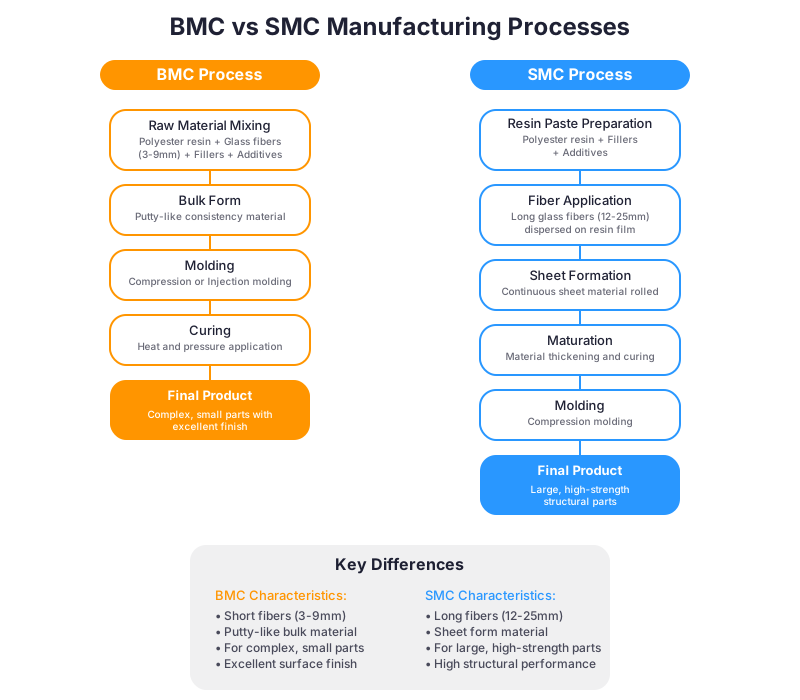
BMC is a composite material consisting of a thermoset resin (typically unsaturated polyester), various inert fillers, reinforcing fibers (most often short glass fibers), and additives like catalysts and pigments. The key characteristic of BMC is its dough-like, bulk form. The glass fibers are short—usually between 3mm and 12mm—and are mixed into the resin paste, creating a homogenous compound.
Think of BMC like a high-tech modeling clay. It’s amorphous and can be easily injected or compressed into molds with very fine details, sharp corners, and complex geometries.
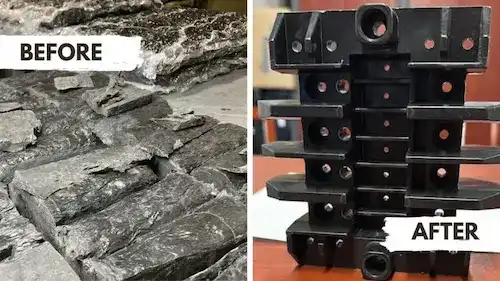
Its excellent flowability makes it the go-to material for small, intricate parts where precision is paramount .
What is SMC (Sheet Molding Compound)?
SMC shares a similar chemical base with BMC—a thermoset resin, fillers, and additives. The defining difference lies in the reinforcement. SMC uses longer glass fibers, typically 25mm (1 inch) or even longer, which are impregnated between two layers of resin paste. This creates a fiber-reinforced sandwich that is then rolled into large sheets.
SMC, on the other hand, is more like pre-made sheets of high-strength, fiber-reinforced dough. Before molding, these sheets are cut and stacked in a specific orientation within the mold. This layered structure with longer fibers gives SMC superior mechanical properties, particularly in larger components.
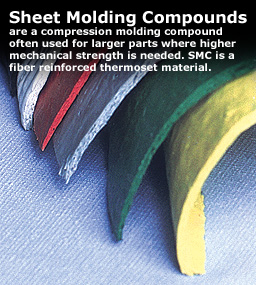
This makes SMC ideal for parts that require high strength and stiffness across a large surface area, like automotive body panels or large electrical enclosures .
Key Takeaway: The fundamental difference is fiber length and form. BMC is a bulk dough with short, mixed-in fibers, making it ideal for complex, smaller parts. SMC is a sheet with long, layered fibers, giving it superior strength for larger, structural components.
The Head-to-Head Comparison: BMC vs. SMC
Now, let’s put these materials side-by-side across the four areas that matter most to an engineer: mechanical properties, electrical performance, manufacturing, and cost.
1. Physical & Mechanical Properties
This is often the first consideration. Will the insulator crack, bend, or deform under load? The answer lies in the numbers, which are directly influenced by fiber length.
| Property | Bulk Molding Compound (BMC) | Sheet Molding Compound (SMC) | Winner for High Performance |
|---|---|---|---|
| Fiber Length | Short (3mm – 12mm) | Long (25mm – 50mm+) | SMC |
| Tensile Strength | 35 – 100 MPa | 55 – 125 MPa | SMC |
| Flexural Strength | 80 – 180 MPa | 120 – 230 MPa | SMC |
| Impact Strength (Izod) | 15 – 50 kJ/m² | 40 – 80 kJ/m² | SMC |
| Density | 1.6 – 2.1 g/cm³ | 1.3 – 2.0 g/cm³ | Application Dependent |
What This Means for You:
The data is clear: SMC is mechanically superior to BMC. The longer glass fibers act like a dense, intertwined rebar network, distributing stress far more effectively across the part. If your insulator needs to withstand significant static loads, high cantilever forces from heavy busbars, or potential impact/vibration, SMC is the stronger choice .
BMC’s strength is more than adequate for many applications, especially smaller standoff insulators where the primary role is insulation and spacing rather than heavy mechanical support. However, for large structural insulators or components that are part of a system’s chassis, SMC’s higher tensile and flexural strength provide a much larger safety margin.
2. Electrical Performance Characteristics
While mechanical strength is crucial, an insulator’s primary job is to insulate. Both BMC and SMC are excellent electrical insulators, but subtle differences can be important.
| Property | Bulk Molding Compound (BMC) | Sheet Molding Compound (SMC) | Notes |
|---|---|---|---|
| Dielectric Strength | 12 – 20 kV/mm | 10 – 18 kV/mm | Both are excellent for LV/MV applications. |
| Arc Resistance | 130 – 190 seconds | 120 – 180 seconds | BMC often has a slight edge due to filler composition. |
| Comparative Tracking Index (CTI) | > 600V (PLC 0) | > 600V (PLC 0) | Both offer top-tier tracking resistance. |
| Volume Resistivity | 10¹² – 10¹⁴ Ω·cm | 10¹² – 10¹⁴ Ω·cm | Very high for both materials. |
What This Means for You:
For most standard low and medium-voltage applications (up to ~35kV), both BMC and SMC offer outstanding and broadly comparable electrical performance. Both provide high dielectric strength, preventing current from passing through, and an excellent CTI, which measures their resistance to forming conductive tracks on their surface in the presence of contamination and moisture.
Where BMC sometimes has a slight advantage is in arc resistance. In the event of an arc flash, the material’s ability to resist charring and maintain its insulating properties is critical. BMC’s formulation, often with higher filler content like alumina trihydrate (ATH), can give it a performance edge in this specific failure mode . This makes it a favorite for components inside arc-resistant switchgear.
3. Manufacturing Process & Design Complexity
How a part is made dictates its geometry, cost, and production speed. This is where the two materials diverge most significantly.
| Aspect | Bulk Molding Compound (BMC) | Sheet Molding Compound (SMC) | Notes |
|---|---|---|---|
| Form | Dough/Putty-like | Pre-cut Sheets | BMC is bulk, SMC is pre-preg. |
| Primary Process | Injection Molding, Compression Molding | Compression Molding Only | BMC’s injection capability is key for complex parts. |
| Flowability in Mold | Excellent | Good to Moderate | Shorter fibers allow BMC to fill tiny features. |
| Suitability for Complexity | Very High (ribs, bosses, thin walls) | Moderate | Best for larger parts with less intricate detail. |
| Waste / Scrap | Low | Moderate (off-cuts from sheets) | Injection molding is highly efficient. |
What This Means for You:
This is BMC’s home turf. Its superb flowability makes it perfect for injection molding, a highly automated and precise process. This allows you to design parts with a high degree of complexity: intricate ribs for reinforcement, molded-in brass or copper inserts, tight tolerances, and varying wall thicknesses. If your design looks more like a detailed plastic part than a simple block, BMC is almost certainly the right busbar insulator material.
SMC is limited to compression molding. The process involves placing manually or robotically stacked sheets into a mold cavity before pressing. This is highly effective for parts with large surface areas and relatively simple geometries—think panels, housings, and larger standoff insulators. Attempting to force the long-fiber sheets into tiny, complex features can lead to inconsistent fiber distribution and weak spots.
Pro-Tip: When designing for SMC, avoid sharp internal corners. Use generous radii to help the material flow and prevent resin-rich, fiber-poor areas that can become mechanical weak points. For BMC, discuss gate locations with your molder to optimize material flow and minimize weld lines in cosmetically or mechanically critical areas.
4. Cost & Application Suitability
Finally, the bottom line. Cost is a function of raw materials, tooling, and cycle time.
| Aspect | Bulk Molding Compound (BMC) | Sheet Molding Compound (SMC) | Winner |
|---|---|---|---|
| Material Cost | Lower | Higher | BMC |
| Tooling Cost | Can be higher for complex injection molds | Generally lower for simpler compression molds | Application Dependent |
| Cycle Time | Faster (especially with injection molding) | Slower (due to manual/robotic loading) | BMC |
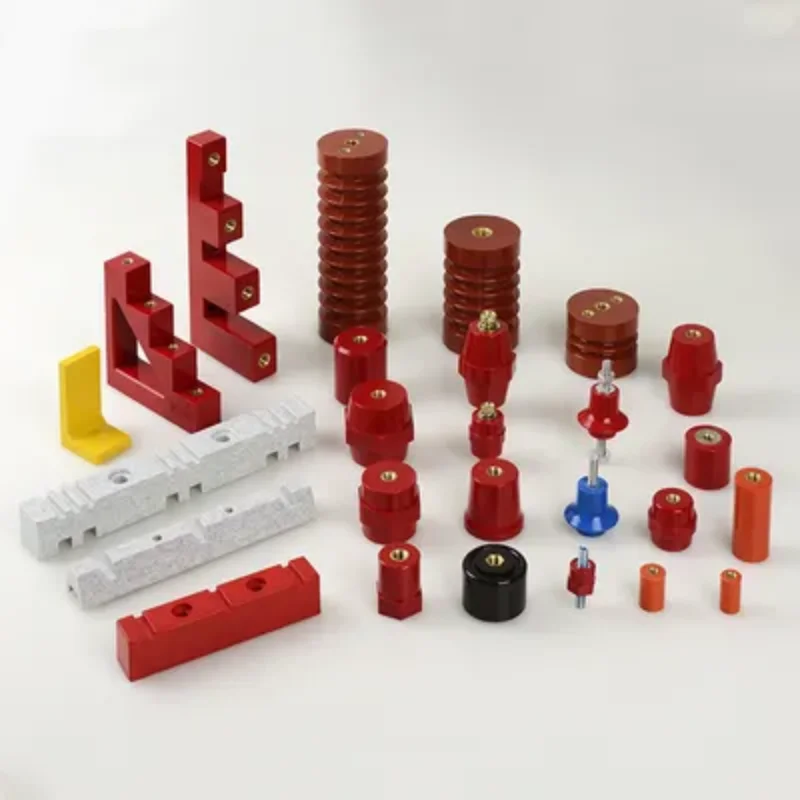
| Ideal Applications | Intricate components, standoff insulators, circuit breaker housings, motor brackets. | Large structural parts, high-strength insulators, panel boards, electrical enclosures. | Application Dependent |
What This Means for You:
On a per-kilogram basis, BMC is generally cheaper than SMC. It often contains a higher percentage of low-cost fillers and the manufacturing process for the raw material is less complex . This cost advantage, combined with faster cycle times, makes BMC highly economical for high-volume production of smaller parts.
However, tooling can be the great equalizer. A complex, multi-cavity injection mold for a BMC part can be significantly more expensive than a simpler compression mold for an SMC part.
Your application is the ultimate decider.
- For a small, high-volume standoff insulator with molded-in threads, BMC is the clear winner on cost and manufacturability.
- For a large, 2-meter long busbar support for a utility-scale inverter, SMC is the only viable choice due to its superior mechanical strength.
Your Decision Framework: How to Choose Between BMC and SMC
Feeling overwhelmed? Don’t be. You can break the decision down into a logical, step-by-step process.
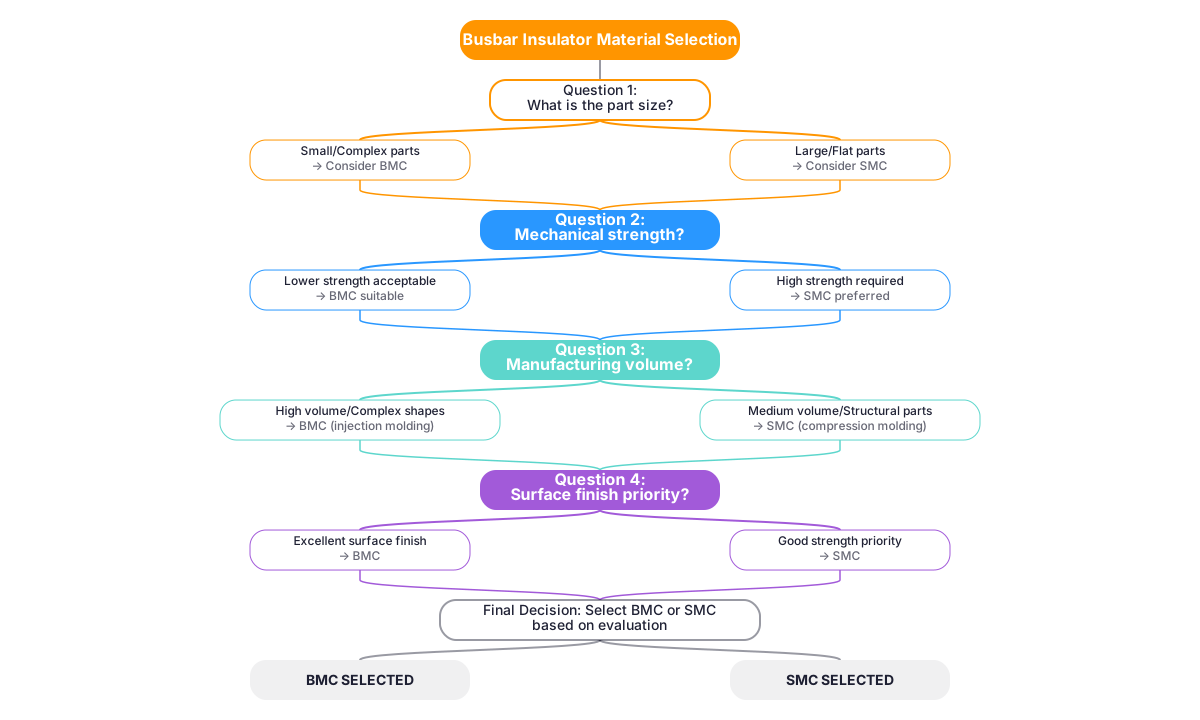
Step 1: Assess Mechanical Load & Part Geometry
- Is the part primarily structural? Will it bear significant weight, vibration, or cantilever loads? If yes, lean heavily towards SMC.
- Is the part geometrically complex? Does it have intricate features, molded-in inserts, or varying wall thicknesses? If yes, BMC is the stronger candidate.
Step 2: Define the Electrical Environment
- What is the operating voltage? For most LV and MV systems, both are excellent.
- Is high arc resistance a critical safety requirement? If the insulator is in an “arc-in-a-box” scenario like switchgear, BMC‘s formulation may offer a safety advantage.
Step 3: Consider Production Volume and Cost Constraints
- What is your expected production volume? For high volumes (>10,000s of parts), the faster cycle times of BMC injection molding offer significant cost savings.
- What is your tooling budget? If the part is simple, SMC compression molding may offer a lower tooling investment, which is ideal for lower volume projects.
Step 4: Evaluate Environmental & Thermal Stress
- What is the continuous operating temperature? Both BMC and SMC have excellent thermal stability (typically up to 140°C or more), but specific formulations vary. Always check the datasheet .
- Will the part be exposed to chemicals or UV? Both materials offer good chemical resistance, but special formulations can be specified for harsh environments.
By walking through these four steps, you can move from a general query to a specific, data-backed material selection.
Frequently Asked Questions (FAQ)
Here are answers to some of the most common questions I get from engineers and purchasing managers in the field.
1. Is SMC always stronger than BMC?
Generally, yes. On a material-to-material basis, a standard grade of SMC will have higher tensile, flexural, and impact strength than a standard grade of BMC. This is a direct result of the longer glass fibers. However, a poorly designed SMC part can be weaker than a well-designed BMC part. Part design, gating, and molding process control are just as important as the raw material.
2. How does tooling cost differ between BMC and SMC parts?
It depends entirely on the part’s complexity. For a simple shape like a cylindrical standoff, a compression mold for SMC and an injection mold for BMC might be comparable in cost. But for a complex circuit breaker housing with multiple cores and slides, the injection mold for BMC will be substantially more expensive. The trade-off is that the higher tooling cost for BMC is often amortized over a high production volume with much lower per-part costs.
3. Which material is better for outdoor or high-humidity environments?
Both BMC and SMC have very low water absorption and can be formulated for excellent weather resistance. Unsaturated polyester resin, the base for most standard grades, can be susceptible to long-term UV degradation. For demanding outdoor applications, it’s crucial to specify a UV-stabilized formulation or switch to a vinyl ester resin base, which can be used in both BMC and SMC and offers superior moisture and chemical resistance.
4. Can we get Class-A surface finishes with these materials?
Yes, but SMC has the advantage here. SMC is famous in the automotive industry for producing Class-A body panels with a smooth, paint-ready surface right out of the mold. This is achieved using specialized low-profile additives. While BMC can produce a very good surface finish, SMC is generally superior for large, cosmetically critical parts.
5. What are the typical lead times for BMC vs. SMC components?
Lead times are primarily driven by tooling fabrication, which can take anywhere from 8 to 20 weeks depending on complexity. Once the tool is ready, part production is fast. BMC injection molding is quicker on a per-part basis, so large orders can be fulfilled faster. For initial samples or small runs, the difference is often negligible.
6. How do BMC and SMC compare to porcelain or epoxy insulators?
- Porcelain: Is extremely strong in compression and handles high heat well, but it’s heavy and brittle, making it prone to cracking from impact or tensile stress 7. BMC/SMC offer far better impact resistance and design flexibility.
- Epoxy: Cast epoxy offers excellent electrical properties and can be used for complex shapes. However, it’s generally more expensive than BMC/SMC and can have longer cycle times. BMC and SMC often provide a more cost-effective solution for high-volume applications with similar performance.
7. Are there color limitations for BMC or SMC insulators?
No. Both materials can be pigmented to match almost any color, though red, black, and orange are common standards in the electrical industry. The pigment is mixed in with the resin paste, so the color is consistent throughout the entire part, meaning scratches won’t reveal a different color underneath.
8. What is the most common failure mode for BMC/SMC insulators and how can it be prevented?
The most common failure mode is mechanical cracking from over-torquing fasteners or from unaccounted-for vibration/flexural stress. This can be prevented during the design phase. Use torque limiters during assembly, and perform a proper Finite Element Analysis (FEA) to understand the stresses on the insulator in its real-world operating environment. Choosing SMC for high-stress locations provides an additional safety margin.
Conclusion: The Right Material for the Right Job
Returning to Sarah’s 2 a.m. problem, the choice becomes clear. The failed insulator was at a joint experiencing unexpected flexural stress. It was a smaller component, but the mechanical load was the real killer.
- A simple BMC replacement might fail again for the same reason.
- A robust SMC replacement, even if slightly more expensive, provides the necessary mechanical strength to prevent a future failure. The higher flexural strength from its long-fiber reinforcement is the perfect insurance policy against the stresses that caused the first failure.
There is no universal “best” busbar insulator material. The optimal choice is always a function of the application. BMC offers unmatched design freedom and cost-effectiveness for complex, high-volume parts where its good mechanical properties are sufficient. SMC provides the superior strength and stiffness required for larger structural components or in applications where the mechanical safety margin is paramount.
As an engineer, your job is to understand these trade-offs. By arming yourself with this knowledge, you can move beyond generic specs and make an informed, data-driven decision that ensures the safety, reliability, and longevity of your electrical systems.
