
High-Quality Circuit Breaker Busbars – Willele

Understanding Circuit Breaker Busbars: Essential Power Distribution Solutions
Circuit breaker busbars are critical components in electrical power distribution systems, serving as the backbone for safe and efficient electricity transmission. WILLELE Electric specializes in manufacturing high-quality circuit breaker busbars that meet international standards and deliver exceptional performance across industrial, commercial, and residential applications.
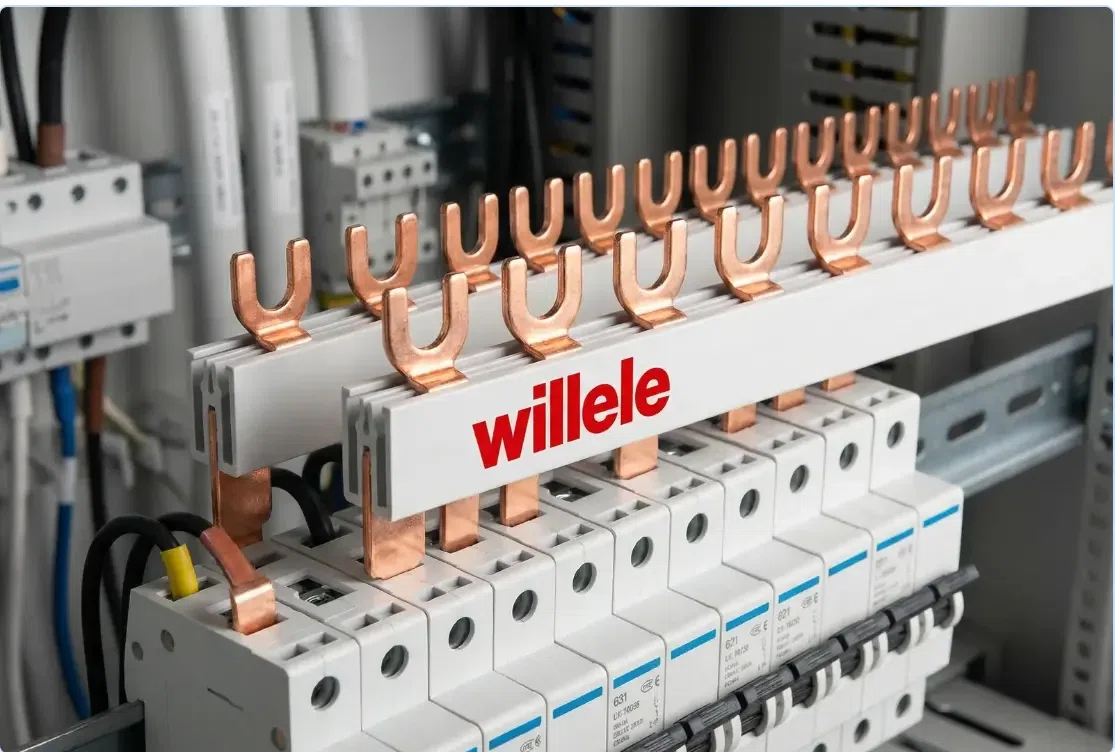
Professional installation of WILLELE circuit breaker busbars in modern electrical distribution panel
What Are Circuit Breaker Busbars?
Circuit breaker busbars are conductive metal bars or strips designed to distribute electrical power from a main source to multiple circuits through connected circuit breakers. These essential components act as central collection points, allowing efficient power routing while maintaining circuit protection capabilities.
Busbars eliminate the need for complex wire-to-wire connections, reducing installation time, improving reliability, and enhancing overall system safety. In modern electrical installations, circuit breaker busbars have become indispensable for creating organized, maintainable, and code-compliant power distribution systems.
Key Functions and Benefits
Primary Functions:
- Centralized power distribution from main feeders
- Low-resistance current pathways between circuit breakers
- Mechanical support for circuit breaker mounting
- Simplified system configuration and expansion
- Enhanced safety through standardized connections
Operational Advantages:
- Reduced installation complexity and labor costs
- Improved system reliability through fewer connection points
- Better thermal management with larger conductor surface areas
- Easier troubleshooting and maintenance access
- Scalable design for future capacity increases
Types of Circuit Breaker Busbars
WILLELE Electric manufactures various busbar configurations to accommodate different installation requirements and circuit breaker types.
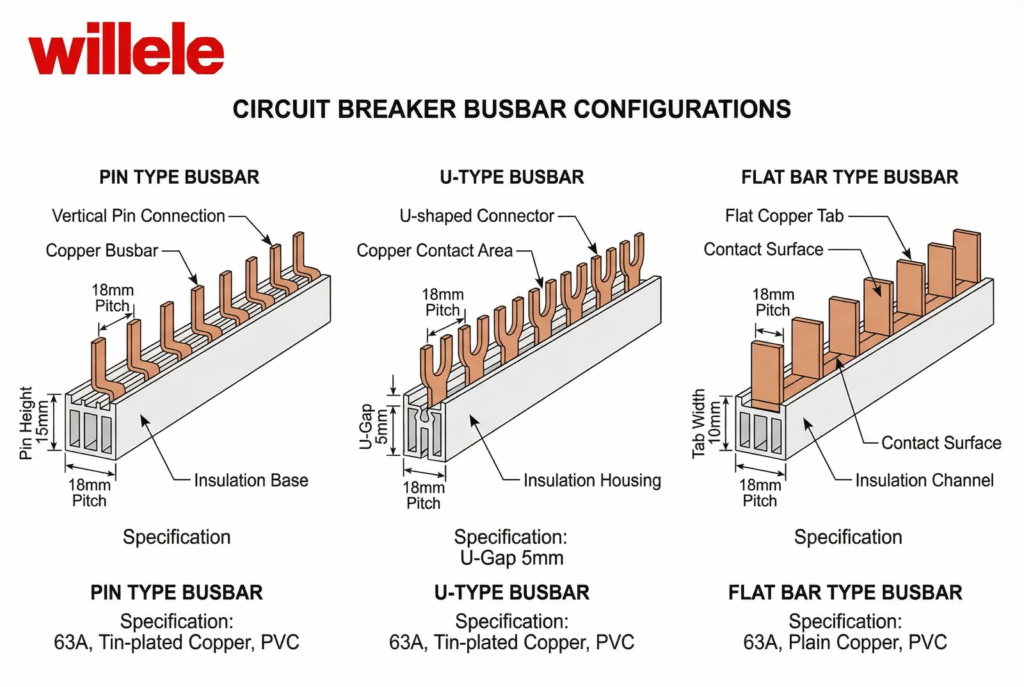
Technical schematic showing various circuit breaker busbar configurations manufactured by WILLELE
PIN Type Busbars
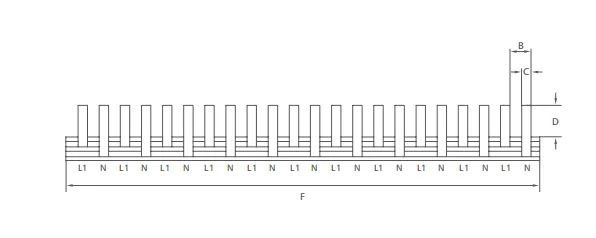
PIN type busbars feature protruding pin connections designed for direct insertion into circuit breaker terminals. This design provides secure mechanical and electrical connections with minimal contact resistance.
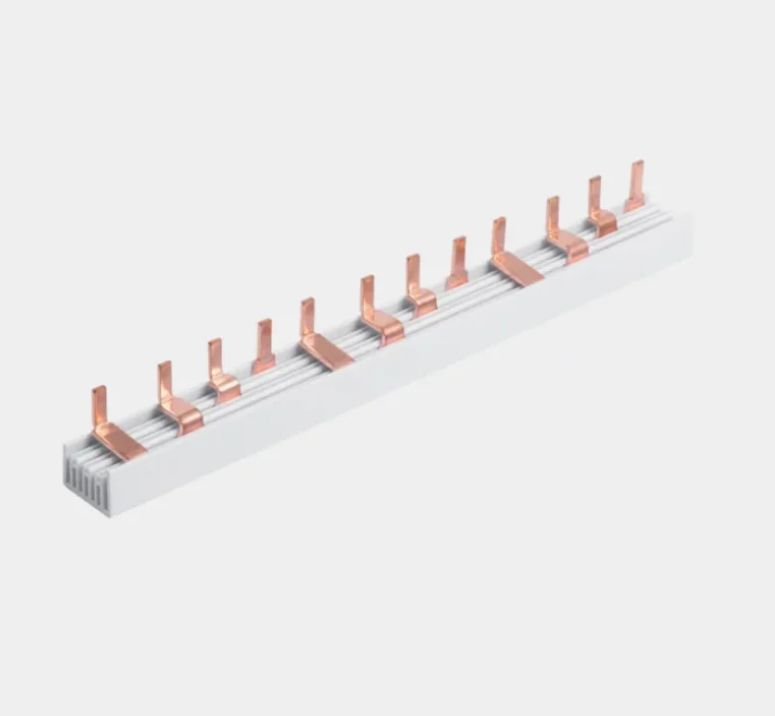
WILLELE PIN type busbar showing precision-engineered pin connections
Applications:
- Miniature circuit breakers (MCB)
- Molded case circuit breakers (MCCB)
- Residential distribution boards
- Light commercial installations
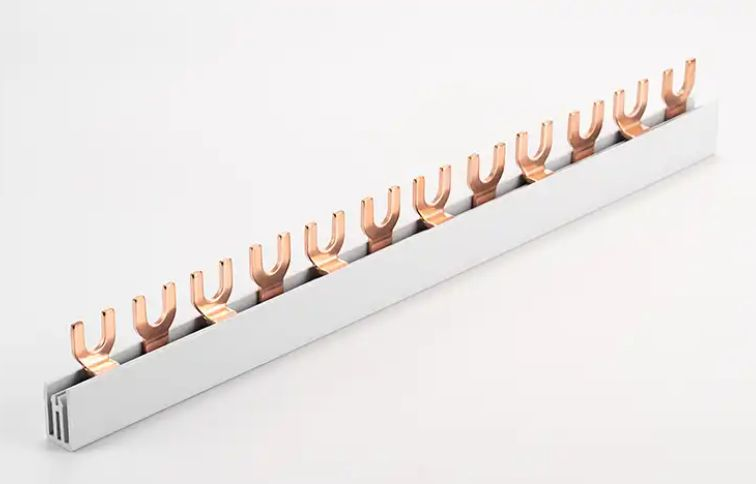
U-Type Busbars
U-type busbars incorporate U-shaped connection points that embrace circuit breaker terminals, providing robust mechanical stability and excellent electrical contact across multiple connection surfaces.
\
WILLELE U-type busbar with superior contact design for enhanced performance
Applications:
- Heavy-duty industrial panels
- High-current distribution systems
- Commercial building main distribution
- Industrial control centers
Comparison Table: Busbar Types
| Feature | PIN Type | U-Type | Flat Bar Type |
|---|---|---|---|
| Current Rating | 63-125A | 100-630A | 400-4000A |
| Connection Method | Direct pin insertion | U-clamp embrace | Bolted connection |
| Installation Speed | Fast (snap-in) | Moderate | Slower (requires bolting) |
| Contact Stability | Good | Excellent | Superior |
| Thermal Performance | Standard | Enhanced | Maximum |
| Typical Applications | Residential, Light commercial | Commercial, Industrial | Heavy industrial, Substations |
| Maintenance Access | Easy | Moderate | Requires disassembly |
| Cost Efficiency | High | Moderate | Lower (offset by performance) |
Materials and Construction
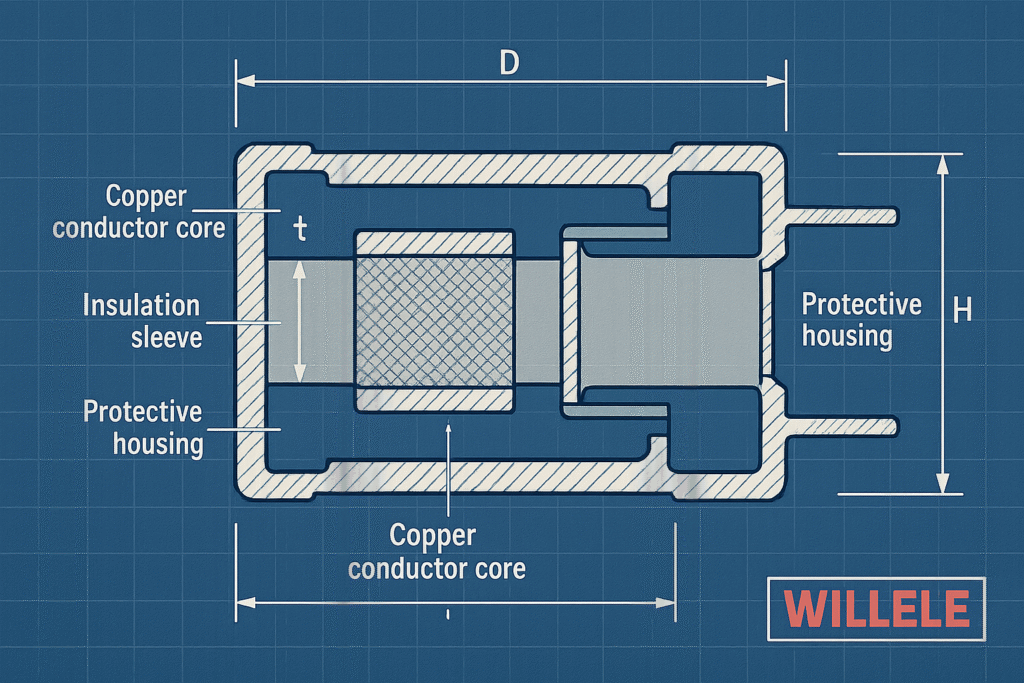
WILLELE circuit breaker busbars are manufactured using premium materials selected for optimal electrical and mechanical performance.
\
Detailed technical diagram showing WILLELE busbar internal construction and material layers
Conductor Materials
Electrolytic Copper (C11000)
- Conductivity: 99.95% IACS minimum
- Superior current-carrying capacity
- Excellent thermal dissipation
- Corrosion-resistant properties
- Industry-standard for premium applications
Tin-Plated Copper
- Enhanced oxidation resistance
- Improved contact reliability over time
- Reduced connection resistance
- Extended service life in humid environments
Aluminum Alloy (6101-T61)
- Cost-effective alternative for larger installations
- 61% conductivity of copper by volume
- Lightweight design reduces structural requirements
- Suitable for lower-current applications
Insulation Materials
WILLELE employs advanced insulation systems to ensure safety and performance:
- Thermoplastic Polymers: High dielectric strength, flame-retardant, UV-resistant
- Epoxy Resin Coatings: Superior arc resistance for critical applications
- PVC Housing: Economical solution for standard installations
- Polyamide (Nylon) Barriers: Mechanical strength and thermal stability
Technical Specifications
Standard Ratings and Dimensions
| Current Rating | Conductor Size (mm) | Insulation Thickness (mm) | Weight (kg/m) | Temperature Rise (°K) |
|---|---|---|---|---|
| 63A | 5 × 20 | 1.5 | 0.45 | 45 |
| 100A | 5 × 30 | 2.0 | 0.68 | 45 |
| 160A | 5 × 40 | 2.0 | 0.91 | 50 |
| 250A | 10 × 40 | 2.5 | 1.82 | 50 |
| 400A | 10 × 60 | 3.0 | 2.73 | 55 |
| 630A | 10 × 80 | 3.0 | 3.64 | 55 |
| 800A | 10 × 100 | 3.5 | 4.55 | 60 |
| 1000A | 15 × 100 | 4.0 | 6.82 | 60 |
Electrical Performance Parameters
Voltage Ratings:
- Low voltage: Up to 690V AC
- Insulation voltage: 1000V AC (1 minute test)
- Impulse withstand: 8kV (1.2/50μs)
Current Characteristics:
- Continuous current: As rated
- Short-time current: 25× rated for 1 second
- Peak withstand current: 2.5× short-time current
- Temperature coefficient: ≤0.4% per °C
Mechanical Properties:
- Tensile strength: ≥220 MPa (copper)
- Yield strength: ≥70 MPa (copper)
- Bending radius: 3× material thickness minimum
- Hardness: 75-95 HV (Vickers)
Applications Across Industries
Industrial Manufacturing
Circuit breaker busbars from WILLELE serve critical roles in:
- Motor control centers (MCC)
- Process control panels
- Automated production line distribution
- Heavy machinery power supplies
- Crane and hoist systems
Commercial Buildings
- Main distribution boards
- Sub-distribution panels
- Elevator and HVAC systems
- Emergency power distribution
- Data center power infrastructure
Residential Installations
- Consumer unit busbar systems
- Multi-dwelling unit main panels
- Smart home distribution systems
- Solar integration panels
- EV charging infrastructure
Utility and Infrastructure
- Substation distribution equipment
- Switchgear assemblies
- Renewable energy connection points
- Grid distribution networks
- Backup power systems
Quality Standards and Certifications
WILLELE Electric maintains rigorous quality control processes and international certifications:
International Standards Compliance:
- IEC 61439-1/2: Low-voltage switchgear and controlgear assemblies
- IEC 60947: Low-voltage switchgear and controlgear
- UL 891: Switchboards (North American markets)
- GB/T 7251: Chinese national standards
- EN 60439: European harmonized standards
Quality Assurance Testing:
- Thermal rise verification testing
- Short-circuit withstand testing
- Dielectric strength testing
- Contact resistance measurement
- Mechanical endurance testing
- Corrosion resistance evaluation
Manufacturing Certifications:
- ISO 9001:2015 Quality Management
- ISO 14001:2015 Environmental Management
- ISO 45001:2018 Occupational Health & Safety
- RoHS compliance for environmental protection
- REACH regulation compliance
Why Choose WILLELE Circuit Breaker Busbars?
Manufacturing Excellence
WILLELE Electric operates state-of-the-art production facilities equipped with advanced CNC machining, precision stamping, and automated assembly systems. Our manufacturing capabilities ensure:
- Dimensional accuracy within ±0.05mm tolerances
- Consistent material properties across production batches
- High-volume production without quality compromise
- Customization capabilities for special requirements
Engineering Support
Our technical team provides comprehensive support:
- Application engineering consultation
- Custom design services
- Load calculation assistance
- Installation guidance
- Technical documentation in multiple languages
Global Supply Chain
- Strategic warehouse locations for rapid delivery
- Flexible order quantities from prototype to bulk
- Competitive B2B pricing structures
- Long-term supply agreements available
- Quality assurance for every shipment
Installation Guidelines
\
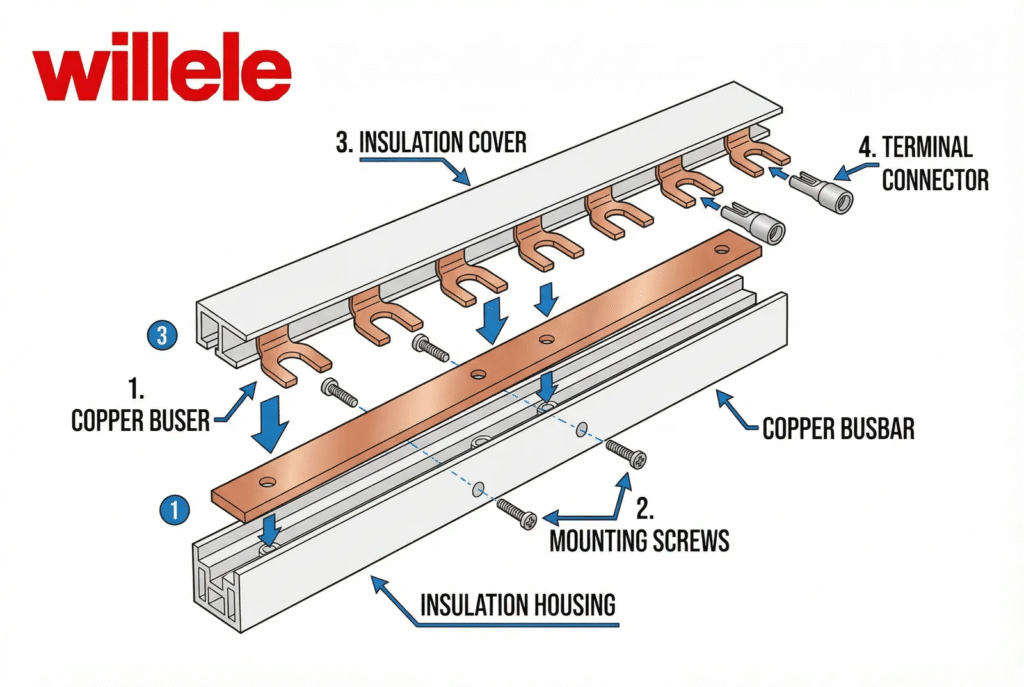
Step-by-step WILLELE busbar assembly process with detailed component identification
Pre-Installation Requirements
Environmental Considerations:
- Operating temperature: -25°C to +70°C
- Relative humidity: ≤95% (non-condensing)
- Altitude: ≤2000m (derate for higher elevations)
- Pollution degree: 2 or 3 per IEC standards
Tools and Equipment:
- Torque wrench calibrated to specifications
- Insulation resistance tester (megohmmeter)
- Contact resistance meter
- Appropriate personal protective equipment (PPE)
Installation Procedure
- Preparation: Verify busbar specifications match circuit requirements
- Mounting: Secure busbar to panel using appropriate hardware
- Circuit Breaker Installation: Attach breakers following manufacturer torque specifications
- Connection: Connect incoming and outgoing cables with proper terminations
- Testing: Perform insulation resistance and continuity tests
- Documentation: Record installation details and test results
Torque Specifications
| Connection Type | Recommended Torque (N·m) | Retorque After (hours) |
|---|---|---|
| M4 terminals | 1.2 – 1.8 | 24 |
| M5 terminals | 2.0 – 3.0 | 24 |
| M6 terminals | 4.0 – 6.0 | 48 |
| M8 terminals | 10 – 15 | 48 |
| M10 terminals | 20 – 30 | 72 |
Maintenance and Service Life
Preventive Maintenance Schedule
Annual Inspection:
- Visual inspection for signs of overheating or discoloration
- Connection tightness verification
- Insulation resistance testing
- Thermal imaging survey
- Cleaning of accumulated dust and debris
Three-Year Maintenance:
- Retorque all connections to specifications
- Contact resistance measurement
- Replace degraded insulation materials
- Update documentation and maintenance records
Expected Service Life:
- Under normal conditions: 25-30 years
- In harsh environments: 15-20 years (with proper maintenance)
- Replacement indicators: Visible corrosion, thermal damage, mechanical deformation
Troubleshooting Common Issues
| Symptom | Probable Cause | Solution |
|---|---|---|
| Overheating at connections | Loose terminals | Retorque to specifications |
| Discoloration of busbar | Overload condition | Check load calculations, upgrade if needed |
| Intermittent connection | Oxidation/corrosion | Clean contacts, apply contact compound |
| Unusual noise/vibration | Loose mounting | Tighten mounting hardware |
| Insulation damage | Mechanical stress/age | Replace affected section |
Frequently Asked Questions (FAQ)
Q: What is the difference between aluminum and copper circuit breaker busbars?
A: Copper busbars offer superior conductivity (40% better than aluminum by volume), better mechanical strength, and smaller physical size for equivalent current ratings. Aluminum busbars provide cost advantages for larger installations and weigh approximately 70% less than copper, making them suitable for applications where weight is a concern. WILLELE recommends copper for high-performance applications and aluminum for budget-conscious projects with adequate space.
Q: Can I mix different types of circuit breakers on the same busbar?
A: Yes, provided all breakers have compatible connection types and the busbar is rated for the highest current requirement. However, ensure proper load balancing and that the combined load does not exceed the busbar’s continuous current rating. WILLELE provides detailed compatibility charts with our products to assist in proper selection.
Q: How do I calculate the correct busbar size for my application?
A: Calculate total connected load, apply diversity factors (typically 0.7-0.9), add 25% safety margin, and consider future expansion. The formula is: Busbar Current Rating ≥ (Total Load Current × Diversity Factor × 1.25). WILLELE’s engineering team offers free load calculation assistance for B2B customers to ensure optimal sizing.
Q: What is the typical lead time for custom busbar configurations?
A: Standard configurations ship within 5-7 business days. Custom-designed busbars typically require 2-3 weeks for engineering review, prototype production, and testing. For large orders or complex specifications, lead times may extend to 4-6 weeks. WILLELE maintains inventory of common sizes for immediate availability.
Q: Do circuit breaker busbars require special certifications for international markets?
A: Yes, different regions have specific requirements. WILLELE circuit breaker busbars carry multiple international certifications including IEC, UL, CE, and regional standards compliance. We provide certification documentation with each shipment and can assist with market-specific requirements for global B2B customers.
Q: How do environmental factors affect busbar performance?
A: High humidity increases risk of insulation breakdown and corrosion. Extreme temperatures affect current-carrying capacity (derate by 10% for every 10°C above 40°C). Corrosive atmospheres require enhanced protection such as tin-plating or conformal coatings. WILLELE offers environmental rating specifications and protective coatings for harsh operating conditions.
Q: What warranty does WILLELE provide on circuit breaker busbars?
A: WILLELE provides a comprehensive 5-year warranty covering manufacturing defects, material failures, and workmanship issues. Extended warranty programs are available for high-volume B2B customers. Warranty terms include free replacement of defective units and technical support throughout the product lifecycle.
Q: Can existing busbar systems be upgraded or expanded?
A: Most systems can be expanded if the main busbar has sufficient capacity. Upgrades may require replacing the main busbar if current capacity is insufficient. WILLELE provides retrofit solutions and compatibility assessments for existing installations, ensuring seamless integration with legacy systems.
Contact WILLELE Electric Today
For technical specifications, custom quotations, or application support, contact WILLELE Electric’s B2B sales team. We provide comprehensive solutions for circuit breaker busbar requirements across all industries, backed by our commitment to quality, reliability, and customer service excellence.
