
How to Choose the Right Size and Shrink Ratio for Heat Shrink Tube: Complete Selection Guide

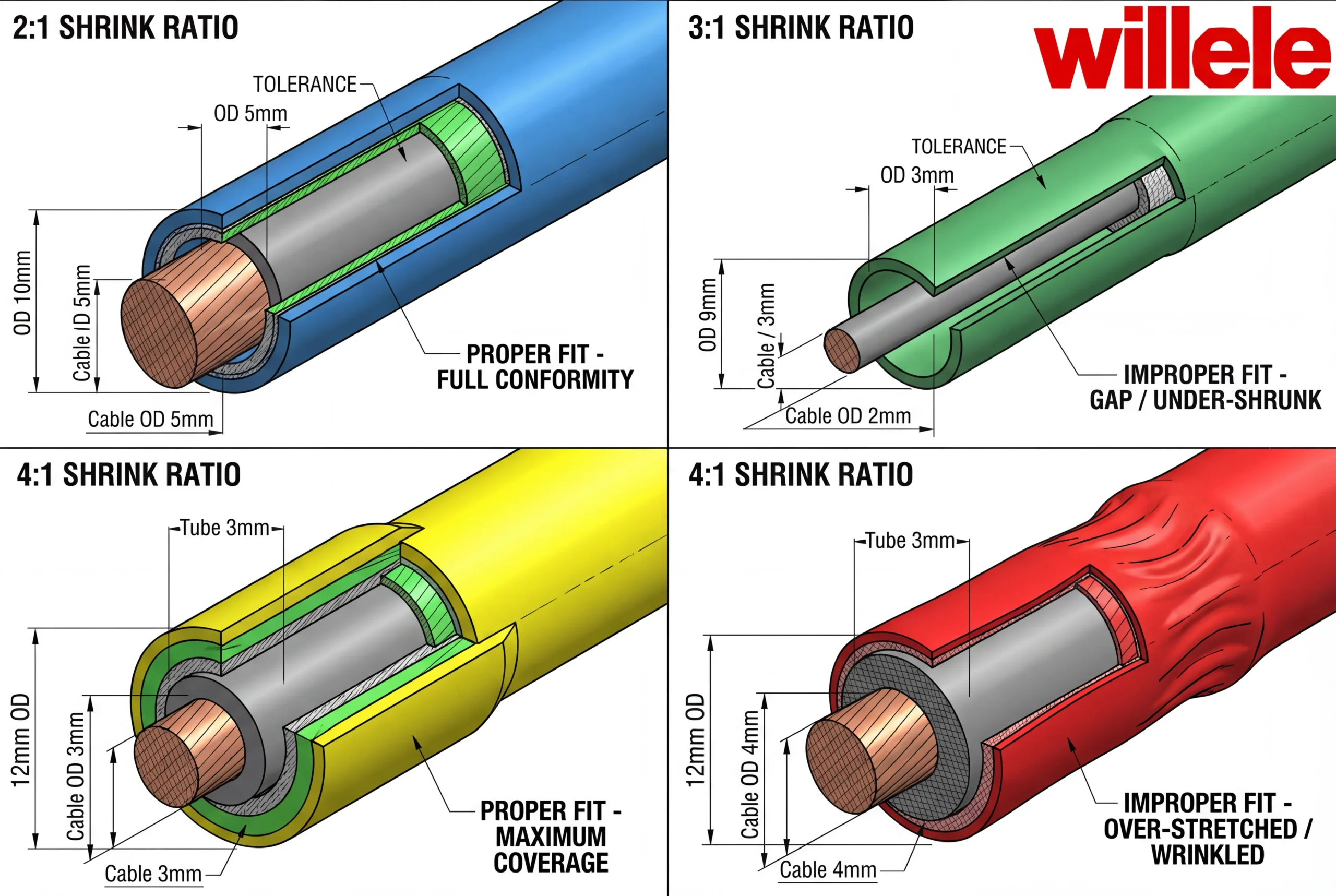
Why Correct Sizing and Shrink Ratio Selection Matters
Selecting the appropriate heat shrink tube size and shrink ratio represents one of the most critical decisions in wire protection and cable management applications. An incorrectly sized heat shrink tube can lead to installation failures, inadequate protection, equipment damage, and costly production delays. For procurement managers and engineers specifying heat shrink tube for industrial applications, understanding the relationship between cable diameter, tube sizing, and shrink ratio ensures optimal performance, cost-efficiency, and long-term reliability.
WILLELE Electric specializes in precision-engineered heat shrink tubes with advanced EVA material formulations, offering superior dimensional stability and predictable shrinkage characteristics. This guide provides technical professionals with the knowledge and calculation methods needed to select the correct heat shrink tube size and shrink ratio for any application, from delicate electronics assembly to heavy-duty industrial cable protection.
Understanding Heat Shrink Tube Shrink Ratio
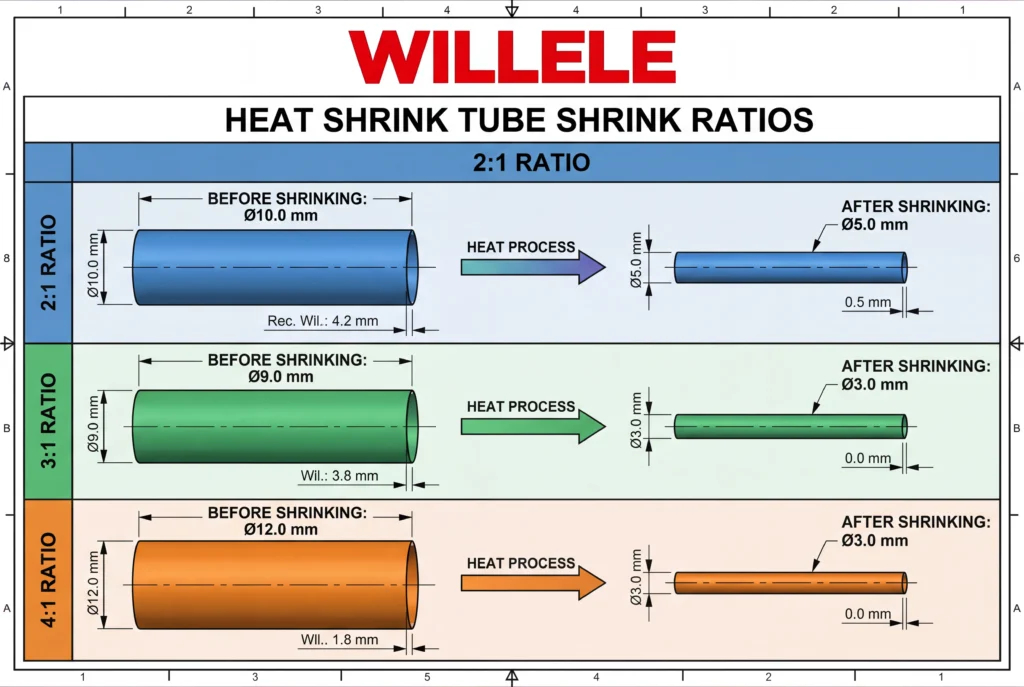
Heat shrink tube shrink ratio describes the relationship between the tube’s expanded diameter (as supplied) and its recovered diameter (after heat application). This ratio determines how much the tube contracts when heated and directly influences which cable sizes a single tube dimension can accommodate.
Defining Standard Shrink Ratios
2:1 Shrink Ratio (Most Common)\
The tube shrinks to one-half its original supplied diameter. For example, a heat shrink tube with a 12mm supplied diameter will recover to approximately 6mm after proper heat application. This ratio provides reliable performance for applications where substrate diameters remain relatively consistent.
3:1 Shrink Ratio (Versatile)\
The tube contracts to one-third of its expanded diameter. A 12mm tube shrinks down to 4mm, offering significantly greater flexibility in covering varied cable sizes. This ratio proves particularly valuable when working with irregular shapes or when a single tube size must accommodate multiple cable diameters.
4:1 Shrink Ratio (Maximum Range)\
Specialized tubes shrink to one-quarter of their original diameter (16mm → 4mm), providing the widest substrate coverage range. Typically reserved for applications involving complex geometries, molded boots, or extreme diameter variations within a single assembly.
How Shrink Ratio Is Calculated
The shrink ratio calculation follows a simple formula:
Shrink Ratio = Supplied Diameter ÷ Recovered Diameter
For instance:
- A tube measuring 10mm (supplied) shrinking to 5mm (recovered) = 10 ÷ 5 = 2:1 ratio
- A tube measuring 15mm (supplied) shrinking to 5mm (recovered) = 15 ÷ 5 = 3:1 ratio
Understanding this fundamental relationship enables accurate tube selection and prevents common sizing errors that compromise installation quality.
How Shrink Ratio Affects Performance
The chosen shrink ratio impacts multiple performance characteristics beyond simple diameter coverage:
Substrate Coverage Range
Higher shrink ratios accommodate wider diameter variations, reducing inventory requirements. A single 3:1 ratio tube can replace two or three different 2:1 ratio sizes, simplifying procurement and reducing storage complexity for high-volume manufacturers.
Wall Thickness After Shrinking
As tubes contract, wall thickness increases proportionally. A 2:1 ratio tube approximately doubles its wall thickness after full recovery, while a 3:1 ratio tube triples its thickness. This affects:
- Mechanical protection capability
- Electrical insulation properties
- Flexibility of the finished assembly
- Overall profile dimensions
Installation Tolerance
Higher shrink ratios provide greater installation forgiveness, accommodating slight measurement errors or component variations without compromising fit quality. However, excessive shrinkage can create installation challenges if the tube becomes difficult to position over connectors or enlarged cable sections.
Material Stress and Recovery
WILLELE’s EVA heat shrink tubes demonstrate superior recovery characteristics across all shrink ratios due to advanced cross-linking technology. EVA’s exceptional elongation properties (up to 500%) ensure complete shrinkage without material stress, cracking, or splitting—common problems with lower-quality polyolefin tubes when using higher shrink ratios.
Step-by-Step Guide to Choosing the Right Size
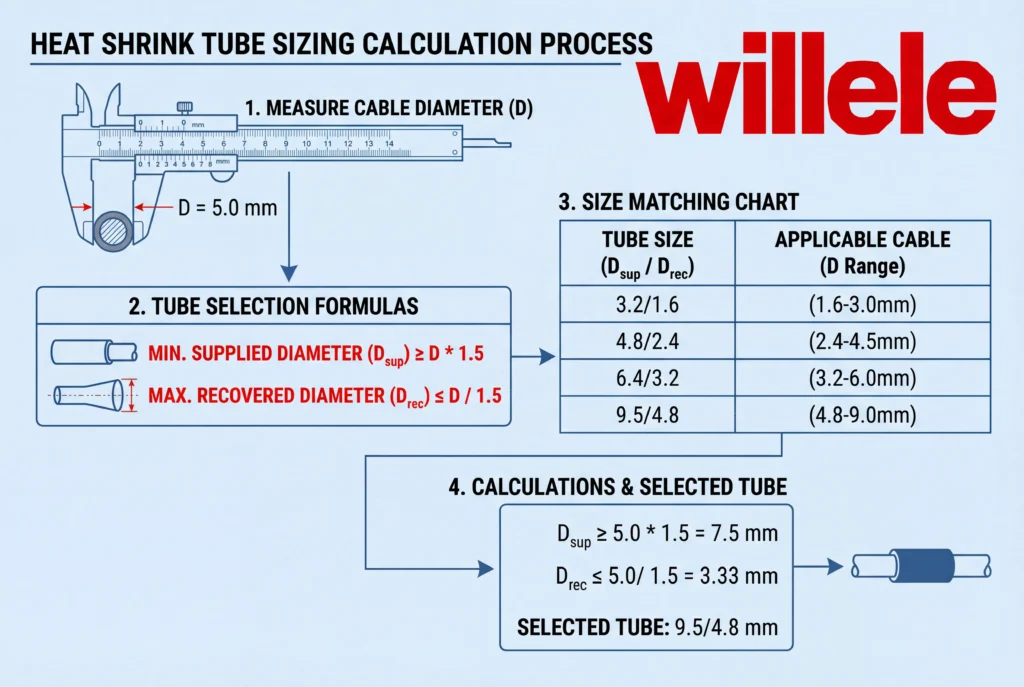
Accurate heat shrink tube sizing requires systematic measurement and calculation. Follow this professional methodology for optimal results:
Step 1: Measure Maximum Substrate Diameter
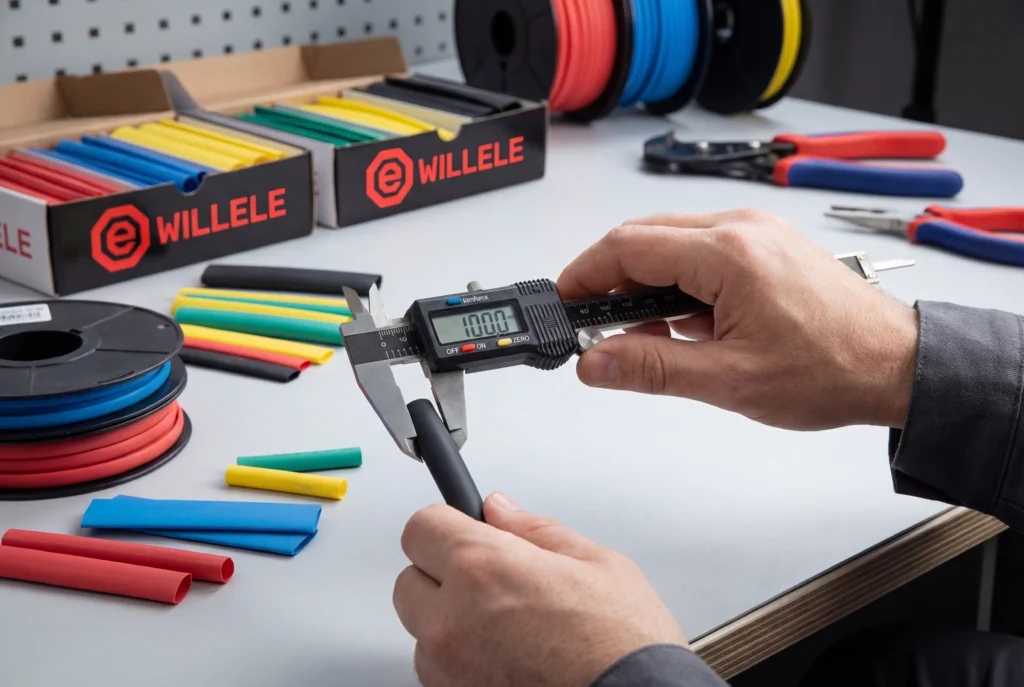
Using precision calipers or micrometers, measure the largest diameter the heat shrink tube must cover, including:
- Cable insulation outer diameter
- Connector body dimensions
- Wire bundle maximum diameter
- Any terminals, splices, or irregular features
Critical Tip: Always measure at the widest point. Overlooking a connector housing or cable tie can result in tube selection that won’t fit during installation.
Step 2: Calculate Required Recovered Diameter
The heat shrink tube’s recovered (shrunk) diameter should be 10-20% smaller than your maximum substrate diameter to ensure secure fit without excessive compression. Use this formula:
Required Recovered Diameter = Maximum Substrate Diameter × 0.80 to 0.90
Example: For a 8mm cable diameter:
- Recovered diameter = 8mm × 0.85 = 6.8mm
- Select tube with approximately 6-7mm recovered diameter
Step 3: Determine Supplied Diameter Based on Shrink Ratio
Once you know the required recovered diameter, calculate the necessary supplied diameter using your chosen shrink ratio:
Supplied Diameter = Recovered Diameter × Shrink Ratio
Using our 6.8mm recovered diameter example:
- For 2:1 ratio: 6.8mm × 2 = 13.6mm supplied diameter
- For 3:1 ratio: 6.8mm × 3 = 20.4mm supplied diameter
Step 4: Verify Installation Clearance
The supplied diameter must be large enough to slide easily over any connectors, terminals, or enlarged sections during installation. Add 20-30% clearance:
Installation Diameter = Maximum Substrate Diameter × 1.20 to 1.30
For our 8mm cable: 8mm × 1.25 = 10mm minimum installation clearance needed
Step 5: Select from Standard Sizes
Compare your calculated dimensions against manufacturer standard sizes. WILLELE offers comprehensive sizing from 1.6mm to 50.8mm supplied diameters, ensuring optimal fit for virtually any application.
Shrink Ratio Comparison and Selection
Choosing between shrink ratios depends on application-specific requirements:
| Shrink Ratio | Diameter Coverage | Best Applications | Advantages | Limitations |
|---|---|---|---|---|
| 2:1 | Moderate (covers 2× diameter range) | Standard wire insulation, consistent cable sizes, general purpose | Predictable shrinkage, consistent wall thickness, cost-effective | Limited size versatility, requires more inventory SKUs |
| 3:1 | Wide (covers 3× diameter range) | Cable harnesses, irregular shapes, multi-diameter assemblies | Greater flexibility, reduced inventory, accommodates design variations | Slightly higher cost, thicker final wall |
| 4:1 | Maximum (covers 4× diameter range) | Connector boots, complex geometries, extreme variations | Ultimate versatility, specialty applications | Premium pricing, limited material options, installation complexity |
Application-Specific Shrink Ratio Selection
| Application Type | Recommended Ratio | Reasoning |
|---|---|---|
| Circuit board wire connections | 2:1 | Compact profile, minimal thickness increase |
| Automotive wire harnesses | 2:1 or 3:1 | Balance between protection and space efficiency |
| Cable bundling and organization | 3:1 | Accommodates multiple wire gauges |
| Connector environmental sealing | 3:1 or 4:1 | Conforms to irregular connector shapes |
| Marine/outdoor applications | 3:1 (adhesive-lined) | Ensures complete sealing around varied diameters |
| Aerospace/military applications | Per specification | Follows strict MIL-SPEC requirements |
| Repair and retrofit work | 3:1 | Handles unpredictable existing cable sizes |
Quick Reference Sizing Tables
Standard Cable Diameter to Tube Size Matching (2:1 Ratio)
| Cable Diameter Range (mm) | Recommended Tube Supplied Ø (mm) | Recovered Ø (mm) | Wall Thickness (mm) |
|---|---|---|---|
| 0.5 – 1.2 | 3.2 | 1.6 | 0.30 |
| 1.0 – 2.4 | 6.4 | 3.2 | 0.35 |
| 2.0 – 4.8 | 9.5 | 4.8 | 0.40 |
| 3.5 – 7.5 | 12.7 | 6.4 | 0.45 |
| 5.0 – 10.0 | 19.1 | 9.5 | 0.50 |
| 8.0 – 15.0 | 25.4 | 12.7 | 0.60 |
| 10.0 – 20.0 | 38.1 | 19.1 | 0.70 |
| 16.0 – 30.0 | 50.8 | 25.4 | 0.80 |
Shrink Ratio Comparison by Material Type
| Material | Available Ratios | Shrink Temperature | Typical Applications | WILLELE Specialty |
|---|---|---|---|---|
| EVA | 2:1, 3:1 | 70-90°C | Electronics, consumer goods, flexible applications | ✓ Primary expertise |
| Polyolefin | 2:1, 3:1, 4:1 | 90-120°C | General industrial, electrical | Available |
| PVC | 2:1 | 70-100°C | Light-duty, cost-sensitive | Available |
| PTFE | 1.7:1, 2:1 | 327-343°C | Aerospace, high-temperature | Available |
| FEP/PVDF | 1.6:1, 2:1 | 170-190°C | Chemical resistance | Available |
Size Selection Decision Matrix
| Scenario | Cable Diameter | Recommended Tube (2:1) | Alternative (3:1) | Notes |
|---|---|---|---|---|
| Standard AWG 18 wire | 1.5mm | 3.2mm supplied → 1.6mm recovered | 4.8mm supplied → 1.6mm recovered | 2:1 sufficient for consistent wire |
| Wire bundle (3× AWG 22) | 2.8mm | 6.4mm supplied → 3.2mm recovered | 9.5mm supplied → 3.2mm recovered | 3:1 better for bundle variations |
| Connector + 5mm cable | 8mm connector, 5mm cable | 19.1mm supplied → 9.5mm recovered | 28.6mm supplied → 9.5mm recovered | Must accommodate connector diameter |
| Irregular splice | Varies 4-7mm | Multiple sizes needed | 12.7mm supplied → 4.2mm recovered | 3:1 covers entire range |
Common Sizing Mistakes and How to Avoid Them
Critical Errors and Solutions
| Common Mistake | Consequence | Prevention Strategy | Correct Approach |
|---|---|---|---|
| Measuring only cable, ignoring connectors | Tube won’t fit over connector during installation | Measure widest point including all components | Always measure maximum diameter along entire length |
| Selecting tube with insufficient clearance | Difficult installation, potential damage | Add 20-30% to maximum diameter for supplied size | Calculate: Max Ø × 1.25 = minimum supplied Ø |
| Choosing recovered diameter too large | Loose fit, inadequate protection | Recovered Ø should be 10-20% smaller than substrate | Target: Substrate Ø × 0.85 = recovered Ø |
| Overlooking shrinkage direction | Incomplete coverage, exposed areas | Plan for both radial and longitudinal shrinkage | Add 5-10mm length beyond coverage area |
| Mixing shrink ratios without calculation | Inconsistent results, inventory confusion | Maintain ratio consistency or recalculate for each | Document ratio with size in procurement specs |
| Ignoring wall thickness increase | Tight-fit assemblies compromised | Consider final wall thickness in design | Check final OD: Substrate Ø + (2 × final wall) |
| Using damaged or stored tubes | Incomplete shrinkage, cracking | Inspect tubes before use, proper storage | Store in cool, dry, dark conditions |
Practical Prevention Tips
For Engineers: Always create detailed sizing specifications including shrink ratio, supplied diameter, recovered diameter, and wall thickness requirements. Include tolerance ranges to prevent procurement errors.
For Procurement Teams: Standardize on specific shrink ratios (preferably 2:1 and 3:1) to reduce inventory complexity. Establish clear part numbering systems that include ratio designation.
For Installation Technicians: Verify tube sizing before beginning production runs. Conduct test shrinkage on sample pieces to confirm proper fit before committing entire batches.
WILLELE’s Sizing Solutions and Support
EVA Material Advantages in Dimensional Stability
WILLELE’s proprietary EVA heat shrink tube formulations deliver superior sizing performance characteristics:
Predictable Shrinkage: Advanced cross-linking technology ensures consistent shrink ratios with minimal variation batch-to-batch. EVA’s molecular structure provides uniform recovery across the entire tube length, eliminating common “dog-boning” effects where tube ends shrink disproportionately.
Excellent Memory: EVA material maintains dimensional stability during storage and demonstrates reliable “memory effect” during heat application. Tubes shrink uniformly at lower activation temperatures (70-90°C), reducing risk of overheating and dimensional distortion.
Tight Tolerances: WILLELE’s precision extrusion processes maintain supplied diameter tolerances within ±0.1mm for tubes under 10mm diameter and ±0.2mm for larger sizes—critical for automated assembly operations requiring consistent fit.
Superior Elongation: With elongation capabilities up to 500%, EVA accommodates sizing variations without splitting or tearing, even when using higher shrink ratios or covering irregular substrates.
Technical Sizing Support Services
Free Sample Kits: WILLELE provides comprehensive sample kits containing various sizes and shrink ratios, allowing engineering teams to conduct physical testing and verification before production orders.
Sizing Calculation Assistance: Our technical support team offers consultation services for complex applications, providing specific size recommendations based on your substrate dimensions, environmental conditions, and performance requirements.
Custom Size Development: For applications requiring non-standard dimensions, WILLELE develops custom tube sizes with specified shrink ratios, wall thicknesses, and diameters tailored to your exact specifications.
Application Testing: Submit samples of your cables, connectors, or assemblies for professional evaluation. WILLELE’s laboratory conducts shrinkage testing and provides documented sizing recommendations with photographic evidence.
Frequently Asked Questions About Heat Shrink Tube Sizing
Q1: How do I determine if I need 2:1 or 3:1 shrink ratio for my application?
Choose 2:1 shrink ratio when working with consistent substrate diameters that vary by less than 50% throughout your assembly. Select 3:1 shrink ratio when substrate diameters vary by 100% or more, when covering connectors with irregular shapes, or when you need to minimize inventory SKUs. For example, if protecting a cable that ranges from 5mm to 8mm diameter, a 3:1 ratio tube accommodates this entire range, while 2:1 ratio would require two different tube sizes.
Q2: What happens if I select a heat shrink tube that’s too small or too large?
If the tube’s recovered diameter is too small, it may not shrink completely around the substrate, creating excessive stress that can cause splitting or incomplete coverage. If too large, the recovered tube will fit loosely, providing inadequate mechanical protection and potential for moisture ingress. Always target a recovered diameter 10-20% smaller than your substrate diameter for optimal fit. WILLELE’s EVA tubes offer some sizing forgiveness due to superior elongation properties, but proper initial sizing remains essential.
Q3: Can I use the same heat shrink tube size for cables with significantly different diameters?
This depends on the shrink ratio. A 2:1 ratio tube covers substrate diameters ranging from its recovered diameter up to approximately 1.8× that diameter. A 3:1 ratio tube covers a range from recovered diameter to approximately 2.5× that diameter. For example, a 12mm supplied diameter 3:1 tube (recovering to 4mm) can effectively cover cables from 4mm to approximately 10mm diameter. However, for optimal performance, limit the actual substrate diameter range to no more than 75% of the theoretical maximum range.
Q4: How much extra length should I add when cutting heat shrink tube?
Add 5-10mm beyond each end of the area requiring coverage to account for longitudinal shrinkage (typically 5-10% of tube length) and ensure complete protection. For critical environmental sealing applications using adhesive-lined tubes, increase this to 10-15mm per end to guarantee complete adhesive coverage. When covering connectors or splices, position the tube to extend at least 5mm beyond both the cable and connector body to prevent exposed transitions.
Q5: Does heat shrink tube shrink in length as well as diameter?
Yes, heat shrink tube experiences both radial (diameter) and longitudinal (length) shrinkage, though radial shrinkage is primary. Expect 5-10% longitudinal shrinkage during heat application. This means a 100mm tube section will shrink to approximately 90-95mm length after full recovery. WILLELE’s EVA formulations minimize longitudinal shrinkage through optimized cross-linking processes, providing more predictable final dimensions than standard polyolefin tubes.
Q6: How do environmental conditions affect heat shrink tube sizing requirements?
Temperature extremes influence sizing decisions. For cold environments below -20°C, select tubes with more generous sizing (aim for 15-20% smaller recovered diameter rather than 10-15%) to maintain flexibility and prevent brittleness. WILLELE’s EVA material maintains pliability down to -40°C, reducing cold-weather sizing concerns. For high-vibration environments, slightly tighter fits (recovered diameter 15-20% smaller than substrate) improve mechanical retention. In high-humidity or marine applications, use adhesive-lined tubes with 3:1 shrink ratios to ensure complete environmental sealing despite dimensional variations.
Conclusion: Precision Sizing for Optimal Performance
Correct heat shrink tube sizing and shrink ratio selection directly impact installation success, long-term reliability, and total cost of ownership. By following systematic measurement procedures, understanding shrink ratio implications, and applying proper calculation methods, engineers and procurement professionals can specify heat shrink tube solutions that deliver consistent performance across demanding industrial applications.
WILLELE’s advanced EVA heat shrink tube formulations, precision manufacturing tolerances, and comprehensive technical support services ensure optimal sizing outcomes for B2B customers worldwide. Our commitment to dimensional consistency, predictable shrinkage characteristics, and application-specific customization makes WILLELE your trusted partner for heat shrink tube solutions requiring exacting specifications.
Contact WILLELE’s Technical Sales Team for sizing consultation, sample evaluation, or custom tube development to meet your specific application requirements. Our engineering support ensures you select the right size and shrink ratio for reliable, cost-effective wire protection.
