
Low Temperature Heat Shrink Tubing: Specifications for Cold Climate Applications

Introduction: Meeting the Challenges of Cold Climate Electrical Protection
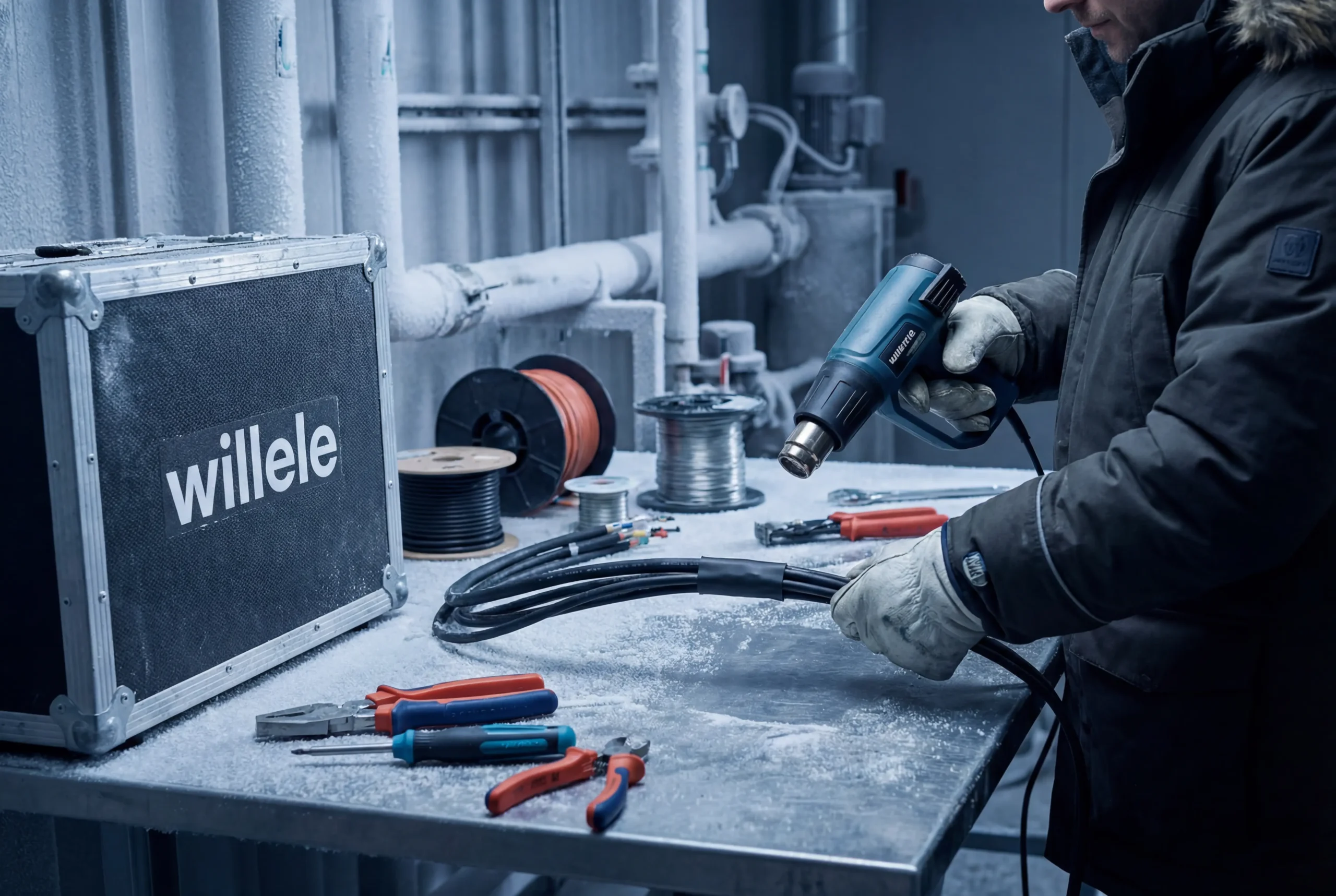
In extreme cold environments, standard electrical insulation materials face significant challenges. When temperatures plummet below -40°C, conventional heat shrink tubing becomes brittle, loses flexibility, and compromises the integrity of electrical connections. This is where specialized low temperature heat shrink tubing becomes essential for reliable performance in arctic regions, high-altitude installations, and winter-critical infrastructure.
willele Electric, a leading B2B manufacturer of advanced heat shrink tube solutions, has engineered specialized low temperature heat shrink tubing designed specifically for cold climate applications. Our products maintain exceptional flexibility, adhesion, and protective properties even in the most demanding sub-zero conditions.
What is Low Temperature Heat Shrink Tubing?
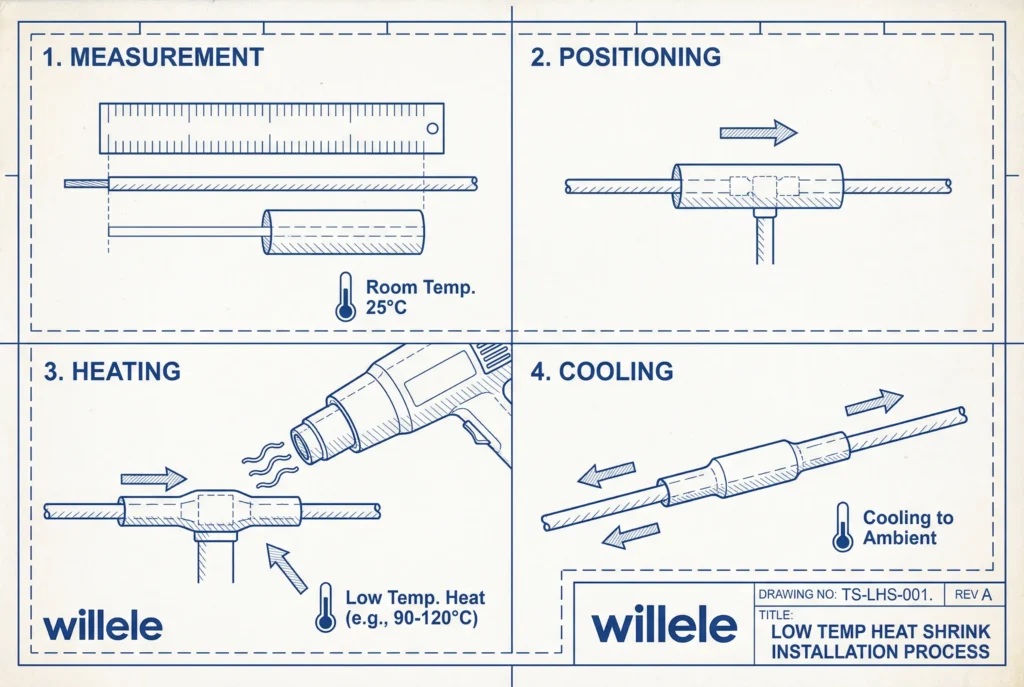
Low temperature heat shrink tubing is a specialized thermoplastic sleeve designed to maintain its performance characteristics in extreme cold environments. Unlike standard heat shrink products that become rigid or crack at sub-zero temperatures, low temperature variants are formulated with proprietary polymer blends that retain flexibility, impact resistance, and sealing capabilities down to -55°C or lower.
Key Features of Low Temperature Heat Shrink Tubing
- Enhanced Cold Flexibility: Maintains pliability at temperatures as low as -55°C
- Superior Impact Resistance: Withstands mechanical stress in frozen conditions
- Reliable Adhesion: Hot-melt adhesive layers remain bonded in extreme cold
- Moisture Barrier: Prevents ice crystal formation and moisture ingress
- UV Stability: Resists degradation from intense solar reflection off snow
- Chemical Resistance: Protects against de-icing agents and antifreeze compounds
Technical Specifications
Low temperature heat shrink tubing from willele Electric meets rigorous performance standards for cold climate applications. The following table outlines the critical technical specifications:
| Specification Parameter | Standard Range | Low Temperature Grade |
|---|---|---|
| Operating Temperature Range | -30°C to +125°C | -55°C to +135°C |
| Minimum Installation Temperature | +10°C | -20°C |
| Shrink Temperature | 120°C – 150°C | 90°C – 130°C |
| Shrink Ratio | 2:1, 3:1, 4:1 | 2:1, 3:1, 4:1 |
| Longitudinal Shrinkage | ≤5% | ≤8% |
| Tensile Strength at -40°C | 8 MPa | 15 MPa |
| Elongation at Break (-40°C) | 150% | 300% |
| Dielectric Strength | 15 kV/mm | 20 kV/mm |
| Water Absorption | <0.5% | <0.3% |
| Flame Retardancy | UL224 VW-1 | UL224 VW-1 |
Material Composition and Performance
Advanced Polymer Formulations
Low temperature heat shrink tubing utilizes specialized polymer compositions engineered for cold climate performance:
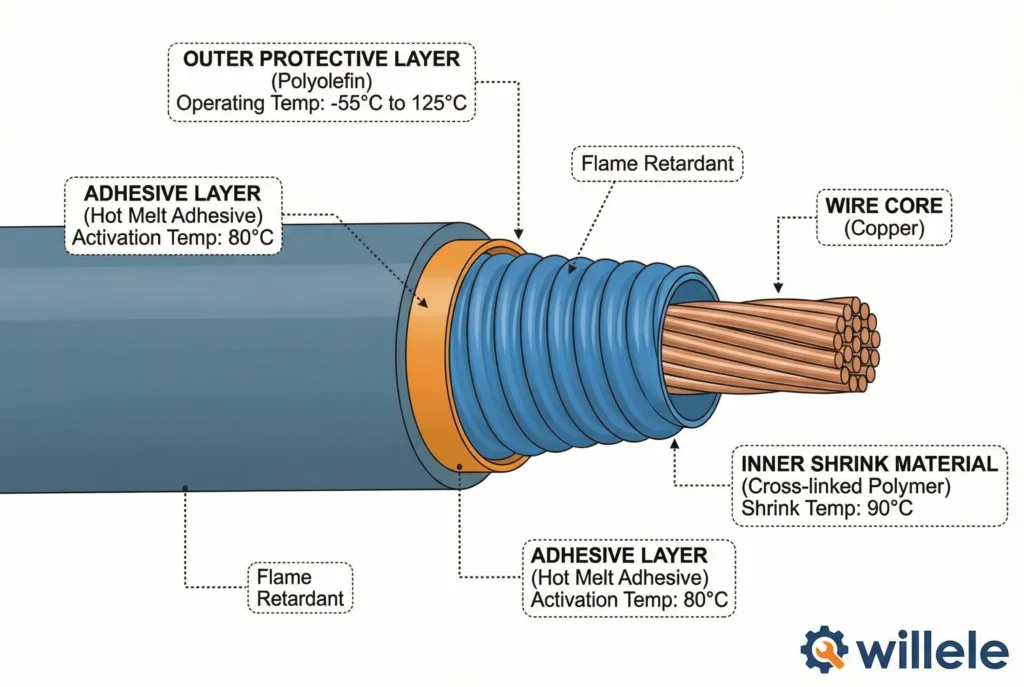
Modified Polyolefin Blends: The base material consists of cross-linked polyethylene (XLPE) or modified polyolefin compounds with plasticizers that remain flexible at extremely low temperatures. willele Electric’s proprietary formulation incorporates impact modifiers that prevent brittleness and maintain mechanical integrity.
Fluoropolymer Options: For the most demanding applications, perfluoroalkoxy (PFA) and fluorinated ethylene propylene (FEP) based low temperature heat shrink tubing offers superior chemical resistance and can operate continuously at temperatures ranging from -200°C to +200°C.
Adhesive Layer Technology: Dual-wall low temperature heat shrink tubing features a hot-melt adhesive inner layer formulated to remain tacky and form hermetic seals even when applied in sub-zero conditions. The adhesive maintains its bonding strength throughout the entire operating temperature range.
Performance Characteristics in Extreme Cold
| Performance Metric | Test Condition | Result |
|---|---|---|
| Flexibility | -55°C mandrel bend test | No cracking, full recovery |
| Impact Resistance | -40°C impact test (ASTM D2444) | No fracture at 1.5 kg·m |
| Peel Strength | -40°C peel test | ≥35 N/25mm width |
| Cold Crack Resistance | -60°C fold test | No visible cracks after 100 cycles |
| Thermal Shock | -55°C to +135°C cycles | Maintains integrity after 200 cycles |
| Moisture Seal | -40°C humidity chamber | <0.01% water vapor transmission |
Applications in Cold Climate Environments
Low temperature heat shrink tubing is essential across multiple industries operating in extreme cold conditions:
Oil & Gas Infrastructure
- Pipeline Instrumentation: Protecting sensor cables and control wiring in arctic oil fields
- Wellhead Equipment: Insulating electrical connections on offshore platforms
- Remote Monitoring Systems: Ensuring reliable data transmission in permafrost regions
Telecommunications
- Antenna Feed Lines: Weatherproofing coaxial connections at mountain-top cell towers
- Fiber Optic Splices: Protecting fusion splices in buried arctic cable runs
- Power Supply Cables: Insulating DC power feeds to remote repeater stations
Renewable Energy
- Wind Turbine Systems: Cable harness protection in cold climate wind farms
- Solar Arrays: Junction box sealing in high-altitude or northern latitude installations
- Energy Storage: Battery connection protection in off-grid power systems
Transportation
- Aviation Ground Support: Wire harness protection for de-icing systems and ground power
- Railway Signaling: Protecting track-side electrical connections in winter conditions
- Automotive Testing: Cold chamber environmental testing facility installations
Standard vs Low Temperature Heat Shrink Tubing Comparison
Understanding the differences between standard and low temperature heat shrink tubing is crucial for proper material selection:
| Feature | Standard Heat Shrink Tubing | Low Temperature Heat Shrink Tubing |
|---|---|---|
| Base Material | Polyolefin, PVC | Modified polyolefin, fluoropolymer blends |
| Minimum Operating Temp | -30°C to -40°C | -55°C to -65°C |
| Cold Flexibility | Limited, becomes rigid | Maintains flexibility throughout range |
| Installation Temperature | +10°C minimum | -20°C capable |
| Shrink Temperature | 120°C – 150°C | 90°C – 130°C (optimized for cold conditions) |
| Cold Impact Resistance | Poor, prone to cracking | Excellent, high impact tolerance |
| Adhesive Performance | Degrades in extreme cold | Maintains bonding at -55°C |
| Cost | Standard pricing | 15-30% premium |
| Typical Applications | General industrial, temperate climate | Arctic, high-altitude, winter-critical systems |
| Service Life in Cold | 3-5 years | 10-15 years |
Installation Guidelines for Cold Conditions
Pre-Installation Preparation
Surface Preparation: Even in cold environments, proper surface preparation is critical. Remove ice, frost, and moisture from cable surfaces using isopropyl alcohol (which remains liquid at -89°C). Ensure substrates are dry before installation.
Material Conditioning: While low temperature heat shrink tubing can be installed at -20°C, storing the material at room temperature (20-25°C) for 24 hours before installation improves handling characteristics and ensures optimal shrinkage.
Tool Selection: Use heat guns specifically rated for cold weather operation. willele Electric recommends dual-temperature models with a low-heat setting (90-110°C) for gradual, even shrinkage that prevents thermal shock to cold substrates.
Installation Process
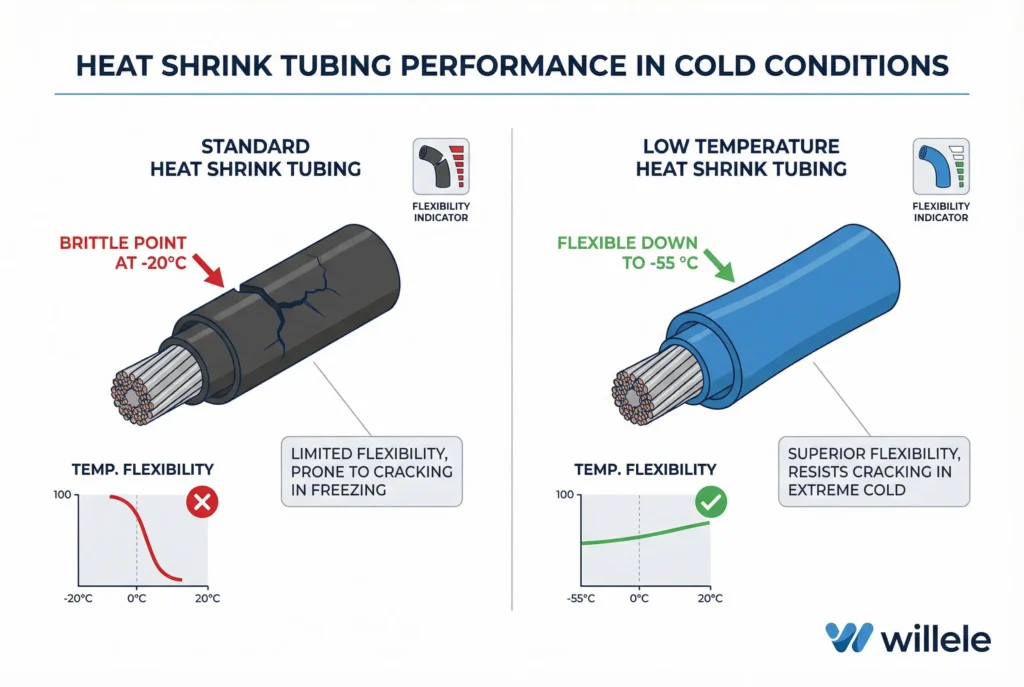
- Measurement: Select tubing with a recovered diameter 20-30% smaller than the cable diameter to ensure proper grip in cold conditions
- Positioning: Slide tubing over the connection, allowing 25mm overlap on each side
- Heating: Apply heat evenly using a circular motion, starting from the center and working toward the ends
- Cooling: Allow natural cooling; do not use forced cooling methods that could create thermal stress
- Inspection: Verify complete shrinkage, adhesive flow (for dual-wall types), and absence of air pockets
Cold Weather Best Practices
- Install in sheltered areas when possible to minimize wind chill effects
- Use infrared thermometers to monitor surface temperature during installation
- Allow 50% longer shrinking time compared to room temperature installations
- For adhesive-lined tubing, ensure complete adhesive melt-out is visible at both ends
- Avoid installation during active precipitation (snow, freezing rain)
Industry Standards and Certifications
willele Electric’s low temperature heat shrink tubing complies with international standards ensuring quality and reliability:
| Standard | Description | Relevance to Cold Climate Applications |
|---|---|---|
| SAE-AMS-DTL-23053/5 | Military specification for heat shrink tubing | Class 1 and Class 2 ratings for extreme environment performance |
| ASTM D2671 | Standard Test Methods for Heat Shrinkable Tubing | Defines cold temperature flexibility and shrinkage testing protocols |
| IEC 60684-3 | Flexible insulating sleeving specifications | Part 211 covers low temperature requirements down to -55°C |
| UL 224 | Extruded insulating tubing standard | VW-1 flame rating with cold temperature modifiers |
| MIL-I-23053/5 | Military specification Class 1/2/3 | Environmental exposure requirements for arctic applications |
| ISO 9001:2015 | Quality management systems | willele manufacturing facility certification |
| RoHS / REACH | Environmental compliance | Lead-free, halogen-free options for environmentally sensitive areas |
| CSA C22.2 | Canadian electrical standards | Cold climate testing requirements specific to Canadian markets |
Selection Criteria for Low Temperature Heat Shrink Tubing
Choosing the appropriate low temperature heat shrink tubing requires careful consideration of multiple factors:
Material Selection Matrix
| Application Requirements | Recommended Material | Operating Range | Key Benefits |
|---|---|---|---|
| General cold climate electrical | Modified polyolefin | -55°C to +125°C | Cost-effective, excellent flexibility |
| Chemical exposure environments | Fluoropolymer (PTFE/FEP) | -200°C to +200°C | Superior chemical resistance, ultra-low temp |
| High voltage insulation | Cross-linked polyolefin | -55°C to +135°C | Enhanced dielectric strength, flame retardant |
| Moisture-critical applications | Dual-wall adhesive lined | -55°C to +110°C | Hermetic seal, corrosion prevention |
| Harsh mechanical environments | Thick-wall modified polyolefin | -55°C to +125°C | Abrasion resistance, high impact tolerance |
Sizing Considerations
Shrink Ratio Selection: For cold climate applications, willele Electric recommends:
- 2:1 ratio: Ideal for cables with limited size variation and pre-installed connectors
- 3:1 ratio: Best for irregular shapes and assemblies requiring greater conformability
- 4:1 ratio: Optimal for branching harnesses and significant diameter transitions
Wall Thickness Guidelines:
- Thin wall (0.25-0.5mm): Low voltage, indoor cold storage applications
- Medium wall (0.5-1.0mm): General outdoor cold climate installations
- Heavy wall (1.0-2.5mm): Buried cables, high-abuse mechanical environments
Environmental Factors
Consider these additional parameters when selecting low temperature heat shrink tubing:
- UV Exposure: Arctic and high-altitude locations experience intense UV; specify UV-stabilized formulations
- Chemical Contact: De-icing salts, hydraulic fluids, and antifreeze require chemically resistant materials
- Mechanical Stress: Areas subject to ice loading or impact require heavy-wall constructions
- Regulatory Requirements: Offshore platforms, aircraft, and nuclear facilities have specific material certifications
FAQ: Low Temperature Heat Shrink Tubing
Q: What is the lowest temperature at which heat shrink tubing can be installed?
A: willele Electric’s low temperature heat shrink tubing can be installed at temperatures as low as -20°C. However, for optimal results, we recommend pre-warming the tubing to room temperature and ensuring substrate surfaces are free of ice and moisture. Standard heat shrink tubing should not be installed below +10°C.
Q: How does low temperature heat shrink tubing differ from standard products?
A: Low temperature heat shrink tubing uses specialized polymer formulations with plasticizers and impact modifiers that maintain flexibility and prevent brittleness at extreme cold temperatures down to -55°C or lower. The adhesive layers in dual-wall versions are specifically designed to remain tacky and form reliable seals in sub-zero conditions, unlike standard adhesives that become hard and lose bonding strength.
Q: Can I use a standard heat gun for installation in cold weather?
A: While standard heat guns can be used, we recommend heat tools specifically rated for cold weather operation with adjustable temperature controls. Low temperature heat shrink tubing is optimized to shrink at lower temperatures (90-130°C), which is advantageous when working on cold substrates to prevent thermal shock and ensure even shrinkage.
Q: What is the expected service life of low temperature heat shrink tubing in arctic conditions?
A: When properly installed, willele Electric’s low temperature heat shrink tubing provides a service life of 10-15 years in continuous arctic exposure, compared to 3-5 years for standard materials. The actual lifespan depends on UV exposure, mechanical stress, and chemical contact. Regular inspection and maintenance extend operational life.
Q: Is low temperature heat shrink tubing suitable for both indoor and outdoor cold climate applications?
A: Yes, low temperature heat shrink tubing is designed for versatility across all cold climate environments. Indoor applications include cold storage facilities, freezer rooms, and cryogenic laboratories. Outdoor applications encompass arctic infrastructure, mountain telecommunications, winter sports facilities, and seasonal equipment. UV-stabilized versions are recommended for continuous outdoor exposure.
Q: How do I calculate the correct size for irregular cable bundles?
A: For irregular cable bundles in cold climates, measure the largest cross-sectional dimension of the assembly and select tubing with a recovered (shrunk) inner diameter 20-30% smaller than this measurement. For complex shapes, 3:1 or 4:1 shrink ratio tubing provides better conformability. willele Electric’s technical team can provide detailed sizing assistance for challenging configurations.
Why Choose willele Electric for Low Temperature Heat Shrink Tubing
As a specialized B2B manufacturer of electric equipment with extensive expertise in heat shrink tube technology, willele Electric delivers engineered solutions for the most demanding cold climate applications. Our low temperature heat shrink tubing is manufactured under ISO 9001:2015 quality standards, with rigorous testing protocols ensuring consistent performance in extreme environments.
Our technical support team provides application-specific recommendations, custom sizing solutions, and installation training to ensure optimal results in your cold climate projects. Contact willele Electric today to discuss your low temperature heat shrink tubing requirements and discover how our products can enhance the reliability of your electrical infrastructure in extreme cold conditions.
