
Cable Ties vs Velcro Straps: Which Is Better for Your Application?

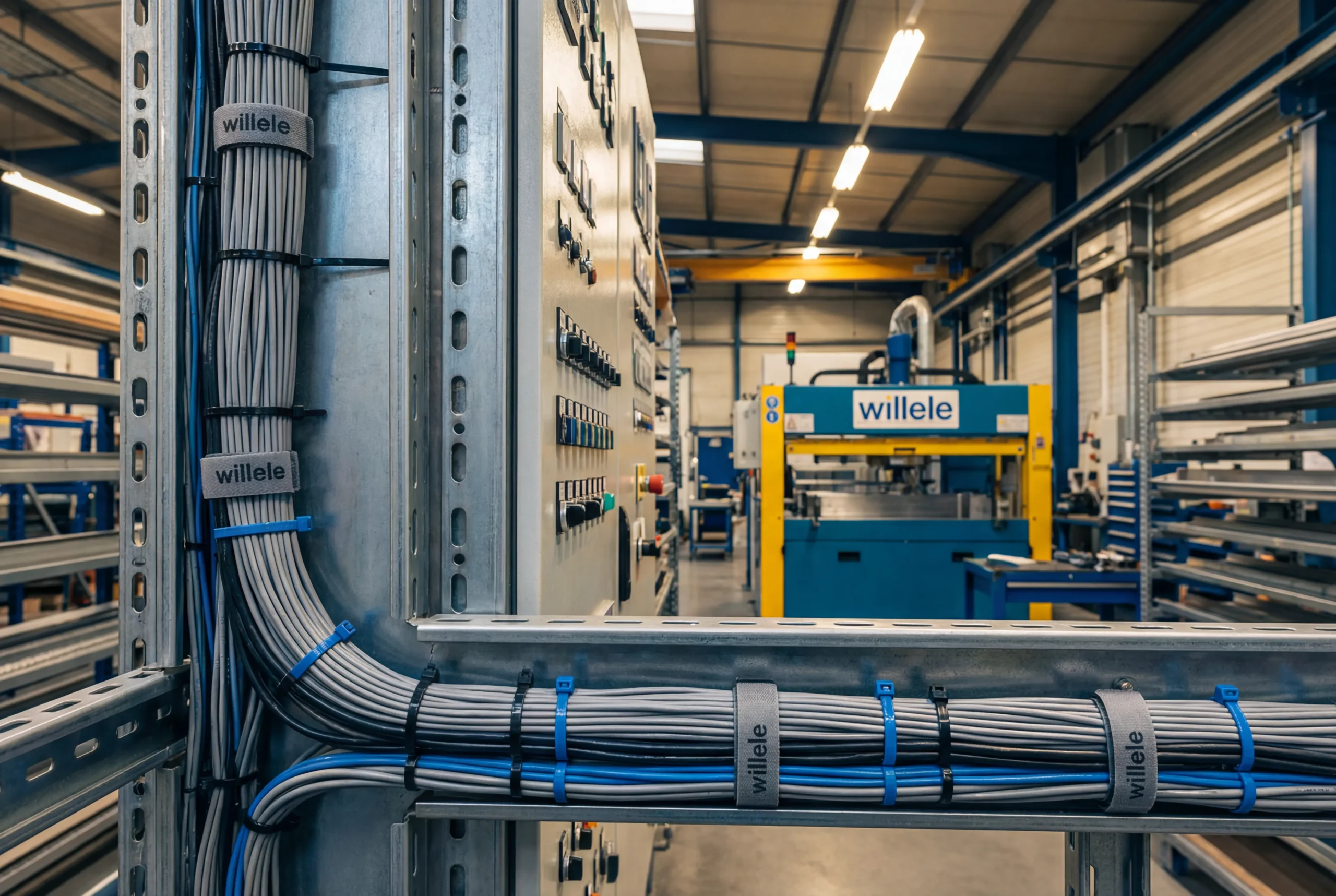
Introduction: Choosing the Right Cable Management Solution
In industrial and commercial electrical installations, effective cable management is critical for safety, organization, and long-term reliability. The debate between cable ties vs velcro straps has become increasingly relevant as facilities managers, electrical contractors, and maintenance professionals seek the optimal solution for wire bundling and organization. While both fastening methods serve similar purposes, understanding their distinct characteristics, performance metrics, and ideal applications is essential for making informed procurement decisions.
The choice between cable ties and velcro straps impacts not only initial installation costs but also long-term maintenance efficiency, system flexibility, and operational safety. This comprehensive guide examines both solutions from a technical perspective, providing the data-driven insights necessary for B2B electrical equipment professionals to select the appropriate cable management method for specific applications.
Understanding Cable Ties: Construction and Characteristics
What Are Cable Ties?
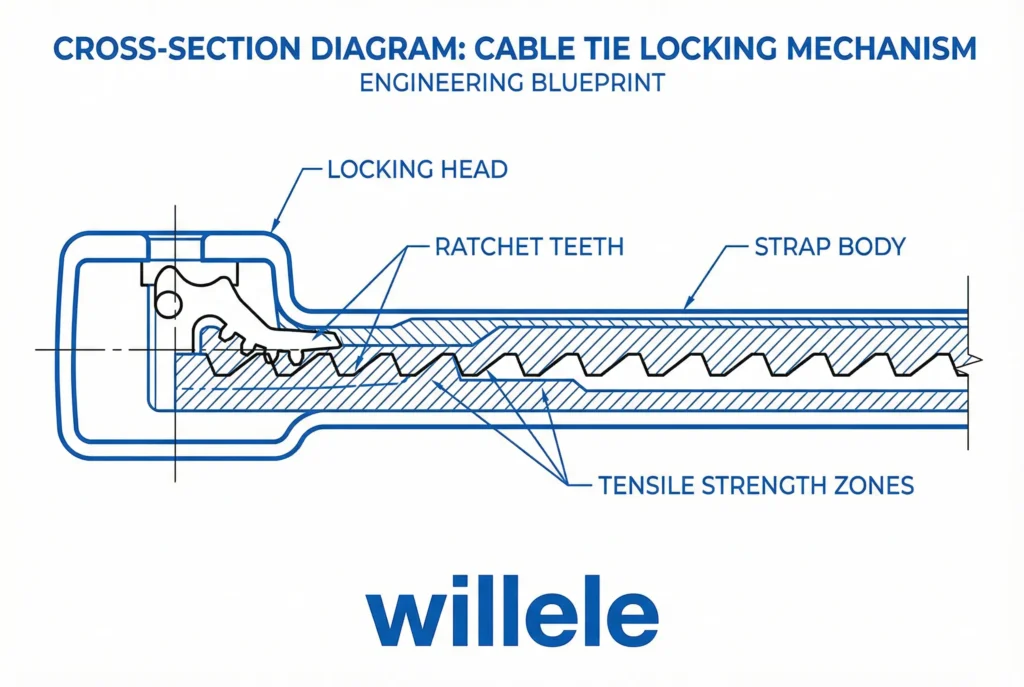
Cable ties, also known as zip ties or tie wraps, are single-use fastening devices manufactured from nylon (polyamide) or other polymer materials. They feature a flexible strap with integrated ratchet teeth and a locking head mechanism that allows one-directional tightening and permanent closure.
Key Features and Specifications
Material Composition: Standard cable ties are manufactured from Nylon 6/6 (PA66), offering excellent tensile strength ranging from 18 lbs (8 kg) for light-duty applications to over 250 lbs (113 kg) for heavy-duty industrial variants. Specialized versions include:
- UV-stabilized nylon for outdoor applications
- Heat-stabilized variants for high-temperature environments (up to 185°F/85°C continuous)
- Metal-detectable ties for food processing industries
- Stainless steel cable ties for extreme conditions (operating temperatures from -112°F to 1000°F)
Locking Mechanisms: The ratchet-and-pawl design creates an irreversible closure, providing consistent bundling tension. Once tightened, standard cable ties cannot be loosened without cutting, ensuring permanent installation security.
Advantages of Cable Ties
- High Tensile Strength: Industrial-grade cable ties provide superior holding power, with breaking strengths exceeding 175 lbs for 1/4-inch width straps.
- Cost-Effectiveness: Bulk pricing typically ranges from $0.01 to $0.15 per unit, making cable ties the most economical option for large-scale installations.
- Temperature Resistance: Standard nylon cable ties perform reliably from -40°F to 185°F (-40°C to 85°C), with specialty variants extending these ranges significantly.
- Chemical Resistance: Nylon 6/6 exhibits excellent resistance to oils, greases, alkalis, and most industrial solvents.
- Installation Speed: Quick application requires only pulling the strap through the head until the desired tension is achieved.
- Vibration Resistance: The permanent locking mechanism prevents loosening in high-vibration environments such as manufacturing equipment and automotive applications.
Disadvantages of Cable Ties
- Single-Use Design: Cable ties must be cut for removal, generating waste and requiring complete replacement for any maintenance access.
- Inflexibility: Once installed, adjustments require cutting and reinstalling new ties, increasing long-term operational costs.
- Potential Cable Damage: Over-tightening can compress and damage wire insulation or restrict cable movement in environments requiring thermal expansion.
- Environmental Concerns: As single-use plastics, cable ties contribute to waste streams, though recyclable variants are available.
- Installation Permanence: Incorrect initial installation cannot be corrected without destroying the tie.
Ideal Applications for Cable Ties
Cable ties excel in applications requiring:
- Permanent installations with minimal anticipated maintenance requirements
- High-security bundling where tamper evidence is important
- Harsh environmental conditions (extreme temperatures, chemical exposure, outdoor UV exposure)
- Cost-sensitive projects with large quantities of bundling points
- Vibration-prone environments (machinery, vehicles, heavy equipment)
- One-time wire harness assembly in manufacturing processes
Understanding Velcro Straps: Design and Performance
What Are Velcro Straps?
Velcro straps, technically known as hook-and-loop cable ties, utilize a two-part fastening system consisting of microscopic hooks on one surface that engage with loops on the opposing surface. These reusable cable management products are typically manufactured from nylon or polyester materials with molded hook-and-loop closures.
Key Features and Specifications
Construction Materials: Quality velcro straps feature:
- Woven nylon or polyester backing for tensile strength
- Polypropylene or nylon hooks with loop density ranging from 200-400 loops per square inch
- Integrated design where the hook and loop sections are permanently attached to the strap body
Load Capacities: Commercial-grade velcro straps typically support loads between 10-75 lbs, depending on width, length, and closure overlap area. Industrial variants with reinforced backing can achieve higher ratings.
Operating Parameters: Standard velcro cable straps function effectively within temperature ranges of 0°F to 160°F (-18°C to 71°C), with specialized high-temperature versions extending to 225°F (107°C).
Advantages of Velcro Straps
- Reusability: Velcro straps can be opened and closed thousands of times, making them ideal for installations requiring frequent access or modifications.
- Adjustability: Easy tension adjustment without removing the strap allows precise bundling control and accommodation of varying cable quantities.
- Cable Protection: The broad contact surface distributes pressure evenly, preventing insulation compression and allowing necessary cable movement.
- Maintenance Efficiency: Significantly reduces labor costs in environments requiring regular cable access, with no tools required for opening or closing.
- Organization Flexibility: Simple reconfiguration supports dynamic cable routing changes common in data centers, laboratories, and development environments.
- Reduced Waste: Reusable design minimizes environmental impact and reduces long-term procurement costs.
- Color Coding: Available in multiple colors for easy circuit identification and organization systems.
Disadvantages of Velcro Straps
- Higher Initial Cost: Unit costs typically range from $0.50 to $3.00, representing 5-20x the cost of comparable cable ties.
- Lower Tensile Strength: Maximum load ratings are generally 30-60% lower than equivalent-sized cable ties.
- Reduced Environmental Resistance: Limited performance in extreme temperatures, chemical exposure, or outdoor UV conditions compared to specialized cable ties.
- Contamination Vulnerability: Hook-and-loop surfaces can accumulate dust, lint, and debris in dirty environments, reducing holding power over time.
- Vibration Loosening: In high-vibration environments, velcro closures may gradually loosen, requiring periodic inspection and retightening.
- Wear Degradation: Repeated opening and closing gradually reduces hook-and-loop engagement strength, typically noticeable after 500-1000 cycles.
Ideal Applications for Velcro Straps
Velcro straps are optimal for:
- Dynamic environments requiring frequent cable additions, removals, or rerouting (data centers, network closets, AV installations)
- Temporary installations or project-based setups
- Equipment requiring regular maintenance access (test equipment, development labs, server racks)
- Applications prioritizing cable protection over maximum security
- Clean room environments with controlled temperature and humidity
- Audiovisual and entertainment systems needing rapid reconfiguration
- Consumer electronics and appliance wire management
Cable Ties vs Velcro Straps: Direct Comparison

Performance Comparison Table
| Feature | Cable Ties | Velcro Straps | Winner |
|---|---|---|---|
| Tensile Strength | 18-250+ lbs | 10-75 lbs | Cable Ties |
| Reusability | Single-use | 500-1000+ cycles | Velcro Straps |
| Installation Speed | Fast (permanent) | Fast (adjustable) | Tie |
| Temperature Range | -40°F to 185°F (std) | 0°F to 160°F (std) | Cable Ties |
| Cost per Unit | $0.01-$0.15 | $0.50-$3.00 | Cable Ties |
| Maintenance Access | Requires cutting | Tool-free opening | Velcro Straps |
| Environmental Resistance | Excellent | Moderate | Cable Ties |
| Cable Protection | Risk of over-tightening | Gentle, distributed pressure | Velcro Straps |
| Vibration Resistance | Excellent | Moderate to Good | Cable Ties |
| Waste Generation | High (single-use) | Minimal (reusable) | Velcro Straps |
Cost Analysis Over Time
| Scenario | Initial Installation (100 ties) | Year 1 Maintenance (20 accesses) | 3-Year Total Cost | Most Economical |
|---|---|---|---|---|
| Cable Ties | $5 (100 × $0.05) | $100 (labor) + $5 (materials) | $320 | Static installations |
| Velcro Straps | $150 (100 × $1.50) | $20 (labor only) | $210 | Dynamic environments |
Note: Labor costs estimated at $50/hour, assuming 2 hours for cable tie replacement vs. 0.4 hours for velcro strap adjustments
Application-Specific Recommendations
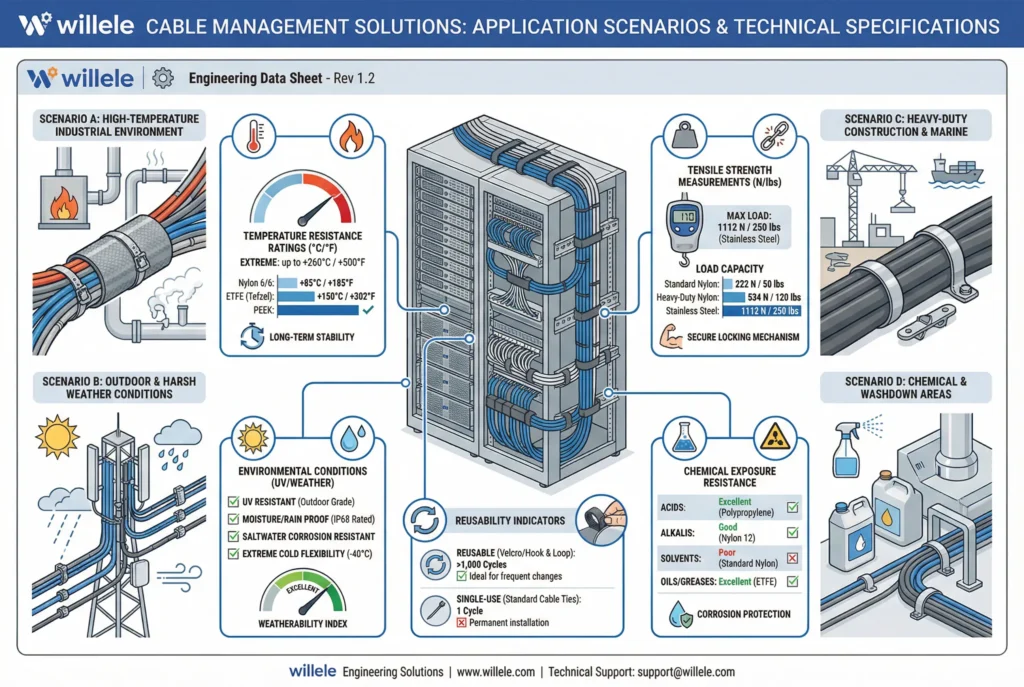
Choose Cable Ties When:
- Permanent installations with minimal expected changes
- High-security requirements (tamper evidence, critical infrastructure)
- Extreme environmental conditions (outdoor, high-temperature, chemical exposure)
- Maximum tensile strength is required (heavy cable bundles, structural mounting)
- Budget constraints dictate lowest per-unit cost
- Vibration-intensive environments (machinery, transportation, HVAC equipment)
Choose Velcro Straps When:
- Frequent maintenance access is required (weekly or monthly cable changes)
- Cable protection is prioritized (sensitive fiber optics, delicate wiring)
- Installation flexibility and future modifications are anticipated
- Long-term cost optimization through reusability outweighs initial investment
- Clean, controlled environments (offices, laboratories, data centers)
- Color-coding and organization systems are important
Integrating Cable Management with Willele’s Heat Shrink Solutions
As a leading B2B electrical equipment manufacturer specializing in heat shrink tubing, Willele understands that comprehensive cable protection extends beyond bundling to include insulation, strain relief, and environmental sealing. Cable ties and velcro straps serve complementary roles within complete wire management systems.
Synergistic Applications
Heat Shrink + Cable Ties: For permanent outdoor installations, combining UV-resistant cable ties with heat shrink tubing provides dual-layer protection—mechanical bundling plus environmental sealing against moisture, chemicals, and temperature extremes.
Heat Shrink + Velcro Straps: In maintenance-intensive applications, velcro straps allow easy access while heat shrink markers and end caps provide permanent identification and termination protection.
Integrated Systems: Professional installations often utilize cable ties for permanent infrastructure points (wall penetrations, equipment mounting) while employing velcro straps for accessible routing sections requiring periodic inspection or modification.
Willele’s expertise in thermal management solutions complements both cable tie and velcro strap applications, ensuring complete cable protection from mechanical stress, environmental factors, and electrical insulation requirements.
Frequently Asked Questions
Can I reuse cable ties?
Standard cable ties are designed for single-use only. However, specialty releasable cable ties with manual release mechanisms are available for applications requiring occasional adjustments. These cost 3-5x more than standard ties but offer limited reusability (typically 5-10 cycles). For frequent access requirements, velcro straps provide superior reusability economics.
What is the maximum load capacity for velcro straps?
Standard commercial velcro cable straps support 10-30 lbs depending on width (1/2-inch to 2-inch) and closure overlap. Industrial-grade versions with reinforced backing can achieve 50-75 lbs. For loads exceeding these capacities, cable ties or mechanical clamps are recommended.
Do cable ties damage cables over time?
When properly installed with appropriate tension, quality cable ties do not damage cables. However, over-tightening can compress insulation, restrict thermal expansion, or create stress points. Use cable tie tensioning tools with adjustable torque limits (typically 40-60 in-lbs) for consistent, safe installation. For delicate cables like fiber optics, velcro straps are preferred.
How long do velcro straps maintain their holding power?
Quality velcro cable straps maintain effective holding power for 500-1000 open/close cycles under normal conditions. In clean environments, lifespan can extend beyond 1000 cycles. Contamination from dust, oil, or debris accelerates degradation. Regular cleaning with compressed air or brush can extend service life.
Are there environmentally friendly alternatives?
Yes. Recyclable nylon cable ties are available from major manufacturers. Biodegradable ties made from plant-based polymers are emerging for non-critical applications. Velcro straps inherently offer better environmental profiles due to reusability. Stainless steel cable ties provide indefinite reusability in harsh environments but require cutting tools for removal.
What temperature ratings should I specify for outdoor applications?
For outdoor installations, specify UV-stabilized nylon cable ties rated for -40°F to 185°F (-40°C to 85°C) minimum. In extreme climates, consider stainless steel ties rated for -112°F to 1000°F (-80°C to 538°C). Standard velcro straps are not recommended for prolonged outdoor exposure; however, UV-resistant polyester versions rated to 0°F to 200°F (-18°C to 93°C) are available for covered outdoor applications.
How do I calculate the number of cable ties or straps needed for a project?
Estimate bundling points at 12-18 inch intervals for horizontal cable runs and 24-36 inch intervals for vertical runs. Add 20% contingency for irregular routing and junction points. For a 100-foot cable tray with 50 cables, estimate 100-150 bundling points. Calculate based on: (Total cable length in feet ÷ Spacing in feet) × Number of bundle locations × 1.2 contingency factor.
Conclusion: Making the Right Choice for Your Application
The cable ties vs velcro straps decision ultimately depends on your specific operational requirements, maintenance patterns, and environmental conditions. Both solutions offer distinct advantages that make them optimal for different scenarios.
Select cable ties for permanent installations requiring maximum strength, environmental resistance, and lowest per-unit cost. Their irreversible locking mechanism and superior load capacity make them ideal for industrial environments, outdoor applications, and installations with minimal anticipated changes.
Choose velcro straps when installation flexibility, frequent maintenance access, and cable protection are priorities. The higher initial investment is offset by reduced maintenance labor costs and reusability in dynamic environments like data centers, laboratories, and AV systems.
Hybrid approaches often provide optimal results—using cable ties for permanent infrastructure points while employing velcro straps for accessible routing sections requiring periodic modification. This balanced strategy maximizes both security and flexibility.
As a trusted partner in electrical equipment solutions, Willele combines deep expertise in heat shrink tubing with comprehensive understanding of complete cable management systems. Whether you’re specifying cable ties, velcro straps, or integrated protection solutions, proper selection and installation ensure long-term reliability, safety, and operational efficiency.
For technical consultation on cable management solutions tailored to your specific applications, contact Willele’s engineering team to leverage our decades of experience in B2B electrical equipment manufacturing and thermal protection technologies.
