
Fire Retardant Standards Halogen-Free Fire Retardant Heat Shrink Tube

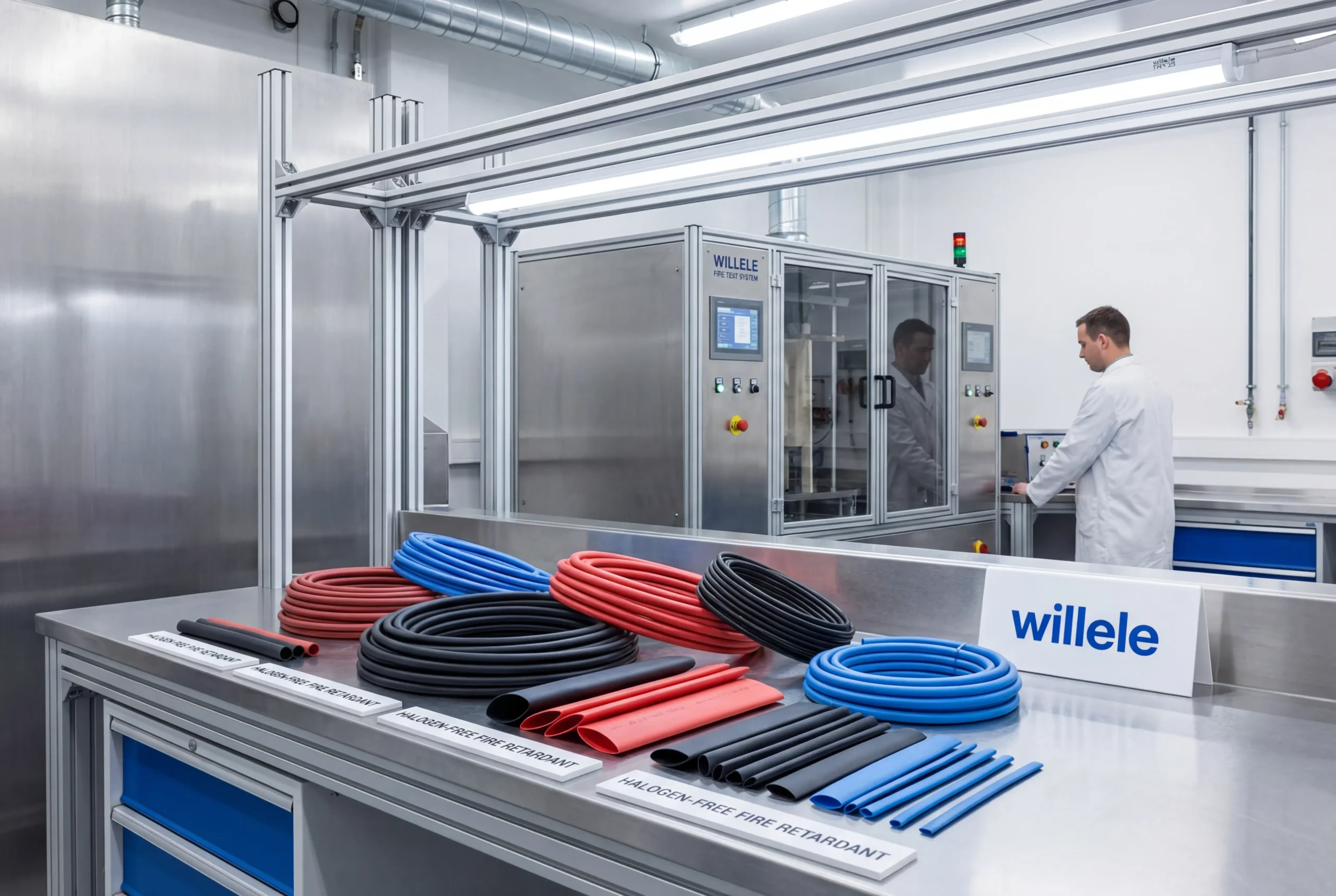
Introduction to Halogen-Free Fire Retardant Heat Shrink Tubes
In today’s safety-conscious industrial environment, fire retardant standards have become increasingly stringent, driving demand for advanced materials that protect both people and equipment. Halogen-free fire retardant heat shrink tubes represent a critical evolution in electrical insulation technology, combining superior flame resistance with environmental responsibility and reduced toxicity. At willele Electric, we specialize in manufacturing premium halogen-free fire retardant heat shrink tubes that meet the most demanding international fire retardant standards while delivering exceptional performance in critical applications.
As a leading B2B manufacturer of electrical equipment components, willele understands that selecting the right fire retardant materials is not just about compliance—it’s about protecting lives, assets, and the environment. Our halogen-free heat shrink tube solutions provide comprehensive fire safety without the hazardous emissions associated with traditional halogenated materials, making them the preferred choice for industries ranging from aerospace and rail transportation to telecommunications and renewable energy.
Understanding Halogen-Free Fire Retardant Materials
What Makes Materials “Halogen-Free”?
Halogen-free fire retardant materials are polymers that achieve flame resistance without incorporating halogen elements—specifically fluorine (F), chlorine (Cl), bromine (Br), iodine (I), and astatine (At). Traditional flame retardants often relied on halogenated compounds like brominated or chlorinated additives due to their effectiveness in suppressing combustion. However, these materials produce toxic and corrosive gases when burned.
According to international standards, truly halogen-free materials must contain:
- Fluorine content < 900 ppm
- Chlorine content < 900 ppm
- Bromine content < 900 ppm
- Total halogen content < 1,500 ppm
willele’s halogen-free fire retardant heat shrink tubes utilize alternative flame retardant systems based on mineral fillers, phosphorus compounds, and intumescent additives that meet or exceed these stringent requirements.
The Science Behind Halogen-Free Flame Retardancy
Halogen-free fire retardant mechanisms work differently from halogenated systems:
Intumescent Action: When exposed to heat, intumescent additives expand to form an insulating char layer that shields the underlying material from flames and oxygen.
Phosphorus Chemistry: Phosphorus-based flame retardants promote char formation and release non-combustible gases that dilute flammable volatiles.
Mineral Fillers: Compounds like aluminum trihydrate (ATH) and magnesium hydroxide (MDH) absorb heat through endothermic decomposition, releasing water vapor that cools the material and dilutes combustible gases.
Synergistic Systems: willele employs carefully balanced combinations of multiple flame retardant mechanisms to achieve optimal fire performance while maintaining mechanical properties and processing characteristics.
Why Halogen-Free Fire Retardant Standards Matter
Health and Safety Advantages
| Factor | Halogenated Materials | Halogen-Free Materials |
|---|---|---|
| Toxic Gas Emission | High (HCl, HBr, dioxins) | Minimal (H₂O, CO₂) |
| Smoke Density | Dense, black smoke | Lower smoke generation |
| Corrosive Products | Highly corrosive acids | Non-corrosive |
| Acute Toxicity | Severe respiratory hazard | Reduced toxicity |
| Environmental Persistence | Bioaccumulative compounds | Environmentally benign |
| Electronic Equipment Damage | Severe corrosion risk | Minimal risk |
| Evacuation Time | Reduced due to smoke/toxicity | Extended safe evacuation |
The devastating consequences of halogenated materials became tragically evident in multiple fire incidents where toxic smoke caused more casualties than the flames themselves. Halogen-free fire retardant standards address this critical safety gap.
Environmental and Regulatory Drivers
Global regulations increasingly mandate halogen-free materials:
- RoHS (Restriction of Hazardous Substances): Limits specific halogenated flame retardants in electrical equipment
- REACH (Registration, Evaluation, Authorization of Chemicals): EU regulation restricting hazardous substances
- IEC 61249-2-21: Standard specifically addressing halogen-free materials for electrical applications
- Railway Standards: EN 45545 requires halogen-free materials in European rail applications
- Building Codes: Many jurisdictions now require halogen-free cables in public buildings
willele’s halogen-free fire retardant heat shrink tubes help manufacturers and integrators meet these evolving compliance requirements while future-proofing their products.
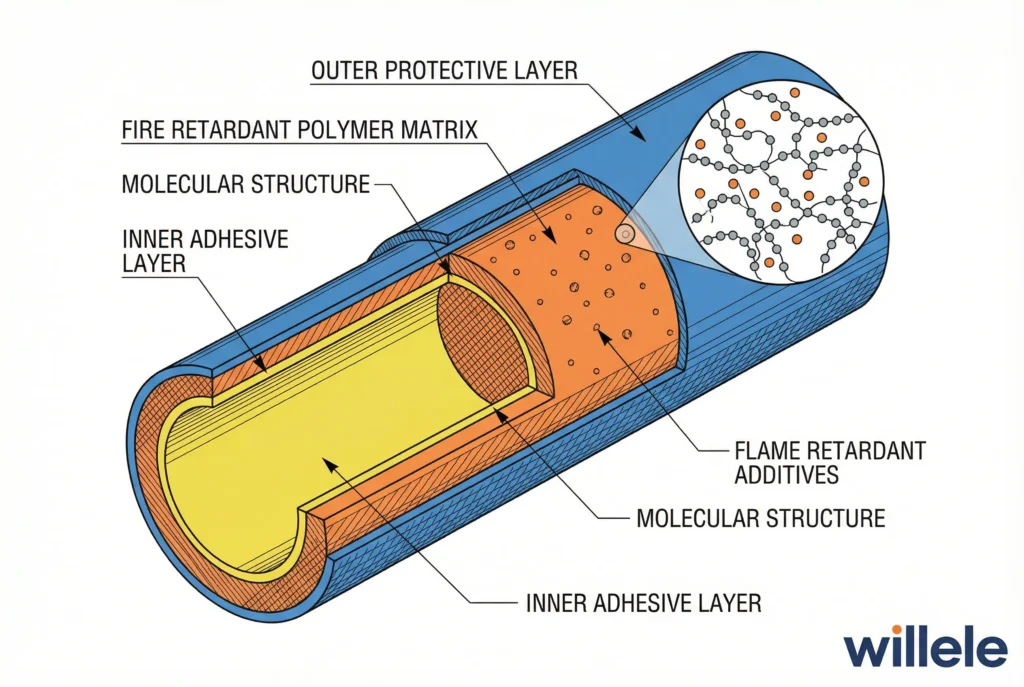
International Fire Retardant Standards
Comprehensive Standards Comparison
| Standard | Issuing Body | Application | Test Method | Key Requirements |
|---|---|---|---|---|
| UL94 V-0 | Underwriters Laboratories (USA) | General plastics | Vertical burn test | Self-extinguish <10s, no dripping |
| IEC 60332-1 | International Electrotechnical Commission | Single cable/wire | Vertical flame propagation | Limited vertical spread |
| IEC 60332-3 | IEC | Cable bundles | Bundled cable test | Category A/B/C classifications |
| VW-1 | UL (Appliance Wire) | Appliance wiring | Vertical wire flame test | Self-extinguish, limited burn |
| FMVSS 302 | US Federal Motor Vehicle Safety | Automotive interiors | Horizontal burn test | <100mm/min burn rate |
| EN 45545 | European rail standards | Railway applications | Toxicity + flame spread | Hazard Level 1-3 requirements |
| ISO 4589 | International Organization for Standardization | Oxygen index | Limiting oxygen index (LOI) | >28% for good flame resistance |
UL94 Flammability Classifications
The UL94 standard remains the most widely recognized fire retardant standard for plastic materials:
| Rating | Description | Burning Time | Dripping | After-Glow |
|---|---|---|---|---|
| V-0 | Best rating | <10 seconds (each flame application) | No flaming drips | <30 seconds |
| V-1 | Good rating | <30 seconds (each flame application) | No flaming drips | <60 seconds |
| V-2 | Acceptable | <30 seconds (each flame application) | Flaming drips allowed | <60 seconds |
| HB | Baseline | Slow horizontal burn | Variable | Variable |
| 5VA/5VB | Enhanced | <60 seconds (5 flame applications) | No burn-through | No after-glow |
willele’s premium halogen-free fire retardant heat shrink tubes consistently achieve UL94 V-0 ratings, representing the highest level of flame resistance.
IEC 60332 Cable Flame Tests
| Test Category | Configuration | Purpose | Acceptance Criteria |
|---|---|---|---|
| IEC 60332-1 | Single vertical cable | Individual conductor | Damage length <540mm |
| IEC 60332-2 | Small cables in bundle | Limited installation | 60-second flame application |
| IEC 60332-3 Cat. A | Large vertical bundle | High fire load | <2.5m vertical spread |
| IEC 60332-3 Cat. B | Vertical bundle | Medium fire load | <2.5m vertical spread |
| IEC 60332-3 Cat. C | Vertical bundle | Lower fire load | <2.5m vertical spread |
These standards ensure that even in dense cable installations, fire propagation remains controlled—a critical consideration for data centers, industrial facilities, and infrastructure projects.
Testing Methods and Certification Requirements
Laboratory Testing Procedures
Achieving fire retardant standards certification requires rigorous testing:
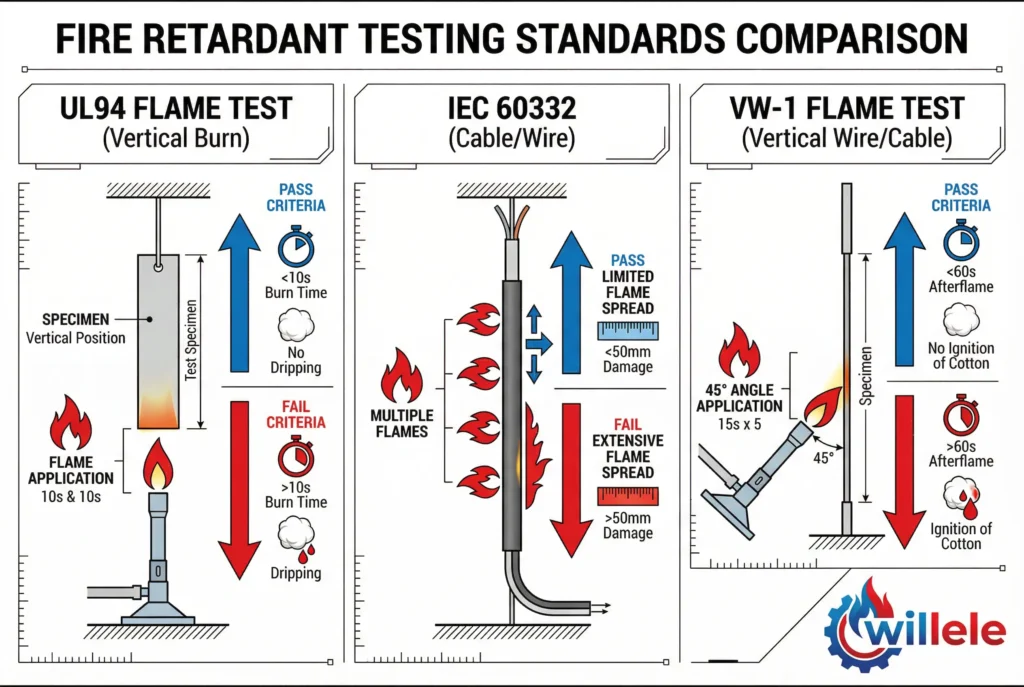
UL94 Vertical Burn Test Protocol:
- Five specimens (125mm × 13mm) conditioned at 23°C and 50% RH
- Bunsen burner flame applied for 10 seconds
- Measure time to self-extinguish
- Second flame application after extinction
- Observe dripping behavior and after-glow duration
- All five specimens must meet criteria for rating
IEC 60332-1 Single Cable Test:
- 600mm cable specimen mounted vertically
- Propane burner flame applied at 45° angle for 60 seconds
- Measure upward flame spread after flame removal
- Damaged section must not exceed 540mm
Limiting Oxygen Index (LOI) Test:
- Material sample placed in oxygen-nitrogen atmosphere
- Gradually reduce oxygen concentration
- Determine minimum oxygen % supporting combustion
- Higher LOI = better flame resistance (typical target: >28%)
Certification Documentation
willele provides comprehensive certification documentation with all halogen-free fire retardant heat shrink tube products:
- UL recognition marks and file numbers
- IEC test reports from accredited laboratories
- RoHS and REACH compliance declarations
- Material composition certificates
- Halogen content test results (showing <1,500 ppm total)
- Performance data sheets with temperature ratings
- Installation and handling guidelines
Material Composition and Performance Characteristics
Technical Specifications
| Property | Standard Grade | Premium Grade | High-Performance |
|---|---|---|---|
| Base Polymer | Polyolefin blend | Cross-linked polyolefin | Modified polyolefin |
| Flame Rating | UL94 V-1 | UL94 V-0 | UL94 V-0 + 5VA |
| Operating Temperature | -55°C to 105°C | -55°C to 125°C | -55°C to 150°C |
| Limiting Oxygen Index | 28% | 32% | 35% |
| Halogen Content | <1,500 ppm | <1,000 ppm | <900 ppm |
| Shrink Ratio | 2:1 | 3:1 | 4:1 |
| Dielectric Strength | 15 kV/mm | 20 kV/mm | 25 kV/mm |
| Tensile Strength | 10 MPa | 12 MPa | 15 MPa |
| Elongation at Break | 200% | 300% | 400% |
| Volume Resistivity | 1×10¹⁴ Ω·cm | 1×10¹⁵ Ω·cm | 1×10¹⁶ Ω·cm |
Color Coding and Identification
willele manufactures halogen-free fire retardant heat shrink tubes in comprehensive color ranges:
- Standard Colors: Black, red, blue, yellow, green, white, brown, orange, gray, violet
- Custom Colors: Available for large-volume orders
- Transparent Options: For visual inspection of connections
- Printed Options: Custom text, logos, or identification markings
All pigments and colorants meet halogen-free requirements and maintain fire retardant properties.
Industry Applications and Compliance Requirements
Critical Application Sectors
Rail Transportation:
- EN 45545 compliance mandatory for European railways
- Halogen-free fire retardant requirements for passenger safety
- Low smoke and toxicity essential for tunnel safety
- willele supplies certified heat shrink tubes for signaling, control, and power systems
Aerospace and Aviation:
- FAR 25.853 flame resistance requirements
- Smoke density and toxicity limitations (FAR 25.855)
- Military specifications (MIL-DTL-23053) for defense applications
- Space-qualified materials for satellite and spacecraft wiring
Marine and Offshore:
- IEC 60092 standards for shipboard electrical installations
- IMO (International Maritime Organization) flame spread requirements
- Harsh environment resistance (salt spray, UV, chemicals)
- Critical for navigation, communication, and safety systems
Building and Infrastructure:
- National Electrical Code (NEC) requirements for plenum spaces
- LEED certification considerations for green buildings
- Smoke and toxicity concerns in occupied spaces
- Data center and telecommunications installations
Renewable Energy:
- Solar PV system DC wiring (UL 4703, IEC 62852)
- Wind turbine electrical systems
- Battery energy storage installations
- High reliability and long-term outdoor exposure
Application-Specific Requirements
| Application | Required Standards | Key Performance Factors | willele Recommendation |
|---|---|---|---|
| Railway signaling | EN 45545, IEC 60332 | Flame spread, toxicity, smoke | Premium V-0 grade |
| Aircraft harness | FAR 25.853, AS23053 | Weight, flexibility, thermal stability | High-performance grade |
| Marine control | IEC 60092, IACS | Salt spray, UV, oil resistance | Marine-grade formulation |
| Building plenum | UL910 (Steiner Tunnel) | Flame spread index <25 | Low-smoke V-0 grade |
| Solar DC wiring | UL 4703, EN 50618 | UV resistance, temperature cycling | Weather-resistant grade |
| EV charging | ISO 17409, IEC 62893 | Oil resistance, flexibility | Automotive-grade |
Selection Criteria for Halogen-Free Fire Retardant Heat Shrink Tubes
Decision Framework
When specifying halogen-free fire retardant heat shrink tubes, evaluate:
1. Regulatory Requirements:
- Identify applicable fire retardant standards for your industry
- Verify halogen-free mandates in target markets
- Ensure documentation supports certification processes
2. Environmental Conditions:
- Operating temperature range (continuous and peak)
- Chemical exposure (oils, solvents, cleaning agents)
- UV exposure and outdoor weathering
- Moisture and humidity levels
3. Electrical Requirements:
- Voltage rating and dielectric strength
- Insulation resistance specifications
- Corona resistance for high-voltage applications
4. Mechanical Properties:
- Flexibility requirements for installation
- Abrasion resistance for high-movement applications
- Shrink ratio to accommodate connector sizes
5. Installation Considerations:
- Shrink temperature and equipment available
- Pre-shrunk vs. field-shrinkable
- Color coding and identification needs
Quality Assurance
willele implements comprehensive quality control for all halogen-free fire retardant heat shrink tubes:
- Incoming raw material testing and certification verification
- In-process monitoring of extrusion and cross-linking
- Batch testing for flame resistance and halogen content
- Dimensional inspection and visual quality checks
- 100% electrical testing for critical properties
- Long-term aging studies and performance validation
- Traceability through lot coding and documentation
Frequently Asked Questions
Q: What is the difference between halogen-free and low-halogen materials?
A: Halogen-free materials contain less than 1,500 ppm total halogens (with individual elements below 900 ppm), while low-halogen materials have reduced but still significant halogen content. Only truly halogen-free materials eliminate corrosive gas generation during fires. willele manufactures genuine halogen-free fire retardant heat shrink tubes that meet the strictest definitions.
Q: Do halogen-free heat shrink tubes perform as well as traditional halogenated versions?
A: Modern halogen-free fire retardant formulations match or exceed halogenated materials in flame resistance while offering superior safety profiles. willele’s premium halogen-free heat shrink tubes achieve UL94 V-0 ratings and high LOI values comparable to or better than traditional products, without toxic emissions.
Q: Are halogen-free materials required by law?
A: Requirements vary by industry and geography. European railway applications mandate halogen-free materials under EN 45545. RoHS restricts certain halogenated flame retardants in electronics. Many building codes now require halogen-free cables in public spaces. Consult relevant standards for your specific application, and willele can provide guidance on compliance requirements.
Q: How do I verify that heat shrink tubes are genuinely halogen-free?
A: Request certification documentation showing halogen content test results from accredited laboratories using ion chromatography or X-ray fluorescence methods. Look for compliance statements referencing IEC 61249-2-21. willele provides comprehensive test reports with all halogen-free fire retardant products, including lot-specific halogen analysis.
Q: What is the cost difference between halogen-free and standard heat shrink tubes?
A: Halogen-free fire retardant heat shrink tubes typically cost 15-30% more than standard products due to specialized flame retardant systems. However, they eliminate potential liability from toxic emissions, reduce equipment corrosion damage in fires, and ensure regulatory compliance. For safety-critical applications, the value proposition strongly favors halogen-free solutions.
Q: Can halogen-free heat shrink tubes be used in high-temperature applications?
A: Yes, willele manufactures halogen-free fire retardant heat shrink tubes rated for continuous operation up to 150°C. Material selection depends on your specific temperature requirements. Our technical team can recommend the optimal formulation for your application environment.
Q: How long do halogen-free fire retardant heat shrink tubes last?
A: When properly specified and installed, willele halogen-free heat shrink tubes provide 20+ years of service life in typical industrial environments. Long-term aging studies demonstrate excellent retention of mechanical, electrical, and flame retardant properties. UV-stabilized grades offer extended outdoor performance.
Conclusion: The Future of Fire Safety
The transition to halogen-free fire retardant standards represents more than regulatory compliance—it reflects a fundamental commitment to protecting human life, environmental health, and valuable assets. As fire safety awareness continues to evolve, halogen-free fire retardant heat shrink tubes will increasingly become the standard rather than the exception across all industries.
willele Electric remains at the forefront of this critical technology evolution, investing continuously in advanced materials research, testing capabilities, and manufacturing processes to deliver halogen-free fire retardant heat shrink tubes that exceed the most demanding fire retardant standards. Our comprehensive product portfolio serves diverse industries, from rail transportation and aerospace to renewable energy and telecommunications, providing B2B partners with certified solutions that meet global regulatory requirements.
Whether you’re designing next-generation electrical systems, upgrading existing installations to meet new safety standards, or simply seeking the highest level of fire protection for critical applications, willele’s halogen-free fire retardant heat shrink tubes deliver proven performance without compromise. Contact our technical team to discuss your specific requirements and discover how our expertise in fire retardant standards can support your safety and compliance objectives.
