
Using Low Voltage Busbar Insulators in Distribution Panel Construction

Introduction to Low Voltage Busbar Insulators in Modern Distribution Systems
In contemporary electrical distribution panel construction, low voltage busbar insulators serve as critical safety components that ensure reliable power distribution while protecting personnel and equipment. As electrical systems become increasingly complex and power demands grow, the role of high-quality busbar insulators has never been more crucial. Willele Electric, a leading B2B manufacturer specializing in heat shrink tubes and electrical insulation equipment, provides comprehensive solutions for distribution panel construction across industrial, commercial, and residential applications.
Low voltage busbar insulators are engineered to provide electrical isolation between conductive busbars and grounded enclosures, preventing short circuits, arc faults, and electrical hazards. These components must withstand mechanical stress, temperature variations, and environmental conditions while maintaining their insulating properties throughout their service life. This article explores the technical aspects, applications, and best practices for implementing low voltage busbar insulators in distribution panel construction.
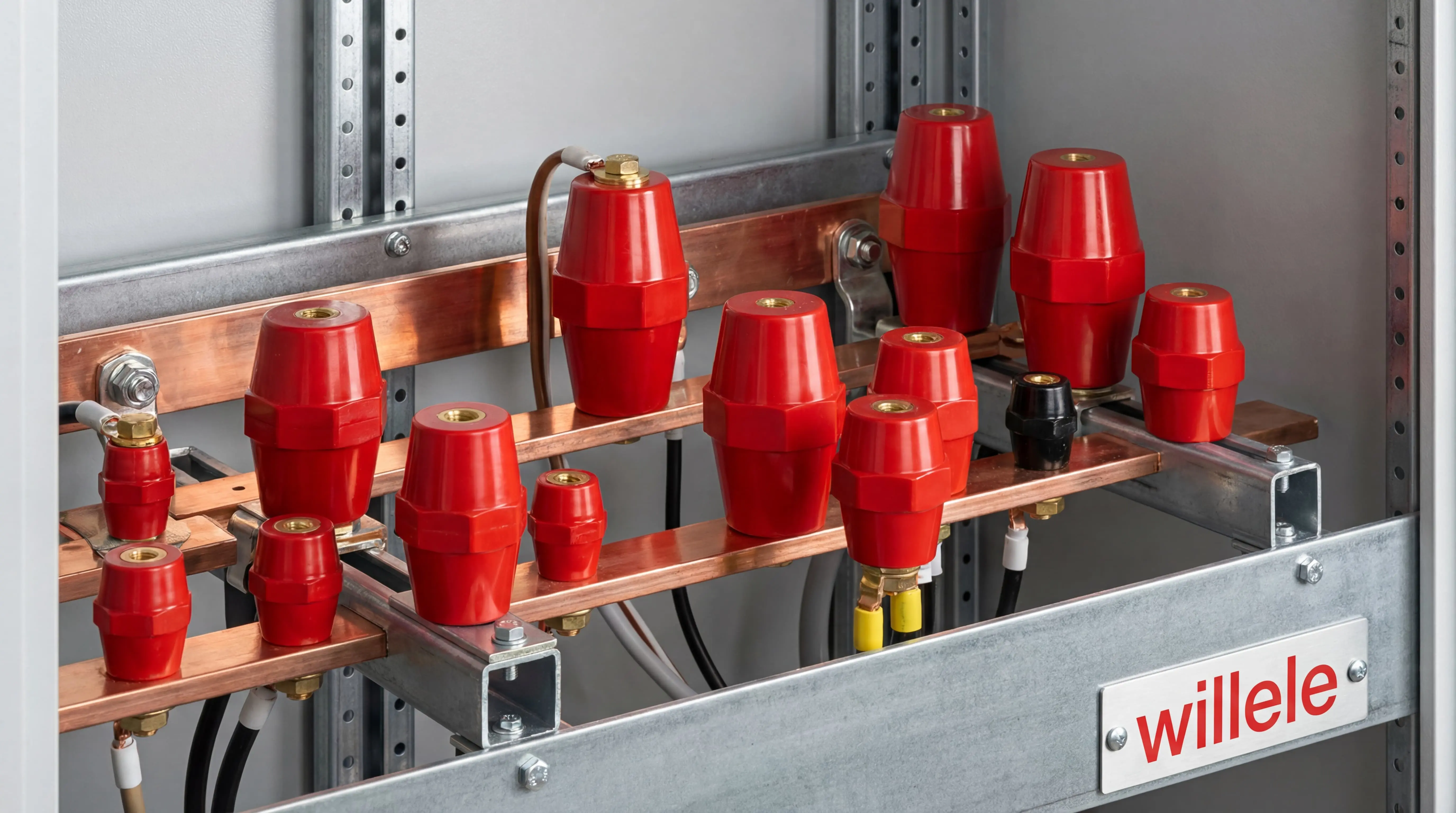
Professional installation of Willele low voltage busbar insulators in modern distribution panel system
Understanding Low Voltage Busbar Insulators
BUSBAR TERMINALWhat Are Low Voltage Busbar Insulators?
Low voltage busbar insulators are specialized electrical components designed to support and isolate conductive busbars within distribution panels and switchgear assemblies. Operating typically in voltage ranges from 50V to 1000V AC or 120V to 1500V DC, these insulators serve multiple functions: mechanical support, electrical isolation, and environmental protection. The insulator body is manufactured from high-grade insulating materials, while metal terminals provide secure connections to busbars and mounting points.
At Willele Electric, our low voltage busbar insulators feature advanced heat shrink tube technology that provides superior insulation properties, enhanced durability, and resistance to environmental factors. The heat shrink construction ensures a tight, moisture-resistant seal that maintains insulation integrity even under challenging conditions.
Core Functions and Importance
The primary functions of low voltage busbar insulators include:
- Electrical Isolation: Creating a dielectric barrier between energized conductors and grounded surfaces
- Mechanical Support: Providing stable mounting for busbar systems while accommodating thermal expansion
- Arc Resistance: Preventing arc tracking and flashover between conductive elements
- Environmental Protection: Shielding connections from moisture, dust, and contaminants
- Vibration Dampening: Reducing mechanical stress from equipment vibration and thermal cycling
Willele’s premium red busbar insulators featuring heat shrink technology and brass terminals
Technical Specifications and Classifications
Material Composition and Properties
Low voltage busbar insulators utilize various insulating materials, each offering specific advantages:
| Material Type | Temperature Range | Dielectric Strength | Key Advantages | Typical Applications |
|---|---|---|---|---|
| Polyamide (PA) | -40°C to +120°C | 25-35 kV/mm | High mechanical strength, chemical resistance | Heavy-duty industrial panels |
| Polyester (DMC) | -30°C to +130°C | 18-25 kV/mm | Excellent tracking resistance, flame retardant | Standard distribution panels |
| Epoxy Resin | -40°C to +155°C | 30-40 kV/mm | Superior insulation, moisture resistance | High-performance applications |
| Heat Shrink (Cross-linked Polyolefin) | -55°C to +135°C | 20-30 kV/mm | Conformable seal, environmental protection | Willele specialty products |
Willele Electric’s proprietary heat shrink tube technology combines cross-linked polyolefin materials with advanced manufacturing processes to deliver insulators that exceed industry standards for reliability and performance.
Voltage and Current Ratings
Understanding the electrical ratings of low voltage busbar insulators is essential for proper application:
| Voltage Rating | Rated Current | Insulation Resistance | Typical Busbar Size | Application Category |
|---|---|---|---|---|
| Up to 400V AC | 63-125A | >1000 MΩ | 10x2mm to 20x3mm | Residential panels |
| 400-690V AC | 125-250A | >1000 MΩ | 20x3mm to 30x5mm | Commercial distribution |
| 690-1000V AC | 250-630A | >1000 MΩ | 30x5mm to 50x10mm | Industrial switchgear |
| DC Systems | Up to 1500V DC | >1000 MΩ | Variable | Solar, battery systems |

Detailed technical diagram showing Willele busbar insulator construction and component specifications
Types of Low Voltage Busbar Insulators
Post-Type Insulators
Post-type busbar insulators are the most common configuration, featuring a cylindrical body with threaded terminals on both ends. These insulators mount perpendicular to the busbar, providing excellent mechanical support and electrical clearance. Willele’s post-type insulators incorporate heat shrink technology that creates a seamless protective envelope around the insulator core.
Key Features:
- Threaded brass or copper alloy terminals
- Metric (M6, M8, M10) or imperial thread options
- Various heights from 15mm to 100mm
- Color-coded for phase identification
Support Block Insulators
Support block insulators provide horizontal mounting options for busbar systems, distributing mechanical loads across a broader surface area. These components are ideal for heavy busbar applications where mechanical strength is paramount.
Typical Applications:
- Main distribution busbars
- Transformer connections
- High-current feeders
- Panel-to-panel transitions
Standoff and Spacer Insulators
Standoff insulators create specified clearance distances between busbars and mounting surfaces or between multiple busbar phases. Willele manufactures precision standoff insulators with tight dimensional tolerances to ensure consistent electrical clearances throughout the panel.
Benefits of Heat Shrink Technology in Busbar Insulators
Superior Environmental Protection
Willele Electric’s heat shrink tube technology provides a conformable, moisture-tight seal that traditional molded insulators cannot match. The heat shrink process creates a protective barrier that prevents moisture ingress, dust accumulation, and chemical contamination—critical factors in maintaining long-term insulation performance.
Comparative Performance:
| Protection Factor | Traditional Molded | Willele Heat Shrink | Performance Improvement |
|---|---|---|---|
| Moisture Resistance | IP20-IP40 | IP54-IP65 | 35-62% better sealing |
| Chemical Resistance | Moderate | Excellent | Enhanced durability |
| UV Resistance | Limited | High | Extended outdoor life |
| Temperature Cycling | Standard | Superior | Reduced thermal stress |
| Vibration Resistance | Good | Excellent | Improved reliability |
Enhanced Electrical Performance
The heat shrink manufacturing process eliminates voids and air gaps that can compromise insulation integrity in conventional insulators. This results in:
- Higher breakdown voltage ratings
- Improved tracking resistance
- Reduced partial discharge activity
- Enhanced arc resistance
- Consistent dielectric properties
Cost-Effectiveness and Reliability
While premium heat shrink busbar insulators may have a higher initial cost, the total cost of ownership is significantly lower due to:
- Extended service life (20+ years in normal conditions)
- Reduced maintenance requirements
- Lower failure rates
- Decreased downtime costs
- Improved safety margins
Applications in Distribution Panel Construction
Main Distribution Panels
Low voltage busbar insulators play a critical role in main distribution panels (MDP), where incoming power is distributed to multiple sub-panels and loads. Willele insulators provide:
- Secure mounting for main busbars (up to 630A)
- Phase-to-phase and phase-to-ground isolation
- Compliance with spacing requirements per IEC 61439 and UL 891
- Accommodation for thermal expansion in high-current applications
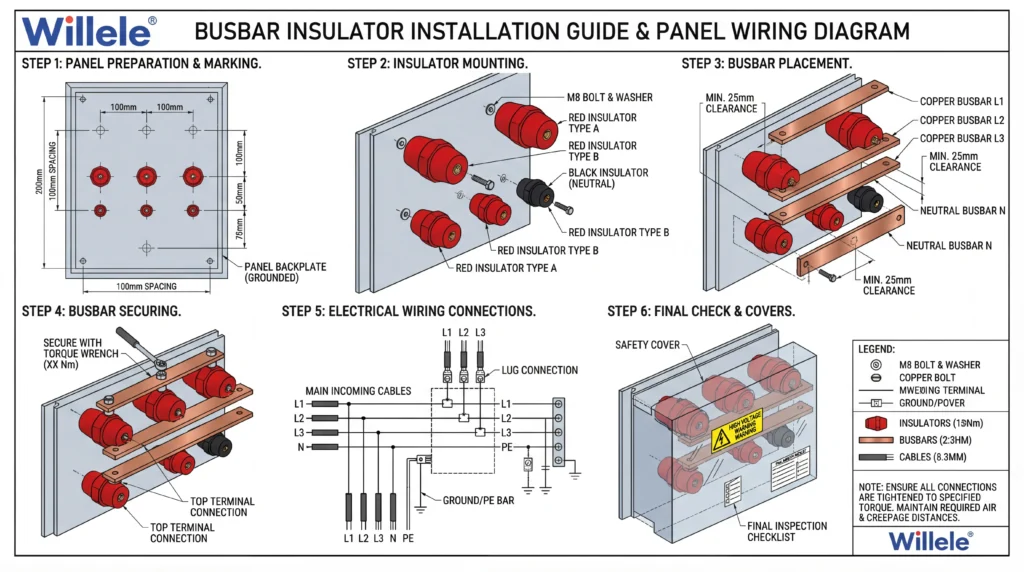
Step-by-step installation schematic for Willele busbar insulators in distribution panel construction
Sub-Distribution Panels
Sub-distribution panels require smaller busbar insulators scaled appropriately for branch circuit protection. Typical applications include:
- Floor distribution boards
- Department or zone panels
- Equipment-specific distribution
- Modular panel systems
Industrial Control Panels
Industrial environments demand robust insulation solutions that withstand harsh conditions:
| Industrial Environment | Specific Challenges | Willele Solution |
|---|---|---|
| Chemical Processing | Corrosive atmospheres | Chemical-resistant heat shrink |
| Food & Beverage | Washdown requirements | IP65-rated sealed insulators |
| Heavy Manufacturing | Vibration and shock | Reinforced mounting systems |
| Outdoor Installations | Temperature extremes, UV | UV-stabilized materials |
| Marine/Offshore | Salt spray, humidity | Marine-grade insulators |
Renewable Energy Systems
Low voltage busbar insulators are essential in solar combiner boxes, battery energy storage systems (BESS), and wind turbine distribution panels. DC-rated insulators from Willele Electric address the unique challenges of renewable energy applications:
- High DC voltage withstand capability
- Resistance to UV degradation
- Wide temperature range operation
- Compliance with UL 1741 and IEC 62109
Installation Guidelines and Best Practices
Pre-Installation Considerations
Before installing low voltage busbar insulators, consider the following factors:
- Electrical Clearances: Verify minimum clearance distances per applicable standards (IEC 61439, UL 891, NEC)
- Mechanical Loading: Calculate mechanical loads from busbar weight, short-circuit forces, and seismic requirements
- Environmental Conditions: Assess temperature range, humidity levels, and potential contaminants
- Accessibility: Ensure adequate space for installation, inspection, and future maintenance
Step-by-Step Installation Process
Step 1: Surface Preparation
- Clean mounting surfaces thoroughly
- Remove any paint, rust, or debris from contact areas
- Ensure mounting plate is level and properly grounded
Step 2: Insulator Positioning
- Position insulators according to engineering drawings
- Maintain specified spacing between phases (minimum 20mm for 400V systems)
- Use alignment tools for precise placement
Step 3: Secure Mounting
- Torque mounting bolts to manufacturer specifications (typically 4-6 Nm for M6, 8-12 Nm for M8)
- Use lock washers or thread-locking compound to prevent loosening
- Verify mechanical stability after tightening
Step 4: Busbar Attachment
- Clean busbar contact surfaces
- Apply anti-oxidation compound to aluminum busbars
- Position busbar on insulator terminals
- Torque connection bolts progressively to specified values
Step 5: Inspection and Testing
- Conduct visual inspection for proper alignment and clearances
- Perform insulation resistance testing (minimum 1000 MΩ)
- Verify mechanical stability under simulated load
- Document installation with photographs and test results
Quality Control Checkpoints
| Checkpoint | Acceptance Criteria | Test Method |
|---|---|---|
| Insulation Resistance | >1000 MΩ at 500V DC | Megohmmeter test |
| Mechanical Security | No movement under 50N lateral force | Pull test |
| Clearance Distance | Per design specification ±1mm | Calibrated measurement |
| Terminal Torque | Within manufacturer range | Torque wrench verification |
| Visual Inspection | No cracks, contamination, or damage | 100% visual examination |
Safety Standards and Compliance
International Standards
Low voltage busbar insulators must comply with various international standards:
- IEC 61439 Series: Low-voltage switchgear and controlgear assemblies
- IEC 60947: Low-voltage switchgear and controlgear standards
- UL 891: Switchboards standard (North America)
- IEC 60664-1: Insulation coordination for equipment within low-voltage systems
- CSA C22.2 No. 29: Switchboards and panelboards (Canada)
Material and Performance Testing
Willele Electric subjects all low voltage busbar insulators to rigorous testing protocols:
| Test Category | Standard Reference | Test Parameters | Acceptance Criteria |
|---|---|---|---|
| Dielectric Withstand | IEC 60664-1 | 2.5x rated voltage, 1 minute | No breakdown or flashover |
| Tracking Resistance | IEC 60112 | CTI >400 | Material class II or better |
| Flame Resistance | UL 94 | V-0 or V-1 rating | Self-extinguishing <10 seconds |
| Thermal Cycling | IEC 60068-2-14 | -40°C to +125°C, 500 cycles | <5% property degradation |
| Humidity Resistance | IEC 60068-2-78 | 95% RH, 40°C, 1000 hours | Maintained insulation >1000 MΩ |
| Short-Circuit Rating | IEC 61439-1 | Peak current test | No mechanical failure |
Safety Certifications
Willele products carry multiple international safety certifications:
- CE marking for European markets
- UL listing for North American applications
- CCC certification for Chinese markets
- TÜV and VDE approvals for enhanced credibility
- RoHS and REACH compliance for environmental responsibility
Material Selection and Design Considerations
Thermal Management
Proper thermal management is crucial for busbar insulator longevity. Heat shrink materials from Willele Electric offer excellent thermal conductivity while maintaining insulation properties:
Thermal Performance Comparison:
| Material Property | Standard Insulators | Willele Heat Shrink | Advantage |
|---|---|---|---|
| Thermal Conductivity | 0.2-0.3 W/m·K | 0.35-0.45 W/m·K | 40-50% better heat dissipation |
| Coefficient of Thermal Expansion | 50-80 ppm/°C | 100-150 ppm/°C | Better stress accommodation |
| Maximum Operating Temperature | 120°C | 135°C | 15°C higher rating |
| Temperature Derating | 2.5%/°C above 70°C | 1.8%/°C above 70°C | Extended high-temp operation |
Chemical Resistance
Different environments require specific chemical resistance properties:
- Industrial Chemicals: Resistant to acids, alkalis, and solvents
- Petroleum Products: Oil and fuel resistance for petrochemical facilities
- Cleaning Agents: Withstand industrial detergents and sanitizers
- Environmental Pollutants: Resistance to ozone, NOx, and SOx
Mechanical Strength Requirements
Busbar insulators must withstand various mechanical stresses:
- Static Loads: Weight of busbars and connected equipment
- Dynamic Loads: Short-circuit electromagnetic forces (up to 60 kA prospective)
- Vibration: Equipment operation and seismic events
- Thermal Expansion: Accommodate busbar length changes (up to 0.2mm/m/10°C)
Maintenance and Lifecycle Management
Routine Inspection Procedures
Regular inspection extends insulator service life and prevents failures:
Recommended Inspection Schedule:
| Inspection Item | Frequency | Action Required |
|---|---|---|
| Visual Examination | Annually | Check for cracks, discoloration, contamination |
| Insulation Resistance | Every 2 years | Test at 500V DC, minimum 1000 MΩ |
| Mechanical Integrity | Annually | Verify mounting torque, check for looseness |
| Clearance Verification | Every 5 years | Measure and document all critical distances |
| Thermal Imaging | Annually (high-current) | Identify hot spots indicating problems |
Troubleshooting Common Issues
| Problem | Possible Causes | Solutions |
|---|---|---|
| Reduced Insulation Resistance | Moisture ingress, surface contamination | Clean and dry, replace if <500 MΩ |
| Mechanical Loosening | Thermal cycling, vibration | Re-torque connections, consider lock washers |
| Discoloration | Overheating, UV exposure | Check load current, replace if charred |
| Cracks or Damage | Mechanical stress, over-torquing | Replace immediately, review installation |
| Tracking or Arcing | Insufficient clearance, contamination | Increase spacing, clean surfaces, replace |
Replacement Criteria
Replace low voltage busbar insulators when:
- Insulation resistance falls below 500 MΩ
- Visible cracks or physical damage appears
- Evidence of tracking or carbon deposits exists
- Discoloration indicates thermal degradation
- Mechanical loosening cannot be corrected
- After fault conditions or short circuits
Willele Electric: Your Trusted Partner in Electrical Insulation
As a specialized B2B manufacturer of heat shrink tubes and electrical equipment, Willele Electric brings decades of expertise to low voltage busbar insulator design and production. Our commitment to quality, innovation, and customer support makes us the preferred supplier for distribution panel manufacturers, electrical contractors, and industrial facilities worldwide.
Why Choose Willele Products?
- Advanced Heat Shrink Technology: Proprietary manufacturing processes deliver superior performance
- Comprehensive Product Range: Insulators for all voltage classes and applications
- Rigorous Quality Control: 100% testing ensures consistent reliability
- Technical Support: Expert engineering assistance for product selection and application
- Global Availability: Distribution network serving markets worldwide
- Customization Capabilities: Tailored solutions for unique requirements
- Competitive Pricing: Excellent value without compromising quality
Frequently Asked Questions (FAQ)
Q1: What is the difference between low voltage and medium voltage busbar insulators?
A: Low voltage busbar insulators are designed for systems up to 1000V AC or 1500V DC, while medium voltage insulators handle 1kV to 36kV. Low voltage insulators typically feature smaller dimensions, different material compositions optimized for lower voltage stress, and often use heat shrink or molded construction. Medium voltage insulators require significantly higher creepage distances, specialized insulating materials like porcelain or epoxy resin, and must meet more stringent testing requirements. For most distribution panel applications up to 690V AC, low voltage busbar insulators from Willele Electric provide adequate performance and cost-effectiveness.
Q2: How do I calculate the required spacing between busbar insulators?
A: Insulator spacing depends on several factors: busbar size and weight, current rating, short-circuit rating, and mechanical strength requirements. As a general guideline, support spacing for low voltage busbars should not exceed: for copper busbars 10x10mm or smaller carrying up to 200A, space insulators every 300-400mm; for 20x5mm busbars at 400A, reduce spacing to 200-300mm; for currents above 600A or short-circuit ratings exceeding 50kA, consult engineering calculations or manufacturer recommendations. Willele technical support can provide detailed spacing calculations based on your specific application parameters including thermal expansion, electromagnetic forces during fault conditions, and seismic requirements.
Q3: Can heat shrink busbar insulators be used in outdoor applications?
A: Yes, Willele’s heat shrink busbar insulators are well-suited for outdoor applications when properly specified. Our UV-stabilized formulations resist degradation from sunlight exposure, while the moisture-tight seal provided by heat shrink technology prevents water ingress that could compromise insulation. For outdoor installations, select insulators rated IP54 or higher, ensure proper enclosure design with drainage provisions, and consider additional protective coatings for extreme environments. Applications include solar combiner boxes, outdoor distribution kiosks, and weather-protected switchgear. Heat shrink insulators typically outperform traditional molded insulators in outdoor environments due to superior environmental sealing and UV resistance.
Q4: What torque specifications should be used when installing busbar insulators?
A: Proper torque is critical for both mechanical security and electrical performance. For Willele busbar insulators, recommended torque values are: M6 terminals: 4-6 Nm (35-53 lb-in), M8 terminals: 8-12 Nm (71-106 lb-in), M10 terminals: 15-20 Nm (133-177 lb-in), and M12 terminals: 25-30 Nm (221-265 lb-in). Always use a calibrated torque wrench and apply torque progressively in multiple stages to avoid damaging the insulator body. Over-torquing can crack the insulator or deform threads, while under-torquing results in poor electrical contact, increased resistance, and potential overheating. Apply anti-oxidation compound to aluminum busbar connections before torquing. After initial installation, re-torque connections after 24-48 hours of operation to compensate for initial settling.
Q5: How long do low voltage busbar insulators typically last?
A: Service life depends on operating conditions, but properly installed Willele heat shrink busbar insulators typically provide 20-30 years of reliable service in normal environments. Factors affecting lifespan include: operating temperature (every 10°C above rated temperature reduces life by approximately 50%), environmental conditions (moisture, chemicals, UV exposure), electrical stress (operating near maximum voltage accelerates aging), and mechanical stress (vibration and thermal cycling). In controlled indoor environments at moderate temperatures, insulators may exceed 30 years. Harsh industrial environments may reduce this to 15-20 years. Regular inspection and testing per the maintenance schedule outlined above helps identify degradation before failure occurs, allowing proactive replacement.
Q6: Are Willele busbar insulators compatible with both copper and aluminum busbars?
A: Yes, Willele low voltage busbar insulators accommodate both copper and aluminum busbars. Our brass or tinned copper terminals provide excellent electrical contact with both conductor materials. However, when connecting aluminum busbars, additional precautions are necessary: thoroughly clean aluminum surfaces to remove oxide layer before assembly, apply oxide-inhibiting compound rated for aluminum connections, use belleville washers or similar devices to maintain pressure despite aluminum’s tendency to creep under sustained compression, and re-torque aluminum connections 24-48 hours after initial installation and periodically thereafter. For critical applications or high-current aluminum busbars, consider using aluminum-to-copper transition plates with plated surfaces optimized for aluminum contact.
Q7: What testing should be performed after installing busbar insulators?
A: After installation, conduct the following tests: (1) Visual inspection—verify proper alignment, clearances, and absence of damage; (2) Insulation resistance test—use a 500V DC megohmmeter, minimum acceptable reading 1000 MΩ between all phases and ground; (3) Mechanical security test—apply moderate lateral force (approximately 50N) to verify no movement or looseness; (4) Torque verification—confirm all connections meet specified torque values; (5) Clearance measurement—verify all phase-to-phase and phase-to-ground clearances meet design specifications; (6) Infrared thermography—after energization under normal load, scan for hot spots indicating poor connections or inadequate current capacity. Document all test results for maintenance records and future reference.
Q8: Can damaged busbar insulators be repaired, or must they be replaced?
A: Damaged busbar insulators should always be replaced rather than repaired. Attempts to repair cracked, charred, or mechanically damaged insulators compromise safety and reliability. Even minor cracks can propagate under thermal cycling and mechanical stress, leading to catastrophic failure. Similarly, tracking damage or carbonization indicates insulation degradation that cannot be reversed. The relatively low cost of replacement insulators compared to the consequences of insulation failure makes replacement the only acceptable option. Willele Electric maintains extensive inventory for rapid replacement part availability. After any electrical fault or mechanical damage incident, inspect all insulators in the affected panel and replace any showing signs of distress, even if not directly involved in the event.
Conclusion
Low voltage busbar insulators are essential components in modern distribution panel construction, providing critical electrical isolation, mechanical support, and environmental protection. As electrical systems become more sophisticated and safety standards more stringent, the quality and reliability of these components directly impact overall system performance and safety.
Willele Electric’s advanced heat shrink tube technology delivers superior performance compared to traditional molded insulators, offering enhanced environmental sealing, improved electrical characteristics, and extended service life. Our comprehensive product range addresses applications from residential distribution panels to heavy industrial switchgear, supported by rigorous quality control and expert technical assistance.
By following proper selection criteria, installation procedures, and maintenance practices outlined in this article, electrical contractors and panel builders can ensure reliable, safe operation of low voltage distribution systems. The investment in premium busbar insulators pays dividends through reduced maintenance costs, extended equipment life, and improved safety margins.
For technical specifications, product selection assistance, or custom solutions for your distribution panel construction projects, contact Willele Electric’s engineering team. Our expertise in heat shrink technology and electrical insulation ensures you receive optimal solutions for your specific application requirements.
