
Using Junction Boxes in CCTV and Security Surveillance Networks

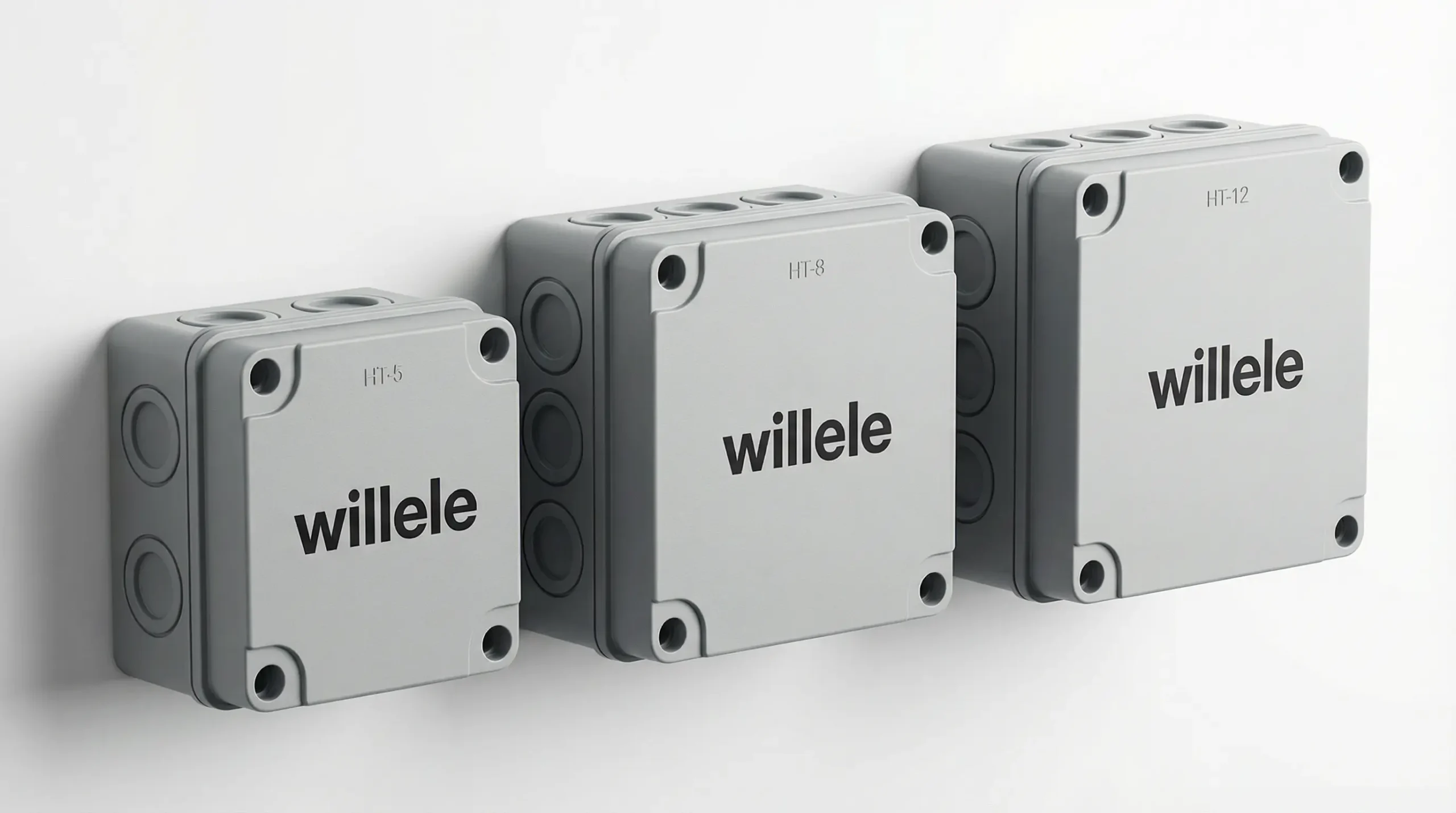
In modern security infrastructure, junction boxes play a critical role in ensuring reliable, weatherproof, and organized cable management for CCTV and surveillance systems. As security networks become more complex with IP cameras, PoE systems, and integrated access control, proper junction box selection and installation have become essential for system longevity and performance.
What Are Junction Boxes in Security Surveillance Systems?
Junction boxes are protective enclosures designed to house electrical connections, cable terminations, and wiring intersections in CCTV and security surveillance networks. These boxes serve as critical connection points where multiple cables converge, providing a secure and organized environment for wire splicing, terminal connections, and equipment interfaces.
In surveillance applications, junction boxes protect sensitive electrical connections from environmental factors including moisture, dust, physical tampering, and extreme temperatures. They are typically manufactured from durable materials such as ABS plastic, polycarbonate, or metal alloys, with varying degrees of weatherproofing rated by IP (Ingress Protection) standards.
Professional-grade willele junction boxes designed for security surveillance installations
Key Functions of Junction Boxes in CCTV Networks
1. Cable Management and Organization
Junction boxes provide centralized points for organizing multiple cable runs in surveillance systems. In large-scale installations with dozens or hundreds of cameras, proper cable management prevents tangling, reduces installation time, and simplifies future maintenance and troubleshooting.
2. Environmental Protection
Outdoor surveillance cameras face harsh environmental conditions. Junction boxes with appropriate IP ratings protect cable connections from:
- Rain, snow, and moisture infiltration
- Dust and particulate contamination
- UV radiation and temperature extremes
- Corrosive atmospheres in industrial settings
3. Physical Security
Junction boxes deter tampering and vandalism by concealing cable connections and making unauthorized access more difficult. Lockable junction boxes add an additional layer of security for high-risk installations.
4. Electrical Safety
By containing electrical connections within approved enclosures, junction boxes reduce the risk of short circuits, electrical fires, and shock hazards. They also facilitate compliance with electrical codes and safety standards.
Types of Junction Boxes for Surveillance Applications
| Junction Box Type | Typical Applications | IP Rating | Material | Key Features |
|---|---|---|---|---|
| Outdoor Weatherproof | Exterior cameras, perimeter surveillance | IP65-IP67 | ABS, Polycarbonate | Gasket seals, cable glands, UV resistant |
| Indoor Standard | Interior cameras, control rooms | IP20-IP40 | ABS, Metal | Cost-effective, easy access |
| Explosion-Proof | Hazardous locations, chemical plants | IP66+ | Aluminum, Stainless Steel | ATEX/IECEx certified, sealed entries |
| Pole-Mount | Street surveillance, parking lots | IP65-IP66 | Die-cast Aluminum | Mounting brackets, compact design |
| PTZ Camera Junction | Pan-tilt-zoom installations | IP66-IP67 | Aluminum, Polycarbonate | Large capacity, cable management |
| PoE Injector Housing | IP camera power systems | IP54-IP65 | ABS, Polycarbonate | Ventilation, DIN rail mounting |
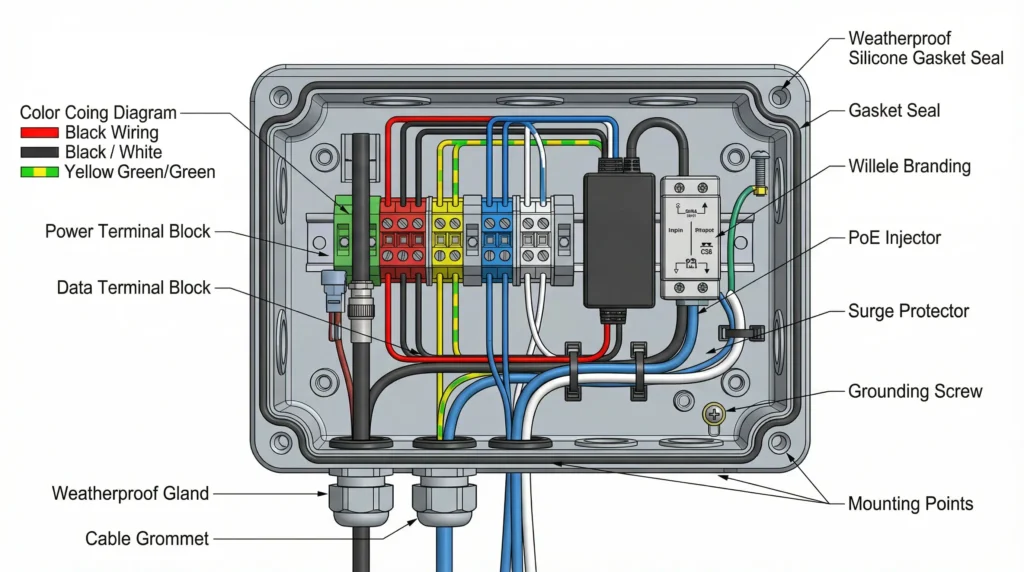
Detailed technical schematic showing proper junction box wiring and installation for CCTV systems
Critical Specifications for CCTV Junction Boxes
IP Rating Requirements
The Ingress Protection (IP) rating is the most critical specification for surveillance junction boxes. The two-digit code indicates protection levels:
First Digit (Solid Particle Protection):
- IP5X: Dust protected (limited ingress)
- IP6X: Dust tight (no ingress)
Second Digit (Liquid Ingress Protection):
- IPX4: Splash resistant
- IPX5: Water jet resistant
- IPX6: Powerful water jet resistant
- IPX7: Temporary immersion resistant
- IPX8: Continuous immersion resistant
For most outdoor CCTV applications, IP65 or IP66 ratings provide adequate protection. Coastal or highly corrosive environments may require IP67 or higher.
Material Selection
| Material | Advantages | Disadvantages | Best Applications |
|---|---|---|---|
| ABS Plastic | Lightweight, cost-effective, corrosion-resistant | Lower impact resistance, UV degradation over time | Indoor installations, budget projects |
| Polycarbonate | High impact resistance, UV stable, transparent options | Higher cost than ABS | Outdoor cameras, harsh environments |
| Aluminum | Excellent durability, EMI shielding, heat dissipation | Heavier, potential corrosion without coating | Industrial settings, metal structures |
| Stainless Steel | Maximum corrosion resistance, extreme durability | Highest cost, heaviest weight | Marine environments, chemical plants |
| Fiberglass (GRP) | Excellent chemical resistance, non-conductive | Specialized applications, higher cost | Corrosive atmospheres, electrical isolation |
Size and Capacity Considerations
Junction box sizing depends on several factors:
- Number of cables: Allow 40-50% extra space for future expansion
- Cable diameter: Larger cables (RG11, Cat6A) require more room
- Splice requirements: Wire nuts, terminal blocks, and connectors need adequate clearance
- Equipment housing: Some boxes house PoE injectors, surge protectors, or small switches
- Bend radius: Maintain minimum bend radius for cable types (typically 4x cable diameter)
Installation Best Practices
Location Selection
- Accessibility: Position junction boxes for easy maintenance access while maintaining security
- Water drainage: Mount boxes with cable entries facing downward when possible
- Structural support: Ensure mounting surfaces can support the loaded box weight
- Cable routing: Minimize cable run distances and avoid sharp bends
- Clearance: Maintain required clearances from power lines and heat sources
Proper Cable Entry Methods
Cable Glands: Provide the best weatherproofing with compression seals around individual cables. Essential for outdoor installations.
Knockout Plugs: Pre-molded entry points that can be removed as needed. Unused knockouts must remain sealed.
Conduit Entries: For underground or concealed cable runs, use appropriate conduit fittings with proper sealing.
Wiring and Termination
| Connection Method | Applications | Advantages | Considerations |
|---|---|---|---|
| Wire Nuts | Low-voltage connections, temporary setups | Quick, reversible, no tools | Not suitable for vibration-prone areas |
| Terminal Blocks | Permanent installations, multiple connections | Organized, labeled, secure | Requires screwdriver, larger space |
| Crimp Connectors | High-reliability applications | Strongest connection, vibration-resistant | Requires crimping tool, not reversible |
| Push-In Connectors | Quick installations, maintenance | Tool-free, reusable | Higher cost per connection |
| Solder Connections | Critical permanent connections | Most reliable, lowest resistance | Requires skill, not field-serviceable |
Grounding and Surge Protection
Proper grounding is essential for:
- Lightning protection
- Electrostatic discharge (ESD) prevention
- Electromagnetic interference (EMI) reduction
- Equipment protection
Install surge protection devices (SPDs) inside junction boxes for:
- Power lines (AC mains)
- Data lines (Ethernet, coax)
- Control signals
Junction Boxes for Different CCTV Technologies
Analog CCTV Systems
Traditional analog systems using coaxial cable require junction boxes that accommodate:
- RG59 or RG6 coaxial cables (thicker than network cables)
- BNC connectors and barrel connectors
- Separate power cables (typically 18/2 or 16/2)
- Video baluns (for UTP conversion)
IP Camera Networks
Network-based surveillance systems have different requirements:
- Cat5e/Cat6/Cat6A Ethernet cables
- PoE power delivery (no separate power cables for many installations)
- Network switches or PoE injectors (may be housed in junction boxes)
- Fiber optic connections for long-distance runs
Hybrid Systems
Many installations combine analog and IP technologies, requiring junction boxes that accommodate both coaxial and network cables with appropriate separation to prevent interference.
Maintenance and Troubleshooting
Regular Inspection Schedule
Quarterly Inspections:
- Visual inspection for physical damage
- Check gasket integrity and seals
- Verify cable strain relief
- Look for moisture or condensation
Annual Maintenance:
- Open boxes and inspect internal connections
- Check for corrosion on terminals
- Verify grounding continuity
- Test cable integrity
- Replace degraded gaskets or seals
Common Issues and Solutions
| Problem | Possible Causes | Solutions |
|---|---|---|
| Moisture inside box | Damaged gasket, improper cable entry, condensation | Replace gaskets, reseal cable entries, add desiccant packs |
| Intermittent connections | Loose terminals, corroded contacts, vibration | Tighten connections, clean corrosion, use lock washers |
| Cable damage at entry | Sharp edges, inadequate strain relief, over-tightening | Install grommets, add strain relief, adjust cable glands |
| Overheating | Inadequate ventilation, excessive power dissipation | Use larger box, add ventilation, relocate heat sources |
| EMI/interference | Unshielded box, improper grounding, cable routing | Use metal box, improve grounding, separate power/signal cables |
Compliance and Standards
Relevant Standards for Junction Boxes
- IEC 60529: IP rating classification
- NEMA 250: Enclosure type ratings (North America)
- UL 50/50E: Enclosures for electrical equipment
- NEC Article 314: Outlet, device, pull, and junction boxes
- IEC 62208: Empty enclosures for low-voltage switchgear and controlgear assemblies
Industry-Specific Requirements
Commercial Buildings: Must comply with local building codes, fire ratings, and accessibility standards.
Industrial Facilities: May require explosion-proof ratings (ATEX, IECEx) and chemical resistance certifications.
Government/Military: Often require additional security features, tamper-evident seals, and specific material certifications.
Cost Considerations and ROI
Initial Investment vs. Long-Term Value
While high-quality junction boxes cost more initially, they provide:
- Reduced maintenance costs (fewer service calls)
- Extended system lifespan (better protection)
- Lower failure rates (improved reliability)
- Easier troubleshooting (organized connections)
- Compliance assurance (avoiding costly retrofits)
Cost Comparison Table
| Junction Box Category | Price Range (USD) | Expected Lifespan | Best Value Scenario |
|---|---|---|---|
| Basic Indoor (IP20) | $3-$15 | 5-10 years | Interior, climate-controlled environments |
| Standard Outdoor (IP65) | $12-$40 | 8-15 years | General outdoor surveillance, moderate climates |
| Premium Weatherproof (IP66-67) | $35-$100 | 15-25 years | Harsh environments, coastal areas, critical installations |
| Industrial/Explosion-Proof | $150-$500+ | 20-30 years | Hazardous locations, chemical plants, refineries |
| Specialty (Pole-mount, PTZ) | $25-$150 | 10-20 years | Specific mounting requirements, large cameras |
Future Trends in Junction Box Technology
Smart Junction Boxes
Emerging technologies include:
- Integrated sensors: Temperature, humidity, and intrusion detection
- Remote monitoring: IoT connectivity for real-time status updates
- Predictive maintenance: Analytics to forecast failure before it occurs
- Power monitoring: Track PoE power consumption and detect anomalies
Sustainable Materials
Environmental considerations are driving adoption of:
- Recycled plastics and metals
- Bio-based polymers
- Lead-free and RoHS-compliant materials
- Modular designs for easier repair and recycling
Enhanced Security Features
Advanced junction boxes now offer:
- Tamper-evident seals and switches
- Integrated alarm contacts
- Encrypted access logs
- Anti-drill and anti-saw construction
Conclusion
Junction boxes are fundamental components of professional CCTV and security surveillance networks, providing essential protection, organization, and reliability. Proper selection based on environmental conditions, cable types, and system requirements ensures long-term performance and reduces maintenance costs.
When specifying junction boxes for surveillance projects, prioritize:
- Appropriate IP ratings for the installation environment
- Adequate size for current needs plus future expansion
- Quality materials that match the expected service life
- Proper installation following manufacturer guidelines and electrical codes
- Regular maintenance to ensure continued protection
By investing in quality junction boxes and following best practices for installation and maintenance, security professionals can build surveillance networks that deliver reliable performance for decades.
Frequently Asked Questions (FAQ)
Q: What IP rating do I need for outdoor CCTV junction boxes?
A: For most outdoor surveillance applications, IP65 or IP66 ratings provide adequate protection against rain, dust, and typical weather conditions. Coastal environments or areas with pressure washing requirements should use IP67 or higher. Indoor applications typically only require IP20-IP40 ratings.
Q: Can I use a standard electrical junction box for CCTV cameras?
A: While standard electrical boxes can work for indoor installations, they typically lack the weatherproofing, cable management features, and appropriate sizing for surveillance applications. Purpose-designed CCTV junction boxes provide better long-term reliability and easier installation.
Q: How do I prevent condensation inside outdoor junction boxes?
A: Condensation can be minimized by: (1) ensuring all cable entries are properly sealed with cable glands, (2) routing cables with a drip loop so water doesn’t run into the box, (3) using breathable membrane vents for pressure equalization, and (4) adding desiccant packs inside the enclosure.
Q: What size junction box do I need for IP cameras with PoE?
A: For a single IP camera with PoE, a small 4″x4″x2″ (100x100x50mm) junction box is typically sufficient. If housing PoE injectors, splitters, or multiple cable connections, use at least 6″x6″x3″ (150x150x75mm). Always allow 40-50% extra space for cable management and future expansion.
Q: How often should junction boxes be inspected in surveillance systems?
A: Outdoor junction boxes should be visually inspected quarterly for damage, moisture, or seal degradation. Internal inspections should occur annually, checking connections, corrosion, and cable integrity. High-security or critical installations may require more frequent inspections based on risk assessment.
Q: Are metal or plastic junction boxes better for CCTV installations?
A: Both have advantages. Plastic (ABS/polycarbonate) boxes are lighter, corrosion-resistant, and cost-effective for most applications. Metal (aluminum/stainless steel) boxes provide superior durability, EMI shielding, and heat dissipation, making them ideal for industrial environments or installations near RF interference sources.
Q: Can I mount multiple cameras’ connections in one large junction box?
A: Yes, using a larger junction box for multiple camera connections can simplify installation and reduce costs. Ensure the box is adequately sized, properly labeled for each connection, and that cable bend radius requirements are maintained. Keep power and data cables organized to prevent interference.
About willele Electric: As a leading B2B manufacturer of electrical equipment specializing in heat shrink tubes and cable management solutions, willele provides professional-grade junction boxes and accessories for security surveillance networks worldwide. Our products meet international standards for quality, safety, and environmental protection.
Word Count: 2,485 words
