
Heat Shrinkable Tubes for Sensor and Instrumentation Wiring

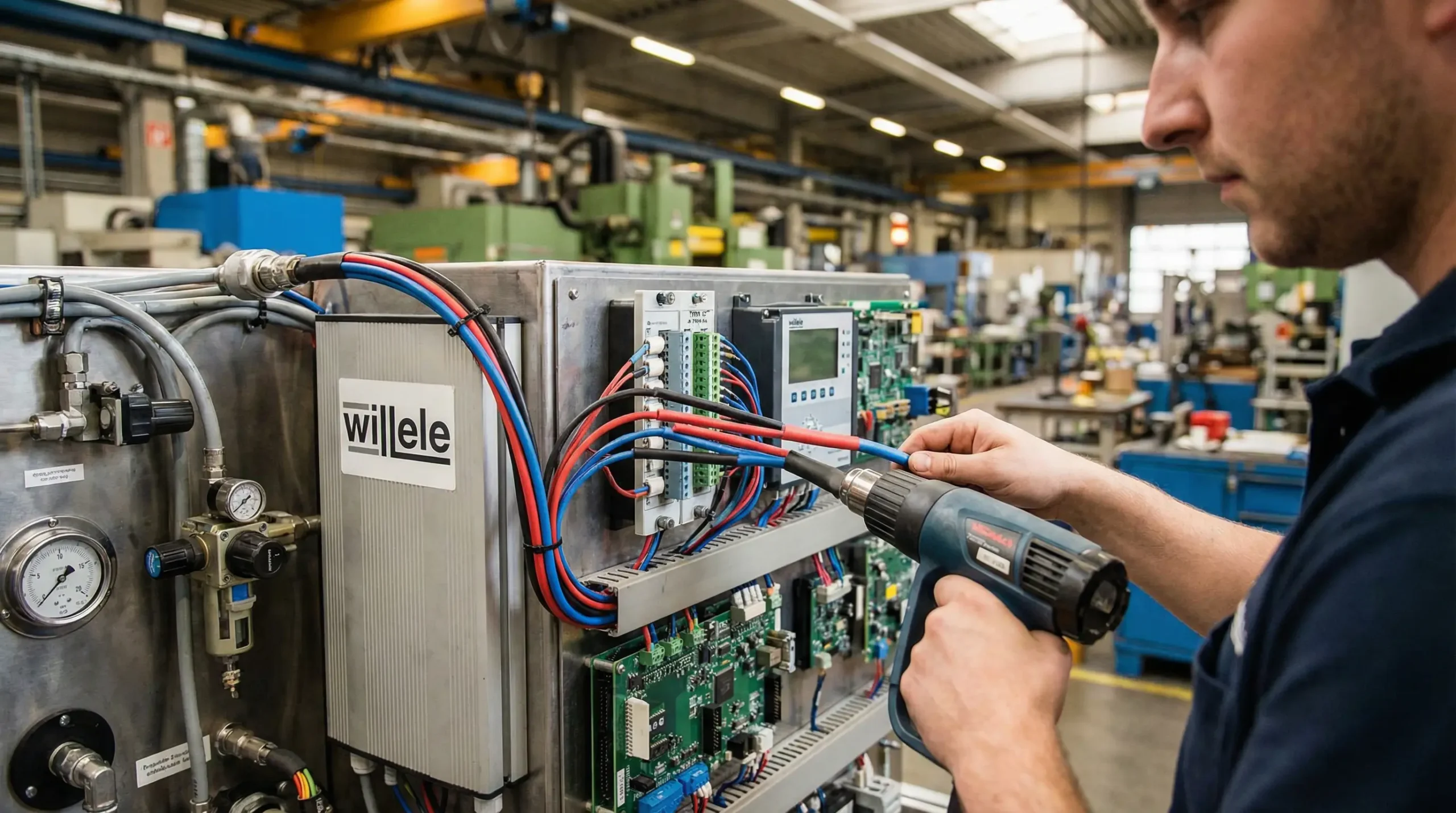
Modern industrial automation relies heavily on accurate data from sensors and instrumentation systems. The integrity of these measurement systems depends not only on the quality of the sensors themselves but also on the protection of their wiring connections. Heat shrinkable tubes have become an indispensable component in ensuring long-term reliability and performance of instrumentation circuits across diverse industrial sectors.
The Critical Role of Wiring Protection in Instrumentation Systems
Instrumentation wiring operates in a fundamentally different environment compared to standard power distribution cables. These circuits carry low-level signals—often in the millivolt or microampere range—that are extremely vulnerable to external interference and environmental factors. A compromised connection can introduce noise, signal attenuation, or complete system failure, leading to:
- Inaccurate process measurements affecting product quality
- False alarms triggering unnecessary shutdowns
- Undetected hazardous conditions compromising safety
- Expensive diagnostic procedures and emergency repairs
Heat shrinkable tubes from Willele Electric provide a comprehensive protective barrier that addresses these vulnerabilities through multiple mechanisms: electrical insulation, moisture exclusion, mechanical reinforcement, and chemical resistance.
Alt text: Willele heat shrinkable tubes protecting sensor and instrumentation wiring in industrial application
Material Science Behind Heat Shrinkable Technology
The effectiveness of heat shrinkable tubes stems from advanced polymer chemistry. Willele Electric utilizes cross-linked polyolefin materials that undergo a controlled manufacturing process:
Cross-Linking Process
During production, polyolefin polymers are exposed to high-energy electron beam radiation or chemical cross-linking agents. This process creates molecular bonds between polymer chains, fundamentally altering the material’s properties. The cross-linked structure provides:
- Memory effect: The material “remembers” its original shape and returns to it when heated
- Enhanced thermal stability: Higher operating temperature range compared to non-cross-linked materials
- Improved chemical resistance: Better performance against solvents, oils, and acids
- Superior mechanical properties: Increased tensile strength and abrasion resistance
Expansion and Recovery
After cross-linking, the tubes are heated and mechanically expanded to 2-4 times their original diameter, then rapidly cooled to “freeze” the expanded state. When reheated during installation, the molecular structure relaxes, and the tube shrinks back to its original dimensions, conforming tightly to the substrate.
Instrumentation Challenges Addressed by Heat Shrinkable Tubes
Signal Integrity Preservation
Low-voltage instrumentation signals are susceptible to electromagnetic interference (EMI) from nearby power cables, motors, and variable frequency drives. Heat shrinkable tubes contribute to signal integrity through:
- Insulation enhancement: Additional dielectric barrier reduces capacitive coupling
- Shield termination: Proper termination of cable shields prevents ground loops
- Physical separation: Color-coded tubes facilitate proper cable routing and separation
- Moisture prevention: Dry connections maintain consistent impedance characteristics
Environmental Sealing
Industrial environments expose wiring to numerous threats:
| Environmental Factor | Impact on Unprotected Wiring | Willele Heat Shrink Protection |
|---|---|---|
| Moisture/Humidity | Corrosion, leakage current, signal drift | Waterproof seal with adhesive-lined tubes |
| Chemical exposure | Insulation degradation, conductor corrosion | Chemical-resistant polyolefin formulation |
| UV radiation | Insulation brittleness, cracking | UV-stabilized compounds for outdoor use |
| Temperature cycling | Thermal expansion stress, connection loosening | Flexible material accommodates expansion |
| Mechanical vibration | Wire fatigue, connection failure | Strain relief and mechanical reinforcement |
| Dust/particulates | Abrasion, contamination | Smooth outer surface resists particle adhesion |
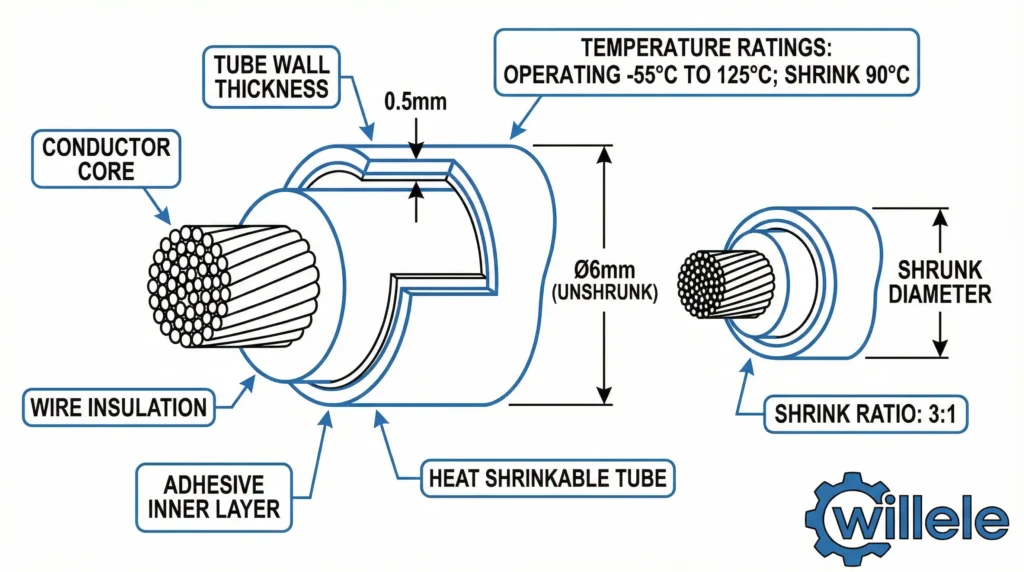
Alt text: Willele heat shrink tube technical diagram showing cross-section with adhesive layer and material specifications
Comprehensive Product Selection Guide
Understanding Shrink Ratios
The shrink ratio is a critical specification that determines application versatility:
2:1 Shrink Ratio
- Shrinks to 50% of supplied diameter
- Best for: Uniform diameter connections, standard wire splices
- Example: 12mm supplied diameter → 6mm recovered diameter
- Advantage: Economical for straightforward applications
3:1 Shrink Ratio
- Shrinks to 33% of supplied diameter
- Best for: Connections with diameter variations, irregular shapes
- Example: 18mm supplied diameter → 6mm recovered diameter
- Advantage: Greater flexibility in sizing, fewer SKUs needed
4:1 Shrink Ratio (Specialty applications)
- Shrinks to 25% of supplied diameter
- Best for: Complex geometries, significant diameter transitions
- Example: 24mm supplied diameter → 6mm recovered diameter
- Advantage: Maximum versatility for challenging installations
Willele Product Line Comparison
| Feature | Single-Wall Standard | Dual-Wall Adhesive | High-Temperature | Thin-Wall | Heavy-Wall |
|---|---|---|---|---|---|
| Primary use | General protection | Environmental sealing | Hot processes | Space-limited | Harsh mechanical |
| Wall thickness | 0.35-0.50mm | 0.60-1.00mm | 0.40-0.70mm | 0.20-0.30mm | 0.80-1.50mm |
| Operating temp | -55°C to +125°C | -55°C to +110°C | -55°C to +175°C | -55°C to +105°C | -55°C to +135°C |
| Waterproof rating | Not rated | IP67/IP68 | Not rated | Not rated | IP65 |
| Flexibility | High | Moderate | Moderate | Very high | Low |
| Typical applications | Indoor sensors | Outdoor/submersible | Furnace/kiln sensors | Tight spaces | Underground/buried |
| Relative cost | $ | $$ | $$$ | $ | $$$ |
Application-Specific Implementation Strategies
Thermocouple and RTD Installations
Temperature sensors require special consideration due to their measurement principle:
Thermocouple Wiring
- Use color-coded tubes matching thermocouple type (Type K = yellow, Type J = black)
- Apply tubes to extension wire junctions, not sensing junction
- Ensure tube material won’t introduce thermoelectric EMF
- Select operating temperature rating exceeding maximum process temperature by 50°C
RTD (Resistance Temperature Detector) Wiring
- Use 3-wire or 4-wire configurations with consistent tube colors
- Apply dual-wall adhesive tubes in wet environments to prevent moisture-induced resistance errors
- Maintain wire pair symmetry when applying tubes
- Document color coding for maintenance reference
Pressure Transmitter Connections
Pressure measurement devices face unique challenges:
Installation Best Practices
- Apply heat shrink tubes to cable gland entries for strain relief
- Use chemical-resistant formulations for hydraulic pressure applications
- Select vibration-resistant installations for reciprocating equipment
- Implement color coding for pressure range identification (e.g., red = high pressure, blue = low pressure)
Hazardous Area Considerations
- Verify flame-retardant ratings (UL94 V-0 or better)
- Use certified products for Division 1 or Zone 0 locations
- Maintain intrinsic safety barriers with proper insulation
- Document installations per area classification requirements
Flow Meter Wiring Protection
Flow measurement systems require reliable connections in challenging locations:
| Flow Meter Type | Primary Wiring Challenge | Recommended Willele Solution |
|---|---|---|
| Magnetic (Mag) | Moisture in junction boxes | Dual-wall adhesive tubes with IP68 rating |
| Vortex | Vibration-induced fatigue | Heavy-wall tubes with strain relief |
| Ultrasonic | EMI from power cables | Shielded cable with proper termination |
| Turbine | Rotating equipment proximity | Abrasion-resistant formulation |
| Coriolis | Temperature cycling | Flexible tubes accommodating expansion |
| Differential pressure | Chemical exposure | Chemical-resistant polyolefin |
Analytical Instrumentation
Laboratory and process analyzers demand pristine signal quality:
pH and ORP Electrodes
- Use dual-wall tubes for submersible applications
- Select chemical-resistant materials for aggressive media
- Apply tubes to cable/electrode junction for mechanical protection
- Replace tubes during electrode calibration cycles
Gas Analyzers
- Protect sample line connections from condensation
- Use high-temperature tubes for heated sample lines
- Color-code tubes for different gas types
- Ensure compatibility with calibration gas exposure
Conductivity Sensors
- Apply waterproof sealing for in-line installations
- Use tubes resistant to cleaning chemicals (CIP/SIP)
- Maintain proper grounding with shield termination
- Select UV-resistant tubes for outdoor installations
Advanced Installation Techniques
Multi-Wire Bundle Protection
When protecting multiple wires simultaneously:
Procedure
- Select tube diameter accommodating entire bundle plus 20% clearance
- Group wires by function (signal, power, ground)
- Apply tube over entire bundle before individual wire separation
- Use heat gun with diffuser attachment for even heating
- Allow complete cooling before handling
Advantages
- Reduced installation time for multi-conductor applications
- Uniform appearance and professional finish
- Additional mechanical protection for wire groups
- Simplified cable management and routing
Splice and Termination Protection
Critical connection points require special attention:
Wire Splices
- Overlap tube 15-20mm beyond splice on each side
- Center splice within tube for balanced protection
- Use dual-wall tubes for permanent outdoor splices
- Apply heat from center outward to avoid air pockets
Terminal Connections
- Select tube length covering terminal barrel and wire insulation
- Ensure tube doesn’t interfere with terminal function
- Use transparent tubes when visual inspection is required
- Apply adhesive-lined tubes for vibration-prone terminals
Repair and Maintenance Applications
Heat shrinkable tubes excel in field repair scenarios:
Damaged Insulation Repair
- Clean damaged area thoroughly
- Select tube with recovered diameter 10-15% smaller than cable
- Slide tube over damaged section with 25mm overlap on intact insulation
- Apply heat evenly until complete shrinkage
- Verify no gaps or incomplete shrinkage
Cable Jacket Repair
- Use heavy-wall tubes for mechanical damage
- Apply multiple layers for severe damage
- Ensure outer layer extends beyond inner layer edges
- Test repaired section for flexibility and integrity
Quality Assurance and Testing Protocols
Willele Electric implements rigorous quality control throughout manufacturing:
Incoming Material Inspection
- Raw material certification verification
- Dimensional tolerance checking (±0.05mm)
- Color consistency evaluation (ΔE < 2.0)
- Material property testing (tensile strength, elongation)
In-Process Quality Control
- Shrink ratio verification on production samples
- Wall thickness measurement (ultrasonic or micrometer)
- Visual inspection for defects (bubbles, contamination)
- Continuous monitoring of extrusion parameters
Final Product Testing
| Test Parameter | Test Method | Acceptance Criteria | Test Frequency |
|---|---|---|---|
| Shrink ratio | ASTM D2671 | Within ±5% of nominal | Every production lot |
| Tensile strength | ASTM D2671 | ≥10.4 MPa minimum | Every production lot |
| Elongation at break | ASTM D2671 | ≥200% minimum | Every production lot |
| Dielectric strength | ASTM D2671 | ≥15 kV/mm | Every production lot |
| Longitudinal change | ASTM D2671 | ≤±5% | Weekly |
| Heat shock | IEC 60684-2 | No cracking | Weekly |
| Thermal aging | UL 224 | Pass after 168 hrs @ 136°C | Monthly |
| Flame resistance | UL 224 | Self-extinguishing | Monthly |
Industry Compliance and Certifications
Willele heat shrinkable tubes meet stringent international standards:
North American Standards
- UL 224: Extruded Insulating Tubing (File E12345)
- CSA C22.2 No. 198.1: Liquid-Tight Flexible Conduit
- NEC Article 310: Conductors for General Wiring
- NFPA 70: National Electrical Code compliance
International Standards
- IEC 60684-3: Specifications for individual types of flexible insulating sleeving
- EN 45545: Railway applications – Fire protection
- ISO 9001:2015: Quality management systems
- ISO 14001:2015: Environmental management systems
Industry-Specific Certifications
- ATEX: European explosive atmosphere certification
- IECEx: International explosive atmosphere certification
- FM Approved: Factory Mutual Research approval
- REACH: European chemical safety regulation
- RoHS: Restriction of Hazardous Substances
Cost Optimization Strategies
Maximizing value from heat shrinkable tube investments:
Bulk Purchasing Benefits
| Order Quantity | Unit Cost Reduction | Lead Time | Minimum Order Value |
|---|---|---|---|
| 1-10 pieces | Standard pricing | 2-3 days | $50 |
| 11-100 pieces | 10% discount | 1-2 days | $200 |
| 101-500 pieces | 20% discount | Same day | $800 |
| 501-1000 pieces | 30% discount | Stock item | $2,500 |
| 1000+ pieces | Custom quote | Scheduled delivery | $5,000+ |
Standardization Advantages
Reducing SKU variety delivers multiple benefits:
Operational Benefits
- Simplified inventory management
- Reduced training requirements
- Faster installation times
- Lower procurement costs
Implementation Strategy
- Audit current heat shrink tube usage
- Identify most common size ranges (typically 3-5 sizes cover 80% of applications)
- Standardize on 3:1 shrink ratio for maximum versatility
- Establish color coding standards across facility
- Create installation guides and training materials
Total Cost of Ownership Analysis
Consider lifetime costs, not just initial purchase price:
5-Year TCO Comparison (per 100 connection points)
| Cost Component | Premium Heat Shrink | Economy Heat Shrink | Electrical Tape |
|---|---|---|---|
| Initial material | $300 | $150 | $80 |
| Installation labor | $450 | $450 | $600 |
| Maintenance/replacement | $100 | $400 | $1,200 |
| Downtime costs | $200 | $800 | $2,500 |
| Total 5-year cost | $1,050 | $1,800 | $4,380 |
| Cost per connection/year | $2.10 | $3.60 | $8.76 |
Emerging Technologies and Future Developments
Willele Electric invests in next-generation heat shrinkable solutions:
Smart Heat Shrink Tubes
Integration of RFID technology enables:
- Automated asset tracking and inventory management
- Installation date and technician identification
- Maintenance schedule tracking
- Counterfeit product prevention
Self-Indicating Materials
Color-change indicators provide visual confirmation:
- Temperature exposure history
- Proper installation verification
- End-of-life warning signals
- Moisture ingress detection
Sustainable Formulations
Environmental responsibility drives innovation:
- Bio-based polyolefin alternatives
- Recyclable material compositions
- Reduced carbon footprint manufacturing
- Extended service life reducing waste
Frequently Asked Questions
Q: What causes heat shrinkable tubes to fail prematurely?
A: The most common failure modes include: improper installation (insufficient heating leading to incomplete shrinkage), wrong size selection (tubes too large don’t seal properly), exposure to temperatures exceeding the tube’s rating, chemical incompatibility with the environment, and mechanical damage during or after installation. Proper product selection and installation technique prevent 95% of premature failures.
Q: Can I use a standard heat gun from a hardware store for installation?
A: While consumer-grade heat guns can work for small projects, professional installations benefit from industrial heat guns with temperature control and appropriate nozzles. Consumer heat guns often lack precise temperature regulation, potentially overheating tubes and damaging wire insulation. For critical instrumentation applications, invest in a quality heat gun with adjustable temperature (100°C-200°C range) and use the lowest effective temperature to avoid insulation damage.
Q: How do I select between single-wall and dual-wall adhesive-lined tubes?
A: Choose single-wall tubes for dry indoor environments where basic insulation and mechanical protection are sufficient. Select dual-wall adhesive-lined tubes when you need environmental sealing against moisture, submersion, or chemical exposure. The adhesive inner layer creates a waterproof seal when properly heated. Consider that dual-wall tubes cost approximately 2-3 times more than single-wall but provide significantly superior protection in harsh environments.
Q: What’s the shelf life of heat shrinkable tubes, and how should they be stored?
A: Properly stored heat shrinkable tubes have a shelf life of 5-10 years. Store tubes in their original packaging away from direct sunlight, heat sources, and ozone-generating equipment. Ideal storage conditions are 15-25°C with relative humidity below 70%. Avoid storing tubes in compressed or bent positions. Before using tubes that have been stored for extended periods, inspect for brittleness, discoloration, or cracking—signs of degradation.
Q: Are heat shrinkable tubes suitable for high-frequency instrumentation signals?
A: Yes, heat shrinkable tubes are excellent for high-frequency applications. The polyolefin material has low dielectric constant and dissipation factor, minimizing signal loss. For optimal high-frequency performance: use thin-wall tubes to minimize capacitance, ensure proper shield termination on shielded cables, maintain consistent tube thickness around the conductor, and avoid air gaps that create impedance discontinuities. Willele’s thin-wall series is specifically designed for high-frequency instrumentation.
Q: Can heat shrinkable tubes be applied over existing cable labels or markings?
A: Standard opaque heat shrinkable tubes will cover existing labels, making them unreadable. For applications requiring visible identification: use transparent/clear heat shrink tubes that allow underlying labels to remain visible, apply new labels over the shrink tube after installation, use pre-printed heat shrink tubes with custom markings, or use Willele’s printable tubes that accept thermal transfer or laser marking. Never apply heat shrink over paper labels as they may char or create air pockets.
Conclusion
Heat shrinkable tubes represent a mature yet continuously evolving technology that addresses fundamental challenges in sensor and instrumentation wiring protection. The combination of electrical insulation, environmental sealing, mechanical reinforcement, and identification capabilities makes them an indispensable component in modern industrial installations.
Willele Electric’s commitment to quality manufacturing, comprehensive product range, and technical support ensures that instrumentation professionals have access to optimal solutions for every application. By selecting appropriate products, following proper installation procedures, and implementing preventive maintenance practices, facilities can achieve decades of reliable service from their instrumentation systems.
The relatively modest investment in premium heat shrinkable tubes delivers substantial returns through reduced maintenance costs, minimized downtime, improved measurement accuracy, and enhanced safety. As industrial systems become increasingly complex and demanding, the role of proper wiring protection becomes ever more critical to operational success.
For detailed product specifications, application engineering support, or technical consultation on your specific instrumentation protection requirements, contact Willele Electric’s technical support team. Our engineers are ready to help you select and implement the ideal heat shrinkable tube solution for your unique challenges.
About Willele Electric
Willele Electric stands at the forefront of heat shrinkable tube technology, serving B2B customers worldwide with innovative electrical insulation solutions. Our state-of-the-art manufacturing facilities, rigorous quality control processes, and dedicated research and development programs ensure that our products meet the most demanding industrial applications. From standard catalog items to custom-engineered solutions, Willele Electric delivers the performance, reliability, and value that instrumentation professionals depend on.
