
How to Use Dual Wall Heat Shrinkable Tubes for Waterproof Connections

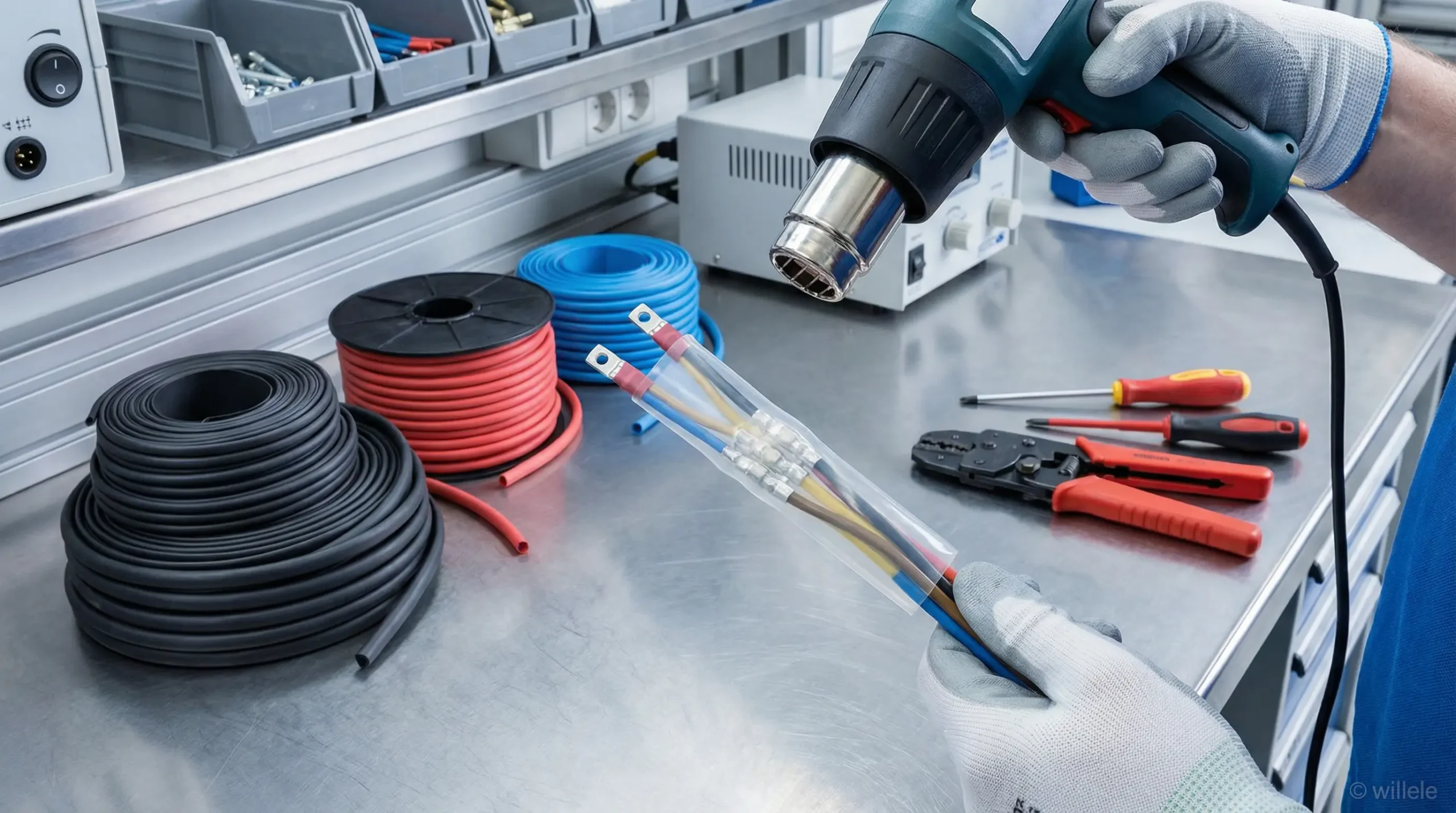
Waterproof electrical connections are critical in countless industrial, automotive, marine, and outdoor applications. When moisture infiltrates wire connections, it can cause corrosion, short circuits, and complete system failure. Dual wall heat shrinkable tubes have emerged as the gold standard solution for creating reliable, long-lasting waterproof connections that withstand harsh environmental conditions. This comprehensive guide will walk you through everything you need to know about selecting, installing, and maximizing the performance of dual wall heat shrink tubing.
Understanding Dual Wall Heat Shrinkable Technology
Dual wall heat shrinkable tubes represent a significant advancement over standard single-wall heat shrink products. The technology combines two distinct layers that work synergistically to provide superior protection. The outer layer consists of cross-linked polyolefin material that shrinks when heated, providing mechanical protection and insulation. The inner layer contains a thermoplastic adhesive that melts during the heating process, flowing around the wire connection to create a complete environmental seal.
This dual-layer construction delivers waterproofing capabilities that single-wall tubes simply cannot match. When properly installed, the adhesive layer forms a continuous barrier that prevents moisture ingress from any direction. The outer layer provides abrasion resistance, UV protection, and mechanical strength, while the inner adhesive layer ensures that even irregular surfaces and connection points are completely sealed.
The manufacturing process for quality dual wall heat shrink tubes involves precise extrusion techniques that ensure uniform wall thickness and consistent shrink ratios. At Willele, our heat shrinkable products undergo rigorous quality control testing to verify shrink performance, adhesive flow characteristics, and environmental resistance. This attention to detail ensures that every tube performs reliably in demanding applications.
Key Advantages of Dual Wall Heat Shrink Tubes
The benefits of dual wall heat shrinkable tubes extend far beyond basic waterproofing. These versatile products offer a comprehensive protection solution that addresses multiple challenges simultaneously. The adhesive inner layer creates a moisture barrier that achieves IP67 or higher ratings when properly installed, making connections suitable for submersion applications. This level of protection is essential in marine environments, underground installations, and outdoor equipment exposed to rain, snow, and humidity.
Corrosion prevention represents another critical advantage. The hermetic seal created by the melted adhesive layer eliminates oxygen and moisture contact with metal conductors and terminals. This protection is particularly valuable in coastal areas where salt spray accelerates corrosion, and in industrial environments where chemical exposure poses risks. The sealed connection maintains electrical integrity for years, even in conditions that would quickly degrade unprotected connections.
Strain relief is an often-overlooked benefit of dual wall heat shrink technology. The adhesive bond between the tube and cable creates a flexible yet secure transition zone that distributes mechanical stress. This prevents the concentration of bending forces at the connection point, which can lead to wire fatigue and eventual failure. In applications involving vibration or movement, this strain relief function significantly extends connection lifespan.
The versatility of dual wall heat shrinkable tubes makes them suitable for an enormous range of applications. From automotive wiring harnesses to industrial control panels, from marine electronics to renewable energy installations, these tubes provide reliable protection. They accommodate various wire gauges, connector types, and environmental requirements, making them a universal solution for waterproofing challenges.
Material Specifications and Performance Characteristics
Understanding the materials and performance specifications of dual wall heat shrink tubes helps ensure proper product selection for your specific application. The outer polyolefin layer typically exhibits a shrink ratio of 3:1 or 4:1, meaning it will shrink to one-third or one-quarter of its original diameter when heated. This high shrink ratio allows a single tube size to accommodate a range of wire gauges and connection configurations.
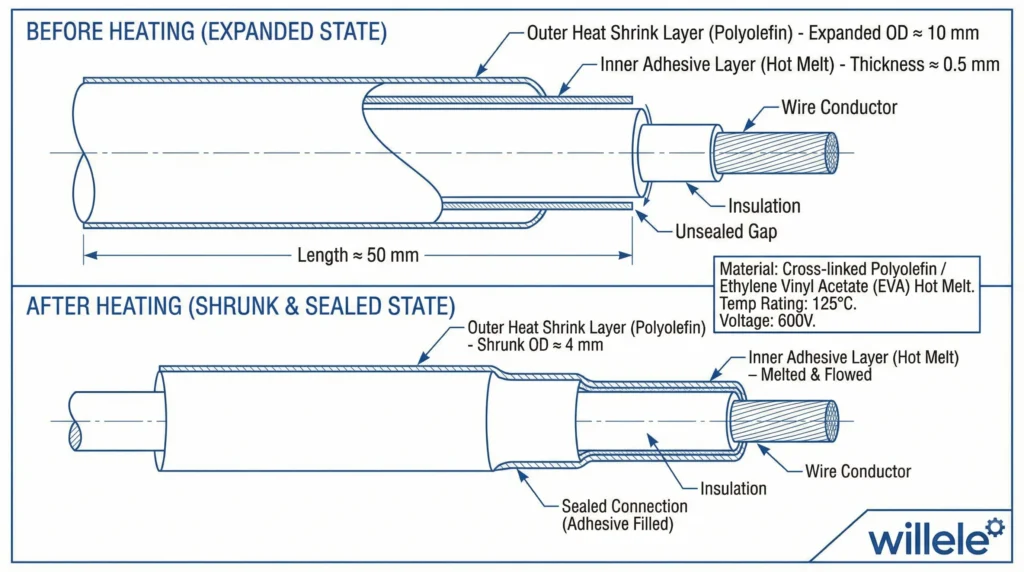
The temperature ratings of quality dual wall heat shrink tubes reflect their ability to perform in extreme conditions. Operating temperature ranges typically span from -55°C to +110°C (-67°F to +230°F), with some specialized formulations extending to +125°C (+257°F). The shrink temperature, which is the heat required to activate the shrinking process, generally falls between 120°C and 140°C (248°F to 284°F). The adhesive melting point is carefully calibrated to occur within this same temperature range, ensuring simultaneous shrinking and sealing.
| Property | Specification | Performance Benefit |
|---|---|---|
| Shrink Ratio | 3:1 or 4:1 | Accommodates various wire sizes |
| Operating Temperature | -55°C to +110°C | Functions in extreme climates |
| Shrink Temperature | 120°C to 140°C | Activates with standard heat guns |
| Tensile Strength | ≥10.4 MPa | Resists mechanical damage |
| Dielectric Strength | ≥15 kV/mm | Prevents electrical breakdown |
| Water Resistance | IP67 rated | Withstands submersion |
| Flame Retardancy | UL224 VW-1 | Meets safety standards |
| UV Resistance | Excellent | Prevents outdoor degradation |
The adhesive formulation in premium dual wall tubes uses hot-melt polyamide or modified polyolefin compounds. These materials provide excellent adhesion to a wide variety of substrates, including PVC, polyethylene, rubber, and metal surfaces. The adhesive viscosity is optimized to flow sufficiently during heating to fill gaps and irregularities, while maintaining enough body to prevent excessive run-out that could create mess or weak spots.
Chemical resistance is another important consideration. Quality dual wall heat shrink tubes resist common automotive fluids, industrial solvents, acids, and alkalis. This chemical resistance ensures that the protection remains intact even when connections are exposed to fuel, oil, hydraulic fluid, cleaning agents, or other potentially damaging substances.
Step-by-Step Installation Guide
Proper installation technique is crucial for achieving the full waterproofing potential of dual wall heat shrinkable tubes. Following a systematic approach ensures consistent, reliable results every time. The process begins well before the heat gun is applied, with careful preparation and planning.
Preparation Phase: Start by assessing the connection to be protected. Measure the length of the connection area, including any terminals, splices, or solder joints. Select a tube length that extends at least 25mm (1 inch) beyond the connection on each side. This overlap onto intact insulation is essential for creating a proper seal. Clean the wire insulation thoroughly with isopropyl alcohol to remove any dirt, oil, or contaminants that could interfere with adhesive bonding.
Tube Selection and Positioning: Choose a tube diameter that will shrink snugly over the largest part of your connection while still fitting over the smallest part before shrinking. For a 3:1 shrink ratio tube, the recovered (shrunk) inner diameter should be approximately 20-30% smaller than the wire diameter to ensure compression and good adhesive contact. Slide the tube over one wire before making the connection—a common mistake is attempting to install the tube after the connection is complete, which may be impossible depending on connector types.
Connection Assembly: Make your electrical connection using proper techniques. For wire splices, ensure adequate overlap and mechanical strength. Solder joints should be smooth without sharp protrusions that could puncture the tube. Clean flux residue thoroughly, as it can interfere with adhesive bonding. Position the tube so it’s centered over the connection with equal overlap on both sides.
Heat Application Technique: Use a heat gun with adjustable temperature control, set to approximately 120-140°C (248-284°F). Industrial heat guns designed for heat shrink applications work best, though propane torches can be used carefully in field situations. Begin heating at one end of the tube, using a sweeping motion to apply heat evenly around the circumference. Slowly work toward the opposite end, watching for the tube to begin shrinking.
As the tube shrinks, you’ll observe the adhesive beginning to flow. This appears as a glossy bead or ring of melted adhesive emerging from the tube ends. This adhesive flow-out is your visual confirmation that proper sealing is occurring. Continue heating until adhesive appears at both ends of the tube, indicating complete seal formation. Avoid overheating, which can cause the outer layer to char or the adhesive to become too fluid and run excessively.
Cooling and Inspection: Allow the connection to cool naturally without forced cooling. The adhesive requires several minutes to solidify and develop full bond strength. Once cooled, inspect the connection carefully. The tube should be uniformly shrunk with no loose areas, and adhesive should be visible at both ends. Gently tug on the tube to verify it’s firmly bonded and cannot rotate or slide on the wire.
Common Installation Mistakes and How to Avoid Them
Even experienced technicians can make errors that compromise the waterproofing effectiveness of dual wall heat shrink installations. Understanding these common pitfalls helps ensure successful results. Insufficient tube length is perhaps the most frequent mistake. When tubes don’t extend adequately onto intact insulation on both sides of the connection, the seal is incomplete. Always add extra length rather than cutting it too short—you can always trim excess if needed, but you cannot add length after installation.
Inadequate surface preparation undermines adhesive bonding. Oil, grease, dirt, and even fingerprints contain contaminants that prevent proper adhesion. Taking the extra minute to clean surfaces with isopropyl alcohol pays dividends in long-term reliability. Similarly, flux residue from soldering must be completely removed, as it creates a barrier between the adhesive and wire insulation.
Uneven heating creates weak spots in the protection. When heat is applied too quickly or concentrated in one area, the tube may shrink unevenly, leaving gaps or loose sections where moisture can penetrate. The sweeping motion technique, moving the heat gun continuously around and along the tube, ensures uniform shrinking and adhesive activation. Patience during this process is essential—rushing leads to inadequate sealing.
Overheating presents the opposite problem but is equally detrimental. Excessive heat can char the outer layer, degrade the adhesive properties, or even damage the wire insulation beneath. If you see smoke, discoloration, or bubbling, you’re applying too much heat. Modern heat guns with temperature control eliminate much of this risk, but vigilance is still required.
Selecting the wrong tube size is another common error. A tube that’s too large won’t shrink tightly enough to create proper compression and sealing. Conversely, a tube that’s too small may not fit over the connection or may be stretched so thin after shrinking that it provides inadequate protection. Consulting size charts and measuring carefully before cutting prevents this issue.
Comparing Dual Wall vs. Single Wall Heat Shrink Tubes
Understanding when to use dual wall versus single wall heat shrink tubes helps optimize both performance and cost-effectiveness. While dual wall tubes offer superior protection, single wall products remain appropriate for many applications. The decision hinges on environmental exposure, reliability requirements, and budget considerations.
| Feature | Single Wall Heat Shrink | Dual Wall Heat Shrink |
|---|---|---|
| Waterproofing | Basic moisture resistance | Complete waterproof seal (IP67+) |
| Installation | Heat and shrink only | Heat, shrink, and adhesive seal |
| Cost | Lower initial cost | Higher initial cost, lower lifecycle cost |
| Applications | Indoor, dry environments | Outdoor, marine, harsh environments |
| Seal Quality | Mechanical fit only | Adhesive hermetic seal |
| Strain Relief | Minimal | Excellent adhesive bond |
| Temperature Range | -55°C to +125°C | -55°C to +110°C (standard) |
| Chemical Resistance | Good | Excellent with sealed protection |
| Repairability | Easily removed and replaced | Permanent installation |
| Corrosion Prevention | Limited | Complete oxygen/moisture barrier |
Single wall heat shrink tubes excel in controlled indoor environments where moisture exposure is minimal. They provide excellent insulation, abrasion protection, and wire identification through color coding. For panel wiring, indoor equipment, and applications where environmental sealing isn’t critical, single wall tubes offer an economical solution. They’re also preferred when connections may need future access, as they can be removed and replaced more easily than adhesive-lined tubes.
Dual wall heat shrinkable tubes become essential when connections face moisture, submersion, salt spray, or corrosive atmospheres. The adhesive seal provides protection that single wall tubes cannot match, making them mandatory for marine applications, underground installations, outdoor equipment, and automotive underbody wiring. While the initial cost per tube is higher, the prevention of corrosion-related failures and the elimination of maintenance callbacks often make dual wall tubes more economical over the product lifecycle.
In some applications, a hybrid approach makes sense. Critical connections exposed to harsh conditions receive dual wall protection, while less critical indoor connections use single wall tubes. This tiered strategy optimizes protection while managing costs effectively.
Application-Specific Considerations
Different industries and applications present unique challenges that influence heat shrink tube selection and installation techniques. Understanding these application-specific factors ensures optimal performance in your particular use case.
Marine and Boat Wiring: Marine environments represent one of the most demanding applications for electrical connections. Constant moisture exposure, salt spray, and submersion potential require the highest level of protection. For marine applications, select dual wall tubes with enhanced UV resistance and consider using marine-grade adhesive formulations. Pay special attention to connections in bilge areas, through-hull fittings, and deck penetrations. Some marine installers apply a thin coating of dielectric grease to conductors before installing heat shrink tubes for additional corrosion protection.
Automotive Applications: Modern vehicles contain hundreds of electrical connections that must function reliably despite exposure to road salt, engine heat, vibration, and underbody splash. Automotive wiring harnesses increasingly rely on dual wall heat shrink for critical connections. Engine bay applications require tubes rated for higher operating temperatures, while underbody connections need maximum moisture protection. The strain relief properties of dual wall tubes are particularly valuable in automotive applications where vibration is constant.
Solar and Renewable Energy: Photovoltaic installations and wind turbines present unique challenges with outdoor exposure, UV radiation, and temperature cycling. Connections in solar arrays must withstand decades of exposure while maintaining low resistance. Dual wall heat shrink tubes protect DC connections between panels, combiner boxes, and inverters. Select tubes with excellent UV resistance and verify compatibility with the specific wire insulation types used in solar cables.
Industrial Control Systems: Factory automation, process control, and industrial machinery involve complex wiring in environments with moisture, chemicals, and physical hazards. Dual wall heat shrink protects sensor connections, motor leads, and control panel wiring from coolant spray, cleaning chemicals, and condensation. In food processing and pharmaceutical facilities, heat shrink tubes must meet additional hygiene and chemical resistance requirements.
Troubleshooting and Quality Verification
Even with proper installation technique, occasionally issues arise that require troubleshooting. Recognizing problems early and understanding their causes prevents field failures. Incomplete adhesive flow is one of the most common issues. If adhesive doesn’t appear at both tube ends after heating, the seal may be incomplete. This can result from insufficient heating, wrong tube size, or contaminated surfaces. The solution is to apply additional heat carefully, focusing on areas where adhesive hasn’t flowed.
Tube splitting or cracking during installation indicates overheating or a tube that’s too small for the application. If this occurs, discard the damaged tube and select the next larger size. Ensure your heat gun temperature is within the recommended range and that you’re not holding it too close to the tube surface.
Adhesive run-out, where excessive melted adhesive flows away from the connection, suggests overheating or prolonged heat application. While some adhesive flow-out is normal and desirable, excessive flow can leave gaps in coverage. Reduce heat gun temperature or shorten the heating time to correct this issue.
Poor adhesion after cooling may indicate contaminated surfaces, incompatible materials, or inadequate heating. If the tube can rotate or slide on the wire after cooling, adhesion has failed. Surface preparation is the most common culprit—thoroughly clean all surfaces before installation. Some wire insulation types, particularly certain silicones and fluoropolymers, have low surface energy that resists adhesion. For these materials, consider mechanical abrasion to improve bonding or select tubes specifically formulated for difficult substrates.
Quality verification should be part of your installation process, particularly for critical connections. Visual inspection confirms uniform shrinking, adhesive flow at both ends, and absence of damage. Physical testing involves gently attempting to rotate or slide the tube—it should be firmly bonded and immovable. For the highest reliability applications, some installers perform pull testing on sample connections to verify bond strength meets specifications.
Maintenance and Long-Term Performance
One of the key advantages of properly installed dual wall heat shrink tubes is their maintenance-free performance. Unlike mechanical sealing methods that require periodic inspection and re-tightening, heat shrink connections remain sealed indefinitely when correctly installed. However, periodic visual inspection is still prudent, particularly in critical applications.
Inspect heat shrink protected connections during regular maintenance intervals for signs of physical damage, UV degradation, or mechanical stress. Look for cracks, splits, or areas where the tube has pulled away from the wire. In high-vibration applications, verify that strain relief remains effective and that no wire fatigue has occurred adjacent to the protected area.
UV exposure can eventually degrade even UV-resistant materials. In outdoor applications with direct sunlight exposure, consider additional protection such as conduit, cable trays, or UV-resistant overwrap for connections that must last decades. Most quality dual wall heat shrink tubes will provide 10-20 years of outdoor service life, but extreme UV exposure can shorten this.
Temperature cycling can affect long-term performance. Connections that experience repeated heating and cooling cycles may eventually develop fatigue in the adhesive bond. This is primarily a concern in applications with extreme temperature swings, such as engine compartments or outdoor equipment in climates with hot summers and cold winters. Selecting tubes with appropriate temperature ratings and ensuring adequate strain relief mitigates this concern.
Frequently Asked Questions
What temperature should I use to shrink dual wall heat shrink tubes?
Most dual wall heat shrink tubes require temperatures between 120°C and 140°C (248°F to 284°F) for proper shrinking and adhesive activation. Use a heat gun with adjustable temperature control set within this range. The adhesive should begin flowing and appear at the tube ends as confirmation of proper heating.
Can I use a lighter or match instead of a heat gun?
While open flames can shrink heat shrink tubes in emergency field situations, they’re not recommended for dual wall tubes. Open flames create uneven heating, risk overheating and damage, and make it difficult to achieve the controlled temperature needed for proper adhesive flow. Heat guns provide consistent, controllable results.
How much should the tube extend beyond my connection?
The tube should extend at least 25mm (1 inch) beyond the connection area on each side, overlapping onto intact wire insulation. This overlap is essential for creating a proper waterproof seal. For larger connections or higher reliability requirements, increase this overlap to 40-50mm.
Are dual wall heat shrink tubes reusable?
No, dual wall heat shrink tubes are permanent, single-use products. Once the adhesive has melted and bonded, the tube cannot be removed without cutting it off and destroying it. If you need to access the connection later, you must cut away the tube and install a new one.
What’s the difference between 3:1 and 4:1 shrink ratios?
The shrink ratio indicates how much the tube diameter reduces when heated. A 3:1 tube shrinks to one-third of its original diameter, while a 4:1 tube shrinks to one-quarter. Higher shrink ratios allow a single tube size to accommodate a wider range of wire gauges but may be more difficult to install over bulky connections.
Can dual wall heat shrink tubes be used underwater?
Yes, properly installed dual wall heat shrink tubes achieve IP67 or higher waterproof ratings, making them suitable for submersion applications. However, the connection must be made and the tube installed before submersion. You cannot install heat shrink tubes on wet connections.
How long do dual wall heat shrink tubes last?
With proper installation, dual wall heat shrink tubes provide decades of reliable protection. Service life depends on environmental factors such as UV exposure, temperature extremes, and chemical exposure. In typical outdoor applications, expect 10-20 years of maintenance-free performance. Indoor applications may last indefinitely.
About Willele Electrical
Willele is a leading B2B manufacturer specializing in heat shrinkable products for industrial, automotive, marine, and renewable energy applications. Our dual wall heat shrink tubes are engineered to meet the most demanding environmental sealing requirements, combining advanced materials with rigorous quality control. For technical specifications, product selection assistance, or bulk ordering information, contact our engineering team or visit willele.com.
