
Junction Boxes in Wind Turbine Power Distribution

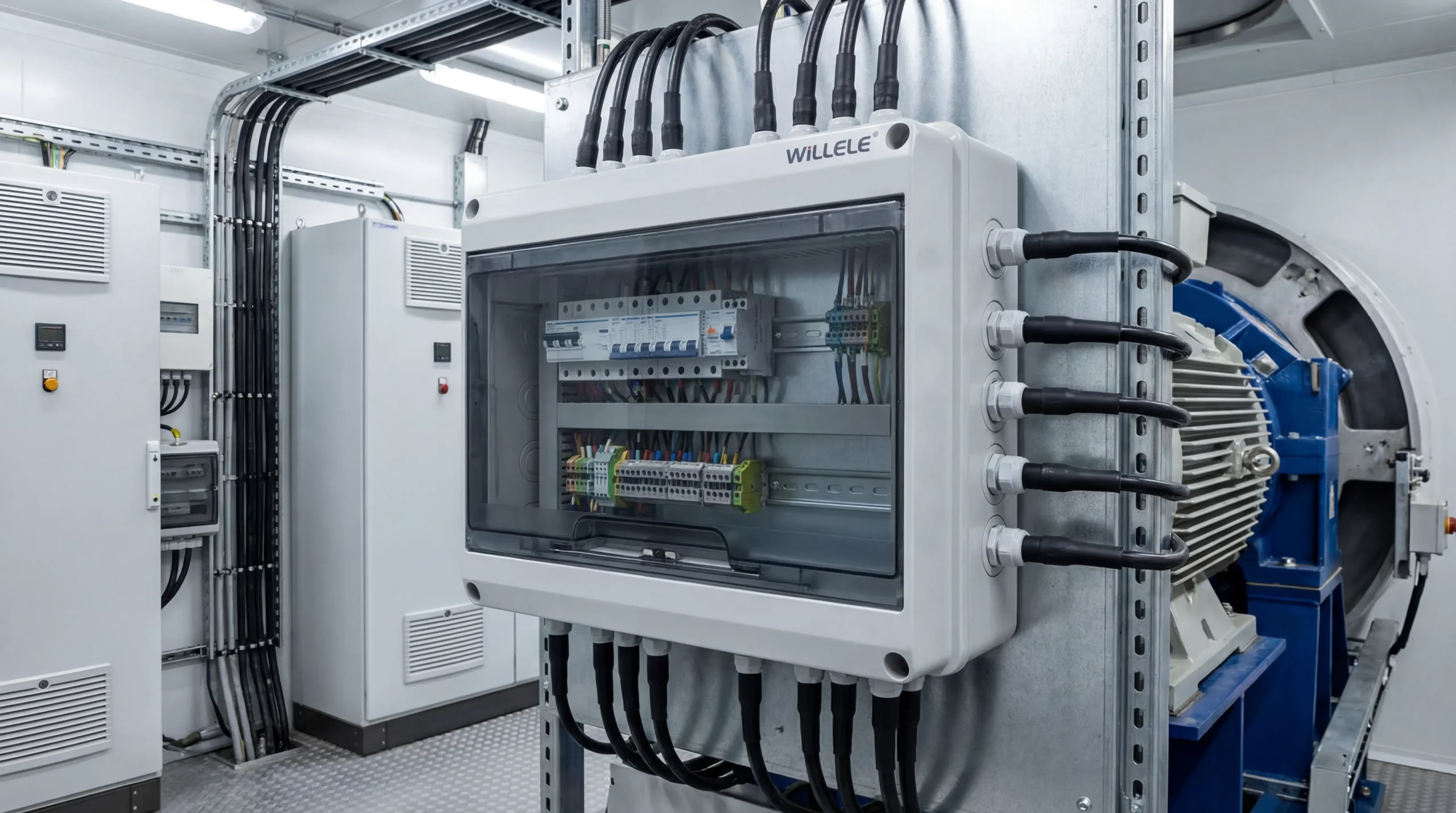
Wind energy continues to dominate the global renewable energy landscape, with turbines growing larger and more powerful each year. At the heart of every wind turbine’s electrical infrastructure lies a critical yet often overlooked component: the junction box. These robust enclosures serve as the nerve centers for power distribution, protecting sensitive electrical connections from extreme environmental conditions while ensuring reliable energy transmission from blade to grid.
For manufacturers and operators in the wind energy sector, understanding the role, specifications, and selection criteria for junction boxes is essential to maximizing turbine performance and longevity. This comprehensive guide explores the technical requirements, design considerations, and best practices for implementing junction boxes in wind turbine power distribution systems.
The Critical Role of Junction Boxes in Wind Turbine Systems
Junction boxes in wind turbines perform multiple essential functions that directly impact system reliability and safety. Unlike conventional electrical installations, wind turbine junction boxes must withstand extraordinary mechanical stress, temperature fluctuations ranging from -40°C to +70°C, constant vibration, humidity, salt spray in offshore applications, and UV radiation exposure. These enclosures house critical electrical connections including generator output terminals, circuit protection devices, grounding systems, and cable management infrastructure.
The strategic placement of junction boxes throughout a wind turbine—from the nacelle to the tower base and transition piece—creates a distributed power management architecture. Each location presents unique challenges: nacelle junction boxes experience maximum vibration and temperature variation, tower junction boxes must accommodate long cable runs and lightning protection systems, and base/transition junction boxes interface with external grid connections while providing the final point of overcurrent protection before power exits the turbine.
Technical Specifications and Industry Standards
Wind turbine junction boxes must comply with rigorous international standards to ensure safety and interoperability. The IEC 61439 series governs low-voltage switchgear and controlgear assemblies, establishing requirements for electrical clearances, temperature rise limits, and mechanical strength. IEC 60529 defines ingress protection (IP) ratings, with IP65 or IP66 being standard for exterior turbine applications and IP54 acceptable for protected nacelle environments.
For offshore installations, additional certifications become mandatory. DNV GL type approval, IEC 61892 for marine electrical installations, and ISO 12944 corrosion protection classifications ensure equipment can survive harsh maritime conditions. North American projects typically require UL 508A certification for industrial control panels and NEMA 4X ratings for corrosion resistance.
Material selection directly impacts junction box performance and lifespan. Modern wind turbine applications favor several enclosure materials, each with distinct advantages:
| Material | Advantages | Typical Applications | Limitations |
|---|---|---|---|
| Polycarbonate (PC) | High impact resistance, UV stable, transparent covers available, lightweight | Nacelle boxes, small distribution boxes | Lower temperature rating than metal |
| Fiberglass (GRP) | Excellent corrosion resistance, non-conductive, good insulation | Offshore installations, coastal sites | Can degrade under prolonged UV exposure |
| Stainless Steel 316L | Superior corrosion resistance, maximum mechanical strength, EMI shielding | Main distribution boxes, offshore transition pieces | Higher cost, heavier weight |
| Aluminum (powder-coated) | Good strength-to-weight ratio, cost-effective, heat dissipation | Tower junction boxes, onshore applications | Requires proper coating for marine environments |
Junction Box Configuration and Internal Components
The internal architecture of a wind turbine junction box must balance accessibility, safety, and space efficiency. A well-designed junction box incorporates several key elements working in concert to manage power distribution effectively.
Terminal blocks form the foundation of electrical connectivity within the junction box. High-current applications demand multi-pole terminal blocks rated for 600V to 1000V and current capacities from 100A to 400A per pole. Spring-cage or screw-type connections must provide vibration-resistant terminations, while color-coded blocks facilitate maintenance and reduce wiring errors. Modern designs increasingly incorporate push-in connection technology that reduces installation time while maintaining connection integrity under vibration.
Circuit protection devices safeguard both personnel and equipment from electrical faults. Molded case circuit breakers (MCCBs) provide overcurrent and short-circuit protection for main power circuits, while miniature circuit breakers (MCBs) protect auxiliary and control circuits. Surge protection devices (SPDs) are essential for lightning-prone installations, with Type 2 SPDs standard for turbine applications and Type 1+2 combined devices recommended for exposed locations.
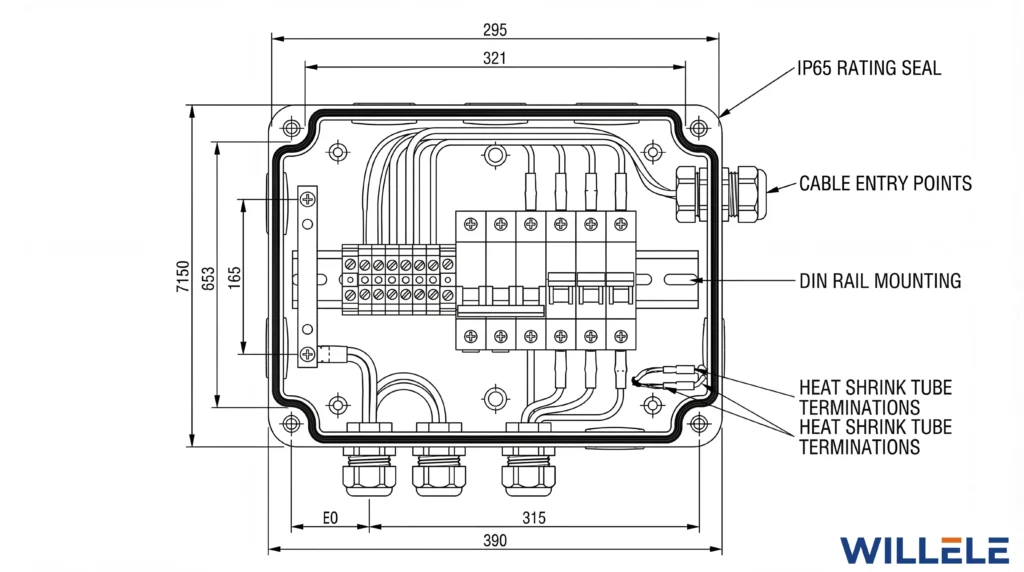
Proper grounding and bonding infrastructure cannot be overstated in wind turbine applications. A dedicated grounding bus bar, typically copper with tin or nickel plating, must accommodate all equipment grounds, cable shields, and enclosure bonding connections. The grounding system must provide a low-impedance path capable of safely conducting fault currents and lightning-induced transients to the turbine’s grounding grid.
Cable Entry and Heat Shrink Tube Integration
Cable management represents one of the most critical aspects of junction box design, particularly where cables enter and exit the enclosure. Wind turbine cables experience continuous flexing, thermal cycling, and environmental exposure, making proper cable entry sealing essential for maintaining IP ratings and preventing moisture ingress.
Cable glands and entry systems must provide multiple layers of protection. Metric or NPT threaded cable glands with elastomer seals create the primary moisture barrier, while strain relief prevents mechanical stress from transferring to electrical connections. For applications requiring enhanced protection, heat shrink tube technology offers superior environmental sealing and mechanical reinforcement.
Heat shrink tubes provide several advantages in wind turbine junction box applications. When properly applied, they create a seamless, waterproof seal around cable entries that conforms to irregular surfaces and fills voids that traditional glands cannot address. Adhesive-lined heat shrink tubes bond directly to cable jackets and enclosure surfaces, creating a permanent environmental seal. For high-voltage applications, medium-voltage heat shrink terminations and joints provide electrical stress control while maintaining mechanical protection.
Willele Electric specializes in heat shrink tube solutions engineered specifically for renewable energy applications. Our product range includes heavy-wall adhesive-lined tubes for cable sealing, medium-voltage cold shrink and heat shrink terminations, UV-resistant outdoor-rated tubes, and flame-retardant tubes meeting UL 224 and CSA standards. These products integrate seamlessly with junction box installations, providing long-term reliability in demanding wind turbine environments.
Junction Box Selection Criteria for Different Turbine Zones
Selecting the appropriate junction box for each location within a wind turbine requires careful consideration of environmental conditions, electrical requirements, and maintenance accessibility. A systematic approach to specification ensures optimal performance and cost-effectiveness.
Nacelle Junction Boxes
The nacelle environment presents unique challenges with temperature extremes from generator heat and ambient cold, constant vibration from rotating machinery, limited space in crowded nacelle layouts, and potential exposure to hydraulic fluids and lubricants. Nacelle junction boxes should feature compact designs with high component density, vibration-dampening mounting systems, temperature ratings from -40°C to +85°C, and chemical-resistant enclosure materials.
Tower Junction Boxes
Tower installations require different considerations. These boxes must accommodate long vertical cable runs with associated voltage drop considerations, provide lightning protection integration points, allow for easy access during maintenance climbs, and withstand condensation from temperature differentials. Specifications should include modular designs allowing for cable coiling and service loops, integrated SPD mounting provisions, IP65 rating minimum with condensation drains, and clear internal labeling for maintenance efficiency.
Base and Transition Piece Junction Boxes
The turbine base or offshore transition piece houses the main distribution junction box, which serves as the interface between turbine and grid. This critical location demands maximum protection and capacity: highest current ratings (up to 2000A for large turbines), comprehensive monitoring and metering integration, redundant sealing for offshore applications, and space for future expansion or retrofits.
Comparison of Junction Box Types for Wind Applications
| Feature | Standard Industrial | Wind Turbine Nacelle | Offshore Transition Piece |
|---|---|---|---|
| IP Rating | IP54-IP65 | IP65-IP66 | IP66-IP67 |
| Vibration Resistance | Standard | Enhanced (IEC 60068-2-6) | Maximum (offshore spec) |
| Temperature Range | -25°C to +60°C | -40°C to +85°C | -40°C to +70°C |
| Corrosion Protection | C3 | C4 | C5-M (marine) |
| UV Resistance | Limited | High (UV8) | Maximum |
| Typical Enclosure | Painted steel | Polycarbonate/GRP | Stainless steel 316L |
| Cable Entry | Standard glands | Reinforced + heat shrink | Marine-grade + redundant seal |
| Certification | IEC 61439 | IEC 61439 + wind-specific | DNV GL + IEC 61892 |
Installation Best Practices and Common Pitfalls
Proper installation of junction boxes significantly impacts long-term reliability and maintenance costs. Following industry best practices prevents common failure modes and extends equipment lifespan.
Mounting and mechanical installation requires attention to structural integrity. Junction boxes must be mounted to substantial structural members capable of supporting the enclosure weight plus cable loading. Vibration isolation mounts should be considered for nacelle installations, while maintaining proper orientation ensures condensation drains function correctly. All mounting hardware must be stainless steel or similarly corrosion-resistant material with appropriate locking mechanisms.
Cable preparation and termination demands meticulous attention to detail. Cables should be cut to appropriate lengths allowing service loops but avoiding excessive coiling that generates heat. Conductor stripping must be precise—too much exposed conductor creates shock hazards, while insufficient stripping leads to poor connections. Heat shrink tube application requires proper sizing, complete coverage of exposed areas, even heating to avoid bubbles or gaps, and adequate cooling time before mechanical stress.
Common installation errors that compromise junction box performance include over-tightening cable glands which damages seals, inadequate torque on electrical connections leading to hot spots, mixing dissimilar metals creating galvanic corrosion, blocking condensation drains with cable bundles, and failing to properly bond cable shields and armor to grounding systems.
Maintenance and Inspection Protocols
Proactive maintenance of junction boxes prevents unexpected failures and extends turbine availability. A structured inspection program should include both routine visual checks and detailed periodic examinations.
Visual inspection intervals vary by location and environmental exposure. Nacelle junction boxes should receive visual inspection during routine turbine maintenance (typically every 6 months), tower boxes during annual inspections, and offshore transition piece boxes quarterly due to harsh conditions. Inspectors should look for signs of moisture ingress, corrosion on terminals or bus bars, discoloration indicating overheating, physical damage to enclosures, and degraded seals or gaskets.
Detailed inspection and testing should occur on an annual or biennial basis, including thermographic imaging to identify hot spots, insulation resistance testing of cables and connections, tightness verification of all electrical connections, seal integrity testing, and functional testing of circuit protection devices.
Predictive maintenance technologies increasingly enable condition-based maintenance strategies. Permanently installed temperature sensors monitor connection temperatures continuously, humidity sensors detect seal failures before damage occurs, and partial discharge monitoring identifies developing insulation problems in high-voltage applications.
Future Trends and Emerging Technologies
The wind energy industry’s evolution drives continuous innovation in junction box technology. Several trends are reshaping how these critical components are designed and deployed.
Smart junction boxes integrate monitoring and communication capabilities directly into the enclosure. Embedded sensors track temperature, humidity, and vibration, while IoT connectivity enables remote monitoring and predictive analytics. These intelligent systems can alert operators to developing problems before failures occur, optimizing maintenance scheduling and reducing downtime.
Modular and scalable designs address the industry’s need for flexibility as turbine sizes and voltages increase. Standardized mounting interfaces and connection systems allow for easier upgrades and capacity expansion without complete replacement. This modularity reduces spare parts inventory requirements and simplifies maintenance logistics for multi-site operators.
Advanced materials and coatings continue to improve environmental resistance and longevity. Nano-ceramic coatings provide superior corrosion protection, while advanced polymer blends offer enhanced UV resistance and impact strength. These material innovations extend service life in harsh environments, particularly for offshore applications where replacement costs are prohibitive.
Higher voltage systems are becoming standard as turbine power ratings increase. Modern large turbines operate at 690V or even 1000V AC, with DC collection systems emerging for offshore wind farms. Junction boxes must evolve to safely handle these higher voltages while maintaining compact form factors, driving innovations in insulation materials and clearance optimization.
Selecting the Right Partner for Junction Box Solutions
The complexity of wind turbine electrical systems demands collaboration with suppliers who understand both the technical requirements and operational realities of renewable energy projects. When evaluating junction box and associated component suppliers, several factors distinguish qualified partners from commodity vendors.
Technical expertise and application engineering support prove invaluable during project specification and design phases. Suppliers should offer consultation on enclosure selection, internal layout optimization, cable entry design, and integration with heat shrink tube sealing systems. This collaborative approach ensures that junction boxes are properly specified for their specific application and environment.
Quality certifications and testing capabilities provide assurance that products will perform as specified. Look for suppliers with ISO 9001 quality management systems, IEC 61439 type-tested assemblies, environmental testing per IEC 60068 series, and traceability systems for materials and components.
Supply chain reliability and global support become critical for international projects and multi-site deployments. Qualified suppliers maintain adequate inventory for timely delivery, offer consistent product availability across regions, provide local technical support in key markets, and maintain long-term product availability for spare parts.
Willele Electric brings decades of experience in electrical component manufacturing to the wind energy sector. Our specialization in heat shrink tube technology complements our understanding of junction box requirements, enabling integrated solutions that address the complete cable entry and sealing challenge. We work closely with turbine manufacturers, EPC contractors, and wind farm operators to deliver products that meet the demanding requirements of modern wind energy installations.
Conclusion
Junction boxes represent a critical infrastructure element in wind turbine power distribution systems, protecting electrical connections while enabling reliable energy transmission from generation to grid. The harsh environmental conditions, mechanical stresses, and high reliability requirements of wind applications demand purpose-designed solutions that go far beyond standard industrial enclosures.
Successful junction box implementation requires careful attention to material selection, internal component specification, cable entry sealing, and installation practices. The integration of advanced technologies such as heat shrink tube sealing systems enhances environmental protection and extends service life, particularly in demanding offshore environments.
As wind turbines continue to grow in size and complexity, junction box technology must evolve to meet increasing voltage levels, current capacities, and monitoring requirements. Partnering with suppliers who understand these challenges and offer comprehensive solutions—from enclosures to cable management to heat shrink tube sealing—ensures optimal performance and long-term reliability.
For wind energy professionals seeking to optimize their electrical infrastructure, investing in properly specified and installed junction boxes pays dividends through reduced maintenance costs, extended equipment life, and improved turbine availability. The junction box may be a small component in the overall turbine system, but its impact on reliability and performance is anything but minor.
Frequently Asked Questions
What IP rating is required for wind turbine junction boxes?
The required IP rating depends on the installation location. Nacelle junction boxes typically require IP65 or IP66 rating to protect against dust and powerful water jets. Offshore transition piece and external tower junction boxes should meet IP66 or IP67 standards for maximum protection against saltwater spray and temporary submersion. Interior tower locations may accept IP54 rating where environmental exposure is limited.
How do heat shrink tubes improve junction box cable entries?
Heat shrink tubes provide superior environmental sealing compared to traditional cable glands alone. Adhesive-lined heat shrink tubes create a permanent, waterproof bond between the cable jacket and the junction box entry point, conforming to irregular surfaces and filling gaps that standard glands cannot address. This redundant sealing is particularly valuable in vibration-prone wind turbine applications where mechanical seals may degrade over time.
What are the main causes of junction box failure in wind turbines?
The most common failure modes include moisture ingress due to seal degradation or improper installation, connection overheating from inadequate torque or corrosion, mechanical damage from vibration or impact, and corrosion in marine environments when inappropriate materials are used. Regular inspection and preventive maintenance significantly reduce these failure risks.
Can standard industrial junction boxes be used in wind turbines?
Standard industrial junction boxes typically lack the environmental protection, vibration resistance, and temperature range required for wind turbine applications. While they may function initially, they are likely to fail prematurely under the extreme conditions present in wind turbines. Purpose-designed wind turbine junction boxes incorporate enhanced sealing, reinforced mounting, wider temperature ratings, and corrosion-resistant materials essential for long-term reliability.
How often should wind turbine junction boxes be inspected?
Inspection frequency depends on environmental exposure and criticality. Nacelle and tower junction boxes should receive visual inspection during routine maintenance visits (typically every 6 months), with detailed inspection including thermography and connection tightness verification annually. Offshore installations require more frequent inspection—quarterly visual checks and semi-annual detailed inspections—due to the harsh marine environment and higher consequence of failure.
What voltage levels do wind turbine junction boxes need to support?
Modern wind turbines typically operate at 690V AC for the generator and main distribution system, though some newer large turbines use 1000V AC systems. Junction boxes must be rated for these voltages with appropriate clearances and insulation. Additionally, control and auxiliary circuits at 24V DC, 230V AC, and 400V AC may be present. Future offshore DC collection systems may require junction boxes rated for 1500V DC or higher.
About Willele Electric: As a leading B2B manufacturer of electrical equipment with specialization in heat shrink tube technology, Willele Electric provides comprehensive solutions for wind energy applications. Our product range includes junction boxes, cable management systems, and heat shrink tube sealing solutions engineered to meet the demanding requirements of modern wind turbines. Contact our technical team to discuss your specific project requirements and discover how our integrated approach can enhance your wind turbine electrical infrastructure.
