
Junction Box Requirements for HVAC System Installations

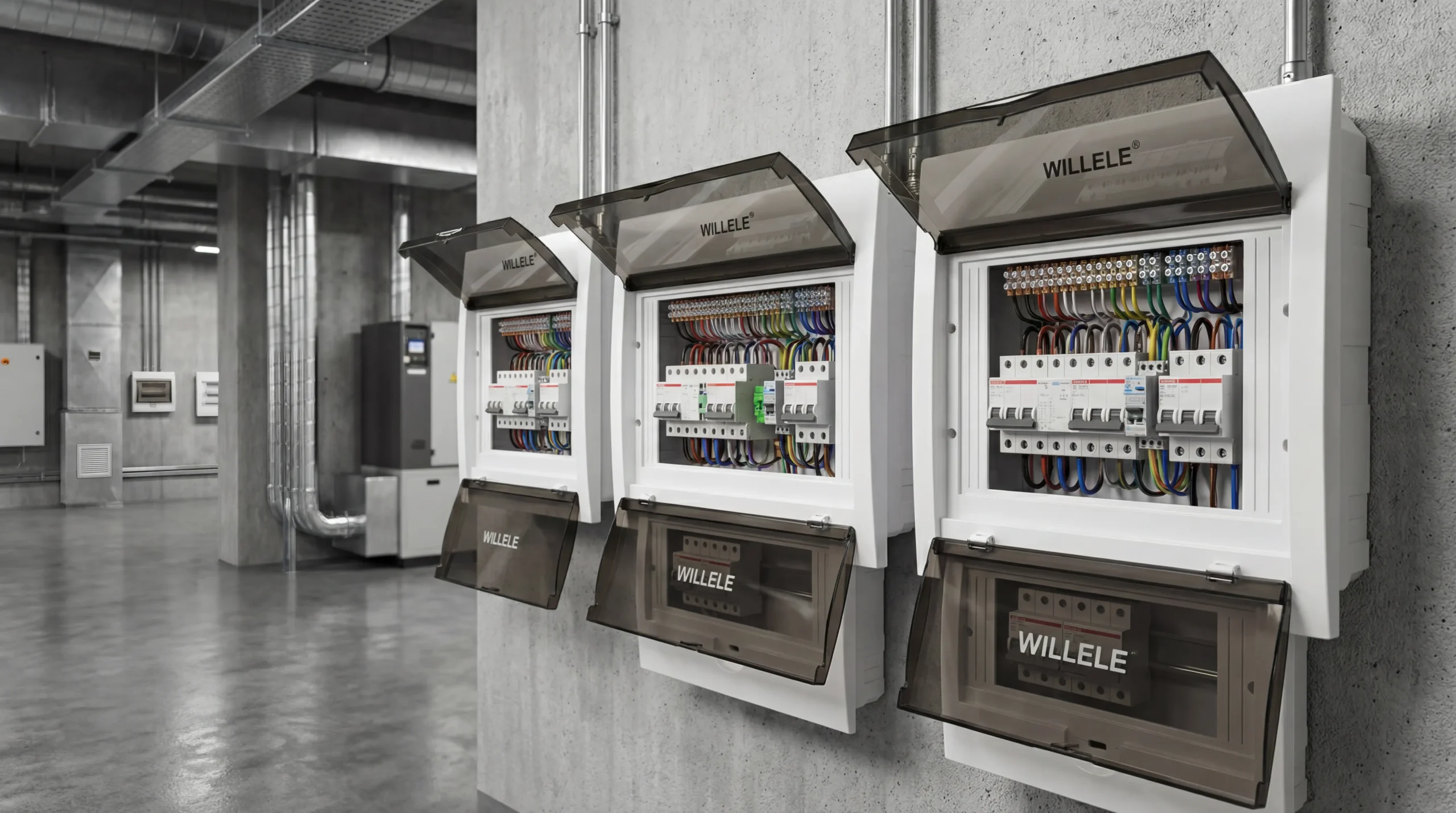
Proper electrical infrastructure forms the backbone of any reliable HVAC system, and junction boxes represent one of the most critical yet frequently overlooked components in these installations. Whether you’re managing a commercial building retrofit or designing a new industrial climate control system, understanding junction box requirements for HVAC system installations ensures compliance, safety, and long-term operational reliability.
At willele Electric, we specialize in manufacturing premium electrical protection solutions including heat shrink tubes and junction boxes engineered specifically for demanding HVAC applications. This comprehensive guide covers everything contractors, engineers, and facility managers need to know about selecting and installing junction boxes for heating, ventilation, and air conditioning systems.
Understanding the Role of Junction Boxes in HVAC Systems
Junction boxes serve as essential electrical enclosures that protect wire connections, splices, and terminations from environmental hazards while providing organized access for maintenance and troubleshooting. In HVAC installations, these enclosures face unique challenges including temperature fluctuations, humidity exposure, vibration from equipment, and potential exposure to condensation or chemical agents.
The proper selection of junction boxes directly impacts system reliability, maintenance accessibility, and compliance with electrical codes including the National Electrical Code (NEC) and local amendments. HVAC systems typically require multiple junction boxes throughout their electrical distribution network, from main power connections at rooftop units to control wiring at zone dampers and thermostats.
Key Junction Box Requirements for HVAC Installations
Environmental Protection Ratings
HVAC installations demand junction boxes with appropriate Ingress Protection (IP) or National Electrical Manufacturers Association (NEMA) ratings based on their location and exposure conditions:
- Indoor Dry Locations: Standard NEMA 1 or IP30 enclosures suffice for mechanical rooms and conditioned spaces where no moisture exposure occurs.
- Indoor Damp Locations: NEMA 4 or IP65-rated boxes protect against condensation, incidental water spray, and humidity common in mechanical rooms and near cooling equipment.
- Outdoor Installations: NEMA 4X or IP66/67 enclosures provide protection against rain, snow, and temperature extremes for rooftop units and exterior equipment.
- Corrosive Environments: NEMA 4X stainless steel or non-metallic enclosures resist chemical exposure in industrial facilities and coastal installations.
Material Selection Considerations
The choice between metallic and non-metallic junction boxes depends on specific application requirements:
Metallic Junction Boxes (Steel/Aluminum)
- Superior electromagnetic shielding for sensitive control circuits
- Higher strength for heavy conduit installations
- Better heat dissipation for high-current connections
- Required for equipment grounding in many applications
Non-Metallic Junction Boxes (Polycarbonate/ABS)
- Excellent corrosion resistance for humid environments
- Lighter weight for easier installation
- Non-conductive properties enhance safety
- Cost-effective for general-purpose applications
Sizing and Capacity Requirements
Proper junction box sizing ensures adequate space for wire connections while maintaining code compliance. The NEC provides specific guidelines for box fill calculations based on conductor size, count, and device types. HVAC applications often require larger boxes than standard residential installations due to:
- Multiple power conductors for compressors, fans, and auxiliary equipment
- Low-voltage control wiring requiring separation from line voltage
- Terminal blocks and wire nuts consuming additional volume
- Future expansion considerations
General sizing guidelines recommend selecting boxes with at least 25% additional capacity beyond immediate needs to accommodate troubleshooting access and future modifications.
Critical Installation Requirements
Mounting and Support
Junction boxes in HVAC installations must withstand continuous vibration from compressors, fans, and air handlers. Secure mounting prevents:
- Conductor fatigue at termination points
- Connection loosening leading to arcing
- Enclosure damage compromising environmental protection
Installers should use vibration-dampening mounts in high-vibration areas and ensure all boxes remain accessible for inspection and maintenance per NEC Article 110.26 requirements for working space clearances.
Conduit and Cable Entry
Proper cable entry management prevents insulation damage and maintains environmental protection ratings:
- Use appropriate cable glands and cord grips matching the outer diameter of cables
- Install bushings and grommets to prevent chafing at metal edges
- Maintain proper cable bend radii to avoid conductor stress
- Seal unused knockout holes with listed closure plugs
For HVAC applications, liquid-tight flexible metal conduit (LFMC) or liquid-tight flexible nonmetallic conduit (LFNC) often provides the best balance of vibration tolerance and environmental protection.
Grounding and Bonding
Effective grounding remains essential for safety and electromagnetic compatibility in HVAC systems:
- Metallic junction boxes require equipment grounding conductor connections
- Bonding jumpers maintain continuity across non-metallic components
- Grounding electrode systems must comply with NEC Article 250
- Control circuit shields require proper grounding to prevent interference
Heat shrink tubes play a vital role in creating reliable ground connections by providing environmental sealing and strain relief at bonding points.
Wire Management and Connection Best Practices
Conductor Organization
Well-organized junction boxes facilitate troubleshooting and reduce maintenance time. Best practices include:
- Color-coding conductors by voltage level and function
- Using terminal blocks for multi-conductor connections
- Labeling all conductors with wire markers at termination points
- Maintaining service loops for future re-termination
Heat Shrink Tube Applications
Heat shrink tubing provides critical protection for HVAC junction box connections:
- Insulation Sealing: Heat shrink tubes create moisture-resistant seals at wire nuts and terminal connections, preventing corrosion in humid mechanical environments.
- Strain Relief: Properly sized shrink tubing relieves mechanical stress on conductors entering the junction box.
- Identification: Colored heat shrink tubes enable quick circuit identification during maintenance.
- Bundling: Heat shrink tubing organizes multiple conductors, reducing clutter and improving airflow within the enclosure.
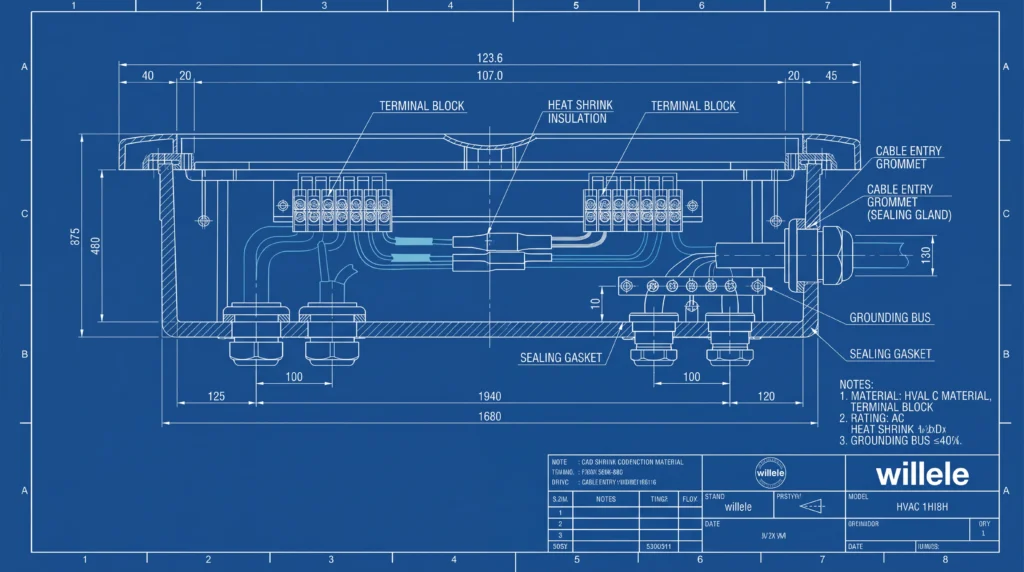
Alt text: Technical schematic diagram showing cross-sectional view of a junction box with detailed annotations for wire connections, heat shrink tube insulation, terminal blocks, and cable entry systems
Junction Box Comparison for HVAC Applications
| Feature | Standard Commercial Grade | Industrial Grade | Premium HVAC-Specific |
|---|---|---|---|
| NEMA Rating | NEMA 1/3 | NEMA 4/4X | NEMA 4X/IP66 |
| Material | Cold-rolled steel | Stainless steel 304 | Polycarbonate/stainless |
| Operating Temperature | -10°C to 50°C | -20°C to 60°C | -40°C to 80°C |
| Vibration Rating | Standard | Enhanced | Heavy-duty dampening |
| Mounting Options | Surface only | Surface/pendant | Multiple with isolation |
| Corrosion Resistance | Basic powder coat | Epoxy coating | UV/chemical resistant |
| Price Range | $ | $$ | $$$ |
| Typical Lifespan | 5-7 years | 10-15 years | 15-20+ years |
| Best Applications | Indoor dry locations | General industrial | Rooftop/corrosive environments |
| Certifications | UL listed | UL/CSA listed | UL/CSA/CE, marine grade |
Code Compliance and Inspection Considerations
National Electrical Code References
Junction box installations in HVAC systems must comply with multiple NEC articles:
- Article 110.26: Working space requirements around electrical equipment
- Article 300.4: Protection against physical damage
- Article 314: Outlet, device, pull, and junction box specifications
- Article 440: Air-conditioning and refrigerating equipment
- Article 725: Class 2 and Class 3 remote-control circuits
Inspection Checklist
Before final inspection, verify the following:
- Junction boxes properly sized for conductor fill per NEC 314.16
- Adequate working space provided per NEC 110.26
- All knockouts sealed with appropriate plugs
- Equipment grounding conductors properly terminated
- Bushings installed to protect conductor insulation
- Covers securely fastened with all screws installed
- Box fill calculations documented and available
- Conductor ampacity properly derated for ambient temperature
- Low and line voltage conductors properly separated
- All connections secure with no exposed copper visible
Advanced Considerations for Complex HVAC Systems
Variable Frequency Drive (VFD) Installations
VFDs generate electrical noise that can interfere with control circuits. Junction box placement and construction should include:
- Shielded cables with proper grounding at junction points
- Segregated high and low voltage junction boxes
- Ferrite cores or noise filters at terminations
- Metallic enclosures for improved electromagnetic compatibility
Building Automation System (BAS) Integration
Modern HVAC systems often integrate with building automation networks requiring:
- Communication cable junction boxes with signal integrity protection
- Separate pathways for power and data conductors
- Surge protection devices at junction points
- Easy-access enclosures for commissioning and adjustments
Maintenance and Troubleshooting
Proper junction box installation simplifies ongoing maintenance:
- Document all junction box locations on system drawings
- Maintain consistent wire color coding throughout the installation
- Use transparent or window-equipped covers where code permits for visual inspection
- Schedule periodic torque checks on terminal connections
- Inspect seals and gaskets annually for degradation
Frequently Asked Questions
Q: What size junction box do I need for a 5-ton rooftop HVAC unit?
A: For a typical 5-ton unit requiring 30-amp, 240-volt power plus control wiring, plan for a minimum 8″ x 8″ x 4″ deep junction box. However, always calculate exact box fill per NEC 314.16 using the specific conductor count and sizes in your installation. Include capacity for future additions.
Q: Can I use a standard plastic junction box for outdoor HVAC installations?
A: Standard plastic boxes lack UV resistance and weatherproof sealing required for outdoor exposure. Use NEMA 4X-rated enclosures specifically designed for outdoor HVAC applications, typically constructed from UV-resistant polycarbonate or stainless steel.
Q: How do I prevent condensation inside junction boxes in humid mechanical rooms?
A: Install junction boxes with integral drain holes (when code permits), use desiccant packs for moisture absorption, ensure proper sealing with heat shrink tubing at all wire entries, and consider heated enclosures for extreme conditions. Maintaining positive pressure within the box using dry nitrogen can also prevent moisture ingress.
Q: What is the maximum number of splices allowed in a junction box?
A: The NEC does not specify a maximum splice count; rather, box sizing depends on total conductor volume. Calculate box fill using NEC Table 314.16(A) and (B), ensuring the total conductor volume does not exceed the box’s cubic inch capacity. When in doubt, use a larger box.
Q: Do junction boxes for low-voltage HVAC controls require the same ratings as power boxes?
A: While low-voltage control boxes don’t require the same electrical safety clearances, they still need appropriate environmental protection for their location. Additionally, maintain separation between line voltage and low voltage conductors—either through separate boxes or listed barriers within shared enclosures.
Q: How often should HVAC junction boxes be inspected?
A: Conduct visual inspections annually as part of routine HVAC maintenance, checking for loose connections, corrosion, damaged insulation, and compromised seals. Perform detailed torque verification and thermal imaging every 3-5 years to identify potential issues before failure.
Conclusion
Selecting and installing proper junction boxes for HVAC system installations requires attention to environmental conditions, code compliance, and long-term reliability factors. By understanding NEMA ratings, material options, sizing requirements, and installation best practices, contractors and facility managers can ensure their HVAC electrical infrastructure performs reliably for decades.
Willele Electric manufactures a complete line of junction boxes and heat shrink tube solutions specifically engineered for the demanding conditions found in HVAC applications. Our products undergo rigorous testing to ensure compliance with industry standards while providing the durability and performance that professional installers demand. Contact our technical support team for assistance specifying the right junction box solutions for your next HVAC project.
