
Busbar Insulators in Electric Vehicle Charging Infrastructure

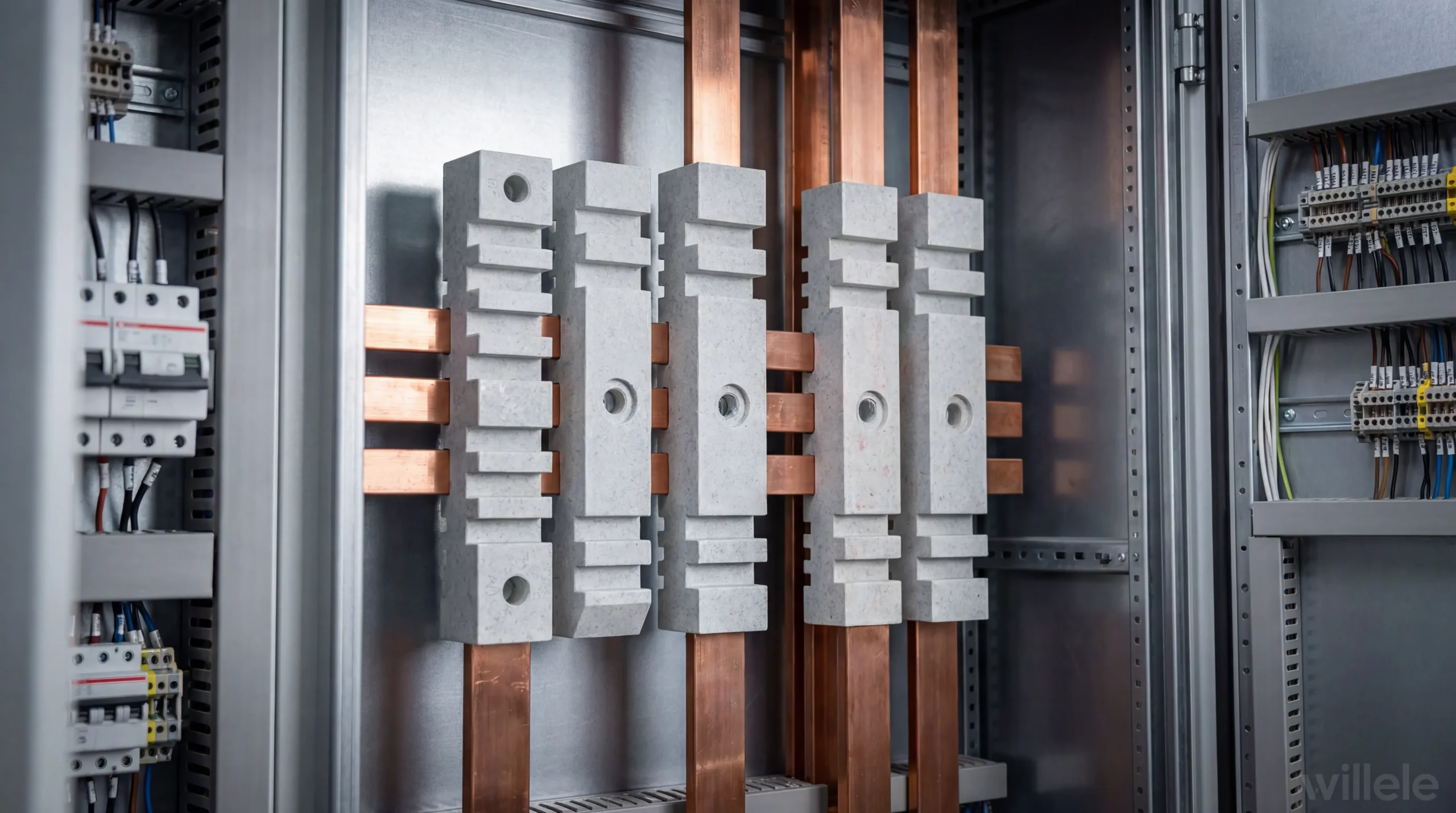
As electric vehicle adoption accelerates globally, the infrastructure supporting EV charging stations has become increasingly sophisticated. At the heart of safe and efficient power distribution within these systems lies a critical yet often overlooked component: busbar insulators. These specialized devices ensure reliable electrical isolation, prevent short circuits, and maintain operational safety in high-power charging environments where currents can exceed 500A and voltages reach up to 1500V DC.
Understanding Busbar Insulators in EV Charging Systems
Busbar insulators serve as the protective barrier between high-current conductors and grounded structures in EV charging infrastructure. In DC fast charging stations, where power levels can reach 350kW or higher, these insulators must withstand extreme electrical stress, thermal cycling, and environmental exposure while maintaining their dielectric properties.
A busbar system essentially consists of an electric conductor and ground plane separated by an insulator. The insulation material’s performance directly impacts the charging station’s reliability, safety margins, and operational lifespan. Modern EV charging infrastructure demands insulators that can handle not only high voltage and current but also the thermal loads generated during rapid charging cycles.
Key Material Options for EV Charging Applications
The selection of insulator materials significantly influences the performance and durability of busbar systems in EV charging stations. Each material offers distinct advantages suited to specific operational requirements.
Material Comparison Table
| Material | Voltage Range | Temperature Resistance | Key Advantages | Typical Applications |
|---|---|---|---|---|
| BMC (Bulk Molding Compound) | 660V – 4500V | -40°C to 140°C | Cost-effective, impact-resistant, good electrical properties | Level 2 AC charging stations, distribution panels |
| SMC (Sheet Molding Compound) | 660V – 4500V | -40°C to 140°C | Superior mechanical strength, excellent for large components | DC fast charging stations, high-power applications |
| Epoxy Resin | Up to 10kV | -40°C to 155°C | Excellent moisture resistance, high mechanical strength | Outdoor charging stations, harsh environments |
| Ceramic (Porcelain) | Up to 36kV | -50°C to 200°C | Outstanding thermal stability, chemical resistance | Ultra-high voltage applications, extreme environments |
| Polymer Composites | 1kV – 15kV | -40°C to 130°C | Lightweight, UV-resistant, flexible design | Outdoor installations, coastal environments |
BMC vs. SMC: Critical Differences for Charging Infrastructure
For EV charging applications, the choice between BMC and SMC materials often determines system reliability. BMC utilizes shorter glass fibers (3-12mm), making it ideal for smaller, high-volume components with complex geometries. Its lower viscosity enables intricate molding details and threaded inserts commonly required in modular charging station designs.
SMC, with its longer glass fiber reinforcement (12-50mm), delivers superior flexural strength—often 30-40% higher than BMC. This mechanical advantage proves essential in DC fast charging stations where heavy copper busbars create significant cantilever loads on support insulators. The longer fibers distribute stress more effectively, preventing mechanical failure under sustained high-current operation.
Technical Requirements and Standards Compliance
EV charging infrastructure must comply with rigorous international standards that govern busbar insulator specifications, safety distances, and performance criteria.
Applicable Standards for EV Charging Busbars
| Standard | Scope | Key Requirements | Voltage Range |
|---|---|---|---|
| IEC 61851 | EV charging systems general requirements | Charging modes, safety protocols, grounding | Up to 1000V AC / 1500V DC |
| IEC 62196-3 | DC charging connectors and interfaces | Thermal limits (90°C max), current capacity | Up to 850V, 125A+ |
| IEC 61439 | Low-voltage switchgear assemblies | Thermal performance, design verification | Up to 1000V AC / 1500V DC |
| GB/T 20234 | Chinese EV charging standard | Insulation resistance, ground continuity | Up to 750V DC |
| SAE J1772 | North American charging standard | Connector specifications, safety features | Level 1/2 AC, DC fast charging |
Critical Electrical Parameters
Clearance and Creepage Distances: IEC 61439 mandates minimum clearance distances of 20mm for bare copper busbars to prevent phase-to-phase or phase-to-ground faults. In high-pollution or high-humidity environments, creepage distances must be increased by 25-40% to maintain insulation integrity.
Insulation Resistance: EV charging stations must maintain insulation resistance above 1MΩ per IEC 61851 requirements. This ensures that leakage currents remain below safe thresholds even during prolonged operation at maximum rated current.
Thermal Performance: DC fast charging generates substantial heat, with busbar temperatures potentially exceeding 90°C at connection points. Insulators must maintain their dielectric properties throughout the operating temperature range while exhibiting low thermal expansion coefficients to prevent mechanical stress on connections.
Design Considerations for Charging Station Busbars
Current-Carrying Capacity and Thermal Management
Modern DC fast charging stations operate at power levels from 50kW to 350kW, requiring busbars capable of handling 125A to 500A continuously. Copper busbars typically range from 0.5mm to 2.5mm thickness for battery cell connections, while module-level connections require thicker conductors (3-6mm) due to higher current demands.
Busbar insulators must accommodate thermal expansion of conductors without compromising electrical isolation. Materials with thermal resistance ratings of 140°C or higher (such as BMC/SMC) provide adequate safety margins for continuous high-power operation. In ultra-fast charging applications (350kW+), active cooling systems may be integrated with busbar assemblies, requiring insulators compatible with liquid coolant exposure.
Mechanical Strength and Vibration Resistance
Unlike stationary power distribution systems, EV charging infrastructure faces unique mechanical challenges. Charging cables exert pulling forces on connectors, while outdoor installations experience wind loading and thermal cycling. Support insulators must provide adequate mechanical strength to prevent busbar displacement or conductor contact with grounded enclosures.
SMC insulators demonstrate superior performance in these applications, with flexural strength values typically exceeding 150 MPa compared to 100-120 MPa for BMC. This 30-40% strength advantage translates directly to longer service life and reduced maintenance requirements in demanding charging station environments.
Environmental Protection Requirements
Outdoor charging stations must withstand UV radiation, temperature extremes (-40°C to +50°C ambient), moisture ingress, and pollution. Polymer-based insulators with UV stabilizers offer excellent weathering resistance, while epoxy resin formulations provide superior moisture barrier properties essential for coastal or high-humidity installations.
IP54 or higher ingress protection ratings are recommended for charging station busbars, with heat-resistant insulation materials (PI, PFA, or ceramic coatings) specified for high-load DC fast charging applications.
Application-Specific Insulator Selection Guide
Level 2 AC Charging Stations (7-22kW)
Recommended Materials: BMC or standard epoxy resin insulators
Voltage Requirements: 208-240V AC single-phase or 400-480V three-phase
Key Considerations: Cost-effectiveness, compact design, moderate thermal loads
Level 2 charging stations represent the most common commercial and residential installation type. BMC insulators provide optimal cost-performance balance, offering adequate electrical and thermal properties for continuous 32A-80A operation. Standard post-type or support insulators with M6-M10 threaded inserts facilitate modular assembly and maintenance.
DC Fast Charging Stations (50-150kW)
Recommended Materials: SMC, high-grade epoxy resin, or polymer composites
Voltage Requirements: 200-500V DC, currents up to 350A
Key Considerations: Enhanced mechanical strength, thermal management, space efficiency
Mid-power DC fast charging demands insulators with superior mechanical properties to support heavier copper busbars and withstand higher thermal cycling. SMC insulators excel in these applications, providing the structural integrity needed for reliable long-term operation. Thermal management becomes critical, with insulator materials requiring continuous temperature ratings of 130-140°C.
Ultra-Fast Charging Stations (150-350kW+)
Recommended Materials: High-performance epoxy resin, ceramic composites, or specialized polymer formulations
Voltage Requirements: 400-1000V DC, currents exceeding 400A
Key Considerations: Maximum thermal performance, minimal electrical losses, active cooling compatibility
Ultra-fast charging infrastructure represents the most demanding application for busbar insulators. Operating currents of 400-500A generate significant I²R heating, requiring insulators with exceptional thermal conductivity and temperature resistance. Ceramic-enhanced polymer composites or high-temperature epoxy formulations (rated to 155°C+) ensure reliable operation under sustained high-power conditions.
Active cooling systems, which circulate liquid coolant through or adjacent to busbars, necessitate insulators with chemical resistance to glycol-based coolants and compatibility with thermal interface materials. citation
Installation Best Practices
Proper Spacing and Support Configuration
IEC 61439 guidelines specify minimum support spacing based on busbar dimensions and current rating. For horizontal busbar runs carrying 400A or more, support insulators should be positioned at intervals not exceeding 600mm to prevent excessive deflection. Vertical installations may extend this spacing to 800mm due to reduced gravitational stress.
Recommended Support Spacing Table
| Current Rating | Horizontal Spacing | Vertical Spacing | Insulator Type |
|---|---|---|---|
| 100-200A | 800mm | 1000mm | BMC post insulator |
| 200-400A | 600mm | 800mm | SMC post insulator |
| 400-630A | 500mm | 700mm | SMC support insulator |
| 630A+ | 400mm | 600mm | Heavy-duty SMC or epoxy |
Torque Specifications and Connection Integrity
Proper torque application on busbar connections prevents both over-tightening (which can crack insulators) and under-tightening (leading to high-resistance connections and thermal hotspots). Manufacturer specifications typically range from 4-8 Nm for M6 fasteners to 15-25 Nm for M10 connections.
Thread inserts in BMC/SMC insulators should be steel with zinc coating or brass to prevent galvanic corrosion and ensure long-term mechanical integrity. Periodic torque verification (annually for outdoor installations, bi-annually for indoor) maintains connection reliability throughout the charging station’s operational life.
Environmental Sealing and Protection
Outdoor charging station busbars require additional protection against moisture ingress and contamination. Heat-shrink insulation sleeves, epoxy encapsulation, or conformal coatings enhance insulator surface resistance and prevent tracking failures in polluted environments. For coastal installations, specify insulators with enhanced creepage distances (20-30% above standard values) to compensate for salt contamination effects.
Cost Analysis and Long-Term Value
Initial Investment vs. Lifecycle Costs
While high-performance ceramic or advanced epoxy insulators may cost 20-30% more than standard BMC components, their extended service life and reduced maintenance requirements often justify the premium. Industry data indicates that ceramic insulators in harsh environments can deliver 15-20 year service life compared to 8-12 years for standard polymer materials.
Failure Cost Considerations
Busbar insulator failure in an operational charging station incurs costs far beyond component replacement. Downtime for a commercial DC fast charging station can result in lost revenue of $$200-500 per day, while emergency repairs typically cost 3-5 times standard maintenance rates. Specifying appropriate insulator materials during initial installation minimizes these lifecycle costs.
Performance Optimization Table
| Cost Factor | BMC Solution | SMC Solution | Premium Epoxy/Ceramic |
|---|---|---|---|
| Initial Unit Cost | $$5-15 | $$12-25 | $$25-60 |
| Expected Service Life | 8-12 years | 12-18 years | 15-25 years |
| Maintenance Frequency | Annual inspection | Bi-annual inspection | Minimal (every 3-5 years) |
| Failure Risk (10-year) | 8-12% | 3-5% | <2% |
| Total Cost of Ownership | Baseline | +15-20% | +25-35% |
| Recommended Application | Level 2 AC charging | DC fast charging | Ultra-fast / harsh environment |
Quality Assurance and Testing
Critical Performance Tests
Busbar insulators for EV charging applications should undergo comprehensive testing to verify compliance with electrical, mechanical, and environmental specifications:
Electrical Testing:
- Dielectric strength test: Minimum 3.5kV AC for 1 minute (for 1kV rated systems)
- Insulation resistance: >1000 MΩ at rated voltage
- Partial discharge testing: <10pC at 1.5x rated voltage
Mechanical Testing:
- Flexural strength: Minimum 100 MPa for BMC, 150 MPa for SMC
- Impact resistance: Withstand 5J impact without cracking
- Vibration testing: 10-500 Hz sweep per IEC 60068-2-6
Thermal Testing:
- Continuous temperature rating verification: 140°C for 1000 hours
- Thermal cycling: -40°C to +140°C, 500 cycles
- Flammability: UL94 V0 rating required
Environmental Testing:
- Salt spray resistance: 500 hours per ASTM B117
- UV aging: 1000 hours QUV exposure with <20% property degradation
- Humidity resistance: 95% RH at 40°C for 500 hours
Certification Requirements
Reputable manufacturers provide CE, UL, RoHS, and SGS certifications for busbar insulators used in EV charging infrastructure. These certifications verify material composition, electrical safety, and environmental compliance—essential for installations subject to regulatory inspection and insurance requirements.
Future Trends and Innovations
Next-Generation Materials
Research into advanced composite materials promises insulators with enhanced performance characteristics. Nano-ceramic filled polymers demonstrate 40-50% improvement in thermal conductivity while maintaining excellent electrical insulation properties. These materials enable more compact busbar designs and improved thermal management in ultra-high-power charging applications (500kW+).
Smart Insulator Technology
Emerging “intelligent” busbar systems integrate temperature sensors and partial discharge monitoring directly into insulator assemblies. These smart components enable predictive maintenance, alerting operators to degradation before failure occurs. Early detection of thermal anomalies or insulation deterioration can prevent costly unplanned downtime and enhance charging network reliability.
Sustainability Considerations
Environmental concerns drive development of bio-based insulator materials and improved recyclability. Next-generation epoxy formulations incorporate renewable feedstocks while maintaining performance characteristics. Copper and aluminum busbars remain highly recyclable (>95% recovery rate), and manufacturers increasingly design insulators for end-of-life disassembly and material recovery.
Frequently Asked Questions
Q: What is the typical lifespan of busbar insulators in EV charging stations?
A: Lifespan varies by material and operating conditions. BMC insulators typically last 8-12 years in standard applications, SMC insulators 12-18 years, and high-grade ceramic or epoxy insulators 15-25 years. Harsh environmental conditions (extreme temperatures, high pollution, coastal exposure) can reduce these values by 20-30%.
Q: How do I determine the correct insulator material for my charging station project?
A: Consider three primary factors: (1) Power level—Level 2 AC charging can use BMC, while DC fast charging requires SMC or epoxy; (2) Environmental conditions—outdoor installations need UV-resistant polymers or epoxy with enhanced creepage distances; (3) Budget constraints—balance initial cost against lifecycle value and expected service life.
Q: What are the most common failure modes for busbar insulators?
A: The three primary failure mechanisms are: (1) Thermal degradation from sustained overcurrent or poor ventilation, leading to reduced dielectric strength; (2) Mechanical cracking from excessive busbar deflection or improper installation torque; (3) Surface tracking in contaminated environments, particularly in coastal or industrial locations with inadequate creepage distances.
Q: Can I retrofit existing charging stations with upgraded insulators?
A: Yes, insulator upgrades are feasible during scheduled maintenance. When upgrading, verify dimensional compatibility, fastener thread specifications, and electrical ratings. Upgrading from BMC to SMC insulators can significantly improve mechanical reliability in high-power applications, though mounting hole patterns must match existing busbar configurations.
Q: What maintenance is required for busbar insulators in charging infrastructure?
A: Annual visual inspection for cracks, discoloration, or contamination buildup is recommended. Verify torque specifications on all connections annually (bi-annually for outdoor installations). Clean insulator surfaces in polluted environments every 6-12 months. Thermal imaging surveys every 2-3 years can identify developing hotspots before failure occurs.
Q: Are there specific requirements for insulators in bidirectional (V2G) charging systems?
A: Bidirectional charging systems follow the same insulator specifications as standard DC fast charging, as the electrical stress remains comparable. However, increased charge-discharge cycling may accelerate thermal aging, making higher-temperature-rated materials (140°C+ continuous) advisable for V2G applications with frequent power flow reversals.
