
Solar Power Installations: Fire-Safe Heat-Shrink Tubing Requirements

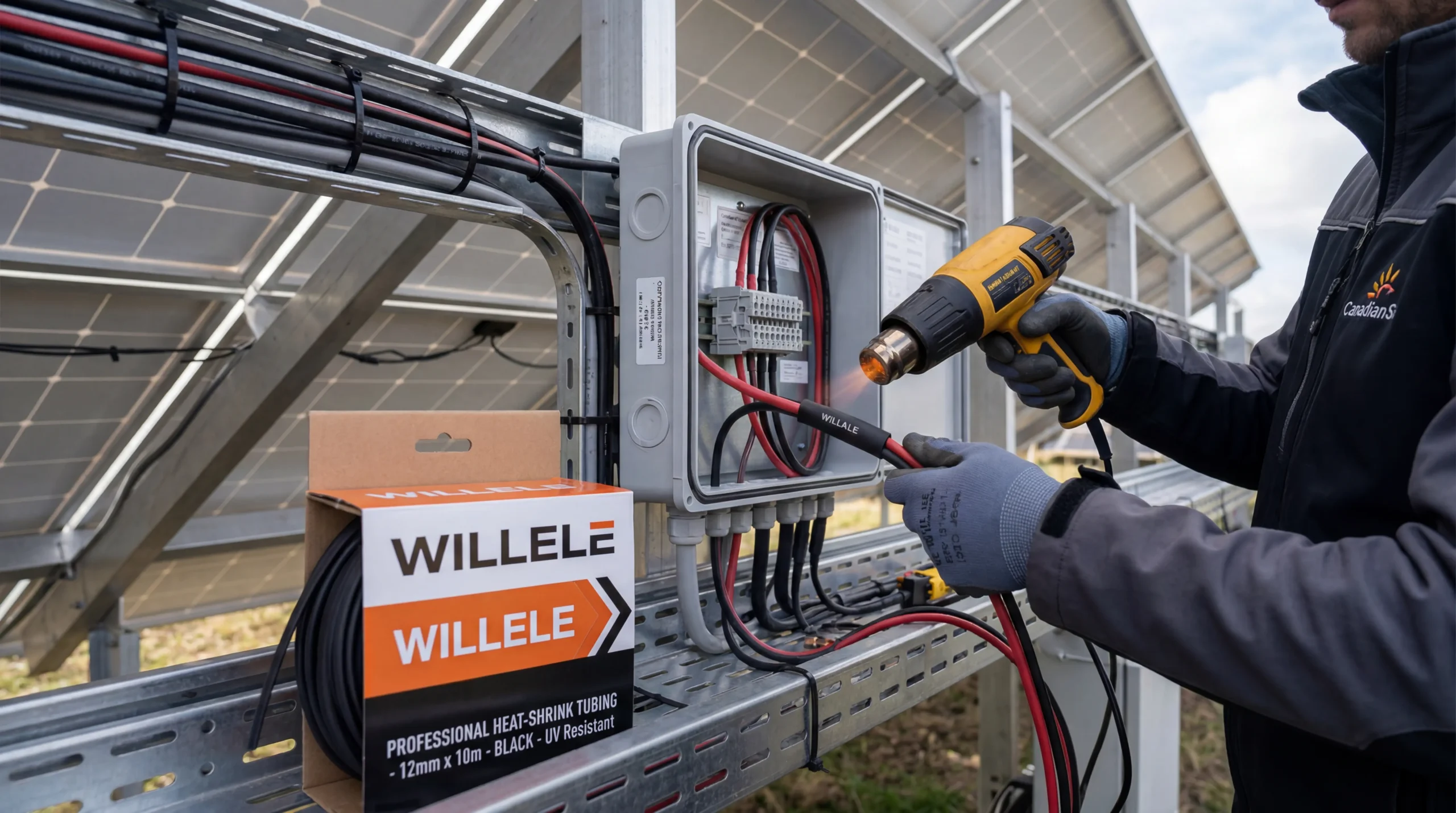
As solar energy systems continue their rapid expansion across residential, commercial, and utility-scale installations, the critical importance of fire-safe electrical components has never been more apparent. Heat-shrink tubing serves as a fundamental protective element in photovoltaic (PV) systems, providing essential insulation, environmental sealing, and flame resistance for interconnecting wires and cable assemblies. With solar installations often exposed to extreme weather conditions, intense UV radiation, and elevated operating temperatures, selecting the appropriate heat-shrink tubing becomes a matter of both performance reliability and life safety.
The solar industry has witnessed several high-profile incidents where inadequate electrical insulation contributed to system failures and fire hazards. These events have prompted stricter regulatory oversight and heightened awareness among installers, engineers, and system owners about the necessity of using properly certified, fire-retardant materials. Understanding the technical requirements, industry standards, and material specifications for heat-shrink tubing in solar applications is essential for anyone involved in designing, installing, or maintaining photovoltaic systems.
Why Fire Safety Matters in Solar Installations
Solar power systems operate under uniquely challenging conditions that amplify fire risks compared to conventional electrical installations. Photovoltaic arrays generate DC power at voltages ranging from 600V to over 1500V in modern utility-scale systems, creating potential arc flash hazards if insulation fails. Unlike AC systems where current alternates and arcs tend to self-extinguish, DC arcs can sustain themselves indefinitely once initiated, generating temperatures exceeding 3000°C that can rapidly ignite surrounding materials.
The outdoor environment compounds these risks significantly. Solar installations endure decades of exposure to intense sunlight, temperature cycling from sub-zero winters to scorching summers, moisture infiltration, and physical stress from wind loading and thermal expansion. Cable connections on rooftops or in field-mounted arrays face particularly harsh conditions, where a single point of insulation failure can compromise an entire string or even trigger a cascading system failure. Heat-shrink tubing provides the critical barrier that prevents moisture ingress, maintains dielectric integrity, and contains potential fault conditions before they escalate into fire events.
Beyond immediate safety concerns, fire incidents in solar installations carry severe financial and reputational consequences. Insurance claims, system downtime, remediation costs, and potential liability exposure can far exceed the modest incremental cost of specifying proper fire-rated materials during initial installation. Regulatory authorities increasingly scrutinize solar fire incidents, and installations found to have used non-compliant materials may face citations, mandatory retrofits, or even system shutdowns.
Understanding UL 224 and Fire-Retardant Standards
The cornerstone standard for heat-shrink tubing in electrical applications is UL 224, the Standard for Extruded Insulating Tubing. This comprehensive specification establishes rigorous testing protocols for physical properties, dielectric strength, environmental resistance, and flammability performance. For solar installations, UL 224 certification provides essential assurance that tubing will perform reliably under the demanding conditions characteristic of photovoltaic systems.
UL 224 testing evaluates multiple critical parameters including tensile strength and elongation to ensure mechanical durability, dielectric withstand and breakdown voltage to verify electrical insulation integrity, and cold temperature flexibility to confirm the material remains functional in winter conditions. The standard also assesses resistance to copper corrosion, a particularly important consideration given that most solar cables use copper conductors. For heat-shrinkable products, the standard includes specific recovery testing to verify that tubing shrinks uniformly and maintains its protective properties after installation.
The flammability component of UL 224 typically incorporates VW-1 (Vertical Wire) flame testing from UL 1581. This test subjects a vertical sample to direct flame application and measures flame propagation, afterglow duration, and whether burning material drips from the specimen. To achieve VW-1 rating, heat-shrink tubing must self-extinguish within 60 seconds after flame removal, exhibit no more than 60 seconds of afterglow, and not ignite surgical cotton placed below the test specimen with any dripping material. This ensures that even if tubing is exposed to a flame source, it will not contribute significantly to fire spread.
Recent developments in UL 224 certification have expanded to address higher voltage applications increasingly common in solar installations. UL Solutions now offers testing up to 2000V specifically targeting emerging applications including photovoltaic systems, battery energy storage, EV charging infrastructure, and DC microgrids. This enhanced certification enables manufacturers to demonstrate compliance for the elevated voltage levels encountered in modern solar installations, where string voltages have steadily increased to improve system efficiency.
Material Selection for Solar Applications
Selecting the appropriate heat-shrink tubing material represents a critical engineering decision that directly impacts system longevity, safety, and maintenance requirements. Different polymer formulations offer distinct advantages and limitations that must be carefully matched to specific application requirements within the solar installation.
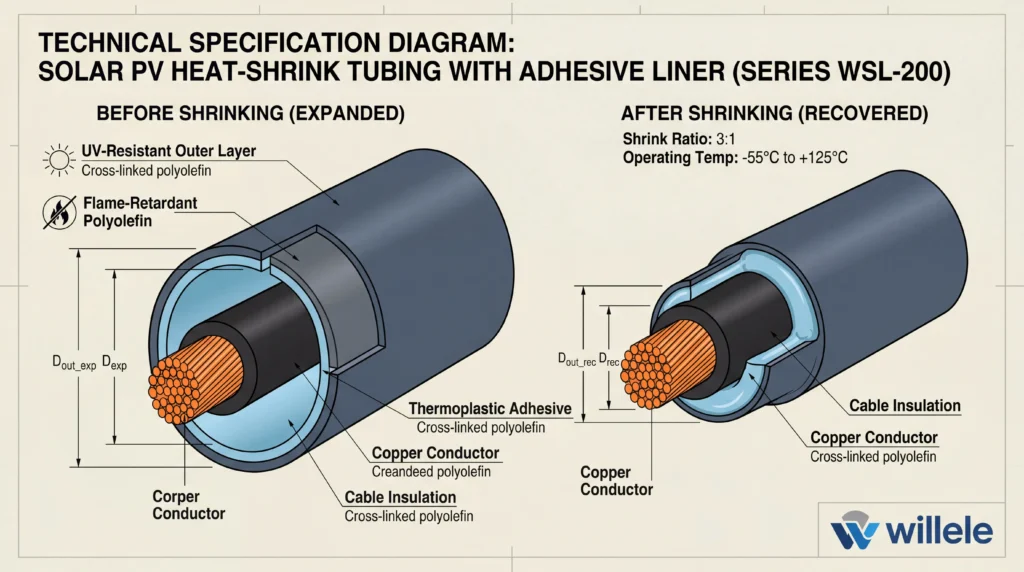
Cross-linked polyolefin stands as the most widely specified material for general-purpose solar applications. This thermoplastic polymer undergoes a cross-linking process that creates three-dimensional molecular bonds, resulting in superior thermal stability, chemical resistance, and mechanical strength compared to non-cross-linked alternatives. Cross-linked polyolefin tubing typically operates reliably across a temperature range of -55°C to +125°C, accommodating the extreme thermal cycling experienced by outdoor solar installations. The material exhibits excellent dielectric properties with breakdown voltages exceeding 500 V/mil for smaller diameters, providing robust electrical insulation for both low-voltage and medium-voltage solar circuits. When formulated with flame-retardant additives, cross-linked polyolefin readily achieves UL 224 VW-1 certification while maintaining flexibility and ease of installation.
Fluoropolymer tubing, including materials such as PVDF (polyvinylidene fluoride) and FEP (fluorinated ethylene propylene), serves specialized high-performance applications where standard polyolefin materials prove inadequate. These premium materials offer exceptional resistance to UV radiation, making them ideal for exposed cable connections that cannot be shielded from direct sunlight. Fluoropolymers maintain their properties at elevated temperatures up to 175°C or higher, providing additional safety margin in high-ambient-temperature environments or where cables may experience significant solar heating. The inherent flame resistance of fluoropolymer chemistry often eliminates the need for additional flame-retardant additives, and these materials generate minimal smoke and toxic gases if exposed to fire. However, fluoropolymer tubing commands a significant price premium and requires higher shrink temperatures during installation, factors that limit its use to critical applications where its superior properties justify the additional cost.
Adhesive-lined dual-wall tubing provides enhanced environmental sealing for applications requiring moisture protection beyond what single-wall tubing can deliver. These products feature an outer cross-linked polyolefin layer for mechanical protection and flame resistance, combined with an inner thermoplastic adhesive layer that melts and flows during heat shrinking to create a complete moisture barrier. In solar installations, dual-wall tubing finds particular application in ground-mounted systems where cable connections may be exposed to standing water, in coastal environments with salt spray exposure, or in any location where long-term moisture ingress could compromise electrical integrity. The adhesive layer also provides strain relief and vibration damping, protecting solder joints and crimp connections from mechanical fatigue.
Halogen-free formulations have gained increasing specification in solar projects driven by environmental, safety, and regulatory considerations. Traditional flame-retardant additives often contained halogenated compounds such as bromine or chlorine, which can generate corrosive and toxic gases when exposed to fire. Halogen-free heat-shrink tubing utilizes alternative flame-retardant technologies based on mineral fillers and phosphorus compounds, delivering comparable fire performance while producing significantly lower smoke density and toxicity during combustion. Many European markets now mandate halogen-free materials for building-integrated photovoltaic systems, and this requirement is expanding globally as environmental regulations tighten.
Critical Specifications for PV Systems
Beyond material selection, several technical specifications must be carefully evaluated to ensure heat-shrink tubing performs reliably throughout the 25-30 year design life of a typical solar installation.
Shrink ratio defines the dimensional change the tubing undergoes when heated, expressed as the ratio of supplied diameter to fully recovered diameter. Standard 2:1 shrink ratio tubing accommodates moderate size variations and provides adequate wall thickness for most solar cable terminations and splices. However, 3:1 and even 4:1 shrink ratios offer significant advantages in solar applications where cable bundles may vary substantially in diameter or where a single tubing size must accommodate multiple cable gauges. Higher shrink ratios also enable thinner supplied wall thickness for a given recovered dimension, improving flexibility and reducing the bulk of cable assemblies in crowded junction boxes or combiner enclosures.
Operating temperature range must encompass the full environmental extremes the installation will experience, plus adequate safety margin for abnormal conditions. While most cross-linked polyolefin tubing rates for continuous operation at 125°C, solar cables on dark rooftops can reach surface temperatures approaching 90°C on summer afternoons. When combined with the self-heating effect of current flow through the conductor, cable temperatures may approach or exceed 100°C under worst-case conditions. Specifying tubing with a 125°C rating provides only modest margin; for critical applications or extreme climates, materials rated to 135°C or 150°C offer greater long-term reliability. Cold temperature performance proves equally important, as tubing must remain flexible and maintain its grip on the cable during winter conditions when thermal contraction creates maximum mechanical stress.
UV resistance represents a critical but often overlooked specification for solar installations. Standard heat-shrink tubing formulations may degrade rapidly when exposed to direct sunlight, with UV radiation breaking down polymer chains and causing embrittlement, cracking, and loss of electrical insulation properties. Solar-grade tubing incorporates UV stabilizers and carbon black pigmentation to block harmful radiation and extend outdoor service life. Manufacturers typically specify UV resistance in terms of exposure hours in accelerated weathering chambers, with quality solar-grade products demonstrating minimal property degradation after 2000+ hours of testing equivalent to decades of real-world exposure.
Dielectric strength determines the voltage the insulation can withstand before electrical breakdown occurs. UL 224 specifies minimum dielectric strength of 500 V/mil (19.7 kV/mm) for tubing up to 12.7mm diameter and 600 V/mil (23.6 kV/mm) for larger sizes. For solar installations operating at 600V or higher, adequate dielectric strength provides essential safety margin against voltage transients, partial discharge, and insulation degradation over time. Quality manufacturers typically exceed minimum UL 224 requirements, with premium products offering dielectric strength of 800 V/mil or higher.
Comparison of Heat-Shrink Tubing Types for Solar Applications
| Tubing Type | Temperature Range | UV Resistance | Flame Rating | Typical Applications | Relative Cost |
|---|---|---|---|---|---|
| Standard Polyolefin | -55°C to +125°C | Moderate | UL 224 VW-1 | Indoor junction boxes, combiner enclosures | $ |
| UV-Stabilized Polyolefin | -55°C to +135°C | Excellent | UL 224 VW-1 | Outdoor cable connections, rooftop installations | $$ |
| Adhesive-Lined Dual-Wall | -55°C to +125°C | Good to Excellent | UL 224 VW-1 | Ground-mount systems, moisture-prone environments | $$$ |
| PVDF Fluoropolymer | -55°C to +175°C | Outstanding | Inherent flame resistance | High-temperature, high-UV exposure applications | |
| Halogen-Free Polyolefin | -55°C to +125°C | Good | UL 224 VW-1, Low smoke | Building-integrated PV, environmentally sensitive sites | $$ |
Installation Best Practices
Proper installation technique proves just as critical as material selection in ensuring heat-shrink tubing delivers its intended protection. Even the highest-quality, properly specified tubing will fail prematurely if installed incorrectly.
Surface preparation begins with thorough cleaning of the cable or connector to remove any contamination, oxidation, or moisture that could compromise adhesion or create localized stress points. For adhesive-lined tubing, surface preparation becomes especially critical, as any contamination will prevent the adhesive from bonding properly and create pathways for moisture infiltration. Installers should use isopropyl alcohol or approved cleaning solvents to wipe down all surfaces, allowing complete evaporation before applying tubing.
Heat application method significantly impacts shrink uniformity and final properties. Hot air guns provide the most controlled and even heating for field installations, allowing the installer to direct heat precisely and monitor the shrinking process visually. When using hot air, maintain a distance of 6-8 inches from the tubing surface and keep the heat source moving continuously in a sweeping motion to prevent localized overheating. Propane torches can shrink tubing quickly but require extreme care to avoid flame contact with the material, which can cause charring, property degradation, or even ignition. Always use a flame diffuser attachment and maintain adequate distance, starting farther away and gradually moving closer as the tubing begins to shrink. For large-scale installations or factory assembly, convection ovens provide the most uniform heating and repeatable results, though they lack the flexibility of portable heat sources for field work.
Shrink verification ensures the tubing has fully recovered and formed a tight seal around the cable. Properly shrunk tubing should show no wrinkles or air gaps, should grip the cable firmly enough to resist rotation under moderate hand pressure, and should display uniform wall thickness around the entire circumference. For adhesive-lined products, small beads of adhesive should be visible emerging from both ends of the tubing, confirming that the inner layer has melted and flowed to create a complete environmental seal. Under-shrinking leaves gaps that allow moisture infiltration and reduces mechanical grip, while over-shrinking from excessive heat can degrade material properties and reduce long-term reliability.
Regulatory Compliance and Documentation
Solar installations must satisfy multiple layers of regulatory requirements, with heat-shrink tubing specifications playing a role in overall system certification and approval.
National Electrical Code (NEC) Article 690 establishes requirements for solar photovoltaic systems in the United States, including specifications for conductors, overcurrent protection, and grounding. While the NEC does not explicitly mandate specific heat-shrink tubing standards, it requires that all materials and equipment be listed or labeled by a qualified testing laboratory, which effectively necessitates UL 224 or equivalent certification for insulating tubing used in PV installations. The 2023 NEC introduced enhanced requirements for rapid shutdown systems and arc-fault protection, both of which place additional emphasis on maintaining robust electrical insulation throughout the system.
International standards including IEC 62852 (Connectors for DC-application in photovoltaic systems) and IEC 60216 (Electrical insulation – Thermal endurance properties) provide globally recognized benchmarks for PV component performance. Solar installations pursuing international certification or operating in markets outside North America must verify that heat-shrink tubing meets applicable IEC requirements in addition to or instead of UL standards.
Documentation and traceability have become increasingly important as authorities having jurisdiction (AHJs) and insurance underwriters scrutinize solar installations more carefully. Installers should maintain records of all materials used, including manufacturer datasheets, UL certification documents, and lot numbers for heat-shrink tubing. This documentation proves invaluable if questions arise during inspection, if warranty claims require investigation, or if system modifications necessitate matching existing materials. Leading solar EPC contractors now implement quality management systems that track every component installed, creating a complete material genealogy for each project.
Emerging Technologies and Future Trends
The heat-shrink tubing industry continues to evolve in response to changing solar technology and increasingly stringent performance requirements.
Higher voltage ratings reflect the industry’s ongoing transition toward elevated DC voltages to reduce current levels and improve system efficiency. As mentioned earlier, UL Solutions now certifies tubing to 2000V, supporting the 1500V systems that have become standard for utility-scale installations and the emerging 2000V+ architectures under development. These higher voltages demand enhanced dielectric properties, thicker insulation walls, and more rigorous quality control to prevent partial discharge and premature failure.
Smart materials incorporating condition monitoring capabilities represent an emerging frontier in electrical insulation technology. Researchers are developing heat-shrink tubing embedded with sensors that can detect moisture infiltration, measure insulation resistance, or monitor temperature in real-time. While still largely in the laboratory phase, these smart materials could eventually provide early warning of developing problems before they escalate into failures, enabling predictive maintenance strategies that maximize system uptime.
Sustainability initiatives are driving development of bio-based and recyclable heat-shrink materials as the solar industry seeks to minimize its environmental footprint. Traditional cross-linked polyolefin tubing cannot be easily recycled due to its thermoset character, contributing to end-of-life waste concerns. New formulations based on thermoplastic elastomers or bio-derived polymers aim to deliver comparable performance while enabling material recovery and reuse when systems are eventually decommissioned.
Frequently Asked Questions
Q: Can I use standard electrical heat-shrink tubing for outdoor solar installations?
A: Standard indoor-rated heat-shrink tubing typically lacks the UV stabilization necessary for long-term outdoor exposure. Solar installations require UV-resistant formulations specifically designed for outdoor service. Using non-UV-rated tubing will result in premature degradation, cracking, and insulation failure, potentially within just 1-2 years of exposure.
Q: What’s the difference between VW-1 and UL 94 flame ratings?
A: VW-1 (Vertical Wire) testing from UL 1581 evaluates flame propagation on wire-mounted samples and is the standard flame rating specified in UL 224 for electrical tubing. UL 94 tests plastic materials in flat sheet form and uses a different classification system (V-0, V-1, V-2, HB). For heat-shrink tubing in solar applications, VW-1 certification under UL 224 is the appropriate and required standard.
Q: How do I determine the correct tubing size for my cable?
A: Select tubing with a recovered (shrunk) inner diameter approximately 20-30% smaller than the cable or connector diameter to ensure a tight grip. The supplied (pre-shrunk) diameter must be large enough to slide easily over the largest dimension of the assembly. For example, a 10mm cable would typically use tubing with a 6-8mm recovered diameter and 12-16mm supplied diameter (2:1 shrink ratio).
Q: Is adhesive-lined tubing always necessary for solar installations?
A: Adhesive-lined dual-wall tubing provides superior moisture sealing but is not required for all applications. Indoor junction boxes and combiner enclosures with environmental protection can typically use standard single-wall tubing. Ground-mounted systems, coastal installations, or any location with significant moisture exposure benefit substantially from the enhanced sealing of adhesive-lined products.
Q: How long should heat-shrink tubing last in a solar installation?
A: Properly specified and installed UV-resistant heat-shrink tubing should provide reliable service for the full 25-30 year design life of a solar installation. Quality materials from reputable manufacturers undergo accelerated aging testing to verify long-term performance. Regular inspection during system maintenance can identify any degradation before it compromises electrical safety.
