
Airport Runway Lighting: Critical Applications of Waterproof Wire Nuts

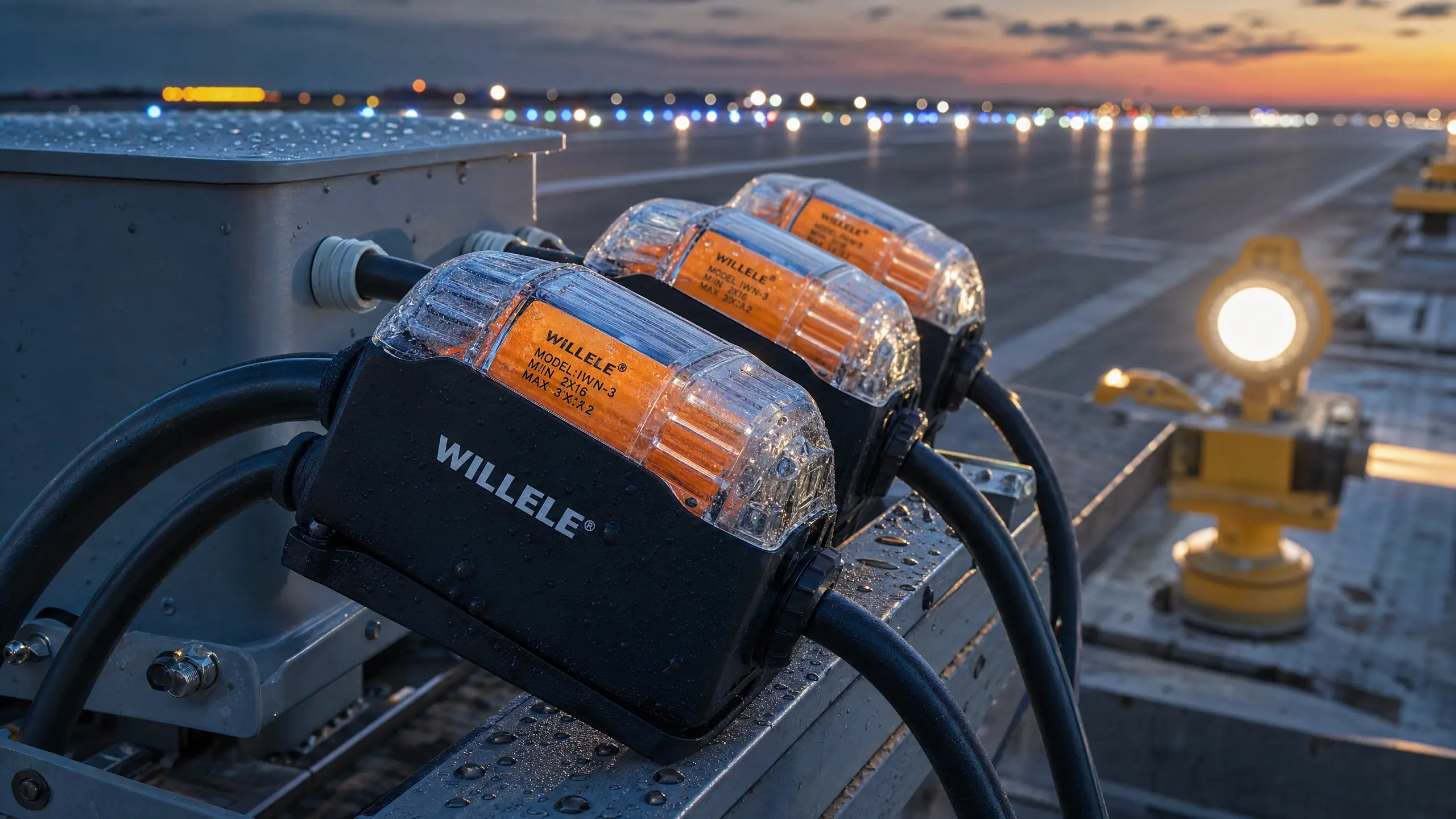
Airport runway lighting systems represent one of the most demanding electrical applications in modern infrastructure. Operating 24/7 in extreme weather conditions, these systems require absolute reliability to ensure aviation safety. At the heart of these critical installations lies a seemingly simple yet essential component: waterproof wire nuts. Understanding their role, specifications, and proper application can mean the difference between safe operations and catastrophic system failures.
The Critical Role of Runway Lighting Infrastructure
Every commercial airport depends on sophisticated lighting systems to guide aircraft during takeoff, landing, and taxiing operations. These systems include runway edge lights, centerline lights, threshold lights, and approach lighting systems (ALS). Unlike conventional outdoor lighting, airport runway lights must withstand jet blast, extreme temperature fluctuations, chemical exposure from de-icing agents, and constant vibration—all while maintaining perfect electrical continuity.
The electrical connections in these systems face unique challenges. Installed in underground vaults, junction boxes, and exposed conduit runs across vast airfield expanses, every connection point becomes a potential failure point. Water intrusion, corrosion, and mechanical stress can compromise standard electrical connections within months. This is where aviation-grade waterproof wire nuts become indispensable.
Why Standard Wire Connectors Fail in Airport Environments
Traditional wire nuts designed for residential or commercial buildings simply cannot survive airfield conditions. Standard connectors lack adequate sealing against moisture ingress, particularly under pressure from groundwater or pooling precipitation. The constant vibration from aircraft operations loosens mechanical connections over time. Temperature cycling between -40°F and 140°F causes standard plastics to become brittle and crack.
Chemical exposure presents another challenge. Airports use potassium acetate, sodium formate, and glycol-based de-icing fluids that can penetrate standard connector housings and accelerate corrosion of copper conductors. Salt spray in coastal airports creates additional corrosive environments. UV radiation degrades non-aviation-grade plastics, leading to housing failures that expose live connections.
Engineering Requirements for Aviation-Grade Waterproof Wire Nuts
Waterproof wire nuts designed for airport runway lighting must meet stringent specifications that far exceed standard electrical connectors. The Federal Aviation Administration (FAA) and International Civil Aviation Organization (ICAO) establish baseline requirements, but manufacturers like Willele engineer products that exceed these minimums.
IP Rating and Waterproof Performance
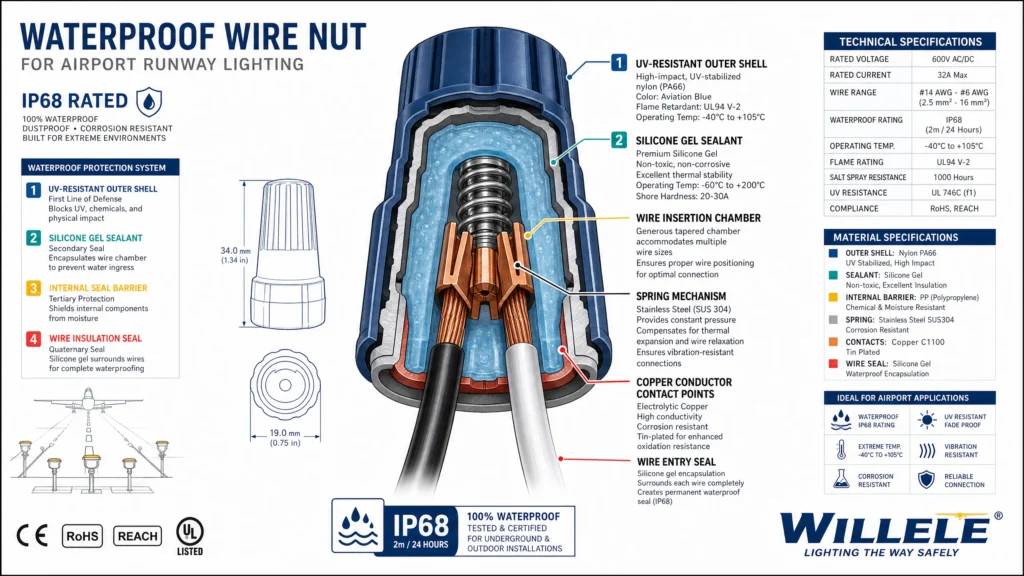
Aviation-grade waterproof wire nuts must achieve IP68 ratings at minimum—meaning complete protection against dust ingress and continuous immersion in water beyond 1 meter depth. Advanced designs incorporate multiple sealing barriers: silicone gel-filled chambers that encapsulate wire connections, compression seals at cable entry points, and UV-resistant outer shells that maintain integrity for decades.
The silicone gel serves multiple functions. It displaces air and moisture from around conductors, provides dielectric insulation, cushions connections against vibration, and remains flexible across extreme temperature ranges. Unlike petroleum-based compounds that can degrade over time, high-grade silicone maintains its properties for 25+ years.
Material Selection and Corrosion Resistance
Copper alloy conductors with tin or silver plating resist corrosion while maintaining excellent conductivity. The connector housing must use UV-stabilized polycarbonate or nylon compounds that resist impact, chemical attack, and thermal cycling. Internal spring mechanisms use stainless steel or phosphor bronze to maintain contact pressure despite temperature changes.
Willele’s aviation-grade waterproof wire nuts incorporate specialized materials tested to MIL-STD-810 environmental standards. The outer housing resists jet fuel, hydraulic fluid, and de-icing chemicals. Internal components maintain electrical performance after 1000+ hours of salt spray exposure per ASTM B117 testing.
Technical Specifications Comparison
| Specification | Standard Wire Nut | Aviation-Grade Waterproof Wire Nut |
|---|---|---|
| IP Rating | IP20 (no water protection) | IP68 (continuous immersion) |
| Temperature Range | -10°C to 80°C | -40°C to 105°C |
| Vibration Resistance | Not rated | MIL-STD-810 Method 514.7 |
| UV Resistance | 500 hours | 5000+ hours (ASTM G154) |
| Salt Spray Resistance | Not tested | 1000+ hours (ASTM B117) |
| Chemical Resistance | Limited | Resistant to de-icing fluids, jet fuel |
| Service Life | 5-10 years | 25+ years |
| Conductor Size Range | 14-22 AWG | 10-24 AWG (aviation wire) |
| Voltage Rating | 600V | 600V (with higher safety margins) |
Installation Best Practices for Airport Applications
Proper installation of waterproof wire nuts in runway lighting systems requires attention to detail that goes beyond standard electrical work. The harsh environment and critical nature of the application demand rigorous procedures.
Surface Preparation and Wire Stripping
Conductors must be stripped to the exact length specified by the manufacturer—typically 12-15mm for most aviation connectors. Over-stripping exposes excessive bare conductor that may not be fully encapsulated by the gel sealant. Under-stripping prevents proper insertion into the connector’s contact chamber. Use calibrated wire strippers to ensure consistency.
Clean all conductors with isopropyl alcohol to remove oxidation, oils, and contaminants. Even fingerprint oils can interfere with the silicone gel’s ability to displace moisture. For connections in existing systems, wire brush the conductors to remove any corrosion before assembly.
Proper Insertion Technique
Insert conductors fully into the waterproof wire nut until they bottom out in the contact chamber. Most aviation-grade connectors use a spring mechanism that requires firm pressure to compress. Incomplete insertion results in high-resistance connections that generate heat and accelerate failure.
For gel-filled connectors, twist the housing clockwise with firm pressure while maintaining inward force on the conductors. This action distributes the silicone gel throughout the connection chamber and ensures complete encapsulation. Continue twisting until resistance increases significantly—typically 3-5 full rotations depending on wire gauge.
Verification and Testing
After installation, perform continuity testing to verify proper electrical connection. Measure resistance across the connection; it should not exceed 0.001 ohms for properly made joints. Visually inspect for gel extrusion from the connector base—this indicates complete filling of the internal chamber.
For critical circuits, perform insulation resistance (megohm) testing between conductors and ground. Aviation standards typically require minimum 100 megohms at 500VDC. This test verifies the integrity of the waterproof seal and dielectric properties of the gel sealant.
Application-Specific Considerations
Different areas of airport runway lighting systems present unique challenges for waterproof wire nut applications.
Underground Vault Installations
Electrical vaults housing runway lighting transformers and distribution panels often experience groundwater infiltration and seasonal flooding. Connections in these environments face continuous water immersion and hydrostatic pressure. Use waterproof wire nuts rated for submersion depths exceeding the maximum anticipated water level—typically IP68 with 3-meter submersion ratings.
Install connections with the wire entry pointing downward when possible to prevent water from pooling at the seal interface. In vaults with chronic flooding, consider mounting junction boxes on elevated platforms and routing cables with drip loops to direct water away from connection points.
Exposed Airfield Installations
Junction boxes mounted on runway light bases or taxiway guidance signs experience extreme temperature cycling, direct UV exposure, and mechanical stress from ground equipment operations. Select waterproof wire nuts with UV-stabilized housings rated for 5000+ hours of exposure. Ensure the connector housing completely fills the junction box to prevent water accumulation.
In cold climates, thermal cycling causes moisture to condense inside junction boxes during warm periods, then freeze during cold snaps. This ice formation can mechanically stress connections. Gel-filled waterproof wire nuts prevent this issue by eliminating air spaces where condensation can form.
Approach Lighting Systems
High-intensity approach lighting systems (ALS) operate at higher voltages and currents than standard runway lights. Waterproof wire nuts for these applications must handle increased thermal loads while maintaining waterproof integrity. Willele’s high-current aviation connectors incorporate larger conductor contact areas and enhanced heat dissipation features.
The elevated towers and structures supporting approach lights experience wind-induced vibration and lightning-related electrical transients. Use waterproof wire nuts with superior vibration resistance and consider surge protection devices at critical connection points.
Maintenance and Inspection Protocols
Even the highest-quality waterproof wire nuts require periodic inspection to ensure continued reliability. Airport maintenance programs should incorporate these practices:
Visual Inspection Schedule
Conduct visual inspections of accessible connections annually or after significant weather events. Look for housing cracks, discoloration indicating UV degradation, or evidence of water intrusion. Any connector showing physical damage should be replaced immediately rather than attempting repair.
Check for gel extrusion or leakage, which may indicate housing failure or improper initial installation. While some gel weeping is normal during temperature cycling, excessive leakage suggests seal compromise.
Electrical Testing
Perform thermographic inspections of runway lighting circuits during operation. Hot spots at connection points indicate high-resistance joints that require immediate attention. Temperature differentials exceeding 10°C compared to adjacent connections warrant investigation.
Conduct insulation resistance testing on critical circuits during scheduled maintenance outages. Declining megohm readings over time indicate moisture ingress or insulation degradation. Establish baseline measurements for new installations and track trends to predict failures before they occur.
Replacement Criteria
Replace waterproof wire nuts that show any of these conditions:
- Visible cracks or damage to housing
- Discoloration or brittleness indicating UV degradation
- Evidence of water intrusion or corrosion
- Insulation resistance below 50 megohms
- Connection resistance exceeding 0.002 ohms
- Age exceeding manufacturer’s rated service life
Cost-Benefit Analysis: Premium vs. Standard Connectors
Airport operators sometimes question the higher cost of aviation-grade waterproof wire nuts compared to standard electrical connectors. However, lifecycle cost analysis consistently favors premium products.
| Cost Factor | Standard Connector | Aviation-Grade Waterproof Wire Nut |
|---|---|---|
| Initial Unit Cost | ||
| Expected Service Life | 3-5 years | 25+ years |
| Failure Rate (annual) | 5-10% | <0.5% |
| Labor Cost per Replacement | ||
| System Downtime Cost | ||
| 20-Year Lifecycle Cost |
The calculation assumes standard connectors require replacement every 4 years due to environmental degradation, while aviation-grade waterproof wire nuts last the full 20-year analysis period. Labor costs remain constant regardless of connector type, but premium connectors require fewer replacement cycles. Most significantly, system failures from standard connector breakdown create operational disruptions and safety risks that far exceed material cost differences.
Regulatory Compliance and Standards
Airport runway lighting installations must comply with multiple regulatory frameworks. In the United States, FAA Advisory Circular AC 150/5340-30J establishes design and installation standards for airfield lighting systems. These standards reference specific performance requirements for electrical components, including connection systems.
International airports must also consider ICAO Annex 14 requirements and local civil aviation authority regulations. European airports follow EASA certification standards, while other regions maintain their own regulatory frameworks. Aviation-grade waterproof wire nuts from manufacturers like Willele are engineered to meet or exceed all major international standards, simplifying compliance for airport operators worldwide.
UL listing and CSA certification provide additional quality assurance for electrical components. Look for products tested to UL 486D (splicing wire connectors) and rated for wet locations. Military specifications such as MIL-DTL-83528 provide even more stringent performance criteria for critical applications.
Emerging Technologies and Future Developments
The aviation industry continues to advance lighting technology, creating new requirements for electrical connection systems. LED runway lights now dominate new installations, offering energy efficiency and longer lamp life. However, LED drivers generate different electrical characteristics than traditional constant-current regulators, including higher-frequency switching noise and different fault modes.
Next-generation waterproof wire nuts incorporate features specifically designed for LED lighting systems: enhanced EMI shielding to prevent electromagnetic interference, improved thermal management for heat generated by LED drivers, and compatibility with smart monitoring systems that detect connection degradation before failure occurs.
Willele’s research and development team actively collaborates with airport operators and lighting system manufacturers to anticipate future needs. Emerging technologies include connectors with integrated sensors that monitor connection resistance, temperature, and moisture levels in real-time. These smart connectors will enable predictive maintenance programs that replace components based on actual condition rather than fixed schedules.
Selecting the Right Waterproof Wire Nut for Your Application
Choosing appropriate waterproof wire nuts for airport runway lighting requires careful consideration of multiple factors:
Wire Gauge Compatibility: Match the connector to your conductor sizes. Airport runway lighting typically uses 8-12 AWG for main distribution and 14-16 AWG for individual light connections. Ensure the waterproof wire nut accommodates your specific wire gauge range.
Current Rating: Verify the connector’s current capacity exceeds your circuit requirements with adequate safety margin. Series runway lighting circuits typically operate at 6.6A or 20A constant current. Approach lighting systems may require higher ratings.
Environmental Exposure: Assess the specific environmental challenges at your location. Coastal airports require enhanced salt spray resistance. Cold-climate airports need connectors that remain flexible at extreme low temperatures. Desert airports must prioritize UV resistance.
Installation Accessibility: Consider how easily technicians can access connection points for maintenance. Difficult-to-reach locations justify premium connectors with longer service life to minimize replacement frequency.
Budget Constraints: While lifecycle cost analysis favors premium products, budget realities exist. Prioritize aviation-grade waterproof wire nuts for the most critical and exposed connections, potentially using lower-grade products for protected indoor applications.
Conclusion
Waterproof wire nuts represent a critical component in airport runway lighting systems, where reliability directly impacts aviation safety. The harsh environmental conditions, regulatory requirements, and operational demands of airfield applications require specialized connectors engineered far beyond standard electrical products.
Aviation-grade waterproof wire nuts from manufacturers like Willele provide the performance, durability, and reliability that airport operators require. Through proper material selection, advanced sealing technologies, and rigorous testing, these connectors deliver decades of maintenance-free service in the most demanding conditions.
The investment in premium waterproof wire nuts pays dividends through reduced maintenance costs, improved system reliability, and enhanced safety margins. As airport lighting technology continues to evolve, the fundamental need for robust, waterproof electrical connections remains constant. Selecting quality components and following proper installation practices ensures that runway lighting systems perform their critical safety function without compromise.
For airport operators, maintenance teams, and electrical contractors working in aviation environments, understanding the unique requirements and proper application of waterproof wire nuts is essential knowledge. The seemingly simple connection point represents a critical link in the chain of aviation safety—one that deserves careful attention and quality components.
Frequently Asked Questions
Q: What IP rating is required for airport runway lighting waterproof wire nuts?
A: Airport runway lighting applications require minimum IP68 rating, which provides complete dust protection and continuous water immersion resistance. This ensures connections remain protected even when submerged in flooded electrical vaults or exposed to heavy precipitation.
Q: How often should waterproof wire nuts in runway lighting systems be replaced?
A: Aviation-grade waterproof wire nuts typically have a 25+ year service life when properly installed. However, conduct annual visual inspections and replace any connectors showing physical damage, UV degradation, or electrical performance issues. Standard connectors may require replacement every 3-5 years.
Q: Can standard electrical wire nuts be used in airport lighting if protected by junction boxes?
A: No. Even within junction boxes, airport environments expose connections to extreme temperature cycling, vibration, chemical exposure, and potential water intrusion. Aviation-grade waterproof wire nuts are required to meet FAA and ICAO standards and ensure reliable long-term performance.
Q: What wire gauge range do airport runway lighting waterproof wire nuts accommodate?
A: Most aviation-grade waterproof wire nuts accommodate 10-24 AWG conductors. Main distribution circuits typically use 8-12 AWG, while individual light connections use 14-16 AWG. Always verify the specific connector’s rated wire gauge range before installation.
Q: How do gel-filled waterproof wire nuts differ from standard sealed connectors?
A: Gel-filled waterproof wire nuts contain silicone gel that completely encapsulates wire connections, displacing all air and moisture. This provides superior waterproofing, vibration dampening, and corrosion protection compared to connectors that rely solely on external housing seals. The gel remains flexible across extreme temperatures and maintains properties for decades.
