
Manufacturing Equipment Wiring with MRK Terminal Blocks: Reliability and Efficiency

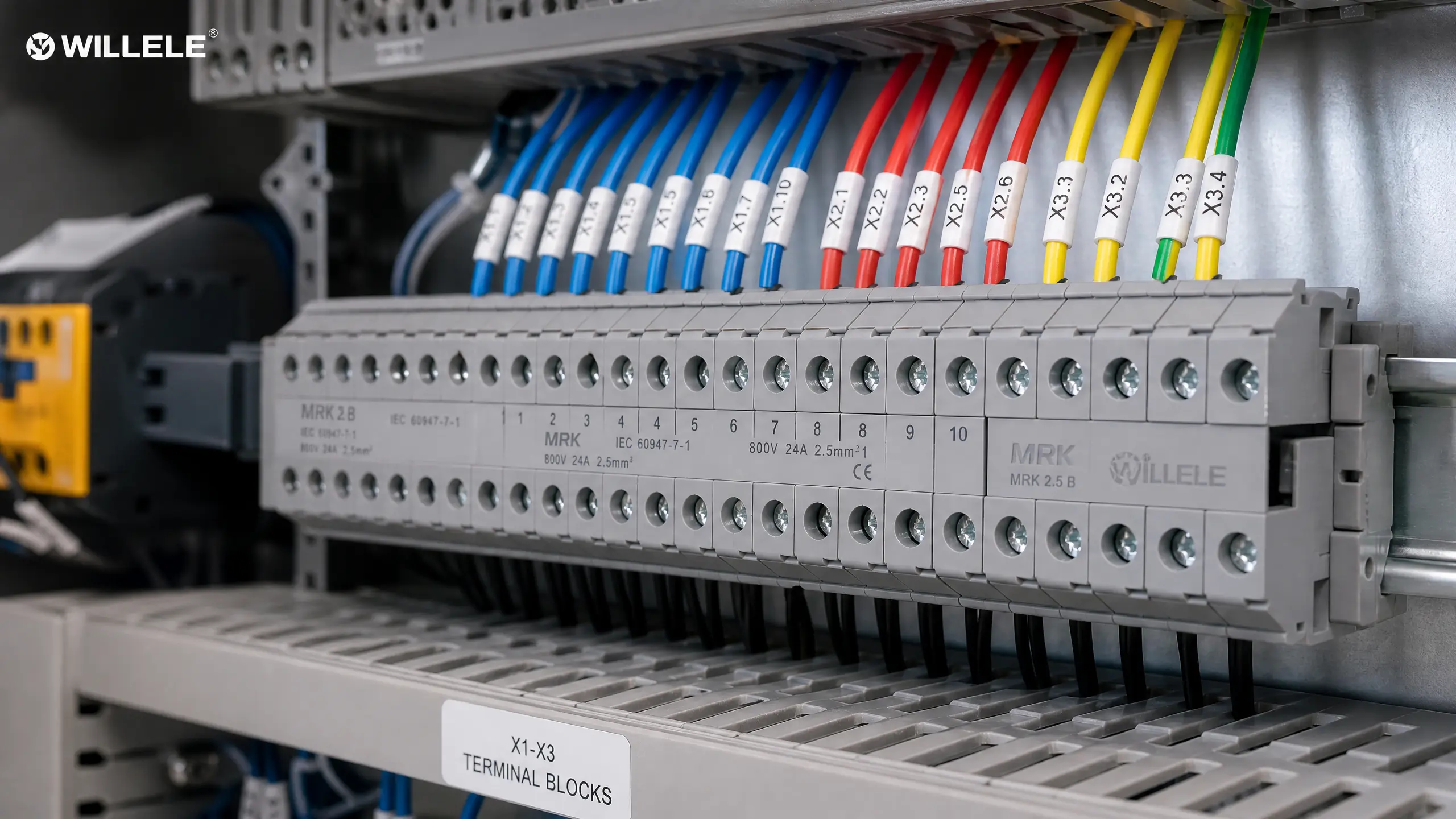
In the demanding world of industrial manufacturing, every electrical connection carries the weight of production uptime. A single loose termination can cascade into unplanned downtime, equipment damage, or safety hazards that ripple through entire production lines. This is precisely where MRK terminal blocks have earned their reputation as a cornerstone component in manufacturing equipment wiring — delivering the reliability and efficiency that modern industrial operations demand.
Willele, a specialized B2B electrical equipment manufacturer headquartered in Yueqing, China, has established itself as a trusted supplier of MRK terminal blocks for control panels, distribution boards, and automation systems worldwide. With a product portfolio spanning from compact 2.5 mm² signal terminations to robust 120 mm² power distribution blocks, Willele’s MRK series provides a unified wiring platform that simplifies procurement, standardizes installation, and enhances long-term serviceability across diverse manufacturing environments.
Understanding MRK Terminal Block Technology
MRK terminal blocks are DIN rail-mounted electrical connectors that use screw-clamp technology to create secure, low-resistance wire terminations. Unlike plug-and-socket connectors designed for frequent disconnection, MRK blocks are engineered for permanent or semi-permanent installations where connection integrity matters most — the wiring backbone of motor control centers, PLC cabinets, power distribution panels, and automated production machinery.
The core operating principle is elegantly simple: a stripped conductor is inserted into the wire entry chamber, and a precision-machined steel screw compresses it against a copper alloy current bar. This mechanical clamping action achieves two critical objectives simultaneously — it establishes a gas-tight, low-resistance electrical contact while providing mechanical retention that resists vibration-induced loosening. The entire assembly is housed within a flame-retardant polyamide (PA6.6) body rated for continuous operation from -40°C to +140°C, making MRK blocks suitable for environments ranging from arctic mining operations to Middle Eastern manufacturing facilities.
The screw-clamp termination method used in MRK blocks offers distinct advantages that explain its enduring popularity despite the emergence of spring-clamp and push-in alternatives. Screw terminals accommodate a broad range of conductor types — solid, stranded, and fine-stranded wires with or without ferrules — without requiring specialized tooling. This universality proves invaluable in manufacturing environments where maintenance electricians may need to replace or reconfigure wiring under tight production schedules, using whatever conductor types are available on-site.
Complete Model Range and Technical Specifications
Willele’s MRK terminal block series encompasses eleven models engineered to cover the full spectrum of manufacturing wiring requirements. The following table presents the complete technical specifications for each model in the lineup:
| Model | Cross-Section | Current Rating | Voltage Class | Typical Wire (AWG) | Width (mm) | Torque (Nm) |
|---|---|---|---|---|---|---|
| MRK-2.5 | 2.5 mm² | 24 A | 750 V | 14 AWG | 5.1 | 0.5 |
| MRK-4 | 4 mm² | 32 A | 750 V | 12 AWG | 5.9 | 0.5 |
| MRK-6 | 6 mm² | 40 A | 750 V | 10 AWG | 7.9 | 0.8 |
| MRK-10 | 10 mm² | 57 A | 750 V | 8 AWG | 9.9 | 1.2 |
| MRK-16 | 16 mm² | 82 A | 750 V | 6 AWG | 11.9 | 1.2 |
| MRK-25 | 25 mm² | 100 A | 750 V | 4 AWG | 15.0 | 2.0 |
| MRK-35 | 35 mm² | 125 A | 750 V | 2 AWG | 15.0 | 2.0 |
| MRK-50 | 50 mm² | 150 A | 750 V | 1 AWG | 20.0 | 3.0 |
| MRK-70 | 70 mm² | 192 A | 750 V | 1/0 AWG | 22.0 | 4.0 |
| MRK-95 | 95 mm² | 232 A | 1000 V | 2/0 AWG | 26.0 | 5.0 |
| MRK-120 | 120 mm² | 269 A | 1000 V | 4/0 AWG | 30.0 | 6.0 |
This comprehensive range enables manufacturing equipment designers to specify a single terminal block family across an entire machine — from the smallest sensor signal circuits at 24 A to the main incoming power feed at 269 A. The resulting consistency simplifies bill-of-materials management, reduces accessory inventory (end clamps, jumpers, and marker strips are shared across the series), and creates a uniform appearance that aids troubleshooting and maintenance.
Key Design Features That Drive Reliability
Several engineering decisions in the MRK series directly contribute to its reliability in manufacturing environments. The closed-end body design eliminates the need for separate end plates — a small detail that yields tangible benefits. Each block arrives with both sides fully enclosed, providing inherent electrical isolation between adjacent terminals and reducing the component count on each DIN rail assembly. This design choice not only saves material cost but also eliminates the risk of end plates being omitted during hurried panel modifications, a common source of insulation faults in field-modified equipment.
The symmetrical housing construction represents another practical innovation. MRK terminal blocks can be mounted on standard 35 mm DIN rails in either orientation, allowing panel builders to optimize wire routing without being constrained by terminal block direction. In dense control cabinets where every millimeter of wireway space matters, this flexibility translates directly into cleaner layouts and reduced cable lengths.
The screw system itself benefits from refinement across the current range. Models from MRK-10 through MRK-35 employ flat-head screws that distribute clamping force evenly across the conductor’s surface area, minimizing strand deformation while maximizing contact area. This is particularly important for fine-stranded conductors used in manufacturing equipment that experiences continuous vibration — evenly distributed clamping prevents individual strands from breaking over time, a failure mode that can be maddeningly intermittent and difficult to diagnose.
Bridging capability further extends the versatility of MRK terminal blocks. Double-sided bridging channels accept insulated comb bridges from 1.5 mm² through 10 mm², enabling efficient power distribution across multiple terminals without individual wire jumpers. This feature proves especially valuable in manufacturing equipment where a single power source must feed numerous control relays, contactors, or solenoid valves — a single bridge bar replaces dozens of individual jumper wires, reducing installation labor and eliminating potential wiring errors.
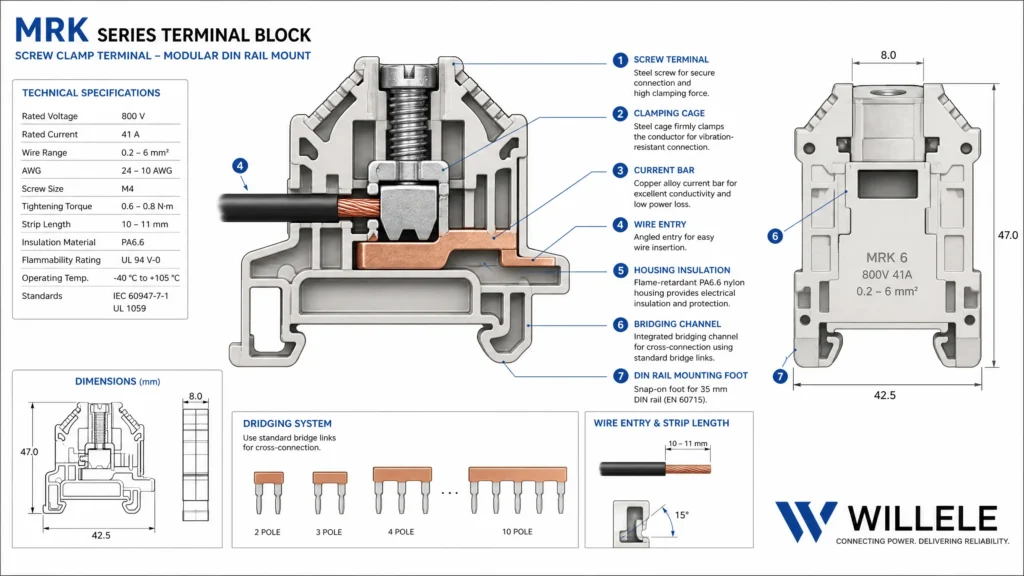
Figure 2: Technical cross-section diagram of an MRK terminal block with annotated callouts identifying key components — the screw-clamp mechanism, copper alloy current bar, flame-retardant PA6.6 housing, wire entry chamber, DIN rail mounting foot, and bridging channel.
Manufacturing Equipment Applications
MRK terminal blocks find their most demanding applications within the manufacturing sector, where they serve as the connective tissue of industrial electrical infrastructure. In CNC machining centers, MRK blocks terminate the control wiring that governs spindle drives, servo motors, coolant pumps, and safety interlocks. The vibration resistance inherent to properly torqued screw-clamp connections proves essential in these applications, where continuous cutting operations generate persistent mechanical oscillation that would challenge less robust termination methods.
Packaging machinery represents another application domain where MRK terminal blocks excel. These high-speed automated systems integrate numerous sensors, actuators, and motor controllers within tightly packed enclosures. The modular, snap-on DIN rail design of MRK blocks enables panel builders to pre-assemble terminal strips on the workbench before mounting them into the enclosure, dramatically accelerating assembly while ensuring consistent spacing and alignment. When machine modifications are required — a frequent occurrence in packaging lines that must adapt to new product formats — individual blocks can be repositioned without disturbing adjacent wiring.
In material handling and conveyor systems, MRK terminal blocks support the distributed control architecture typical of these installations. Motor starters, proximity sensors, emergency stop circuits, and communication gateways all converge at terminal strips distributed along the conveyor path. The wide operating temperature range of MRK blocks (-40°C to +140°C) ensures reliable performance whether the installation is in a refrigerated food processing facility or adjacent to heat-generating drive equipment.
Metal forming and stamping presses place perhaps the greatest demands on terminal block reliability, subjecting every electrical connection to intense shock and vibration with each press cycle. In these applications, the screw-clamp mechanism of MRK blocks — when tightened to the specified torque — provides the mechanical holding force necessary to prevent connection degradation over millions of operating cycles. Regular inspection and periodic retorquing are recommended in these extreme applications, but the fundamental design provides a robust foundation for long-term reliability.
MRK vs. Alternative Terminal Block Technologies
The terminal block market offers several competing connection technologies, each with distinct characteristics suited to different application profiles. Understanding these differences enables informed selection for manufacturing equipment applications:
| Feature | MRK (Screw-Clamp) | Spring-Clamp | Push-In | Insulation Displacement |
|---|---|---|---|---|
| Conductor Compatibility | Solid, stranded, fine-stranded (all types) | Solid, stranded with ferrule | Solid, stranded with ferrule | Solid only |
| Vibration Resistance | Excellent (when torqued) | Very good | Good | Moderate |
| Installation Speed | Moderate | Fast | Very fast | Fastest |
| Tool Requirement | Screwdriver | Screwdriver | None (tool-less) | Specialized tool |
| Re-termination Cycles | Unlimited | High (100+) | Moderate (50+) | Limited (10-20) |
| Cost per Position | Most economical | Moderate | Higher | Varies |
| Field Serviceability | Universal — any electrician | Requires familiarity | Requires familiarity | Requires training |
The screw-clamp approach embodied by MRK terminal blocks offers the broadest conductor compatibility at the most economical price point, with excellent vibration resistance when properly installed. For manufacturing environments where maintenance is performed by general industrial electricians rather than specialized technicians, the universal familiarity of screw terminals reduces the risk of improper termination and simplifies field troubleshooting.
Installation Best Practices for Maximum Reliability
Achieving the full reliability potential of MRK terminal blocks requires adherence to established installation practices. Wire stripping length deserves particular attention — insufficient stripping prevents full conductor insertion into the clamping mechanism, while excessive stripping leaves bare copper exposed beyond the terminal housing, creating potential flashover paths. For most MRK models, the recommended strip length falls between 8 mm and 18 mm depending on block size, with longer strips required for larger cross-sections.
Torque control represents perhaps the single most important variable in screw-clamp terminal reliability. Under-torqued screws fail to establish adequate clamping force, leading to increased contact resistance, localized heating, and potential loosening under vibration. Over-torqued screws can strip threads or sever individual wire strands, reducing the effective cross-section and creating hot spots. Willele provides recommended torque values for each MRK model — ranging from 0.5 Nm for the MRK-2.5 to 6.0 Nm for the MRK-120 — and panel builders should use calibrated torque screwdrivers to ensure consistent installations.
When wiring fine-stranded conductors without ferrules, twist the strands tightly before insertion to prevent individual strands from splaying outside the clamping zone. While MRK terminals accept bare fine-stranded wire, the use of cord end ferrules (bootlace ferrules) is strongly recommended for manufacturing equipment applications — ferrules contain all strands within a uniform cylindrical profile, ensuring even compression and eliminating the risk of stray strands causing adjacent-terminal shorts.
DIN rail organization deserves thoughtful planning before the first terminal block is installed. Group terminals by function — power distribution, control signals, analog inputs, communication — and maintain consistent spacing between groups. Install end clamps at both ends of each terminal strip to prevent lateral movement, and use partition plates between voltage classes where required by applicable electrical codes. Willele supplies compatible end clamps, partition plates, and marking accessories designed specifically for the MRK series, ensuring a fully integrated installation.
Why Choose Willele MRK Terminal Blocks
Willele distinguishes itself in the competitive terminal block market through a comprehensive value proposition centered on quality, compatibility, and engineering support. All MRK terminal blocks are manufactured using copper alloy conductors and flame-retardant PA6.6 nylon housings, with full IQC-IPQC-OQC quality control protocols ensuring consistency from raw material to finished product. Certificates of Conformance and lot traceability documentation support audit requirements and supplier qualification processes for OEM manufacturers.
Cross-brand compatibility represents a practical advantage for manufacturing operations that maintain equipment from multiple OEMs or source terminal blocks from various suppliers. Willele MRK blocks offer dimensional and electrical interchangeability with equivalent models from established brands, enabling drop-in replacement during maintenance without requiring DIN rail reconfiguration or accessory changes. Complete 2D and 3D CAD drawings, available for download in all major formats, streamline integration into panel design workflows using SOLIDWORKS, AutoCAD Electrical, EPLAN, and other engineering software platforms.
Responsive engineering support rounds out the Willele advantage. For panel builders and equipment manufacturers working against project deadlines, Willele provides 24-hour BOM matching, cross-reference identification, and accessory kit recommendations. Sample availability and flexible logistics — with standard parts typically shipping within 7 to 15 days — help keep manufacturing schedules on track.
Conclusion
Manufacturing equipment wiring demands components that perform reliably under the relentless pressure of industrial operation — continuous vibration, temperature extremes, electrical loading, and the inevitable modifications that accompany evolving production requirements. MRK terminal blocks from Willele meet these demands through a combination of proven screw-clamp technology, thoughtful engineering design, comprehensive model coverage, and responsive manufacturing support.
From the smallest signal circuit to the heaviest main power feed, the MRK series provides a unified, economical, and field-proven wiring platform that manufacturing equipment builders and maintenance teams can depend on. When uptime defines profitability, the choice of terminal block is not merely a component selection — it is an investment in production reliability.
Frequently Asked Questions
What does MRK stand for in MRK terminal blocks?
MRK is a product series designation used by multiple manufacturers for their DIN rail-mounted screw-clamp terminal block families. The designation does not represent a specific acronym but identifies a standardized form factor and connection technology widely adopted across the electrical industry.
What wire sizes do MRK terminal blocks accommodate?
MRK terminal blocks cover an extensive range from 0.06 mm² to 120 mm², depending on the specific model. The MRK-2.5 handles the smallest conductors, while the MRK-120 accommodates large-gauge power cables up to 120 mm² (approximately 4/0 AWG). Mid-range models like MRK-4, MRK-6, MRK-10, and MRK-16 cover the most common industrial control and power distribution wire sizes.
Are MRK terminal blocks suitable for high-vibration environments?
Yes. The screw-clamp connection mechanism provides strong mechanical wire retention that resists vibration-induced loosening when screws are tightened to the manufacturer’s specified torque. For extreme vibration applications such as stamping presses and mobile equipment, periodic inspection and retorquing are recommended as part of preventive maintenance routines.
What is the temperature range of MRK terminal blocks?
MRK terminal blocks manufactured with PA6.6 polyamide housings operate reliably from -40°C to +140°C, making them suitable for installation in a wide range of industrial environments including outdoor equipment, refrigerated processing facilities, and machinery generating significant operational heat.
Can MRK terminal blocks be used with both solid and stranded conductors?
Absolutely. One of the key advantages of screw-clamp technology is its universal compatibility — MRK terminal blocks accept solid, stranded, and fine-stranded conductors with or without ferrules. For fine-stranded conductors in manufacturing equipment, the use of cord end ferrules is recommended to ensure optimal clamping and long-term reliability.
Do MRK terminal blocks require end plates?
No — a distinctive feature of the MRK series is the closed-end body design, which provides built-in electrical isolation on both sides of each block. This eliminates the need for separate end plates, reducing component count and simplifying installation while maintaining full insulation integrity between adjacent terminals.
What accessories are available for MRK terminal blocks?
Willele supplies a complete ecosystem of MRK-compatible accessories including end clamps for securing terminal strips to DIN rails, insulated comb bridges for power distribution across multiple blocks, partition plates for voltage separation, marker strips and labeling systems for circuit identification, and end covers for the terminal strip extremities.
