
How Heat Shrink Tubes Improve Electrical Panel Safety

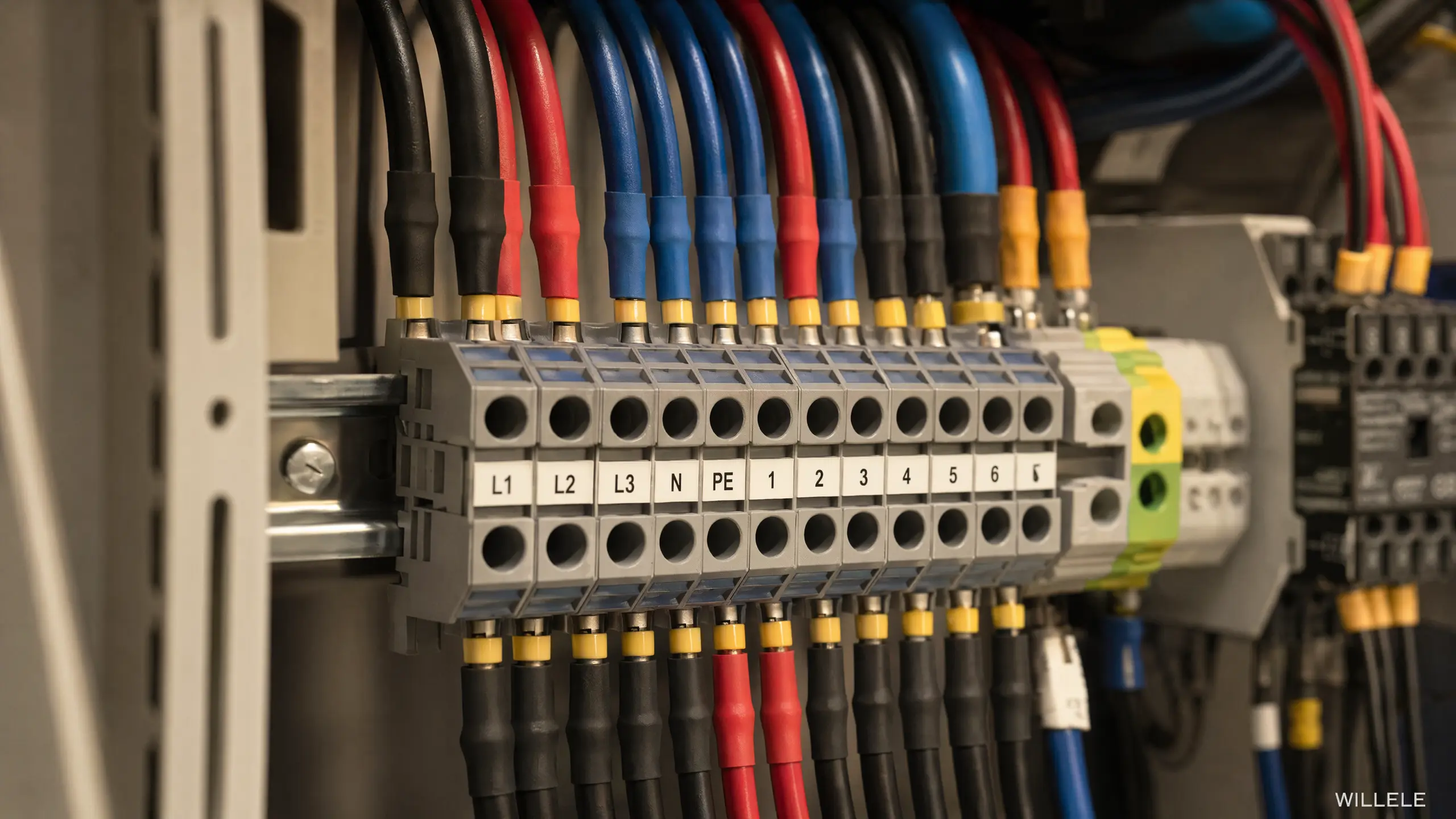
Electrical panels are the nerve centers of industrial facilities — and also the point where one loose connection or degraded insulator can cascade into arc flash, equipment fire, or catastrophic downtime. Heat shrink tubes address these risks at their root by sealing, insulating, and mechanically reinforcing every termination, splice, and busbar joint inside the enclosure. This article explains the safety mechanisms that make heat shrink tubing an essential layer of protection in modern electrical panels, from material selection to installation best practices.
What Heat Shrink Tubes Are and How They Work
A heat shrink tube is a thermoplastic sleeve that contracts radially when heated, gripping the underlying wire, terminal, or component with uniform pressure. The material is cross-linked during manufacturing — a process that builds a three-dimensional polymer network — then expanded to its as-supplied diameter. When a technician applies heat (typically from a hot-air gun), the tube’s shape memory drives it back toward its original, smaller diameter, conforming tightly around irregular surfaces.
This mechanism does three things that separate heat shrink from tape or loose sleeving. First, the radial shrinkage generates consistent compression, so the tube does not unwind or flag under vibration the way adhesive tape eventually will. Second, because the tube is a continuous cylinder — no seam, no overlap — there is no entry path for moisture, dust, or conductive debris. Third, the cross-linked structure resists re-melting: once shrunk, the tube stays dimensionally stable across its full rated operating range, which spans from −55°C to 260°C depending on the material grade.
Five Ways Heat Shrink Tubes Make Electrical Panels Safer
1. Electrical Insulation That Withstands the Panel Environment
Every bare-metal connection inside a panel — crimped terminals, bolted busbar joints, stripped conductor ends — is a potential fault site. Heat shrink tubing delivers a dielectric barrier rated for the voltage class in play. Standard polyolefin tubes carry dielectric strengths of 500 V/mil or higher, enough to suppress surface leakage across adjacent phases in a 600 V panel when properly selected.
Unlike air gaps, which shrink unpredictably as panels heat up and components expand, a shrunk tube maintains a controlled insulation thickness. It also resists tracking: the progressive carbonization that turns a surface from insulator to conductor. In panels exposed to industrial dust or salt spray, that tracking resistance is the difference between years of quiet operation and an unplanned shutdown.
2. Arc Flash Risk Reduction
Arc flash incidents inside electrical panels typically begin small — a conductive particle bridging phases, a loosened terminal that overheats and ionizes the surrounding air. Once plasma forms, the arc temperature jumps past 19,000°C within milliseconds, vaporizing copper and expanding the air volume explosively.
Heat shrink tubes attack this chain at two links. First, by encapsulating exposed conductors at terminations and splices, they eliminate the exposed surfaces where incidental contact or contamination starts the arc. Second, flame-retardant grades — including Willele’s EVA-based and cross-linked polyolefin formulations — self-extinguish if exposed to external flame, preventing a localized insulation failure from propagating into a panel-wide event. For facilities operating under NFPA 70E, specifying heat shrink with documented flame-retardant performance supports the hierarchy of controls by substituting a safer material at the engineering level.
3. Environmental Sealing Against Moisture and Contaminants
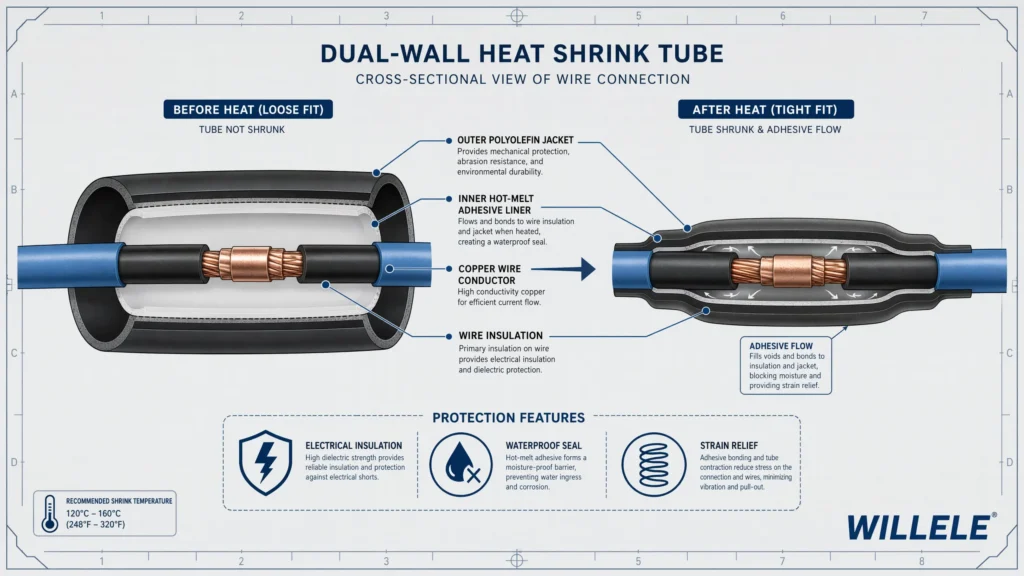
Electrical panels in water-treatment plants, food-processing lines, offshore platforms, and outdoor solar installations face humidity, washdown, and corrosive atmospheres that degrade unsealed connections. Dual-wall heat shrink tubing — a polyolefin outer jacket lined with a hot-melt adhesive — solves this by forming a bonded, watertight seal. As the tube shrinks, the inner adhesive liquefies and flows into every void around the wire and terminal body. The result is an IP67-equivalent seal in a single installation step.
Even single-wall tubes contribute here: by eliminating crevices where condensation can pool and where dust can accumulate, they reduce the probability of tracking failures and galvanic corrosion across dissimilar metals inside the panel.
4. Mechanical Strain Relief at Termination Points
A wire terminated under a screw clamp inside a panel carries mechanical stress at exactly the point where the conductor exits the terminal — the spot most vulnerable to fatigue cracking from vibration or thermal cycling. Heat shrink tubing, applied over the terminal barrel and extending onto the wire insulation, redistributes bending stress across a graduated zone rather than concentrating it at a single edge.
This matters especially in panels mounted on vibrating equipment: motor control centers, compressor skids, conveyor drives. The tube acts as a flexible coupling, absorbing micro-motion without transmitting it to the copper at the clamp face. Over years of operation, that simple sleeve prevents the loose-connection cascade — increased resistance → localized heating → accelerated oxidation → higher resistance — that ends in a burned terminal block.
5. Identification, Organization, and Maintenance Safety
A disorganized panel is a safety hazard. Technicians working under time pressure make mistakes — opening the wrong breaker, probing the wrong terminal — when wiring is a monochrome tangle. Heat shrink tubing is available in standard color codes (black, red, blue, green/yellow for earth, white for neutral) and can be printed with clear, durable legends. A panel where every control wire carries its circuit number in shrink-sleeve marking is a panel where troubleshooting takes minutes instead of hours, and where lockout/tagout procedures are unambiguous.
Bundling related conductors with larger-diameter heat shrink also reduces clutter, improves airflow around heat-generating components, and keeps low-voltage signal wiring separated from power conductors — a straightforward practice that reduces noise-coupled faults and makes future modifications safer for the next technician.
Material Selection: Choosing the Right Heat Shrink Tube for Your Panel
Not all heat shrink tubing is interchangeable. The table below compares the four material families most relevant to electrical panel applications.
| Property | Polyolefin | EVA (Willele Specialty) | PVC | PTFE / Fluoropolymer |
|---|---|---|---|---|
| Operating Temperature | −55°C to 135°C | −40°C to 105°C | −30°C to 105°C | −65°C to 260°C |
| Shrink Temperature | 90–120°C | 80–110°C | 100–140°C | 170–343°C |
| Shrink Ratio | 2:1 to 4:1 | 2:1 to 4:1 | 2:1 | 1.3:1 to 4:1 |
| Flame Retardancy | Good (UL 224 VW-1) | Excellent (self-extinguishing) | Good (self-extinguishing) | Excellent (non-flammable) |
| Flexibility | Good | Excellent (soft-touch, high clarity) | Fair (stiffens when cold) | Good |
| Chemical Resistance | Moderate | Good | Moderate | Excellent |
| Dielectric Strength | ≥500 V/mil | ≥400 V/mil | ≥300 V/mil | ≥1000 V/mil |
| Typical Panel Application | General-purpose insulation, busbar sleeving | High-flex areas, visual-inspection zones | Cost-sensitive retrofit work | Extreme-temperature or corrosive-enclosure applications |
| Relative Cost | $$ | $$ | $ |
For most industrial electrical panels, cross-linked polyolefin or EVA-based tubing covers the application range. PTFE is reserved for panels in chemical plants or high-temperature enclosures where polyolefin would soften or degrade. PVC, while economical, is generally avoided in panels with close-packed components because its lower temperature ceiling leaves little margin during fault conditions.
Shrink Ratio: Getting the Fit Right
A tube’s shrink ratio determines how much diameter range a single SKU can cover. A 2:1 tube shrinks to half its supplied diameter, a 3:1 to one-third, and a 4:1 to one-quarter. The table below illustrates practical coverage.
| Shrink Ratio | Supplied ID Range (typical) | Recovered Wall Thickness | Best Use Case |
|---|---|---|---|
| 2:1 | 1.2 mm – 50 mm | 0.4 – 1.3 mm | Standard wire insulation, terminal covering |
| 3:1 | 1.5 mm – 39 mm | 0.6 – 2.0 mm | Connector bodies, uneven substrates |
| 4:1 | 4 mm – 52 mm | 1.0 – 3.0 mm | Large connectors, busbar joints, transition zones |
Choosing the right ratio is a balance: a higher ratio covers more diameters with fewer SKUs in inventory, but the recovered tube wall is thicker, which may crowd tight terminal blocks. A 2:1 or 3:1 tube handles the majority of in-panel terminations. The 4:1 grades earn their place on irregular shapes — a bolted busbar splice, a lug-to-cable transition — where the substrate diameter changes significantly along the tube’s length.
Standards and Compliance
When specifying heat shrink tubing for electrical panel safety, look for products tested to recognized standards:
- UL 224 / CSA C22.2 No. 198.1 — covers extruded insulating tubing, including flame-retardance (VW-1), dielectric strength, and cold-bend performance.
- IEC 60684-3 — international standard for flexible insulating sleeving, with sub-parts covering specific material types.
- RoHS and REACH — confirm the tube is free of restricted substances; essential for panels exported to the EU.
- NFPA 70E — while not a product standard, the workplace electrical safety standard calls for engineering controls that heat shrink tubing helps satisfy by reducing exposed energized parts.
Willele manufactures its heat shrink tubing under an ISO 9001 quality management system, with in-house dielectric testing, shrink-ratio verification, and accelerated-aging protocols applied to every production batch. For B2B buyers, this means traceable consistency — the tube that passed validation testing is the same tube that arrives on the production floor.
Installation Practices That Maximize Safety
A correctly specified tube installed poorly is a liability. Four practices make the difference:
Surface preparation. Remove oil, cutting fluid, and oxidation from the substrate. A clean surface lets the tube grip without trapping contaminants underneath. For adhesive-lined tubes, cleanliness determines bond strength.
Temperature control. Use a hot-air gun with a deflector nozzle rather than an open flame. Polyolefin shrinks at 90–120°C; exceeding 200°C scorches the surface and embrittles the polymer. Keep the gun moving and heat from the center outward to avoid trapping air bubbles.
Overlap and coverage. Extend the tube at least 6 mm past the bare conductor onto the wire insulation on each side. For dual-wall tubes, confirm adhesive squeeze-out at both ends — it is the visual signal that the seal is complete.
Cool-down discipline. Do not disturb or bend the assembly until the tube has cooled to ambient temperature. Handling while hot can create thin spots or gaps in the wall that compromise both dielectric strength and environmental sealing.
Why B2B Buyers Choose Willele Heat Shrink Tubes
With 18 years of specialization in flame-retardant heat shrink solutions, Willele (Wenzhou Tengyou Electric Co., Ltd.) supplies electrical equipment manufacturers across automotive, new-energy, industrial automation, and data-communications sectors. The company’s EVA-based heat shrink tubing — developed in-house with proprietary formulation technology — combines the soft-touch flexibility and optical clarity that panel builders need for visual-inspection zones with the self-extinguishing flame performance required for enclosed electrical assemblies.
Production runs on electron-beam cross-linking lines, which deliver more uniform cross-link density than chemical methods, translating to tighter shrink-recovery tolerances and more predictable installed wall thickness. In-house testing laboratories verify dielectric strength, shrink ratio, and accelerated-aging performance on every batch, and full material traceability supports the documentation requirements of UL-listed panel shops and IEC-compliant export projects.
For B2B procurement teams, Willele offers custom color matching, pre-cut lengths, private labeling, and just-in-time delivery from ready-to-ship inventory — reducing the part-number count on the production floor without compromising the safety margin inside the panel.
Frequently Asked Questions
Q: What temperature is needed to shrink heat shrink tubing?
Most polyolefin and EVA tubes shrink at 90–120°C. A standard hot-air gun set to 150–200°C (held 10–15 cm from the tube) provides safe, controlled shrinkage. PTFE tubes require higher temperatures — 170–343°C — and should be processed with dedicated equipment.
Q: Can heat shrink tubing replace tape inside an electrical panel?
Yes, and in many cases it should. Tape relies on adhesive that degrades with heat and time; heat shrink tubing forms a permanent, mechanically stable insulation layer that does not unwind, flag, or leave residue. For terminations subject to vibration or thermal cycling, heat shrink is the more reliable choice.
Q: How do I select the correct shrink ratio?
Measure the largest diameter the tube must pass over (the connector body, for example) and the smallest diameter it must grip (typically the wire insulation). The tube’s supplied ID must clear the largest, and its recovered ID must grip the smallest. A 2:1 tube works when the two diameters differ by less than a factor of two; a 3:1 or 4:1 tube covers greater variation.
Q: What is dual-wall heat shrink tubing, and when should I use it?
Dual-wall tubing has an outer polyolefin layer and an inner hot-melt adhesive liner. When heated, the adhesive melts and flows into voids, creating a watertight bond. Use it wherever the panel may see moisture, dust, or corrosive atmospheres — outdoor enclosures, washdown areas, marine electrical panels.
Q: How long does heat shrink tubing last inside an electrical panel?
When installed correctly and operated within its rated temperature range, quality heat shrink tubing lasts 15–25 years or more. The primary degradation mechanism is thermal oxidation, which is accelerated by continuous operation near the upper temperature limit. For panels running hot, selecting a higher-temperature material (fluoropolymer) extends service life.
Q: Does Willele offer custom heat shrink tubing for OEM panel builders?
Yes. Willele provides custom colors, pre-cut-to-length tubing, printed legends, and private-label packaging for OEM partners. Minimum order quantities vary by specification — contact the Willele B2B sales team with your panel build requirements for a tailored quotation.
