
Heat Shrink Tubing Solutions for Substation Wiring Protection

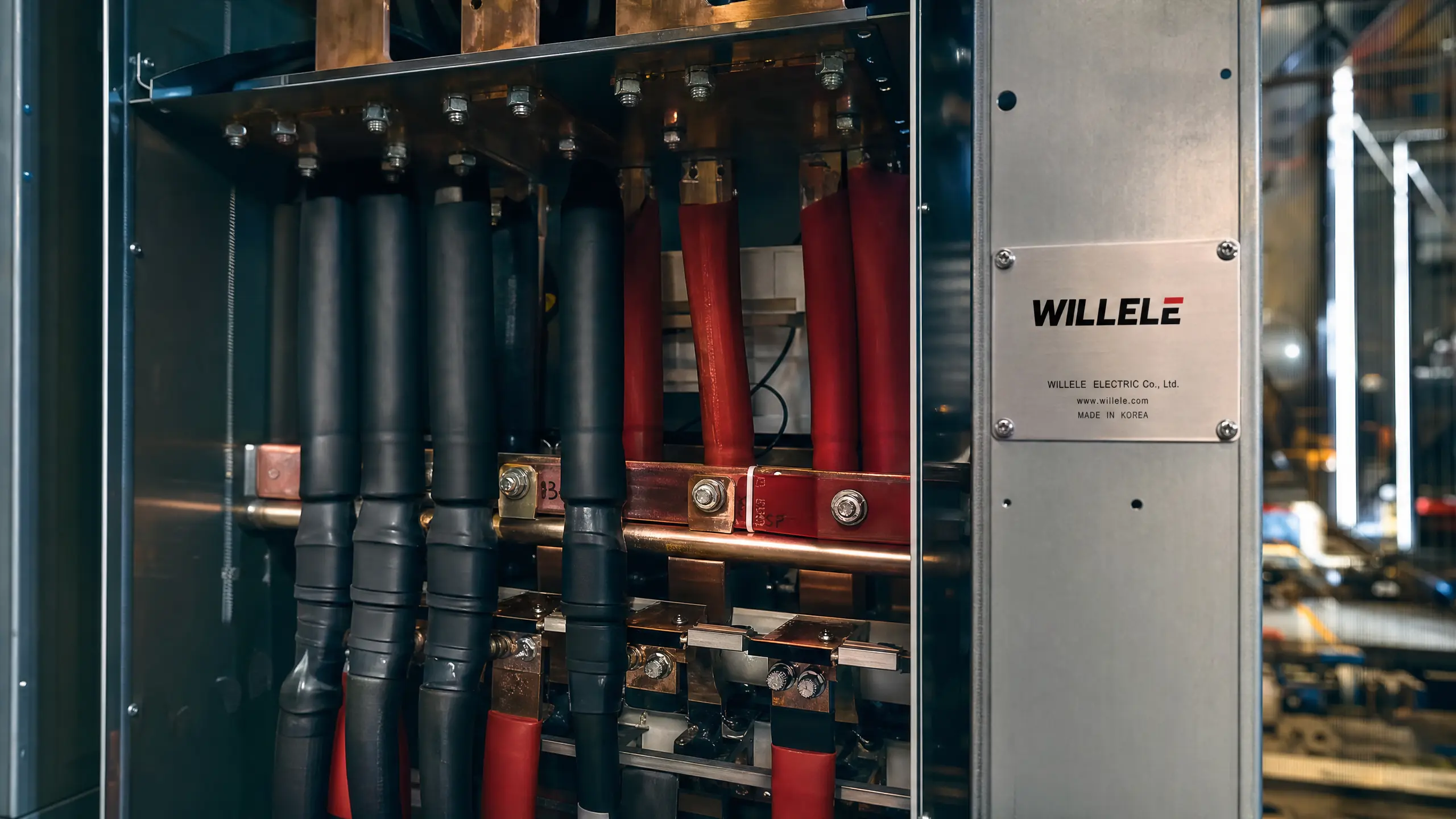
A modern substation is a dense concentration of high-voltage energy, bolted joints, and control wiring packed into a limited footprint. Every busbar transition, cable termination, and bare conductor in that space is a potential point of failure — where flashover, tracking, moisture ingress, or accidental contact can trigger an outage that costs far more than the component itself. Heat shrink tubing has become the workhorse insulation method for these critical junctions, providing a conformal, durable barrier that wraps precisely around irregular geometries where tape and molded boots fall short.
For utilities, EPC contractors, and switchgear OEMs across North America, Europe, and emerging markets in Southeast Asia and Latin America, selecting the right heat shrink tubing is a decision that ripples through decades of service life. This guide examines how heat shrink tubing protects substation wiring, the material and performance criteria that matter in high-voltage environments, and how WILLELE’s manufacturing capabilities translate into reliable, standards-compliant insulation for B2B buyers worldwide.
Why Substations Demand Specialized Insulation
Substation environments punish unprotected conductors. Unlike the controlled interior of a factory floor, a substation combines thermal cycling from load fluctuations, sustained UV exposure in outdoor installations, chemical contamination from industrial atmospheres, and the constant threat of condensation in enclosed cabinets. The wiring running between switchgear, transformers, reclosers, and control panels must withstand all of this while maintaining dielectric integrity at voltages from a few hundred volts up to 35 kV and beyond.
The geometry of the problem is what makes heat shrink tubing uniquely suited. Bolted busbar joints, cable lugs, and transition sleeves are not uniform cylinders. They have shoulders, edges, and irregular profiles where flat tape wraps tend to lift, crease, and leave air pockets that trap moisture and create partial-discharge sites. A heat shrink sleeve, by contrast, recovers radially under heat to grip every contour, squeezing out air and forming a continuous insulation layer with no beginning or end for contaminants to exploit.
This conformal recovery is why medium- and heavy-wall heat shrink tubing is specified in switchgear, motor control centers, and substation cable accessories by manufacturers following ANSI/IEEE C37.20 switchgear standards, which define minimum clearance and withstand requirements for insulated bus in metal-clad equipment. The tubing effectively replaces the air gap as the primary insulation barrier at connection points, allowing denser equipment layouts without sacrificing dielectric margin.
How Heat Shrink Tubing Works
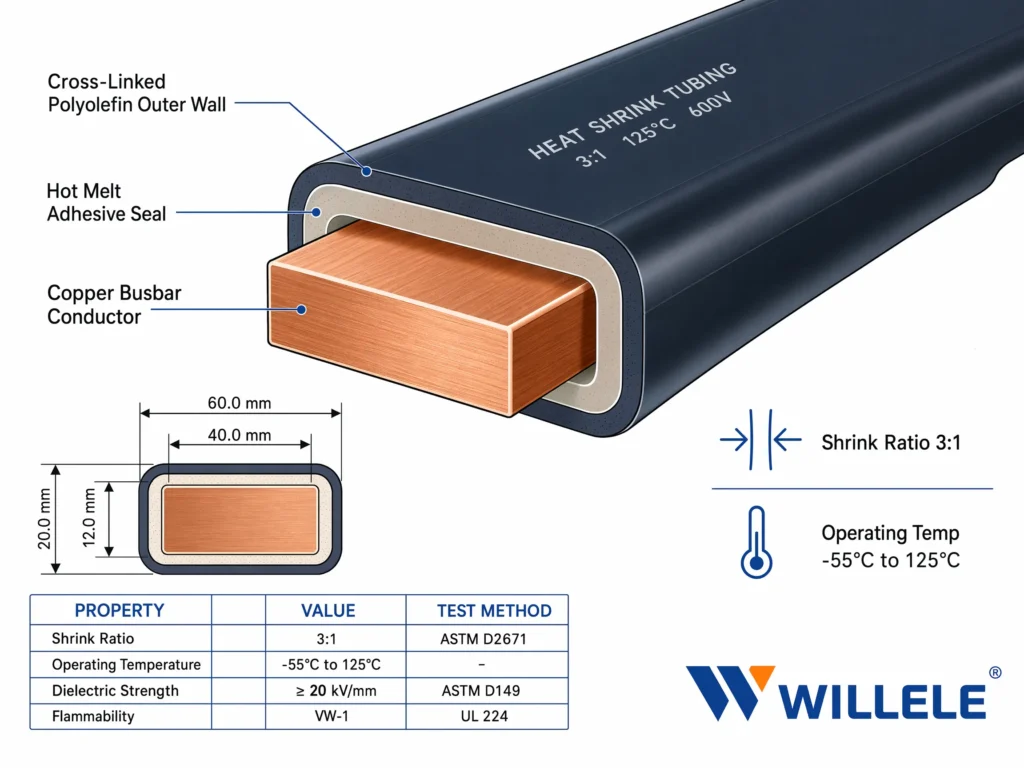
Heat shrink tubing begins life as an extruded polymer tube that has been expanded to a larger diameter and then cooled in that expanded state, locking the molecules in a stretched configuration. This is typically achieved through electron-beam or chemical cross-linking, which creates covalent bonds between polymer chains so that the material remembers its original shape. When heat is reapplied above the recovery temperature — usually between 90°C and 200°C depending on the polymer — the cross-linked network pulls the material back to its pre-expanded dimensions, shrinking it tightly around whatever it covers.
The cross-linking step is what separates substation-grade tubing from cheap commodity sleeves. Uncrosslinked tubing melts and flows when overheated; cross-linked tubing maintains its mechanical and dielectric properties even above its crystalline melting point, because the network structure holds the material together. This thermal-mechanical memory is what allows the tubing to recover forcefully around a busbar, hold that grip for decades, and survive the sustained operating temperatures of current-carrying conductors.
For substation use, a dual-wall construction is often preferred. The outer wall is a cross-linked polyolefin or elastomer that provides dielectric strength, UV resistance, and mechanical toughness. The inner wall is a meltable adhesive that flows during recovery, filling voids and bonding to the substrate to create an environmental seal that blocks moisture and corrosive gases. The resulting barrier is what protects a cable lug or busbar joint through years of thermal cycling and humidity.
Material and Performance Comparison
Not all heat shrink tubing is equal, and material selection is the single most important specification decision for substation applications. The table below compares the four material families most commonly specified in high-voltage electrical protection.
| Material | Operating Temp Range | Dielectric Strength | Key Advantages for Substations | Typical Substation Use |
|---|---|---|---|---|
| Cross-Linked Polyolefin (XLPO) | -55°C to 125°C | 15–20 kV/mm | Low cost, flame-retardant grades, wide size range | Busbar joints, cable terminations, phase identification |
| EVA (Ethylene-Vinyl Acetate) | -55°C to 110°C | 12–18 kV/mm | Excellent clarity, flexibility, soft-touch, easy processing | Control wiring, marker sleeves, low-voltage harnessing |
| Fluoropolymer (PTFE / FEP / PVDF) | -65°C to 260°C | 20–30 kV/mm | Extreme chemical resistance, high-temp, low smoke | High-thermal zones, transformer connections, harsh chemical areas |
| Elastomer (Rubber-based) | -55°C to 150°C | 12–16 kV/mm | High flexibility, abrasion resistance, vibration damping | Cable bends, flexible leads, moving connections |
WILLELE’s manufacturing strength centers on EVA-based and cross-linked polyolefin heat shrink tubing, produced with electron-beam cross-linking technology and premium copolymer resins. The EVA formulation uses optimized vinyl acetate content (typically 18–28%) to balance flexibility, clarity, and thermal stability, while the polyolefin grades carry flame-retardant additives that meet UL 224 and IEC flame-test requirements. Both material lines are backed by ISO 9001 quality management and carry CE and RoHS compliance documentation demanded by international B2B procurement.
Key Specifications to Evaluate
When specifying heat shrink tubing for a substation project, five parameters determine whether the product will perform over a 20- to 30-year service life or become a liability. Buyers should verify each against the manufacturer’s datasheet rather than assuming parity across suppliers.
| Specification | What It Means | Why It Matters in Substations |
|---|---|---|
| Shrink Ratio | Maximum expansion-to-recovered diameter (e.g., 2:1, 3:1, 4:1) | Higher ratios cover a wider range of cable and busbar sizes, reducing SKU count and accommodating stepped joints |
| Recovered Wall Thickness | Final insulation thickness after full shrinkage | Determines dielectric withstand voltage and mechanical protection level |
| Dielectric Strength | Voltage gradient the material withstands (kV/mm) | Sets the upper voltage class; substation bus typically needs 5–35 kV rated tubing |
| Adhesive Lining | Presence of meltable inner sealant | Critical for outdoor and below-grade installations where moisture ingress causes tracking failure |
| Flame Retardancy | Performance under UL 94V-0, IEC 60684, or IEEE 383 flame tests | Prevents fire propagation in densely cabled switchgear cabinets |
A practical selection rule: for any substation connection exposed to outdoor conditions, condensation, or temperature swings exceeding 40°C across the day, choose a dual-wall adhesive-lined tubing with a shrink ratio of at least 3:1. For clean, climate-controlled indoor switchgear, a single-wall flame-retardant polyolefin may suffice and reduces cost. When in doubt, WILLELE’s application engineers can review a project’s voltage class, environmental exposure, and cable schedule to recommend the optimal grade and size.
Substation Application Areas
Heat shrink tubing serves four distinct protection functions within a substation, each with different demands on the material:
Busbar Insulation. Bare copper or aluminum busbars running through switchgear require insulation at bolted joints, tap-offs, and wherever clearance to adjacent phases or ground approaches the minimum specified by ANSI/IEEE C37.20. Medium-wall and heavy-wall tubing (typically 1.5–4.0 mm recovered wall) restores the insulation barrier at these discontinuities, permitting tighter equipment layouts and reducing the risk of phase-to-phase flashover during transient overvoltages. Color-coded tubing — red, yellow, blue for A/B/C phases, green-yellow for ground — provides immediate visual verification of phase identity during maintenance.
Cable Termination and Splice Sealing. Medium-voltage cable terminations at transformer bushings, switchgear potheads, and junction points are the most failure-prone locations in a substation. Adhesive-lined heat shrink tubing seals the cable jacket-to-connector interface, preventing the moisture migration that drives insulation breakdown and partial discharge. The tubing also provides stress relief at the shield cutback, distributing the electrical field to prevent corona at the semicon layer transition.
Control and Protection Wiring. The low-voltage control wiring that carries relay signals, SCADA communications, and breaker trip commands is vulnerable to abrasion, chemical exposure, and misidentification. Thin-wall polyolefin and EVA tubing bundle and insulate these circuits, while printed or color-coded sleeves provide permanent circuit identification that survives the life of the installation.
Corrosion and Environmental Protection. In coastal, industrial, or high-humidity substations, bare metal components corrode rapidly. Heat shrink tubing with adhesive lining encapsulates connectors and exposed metal, blocking salt spray, SO2, and moisture from reaching the conductor surface. This extends maintenance intervals and prevents the green patina of copper corrosion from signaling impending connection failure.
WILLELE’s Manufacturing Advantage
WILLELE brings over 18 years of focused experience in flame-retardant heat shrink tube manufacturing to the substation market. The production base operates electron-beam cross-linking systems, precision extrusion lines, and in-house testing laboratories that verify dielectric strength, shrink ratio, longitudinal change, and flame retardancy on every batch. This vertical integration matters to B2B buyers because it ensures lot-to-lot consistency — the tubing that arrives for a 500-unit switchgear order performs identically to the samples that passed qualification testing.
Certifications and compliance documentation are built into the process. Every WILLELE heat shrink tubing product ships with ISO 9001 quality records, CE conformity, and RoHS material declarations. For utility and infrastructure projects that require full traceability, batch-level test reports are available on request. The product range spans shrink ratios from 2:1 to 4:1, recovered diameters from 0.5 mm to over 150 mm for busbar applications, and operating temperature classes from -55°C to 125°C standard, with high-temperature fluoropolymer options for specialized requirements.
Color availability covers the full phase-identification palette — black, red, yellow, blue, green/yellow, white — and custom colors can be produced for OEM branding or project-specific coding schemes. UV-stabilized grades are standard for outdoor substation use, and halogen-free flame-retardant formulations are available for installations in tunnels, indoor substations, and other confined spaces where smoke toxicity is a safety concern.
SEO and Geographic Targeting Notes
This article is structured to rank for the primary keyword “heat shrink tubing” and its substation-specific long-tail variants across the regions where WILLELE serves B2B clients. The content addresses search intent for procurement managers, electrical engineers, and EPC specifiers searching for reliable insulation solutions for utility-scale and industrial substations. WILLELE supports global shipping with streamlined logistics and a typical 24-hour quotation response, serving buyers in North America, the European Union, the Middle East, Southeast Asia, and Latin America.
FAQ
Q: What voltage ratings are available for WILLELE heat shrink tubing in substation applications?
A: WILLELE manufactures heat shrink tubing rated for low voltage (up to 1 kV), medium voltage (1–35 kV), and high voltage applications. For substation busbar and cable termination use, medium-wall and heavy-wall grades provide dielectric strength of 15–30 kV/mm and are tested to ANSI/IEEE C37.20 withstand requirements.
Q: How do I select the correct shrink ratio for my substation busbar or cable?
A: Measure the largest diameter the tubing must pass over (the cable lug or busbar joint) and the final covered diameter. The shrink ratio must accommodate both. A 3:1 ratio covers most substation joints; use 4:1 for stepped or irregular transitions. WILLELE’s technical team can confirm sizing from your cable schedule.
Q: Is adhesive-lined tubing necessary for indoor switchgear?
A: For clean, climate-controlled indoor cabinets, single-wall flame-retardant tubing is often sufficient. For outdoor substations, below-grade connections, or any location with condensation risk, adhesive-lined dual-wall tubing is strongly recommended to prevent moisture-driven failure.
Q: What is the shelf life of WILLELE heat shrink tubing?
A: When stored in a cool, dry environment away from direct sunlight and excessive heat, WILLELE heat shrink tubing has a shelf life of 3–5 years. Fluoropolymer grades typically last longer than polyolefin or EVA materials.
Q: Does WILLELE provide custom colors and printed identification for phase marking?
A: Yes. Standard phase-identification colors (red, yellow, blue, black, green/yellow) are stocked, and custom colors plus printed identification can be produced for OEM and project-specific requirements. Contact WILLELE’s B2B sales team for minimum order quantities and lead times.
Q: Are WILLELE heat shrink tubes halogen-free?
A: WILLELE offers both standard flame-retardant and halogen-free flame-retardant (HFFR) formulations. Halogen-free grades are recommended for indoor substations, tunnels, and confined spaces where low smoke and non-toxic combustion products are required by specification.
