
Why Electrical Engineers Prefer Flame Retardant Heat Shrink Tubes

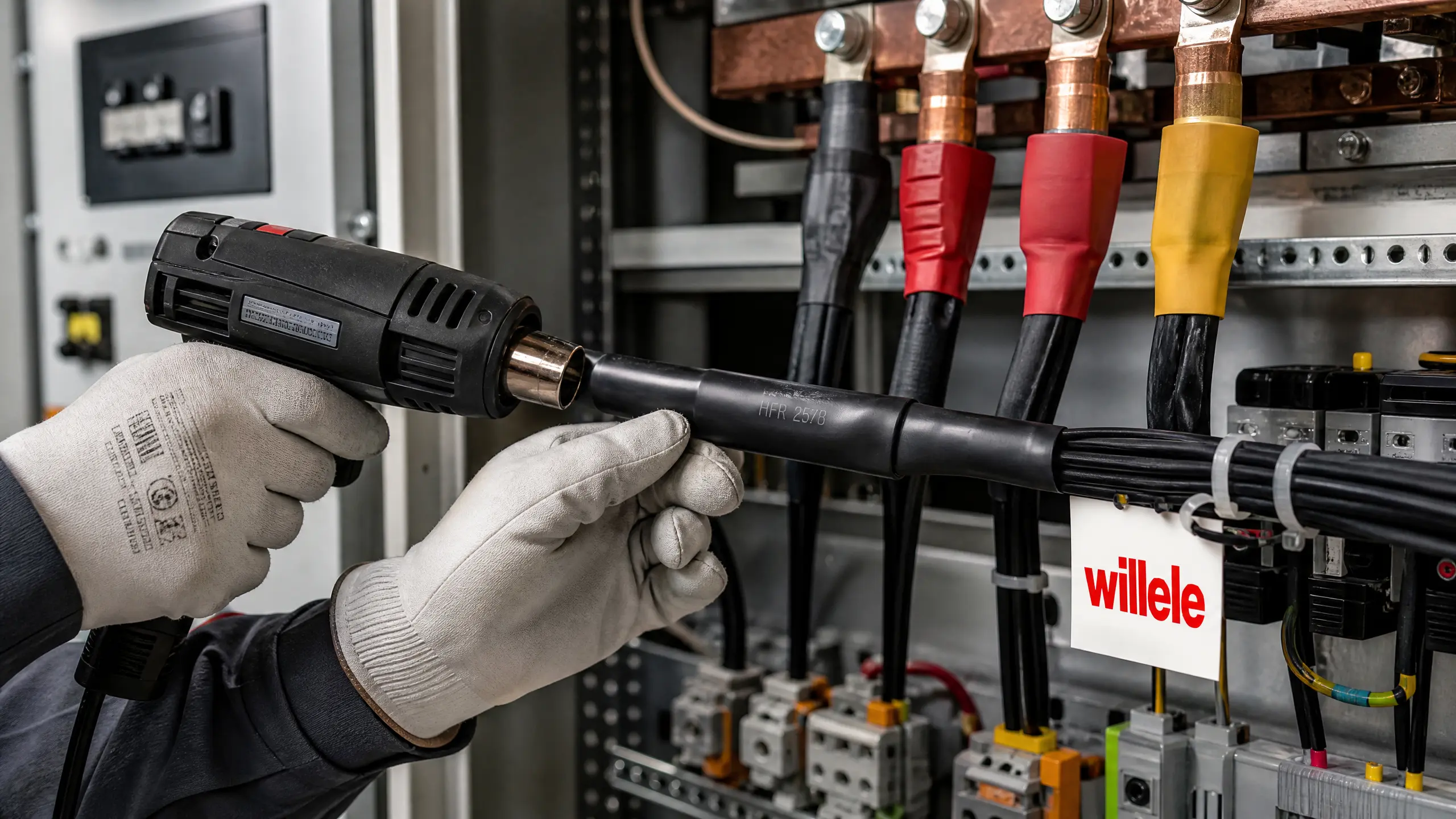
A wire bundle running through a control cabinet doesn’t usually fail quietly. It arcs, it sparks, and if the insulation around it feeds that spark instead of smothering it, a single loose terminal can turn into a cabinet fire in under a minute. That risk is exactly why flame retardant heat shrink tubes have become the default specification—not an optional upgrade—on almost every panel, harness, and busbar connection an electrical engineer signs off on today.
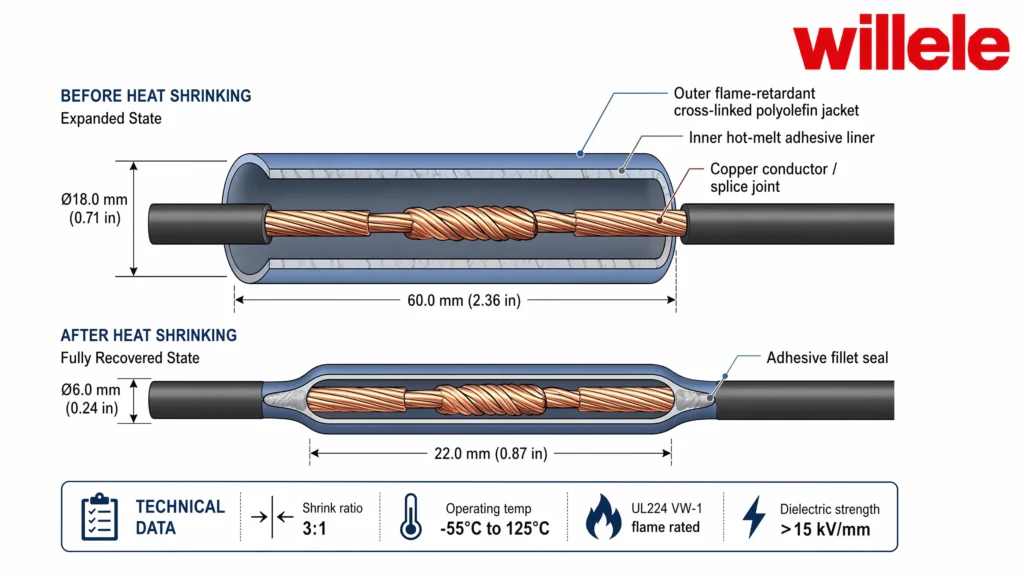
Flame retardant heat shrink tubing is a cross-linked polymer sleeve that shrinks tightly around a conductor, splice, or terminal when heated, and is formulated to self-extinguish rather than sustain a flame once the ignition source is removed. Standard, non-rated heat shrink does the shrinking part just fine. It does not do the self-extinguishing part, which is the whole reason engineers specify the flame retardant grade for anything connected to a live circuit.
What “Flame Retardant” Actually Means in a Heat Shrink Tube
The label gets used loosely in catalogs, so it’s worth being precise about what it verifies. A genuinely flame retardant heat shrink tube has been tested to a recognized vertical flame standard—most commonly UL 224 VW-1 in North America—where a sample is clamped vertically, exposed to a flame for a fixed number of applications, and must self-extinguish within 60 seconds total burn time without dripping flaming particles that ignite a cotton indicator below it. Materials engineers also reference the limiting oxygen index (LOI), the minimum oxygen concentration needed to sustain combustion; a flame retardant polyolefin compound typically reaches an LOI of 28 or higher, well above the roughly 21% oxygen content of normal air, which is precisely why it won’t keep burning once the flame source is gone.
That performance comes from the resin formulation, not just the shrinking mechanism. Flame retardant compounds are built on cross-linked polyolefin loaded with mineral or halogenated flame-retardant additives, then irradiated (typically by electron beam) to lock the polymer chains together so the material holds its shape at elevated temperature instead of melting away from the flame. A plain, unrated polyolefin or PVC tube shares the shrink behavior but skips this additive package and irradiation step, so it can keep burning, drip, or shrink back before the flame threat has passed.
| Property | Flame Retardant Heat Shrink Tube | Standard (Non-Rated) Heat Shrink Tube |
|---|---|---|
| Flame test result | Self-extinguishes in ≤60 sec (UL 224 VW-1) | No flame rating; may sustain or spread flame |
| Limiting Oxygen Index (LOI) | ≥28 | Typically 18–21 |
| Cross-linking process | Electron-beam irradiated | Often none, or minimal |
| Dielectric strength | >15 kV/mm | Varies, often unverified |
| Operating temperature | −55°C to +125°C (up to 200°C fluoropolymer) | Frequently limited to <100°C |
| Compliance documentation | UL, CSA, RoHS, REACH certificates available | Rarely certified or batch-tested |
| Typical use case | Live circuits, panels, harnesses, splices | Cosmetic bundling, non-electrical labeling |
Six Reasons Engineers Keep Specifying It
It stops a fault from becoming a fire. This is the reason every other reason exists to support. When an overloaded connector or a chafed harness starts to arc, the surrounding insulation is the last line of defense between a contained fault and a propagating fire. A VW-1-rated tube smothers that ignition point instead of feeding it, which is why fire-sensitive industries—aerospace, rail, oil and gas—make the rating non-negotiable in their component specs.
Dielectric strength holds up under real voltage stress. Flame retardant polyolefin tubing rated above 15 kV/mm gives engineers a comfortable margin over the working voltage of most low- and medium-voltage connections, so a bare splice or busbar joint stays reliably isolated instead of becoming a tracking path for leakage current.
Mechanical protection comes bundled in, not added on. Once recovered, the tube forms a tough abrasion-resistant jacket that absorbs vibration, resists cable pull-out at the termination, and shields the joint from nicks and flex fatigue—useful in a control cabinet, essential in a vibrating engine bay or a robotic arm’s cable track.
Sealed variants keep moisture and chemicals out entirely. Dual-wall, adhesive-lined constructions melt an internal hot-melt liner during shrinking, producing a continuous seal that meets IP67 in outdoor, underground, marine, and automotive engine-bay installations where a dry splice today can corrode into an open circuit within a season.
The temperature range matches the environment, not just the datasheet. Standard flame retardant polyolefin covers −55°C to +125°C continuous duty, and fluoropolymer variants extend to 200°C, so the same design logic scales from a rooftop solar combiner box to an engine compartment without switching material families mid-project.
Certification turns a spec-sheet claim into an audit-ready fact. UL 224, CSA C22.2, SAE AMS-DTL-23053, RoHS, and REACH compliance mean an engineer isn’t taking a supplier’s word for flame behavior—there’s a test report and a batch traceability record behind it, which matters enormously the first time an insurer or a certifying body asks for proof after an incident.
Standards Engineers Actually Check Before Approving a Part Number
| Standard | Region / Scope | What It Verifies |
|---|---|---|
| UL 224 (VW-1) | North America, general electrical | Vertical flame self-extinguishing within 60 sec |
| CSA C22.2 No. 198.1 | Canada | Equivalent flame and dielectric requirements for the Canadian market |
| IEC 60684-3 | International | Insulating sleeving classification, including flammability category |
| SAE AMS-DTL-23053 / AS23053 | Aerospace | Heat-shrinkable sleeving for military and aerospace wiring |
| RoHS 2011/65/EU | European Union | Restricts lead, mercury, cadmium, and other hazardous substances |
| REACH | European Union | Restricts and discloses substances of very high concern |
Matching the Construction to the Application
Not every flame retardant tube is interchangeable. The shrink ratio, wall construction, and material family need to fit the installation, and this is where a generic “flame retardant heat shrink tube” search on a distributor site gives an engineer more noise than answer.
| Application | Recommended Construction | Shrink Ratio | Operating Range |
|---|---|---|---|
| Control panel wiring, terminal insulation | Single-wall polyolefin, VW-1 | 2:1 or 3:1 | −55°C to 125°C |
| Automotive / EV high-voltage harness | Adhesive-lined dual-wall | 3:1 or 4:1 | −55°C to 125°C |
| Outdoor, underground, or marine splices | Adhesive-lined dual-wall (IP67) | 3:1 or 4:1 | −55°C to 125°C |
| Busbar insulation, high-current joints | Heavy-wall busbar-grade polyolefin | 2:1 | Up to 36 kV rating |
| Rail and public infrastructure | Low-smoke zero-halogen (LSZH) | 3:1 | −55°C to 125°C |
| Engine bay, high-heat aerospace zones | Fluoropolymer (PTFE/FEP) | 2:1 | Up to 200°C |
The pattern behind the table is simple: pick the shrink ratio that clears the largest feature being covered—the connector body, not just the cable—and choose the wall construction (single-wall for insulation and identification, adhesive-lined dual-wall for anything that needs a moisture seal) before worrying about color or brand.
How Willele Builds Flame Retardant Heat Shrink Tubes That Hold Up to This Scrutiny
Willele Electric manufactures flame retardant heat shrink tubing from its ISO 9001-certified facility in Yueqing, Zhejiang—one of China’s established electrical component manufacturing hubs—where in-house electron-beam cross-linking, extrusion, and testing lines cover the process end to end. Every production batch runs through incoming resin inspection, in-process dimensional and flame testing, and outgoing verification, with certificates of conformance, RoHS and REACH statements, and full 2D/3D drawings shipping with every order.
The product range spans single-wall polyolefin in 2:1 and 3:1 shrink ratios certified to UL 224 VW-1, adhesive-lined dual-wall tubing in 3:1 and 4:1 ratios for sealed outdoor and automotive connections, busbar-grade formulations rated to 36 kV, and fluoropolymer variants for continuous 200°C service. For B2B buyers, Willele pairs that range with engineering support—BOM matching, cross-reference against competitor part numbers, and tiered pricing under framework agreements—so a design team can move from spec sheet to approved part number without guessing at equivalence.
The Bottom Line
Electrical engineers don’t choose flame retardant heat shrink tube because it’s the premium option on a price list. They choose it because it’s the only version of the component that has actually been tested to do the one thing insulation is supposed to do in a fault condition: stop, not spread, the fire. Everything else—the dielectric margin, the sealing, the temperature range, the certification paperwork—is what turns that single property into a part number an engineer can specify with confidence and an auditor can verify without a follow-up question.
Frequently Asked Questions
Q: What’s the real difference between flame retardant and standard heat shrink tubing?
A: Standard tubing shrinks but carries no verified flame performance; flame retardant tubing has passed a vertical flame test such as UL 224 VW-1, meaning it self-extinguishes within 60 seconds instead of sustaining combustion.
Q: Does a VW-1 rating mean the tubing is fireproof?
A: No. VW-1 means the material self-extinguishes quickly and won’t propagate flame along the cable—it reduces fire risk significantly but isn’t a claim of total fire immunity.
Q: Can flame retardant heat shrink tube be used outdoors or underground?
A: Yes, provided it’s an adhesive-lined dual-wall construction. The hot-melt inner liner creates an IP67 moisture seal on top of the flame-retardant outer jacket, which single-wall tubing does not provide.
Q: What operating temperature range should I expect?
A: Standard flame retardant polyolefin covers −55°C to +125°C continuously; fluoropolymer (PTFE/FEP) variants extend to 200°C for engine bays and high-heat aerospace zones.
Q: How do I verify a supplier’s flame retardant claim is genuine?
A: Request the UL 224 or IEC 60684-3 test report and batch traceability documentation. Reputable manufacturers, including Willele, provide certificates of conformance and RoHS/REACH statements with every shipment.
