
Waterproof Wire Nuts for Outdoor Lighting Systems: Complete Application Guide

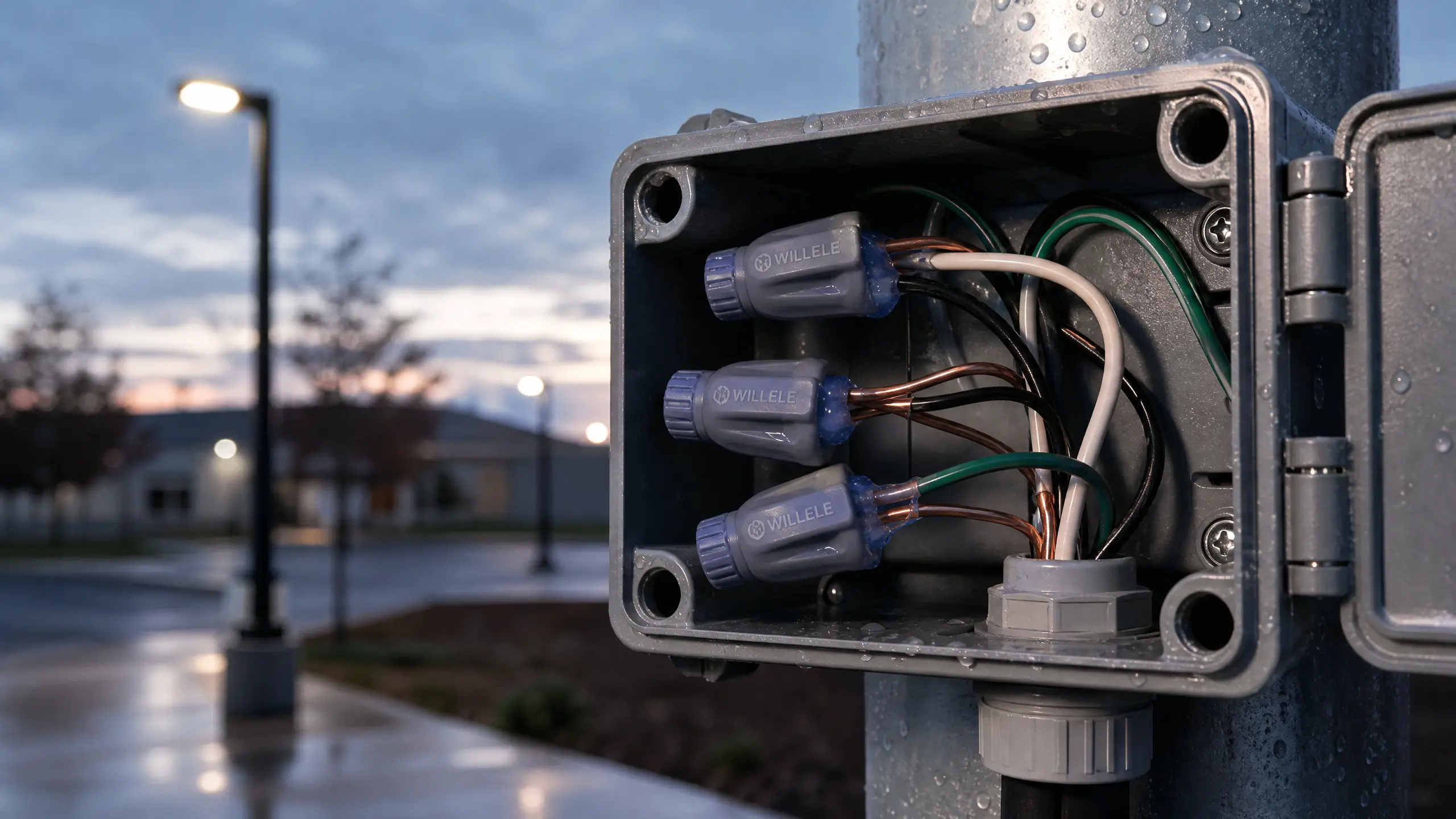
Outdoor lighting circuits spend their entire service life exposed to the one enemy standard wire connectors were never built for: water. Streetlights, parking lot fixtures, landscape lighting, floodlights, and signage all route line- or low-voltage wiring through junction boxes, pole bases, and fixture housings that see rain, condensation, irrigation spray, and freeze-thaw cycles year after year. Waterproof wire nuts are the small, often-overlooked component that determines whether those splices survive a decade of outdoor exposure or fail within a single wet season. This guide covers how waterproof wire nuts are built, which standards and IP ratings actually matter for outdoor lighting, how to size and install them correctly, and how they compare to other sealing methods — using specifications from WILLELE Electric’s waterproof wire nut product line as a technical reference point.
Why Standard Wire Nuts Fail in Outdoor Lighting Circuits
A standard twist-on wire nut relies on a metal spring biting into bare copper, with nothing but air inside the plastic shell. Indoors, in a dry panel, that’s fine. In a streetlight pole base, a parking lot fixture arm, or a landscape lighting transformer box, that air gap becomes a reservoir. Moisture condenses inside the shell overnight, wicks along the stripped conductor, and starts oxidizing the copper. Oxidation raises resistance at the splice, resistance generates heat, and heat under fluctuating outdoor loads is how “the light just stopped working” turns into a scorched fixture or a nuisance breaker trip.
Outdoor lighting adds stresses indoor wiring never sees: standing water in pole bases and pull boxes after storms, UV degradation of exposed plastics on fixtures mounted in direct sun, and constant thermal cycling as circuits heat up at dusk and cool overnight. A coastal boardwalk fixture, a snowbelt parking structure, and a desert highway corridor all load a splice differently, but they share the same failure mode: any gap in the seal eventually fills with moisture. A splice that only has to survive a dry, temperature-stable panel interior is not the same engineering problem as one that has to survive fifteen winters in an in-ground landscape lighting well. Waterproof wire nuts close that gap by pre-filling the connector shell with a sealant that displaces air and moisture the moment the wires are twisted in.
How Waterproof Wire Nuts Work: Inside the Connector
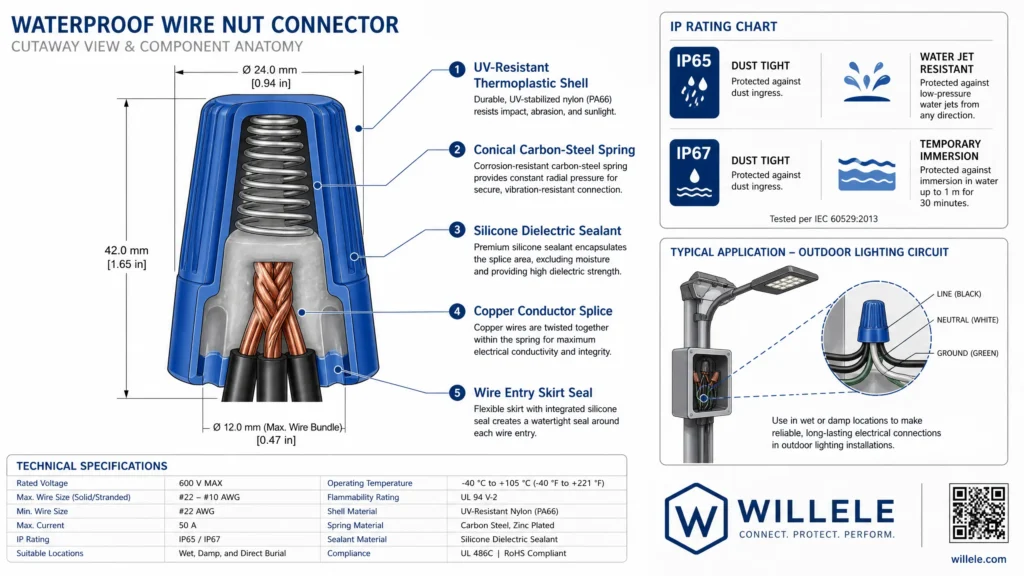
A waterproof wire nut is a small engineered assembly, not just a colored cap over a splice. Three components do the work:
- Shell — a UV-stabilized thermoplastic (typically PA66 or polypropylene) body that resists cracking under sun exposure and carries a UL94V-2 flame-retardant rating.
- Spring — a conical, zinc- or nickel-plated carbon-steel spring that mechanically bites into the twisted conductors, maintaining contact pressure through thermal expansion and vibration.
- Sealant — a non-hardening, 100% silicone-based dielectric gel pre-loaded into the shell. As the wires twist in, the gel is forced around every strand, filling voids that would otherwise trap moisture.
That combination is what separates a true waterproof wire nut from a standard one wrapped in tape: the seal forms mechanically, during installation, instead of depending on a separate wrapping step an installer can rush or skip.
IP Ratings and Standards That Matter for Outdoor Lighting
IP (Ingress Protection) ratings describe how well an enclosure — or a sealed connector inside one — resists solids and liquids. For outdoor lighting, the practical range runs from IP65 through IP68:
| IP Rating | Solid Protection | Liquid Protection | Typical Outdoor Lighting Use |
|---|---|---|---|
| IP65 | Dust-tight | Water jets from any direction | Fixture junction boxes, parking lot pole bases |
| IP67 | Dust-tight | Immersion to 1 m for 30 minutes | Landscape/pathway wells, low-lying pull boxes |
| IP68 | Dust-tight | Continuous immersion beyond 1 m | Submersible fountain and water-feature lighting |
| IP69K | Dust-tight | High-pressure, high-temperature wash | Coastal or marine-adjacent lighting exposed to washdown |
Certification also depends on which market a project sits in. North American installers look for UL 486D listing (sealed wire connectors for damp/wet locations) and, for Canadian projects, compliance with CSA C22.2; NEC Articles 225 and 410 govern outside branch circuits and luminaire wiring more broadly. European and other IEC-aligned markets reference IEC 60529 for the IP rating itself and CE marking for the connector assembly. A waterproof wire nut is only as good as the certification printed on its packaging — verify it against the code actually enforced in the installation’s jurisdiction.
Technical Specifications at a Glance
| Specification | Typical Value | Standard / Reference |
|---|---|---|
| Voltage rating | 600 V (building wire); up to 1000 V for signs/luminaires | UL 486D |
| Temperature rating | 105°C (221°F) connector; sealant stable roughly −45°F to 400°F | CSA C22.2 |
| Wire range | #22 AWG to #8 AWG | — |
| Sealant | 100% silicone-based, non-hardening | — |
| Housing material | UV-stabilized PA66/PP thermoplastic | UL 94V-2 flame retardant |
| Ingress protection | IP65 / IP67 (model-dependent) | IEC 60529 |
| Conductor compatibility | Copper-to-copper only | — |
These figures reflect WILLELE Electric’s waterproof wire nut line (WLE10-series); always confirm the exact rating on a given model’s datasheet before specifying it for a project.
Matching Connector Size to Outdoor Lighting Applications
Outdoor lighting spans very different circuit types, from 12-volt landscape transformers to 277-volt parking lot fixtures, and connector sizing has to follow the actual conductor gauge, not just the fixture category:
| Connector Size (Series) | AWG Range | Common Outdoor Lighting Application |
|---|---|---|
| Small (WLE1010 / WLE1011) | #22–#16 AWG | Low-voltage landscape and pathway lighting, photocell leads |
| Medium (WLE1020) | #18–#12 AWG | Standard 120V fixture pigtails, security and flood lights |
| Large (WLE1030 / WLE1040) | #14–#8 AWG | Parking lot pole circuits, street lighting feeders, combiner/junction boxes |
As a rule, match the connector to the largest conductor in the splice and never exceed the manufacturer’s rated wire count — an overfilled shell forces sealant out before the twist is complete, leaving voids exactly where moisture will find them. Line-voltage circuits (120V–277V) also demand the full UL 486D voltage and temperature rating, while low-voltage landscape runs prioritize compact size and easy field servicing.
Waterproof Wire Nuts vs. Other Sealing Methods
Outdoor lighting contractors typically choose between three approaches to sealing a splice, and each has a place:
| Feature | Waterproof Wire Nuts | Adhesive-Lined Heat Shrink | Standard Wire Nuts |
|---|---|---|---|
| Moisture protection | High (silicone sealant) | Maximum (fully encapsulated) | None |
| Installation speed | Fast — twist-on, no tools | Slower — requires a heat gun | Fast |
| Re-enterability | Possible, not recommended | No — permanent bond | Yes |
| Best for | Fixture and pole-base junction boxes, service/maintenance splices | Direct burial, permanent underground runs | Dry indoor panels only |
For most outdoor lighting maintenance and new-fixture work, waterproof wire nuts win on speed and accessibility. For splices that will be buried or permanently inaccessible — such as feeder runs between pole foundations — adhesive-lined heat shrink tubing remains the more robust choice.
Installation Best Practices for Outdoor Lighting Connections
- De-energize the circuit before opening any junction box or fixture housing.
- Strip to spec — typically 1/2″ to 3/4″ of insulation; check the connector’s packaging, since over- or under-stripping is the single most common cause of a failed seal.
- Align, don’t over-twist the bare conductors evenly before inserting; most waterproof designs don’t require pre-twisting.
- Push fully home until the wires reach the back of the shell, then twist clockwise until snug.
- Confirm the seal — a small bead of silicone should be visible at the wire entry point, showing the cavity is fully displaced.
- Provide strain relief by securing wiring near the connection so vibration and wind load don’t transfer stress onto the splice.
- Close the enclosure properly — even a correctly sealed wire nut fails its purpose if the junction box lid or gland is left loose.
Common Mistakes to Avoid
Reusing a removed waterproof wire nut, mixing copper and aluminum conductors in the same connector, installing waterproof types outside a proper enclosure, and wrapping the connector in electrical tape “for extra protection” (which traps moisture against the shell instead of keeping it out) are the recurring causes of premature outdoor lighting connection failures seen in the field.
Where WILLELE Waterproof Wire Nuts Are Used
As a specialized B2B manufacturer of heat shrink tubes and electrical connection components, WILLELE Electric supplies waterproof wire nuts to contractors, distributors, and OEM lighting manufacturers across street and area lighting, parking structure lighting, landscape and pathway systems, architectural and facade lighting, and signage. The WLE10-series ships with UL/CE documentation and lot traceability, and WILLELE supports OEM/ODM programs — custom shell color, sealant fill, and packaging — for lighting manufacturers sourcing at volume from China.
Frequently Asked Questions
Are waterproof wire nuts rated for direct burial?
No. They are rated for damp and wet locations inside a proper junction box or pole base, not for direct burial in soil. Use direct-burial-rated splice kits or heavy-wall adhesive heat shrink for underground runs.
Can I reuse a waterproof wire nut after removing it?
Not recommended. Once twisted on, the sealant has already displaced around the original splice; reapplying it to a new connection leaves gaps the sealant can no longer fill reliably.
Do waterproof wire nuts work with aluminum conductors?
Only if the specific model is marked for AL/CU use with an appropriate anti-oxidant compound. Standard waterproof wire nuts are copper-to-copper only.
What size waterproof wire nut do I need for landscape lighting?
Most 12V landscape and pathway lighting uses #18–#16 AWG cable, which falls in the small connector range shown above; always confirm against the specific product’s AWG chart before ordering.
