
Why Waterproof Wire Nuts Are Essential for Outdoor Electrical Connections

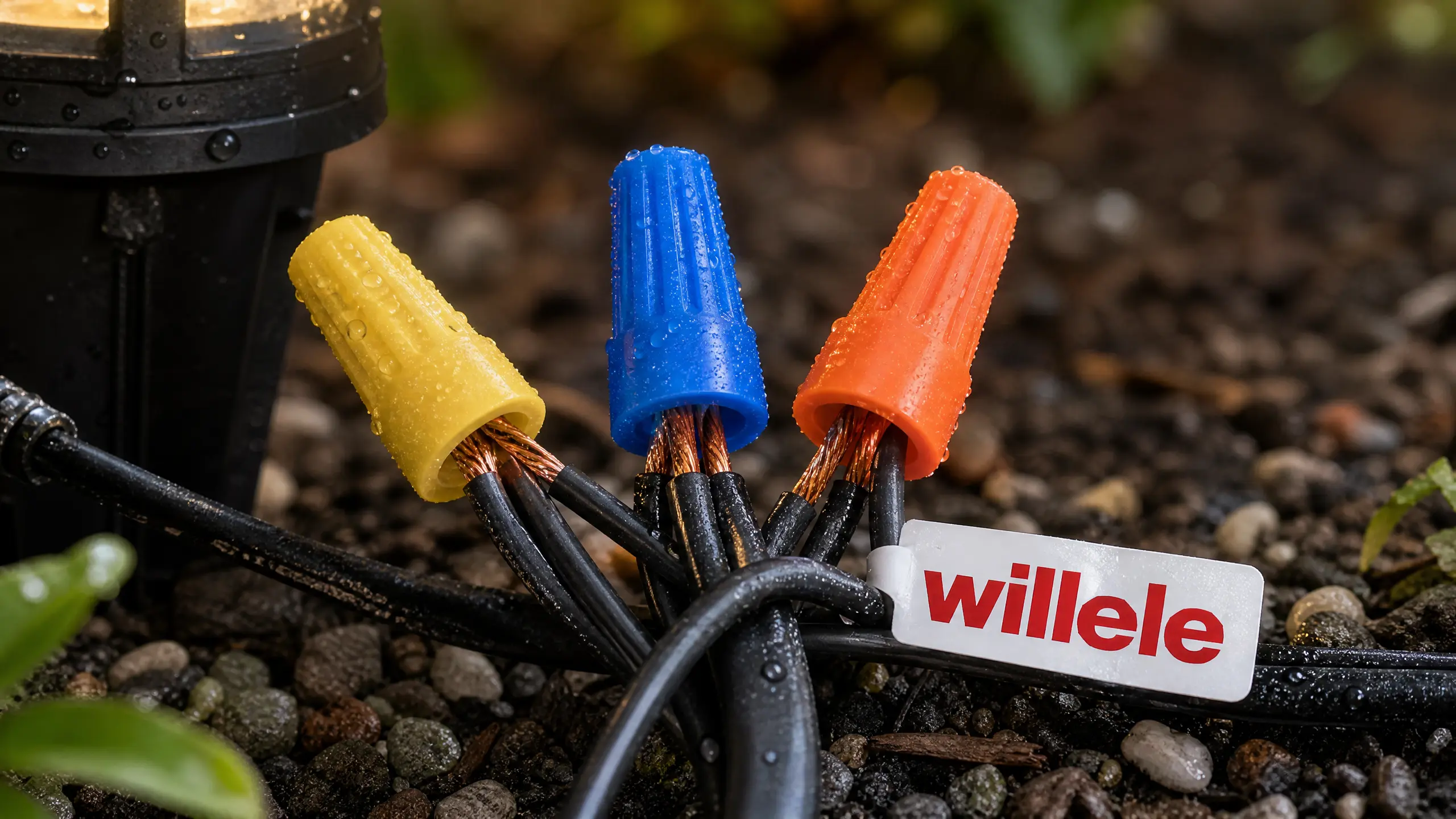
Every outdoor electrical fault seems to have the same origin story: water found its way into a connection that was never built to keep it out. A landscape light stops working after the first hard rain, a dock outlet trips a breaker in humid August air, a rooftop HVAC unit shorts out during a coastal storm — trace any of these back far enough and you usually land on a plain twist-on wire nut, the kind meant for a dry indoor junction box, pressed into service somewhere it was never designed to survive. Waterproof wire nuts exist precisely to close that gap. Built with sealed housings, moisture-displacing gel, and corrosion-resistant internals, they turn an ordinary wire splice into a connection that can sit in mud, spray, or standing water for years without failing. For contractors, OEMs, and facility engineers specifying components for anything that lives outdoors, understanding how waterproof wire nuts differ from standard connectors — and how to match the right one to the actual exposure conditions — is the difference between a connection that lasts a decade and one that needs troubleshooting every spring.
What Is a Waterproof Wire Nut?
A waterproof wire nut is a wire connector engineered to physically block moisture, dust, and airborne contaminants from reaching the copper conductors inside a splice. Where a standard twist-on connector is just a plastic cap over a metal spring, a waterproof version adds three things a dry-location connector doesn’t need: a sealed outer shell rated to a specific IP standard, a silicone or rubber gasket at the wire entry point, and, in most designs, a dielectric gel that fills every remaining air gap once the wires are inserted. That gel does more work than it looks like — it doesn’t just keep liquid water out, it displaces the humid air that would otherwise condense inside the connector and slowly oxidize the copper from within. The result is a splice that stays electrically and mechanically stable in conditions that would corrode a standard connector within a single wet season. The category covers a range of product types, from gel-filled twist-on caps and silicone push-in connectors to fully potted inline splices, and it now sits at the center of most outdoor lighting, irrigation, marine, and industrial wiring specifications precisely because ordinary connectors were never rated for the exposure these environments guarantee.
Why Standard Wire Nuts Fail Outdoors
Standard wire nuts are rated IP20 at best — protected against fingers and small tools, not against water in any form. Move that connector outside and physics starts working against it almost immediately: temperature swings between day and night pull humid air in and out of the plastic cap through microscopic gaps, and every cycle deposits a little more condensation directly onto bare copper. Add rain, sprinkler overspray, or morning dew, and the process accelerates from months to weeks. Once moisture reaches the conductor, galvanic corrosion sets in, contact resistance climbs, and the connection starts generating heat under load — the classic path to a nuisance-tripping breaker or, in worse cases, an arcing fault. None of this shows up on day one, which is exactly why standard connectors keep getting installed outdoors and keep failing quietly a season or two later.
| Condition | Standard Wire Nut (IP20) | Waterproof Wire Nut (IP67/IP68) |
|---|---|---|
| Rain / sprinkler spray | Moisture enters within days | Sealed against direct spray |
| Humidity & condensation | Corrosion begins within weeks | Gel displaces moisture; no condensation |
| Direct burial / submersion | Fails almost immediately | Rated for continuous immersion |
| UV exposure | Housing turns brittle in 1–2 years | UV-stabilized housing, 10+ year life |
| Typical outdoor service life | Under 1 year | 10–20+ years |
How Waterproof Wire Nuts Actually Work
Walk through the design of one of these connectors and the engineering becomes obvious. The outer shell is molded from high-impact polycarbonate or flame-retardant nylon, chosen for UV stability and resistance to cracking under thermal cycling — this is the layer that absorbs the physical abuse of burial, foot traffic, or a dropped tool. Inside that shell sits a precision-wound stainless steel spring, the same basic mechanism found in a standard connector, twisted around the stripped conductors to hold them under constant mechanical pressure and maintain low-resistance contact. What makes the difference is everything around that spring: a silicone gasket seated where the wires enter the connector compresses tightly around the insulation, and the remaining internal cavity is pre-filled or field-filled with a non-corrosive dielectric gel. When the wires are pushed in, that gel is forced to flow around every strand and fill any air pocket left by imperfect stripping or twisting, so there’s no void left for water vapor to occupy even if the outer seal is eventually stressed. Better designs add a secondary O-ring at the cap-to-body interface, effectively building the connector as a two-stage seal rather than relying on a single point of failure. It’s a small assembly, but every material choice — the gel’s dielectric strength, the spring’s contact pressure, the housing’s impact rating — is selected specifically because the connector will spend its working life somewhere wet, buried, or exposed, not sitting dry inside a junction box.
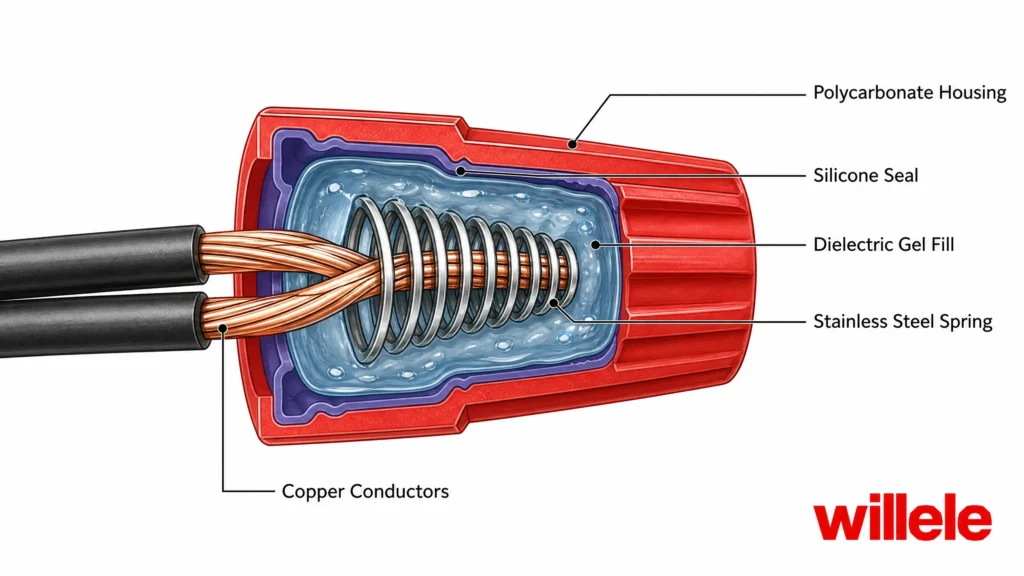
Cross-section of a willele waterproof wire nut showing the sealing and contact mechanism
Understanding IP Ratings for Waterproof Wire Nuts
Every waterproof wire nut worth specifying carries an IP (Ingress Protection) rating, and the second digit is the one that matters most for water. IP65 blocks water jets from any direction but isn’t meant for submersion. IP67 tolerates temporary immersion — typically one meter of depth for thirty minutes — which covers most above-grade outdoor wiring, including landscape fixtures that occasionally sit in a puddle after heavy rain. IP68 goes further, rated for continuous submersion beyond that depth, and is the minimum most specifications call for on direct-burial cable, fountain and pool wiring, or anything installed below the water table. IP69K adds resistance to high-pressure, high-temperature washdown, relevant mainly in food processing and heavy industrial settings rather than typical outdoor electrical work.
| IP Rating | Water Protection | Typical Outdoor Use Case |
|---|---|---|
| IP65 | Water jets, splashing | Exposed junction boxes, covered fixtures |
| IP67 | Temporary immersion (1 m / 30 min) | Landscape lighting, outdoor lighting circuits |
| IP68 | Continuous submersion | Direct burial, irrigation valves, pool/fountain wiring |
| IP69K | High-pressure, hot washdown | Industrial washdown areas, food processing plants |
Matching Waterproof Wire Nuts to Regional Climate Conditions
Outdoor electrical exposure isn’t uniform across the country, and the right waterproof wire nut for one region can be the wrong choice a thousand miles away. Along the Gulf Coast and Southeast — Houston, New Orleans, Tampa — the dominant threat is sustained humidity combined with heavy seasonal rainfall and hurricane-driven flooding, which pushes most specifications toward IP68 gel-filled connectors that can handle both constant moisture and temporary submersion. In the desert Southwest, around Phoenix and Las Vegas, water exposure is intermittent, but UV radiation and surface temperatures well above 60°C on exposed conduit make housing material the priority — a connector needs UV-stabilized polycarbonate or nylon rated well above standard temperature limits, not just a water seal. The Pacific Northwest, from Seattle down through Portland, deals with near-constant low-intensity rain and high ambient humidity for much of the year, a steady-state condition that rewards connectors built for long-term moisture exposure rather than occasional splash. Coastal California and the Eastern Seaboard add salt air into the mix, which accelerates corrosion on any exposed metal and makes tin-plated or silver-plated copper terminals and marine-rated housings worth the added cost. Across the Upper Midwest and New England, freeze-thaw cycling is the real stress test — water that gets into a connector and then freezes can crack a housing that would otherwise have held up fine, so cold-rated silicone seals and impact-resistant shells matter as much as the IP number itself. None of this changes the core requirement — a genuinely sealed, gel-filled waterproof wire nut — but it does change which secondary specifications should carry the most weight in a given region.
| Region | Primary Exposure Risk | Recommended Specification |
|---|---|---|
| Gulf Coast / Southeast | Humidity, heavy rain, flooding | IP68 gel-filled connector |
| Desert Southwest | UV radiation, extreme heat | UV-stabilized housing, 105°C+ rating |
| Pacific Northwest | Sustained rain, high humidity | IP67/IP68, long-term moisture rating |
| Coastal / marine regions | Salt spray, corrosion | Tin/silver-plated terminals, IP68 |
| Upper Midwest / Northeast | Freeze-thaw cycling | Cold-rated silicone, impact-resistant shell |
Waterproof Wire Nuts vs. Other Outdoor Splicing Methods
Waterproof wire nuts aren’t the only way to protect an outdoor splice, and it’s worth being clear-eyed about the alternatives. Wrapping a standard wire nut in electrical tape is the cheapest option and, frankly, not a real waterproofing method — tape degrades under UV within a season and never forms a true seal. A dedicated waterproof junction box adds a layer of physical protection around the splice and makes sense for larger multi-wire connections, but it’s bulkier, costs more, and still needs waterproof connectors inside it to actually seal each conductor. Heat-shrink tubing with an adhesive lining creates an excellent permanent seal once properly heated, arguably the most robust single-splice option, but it’s slower to install, requires a heat source in the field, and can’t be undone without cutting the connection apart. Waterproof gel-filled wire nuts sit in the middle of that range: faster to install than heat shrink, more reliable than tape, and — for correctly sized connectors — cost-competitive with junction box hardware, which is why they’ve become the default choice for landscape lighting, irrigation, and general outdoor splicing where a technician needs a fast, field-proven seal without special tools.
| Method | Install Speed | Reusable | Seal Reliability | Best For |
|---|---|---|---|---|
| Tape-wrapped standard nut | Fast | Yes | Poor — fails within a season | Not recommended outdoors |
| Waterproof gel-filled wire nut | Fast | Limited | High (IP67–IP68) | Landscape lighting, general splicing |
| Waterproof junction box | Moderate | Yes | High, requires sealed entries | Multi-wire panels, control circuits |
| Adhesive heat-shrink splice | Slow (heat required) | No | Very high | Permanent burial, marine |
Selecting the Right Waterproof Wire Nut
Specifying the right connector comes down to three checks, in order. First, confirm the wire gauge range: the connector’s rated AWG capacity has to match the conductor size, since an oversized cavity leaves loose strands and a poor seal, while an undersized one won’t let the gel displace properly. Second, confirm the voltage and current rating against the circuit — most residential and landscape connectors are rated to 600V, but higher-current industrial circuits need connectors rated to 1000V with correspondingly larger spring and terminal contact area. Third, match the IP rating to the actual exposure: don’t over-spec IP68 for a covered, above-grade junction box where IP65 would do, and don’t under-spec IP65 for anything going into the ground. For B2B buyers sourcing at volume, it’s also worth confirming third-party certification rather than relying on a manufacturer’s own IP claim, since ingress testing methodology varies and only certified ratings are independently verifiable.
Standards and Certifications
Reputable waterproof wire nuts are tested against recognized standards rather than marketed on IP numbers alone. In North America, that means UL 486A/C/D for wire connectors and splicing devices, plus CSA C22.2 No. 65 for the Canadian market. Internationally, IEC 60998 and its European equivalent EN 60998 cover connecting devices for low-voltage circuits, while marine and coastal specifications often reference ASTM B117 salt-spray testing and ASTM G154 for UV resistance. A connector carrying these certifications has been through independent dielectric strength, thermal cycling, and ingress testing — not just a manufacturer’s internal claim — which matters when a failure means a safety liability, not just an inconvenience.
Installation Best Practices
Even a correctly rated waterproof wire nut fails if it’s installed wrong:
- Strip conductors to the exact length marked on the connector — too short leaves poor contact, too long leaves exposed copper outside the seal.
- Insert or twist wires fully until the housing seats flush against the wire insulation, with gel visibly displaced around the strands.
- Never reuse an adhesive heat-shrink splice, and inspect gel-filled or push-in connectors for damaged seals before any reuse.
- Perform a pull test after installation — a properly seated connector should resist at least 10N of force without conductor slippage.
- Keep the connector and IP rating consistent across an entire circuit; one unsealed splice undermines every waterproof connector around it.
Why B2B Buyers Choose willele for Waterproof Wire Nuts
willele Electric manufactures waterproof wire nuts and connector assemblies for OEMs, electrical contractors, and industrial distributors who need consistent quality at volume, not just a single certified sample. Every product line runs through ISO 9001:2015-controlled production, with inline dielectric testing and batch-level IP verification rather than spot checks, so buyers can rely on the same seal performance across an order of ten units or ten thousand. willele’s engineering team also works directly with customers on private-label sizing, custom gel formulations for extreme temperature ranges, and application-specific wire gauge configurations — the kind of flexibility that comes from controlling the full manufacturing process in-house rather than reselling a catalog product. For distributors and contractors specifying waterproof wire nuts for landscape lighting programs, marine fleets, or industrial retrofit projects, that combination of certified performance and direct manufacturer support is what turns a one-time purchase into a long-term supply relationship.
Frequently Asked Questions
What IP rating do I need for outdoor waterproof wire nuts?
IP67 covers most above-grade outdoor wiring, including landscape lighting. IP68 is required for direct burial, submersible pumps, or any connection sitting below the water table.
Can waterproof wire nuts be reused?
Gel-filled and silicone push-in types can usually be reused a few times if the seal is undamaged. Adhesive heat-shrink splices are permanent and cannot be reused.
Are waterproof wire nuts rated for direct burial?
Only connectors specifically rated IP68 and listed for underground use are suitable for direct burial; standard IP65/IP67 connectors are not.
Do waterproof wire nuts work with aluminum wire?
Only connectors specifically rated for aluminum conductors should be used, and they require anti-oxidant compound and correct sizing to prevent galvanic corrosion.
How long do waterproof wire nuts last outdoors?
Properly specified and installed waterproof wire nuts typically last 10–20 years outdoors, compared to under a year for standard connectors exposed to the same conditions.
The Bottom Line
Outdoor electrical reliability rarely comes down to one dramatic failure — it comes down to hundreds of small, unsealed splices slowly letting moisture in until something finally trips, corrodes, or arcs. Waterproof wire nuts close that gap at the exact point where most outdoor systems actually fail: the connection itself. Specifying the right IP rating, matching the connector to regional exposure conditions, and sourcing from a manufacturer that tests every batch rather than a single sample turns a low-cost component into the reason a lighting circuit, irrigation system, or industrial installation keeps working for a decade instead of a season. For B2B buyers, that reliability is the actual product.
