
Fire Safety Enhancement in Power Distribution Cabinets

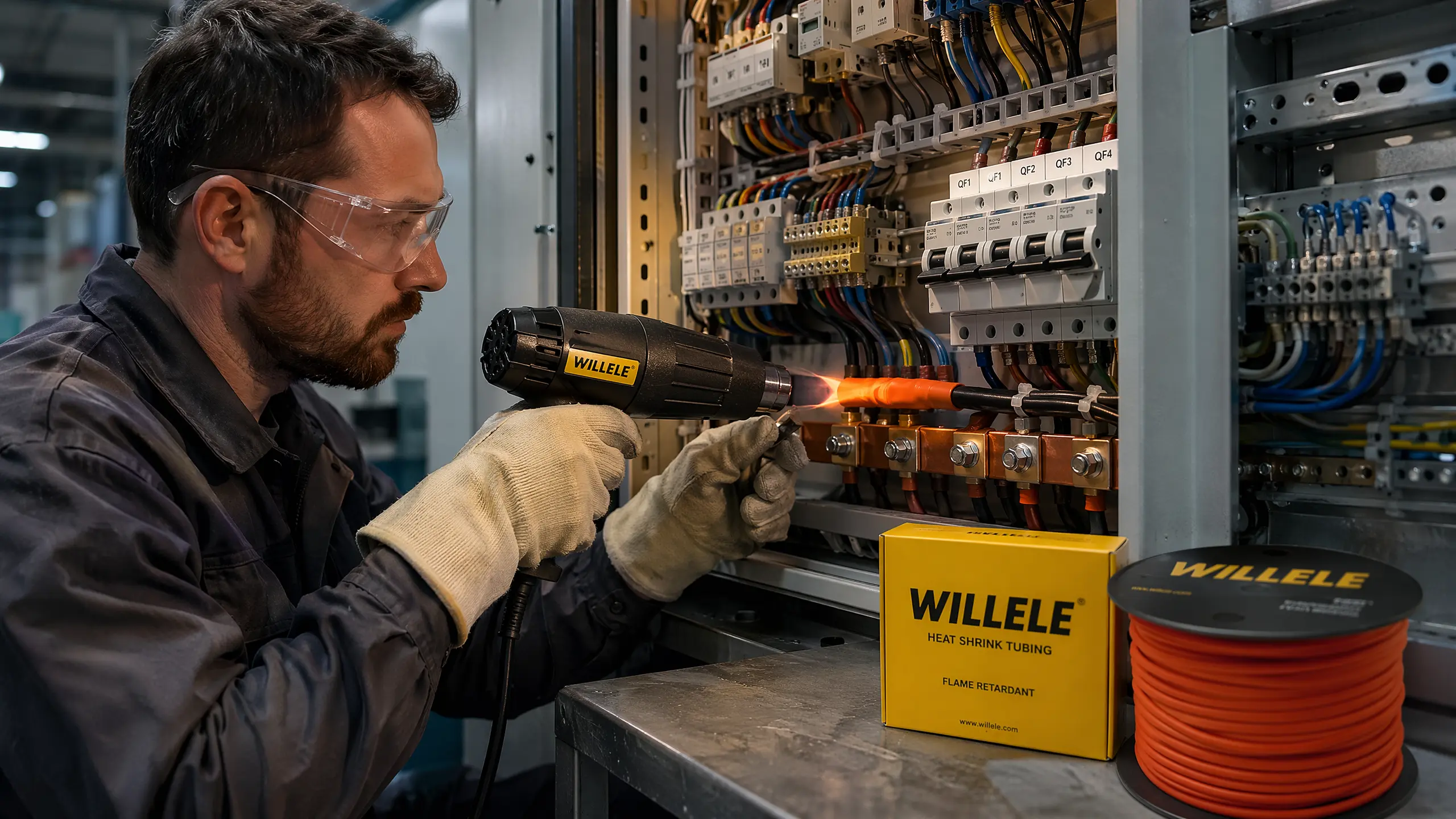
A power distribution cabinet rarely fails because of one dramatic event. It fails in slow motion: a loose lug running a few degrees hotter than its neighbors, insulation that dries and cracks after years of thermal cycling, a splice left bare where a technician ran out of tape. Any of these can become the ignition point for an arc fault, and once flame reaches wiring packed tightly inside a sealed metal enclosure, it has nowhere to vent and everywhere to spread. That is why fire safety inside distribution cabinets has become a design requirement instead of an afterthought, and why one small component keeps showing up on the specification sheet: the heat shrink tube. Properly rated heat shrink tubing does more than tidy up wiring runs; it is one of the few materials inside a cabinet engineered specifically to stop a fire from starting, or from spreading once it does.
Why Fire Risk Concentrates Inside the Cabinet, Not Just the Wire
Cable insulation is rated for a given temperature and voltage under normal load. Trouble starts at the connection points: terminal lugs, splices, and busbar joints, where contact resistance, vibration, and repeated thermal expansion loosen what was once a solid connection. A joint running even 10-15°C above its rating ages the surrounding insulation far faster than the datasheet suggests, and a distribution cabinet compounds the problem by packing dozens of these joints into a sealed steel box with limited airflow.
The U.S. National Fire Protection Association identifies electrical failure and malfunction as one of the leading causes of fire in commercial and industrial buildings. Its own research on non-home electrical-distribution and lighting equipment fires puts the annual toll at roughly 22 civilian deaths, 210 injuries, and $718 million in direct property damage in the United States alone. Most of these incidents trace back not to the cable itself but to an unprotected connection, an aging joint, or a splice patched with general-purpose tape instead of a component built to interrupt combustion.
Panel builders cannot eliminate every loose connection before it happens, but they can control what happens next. That is the real job of fire-rated materials inside a cabinet: not preventing every fault, but making sure a fault does not travel along the wiring harness to the next terminal, the next cabinet, or the next floor.
Heat Shrink Tubes as the First Line of Thermal and Fire Defense
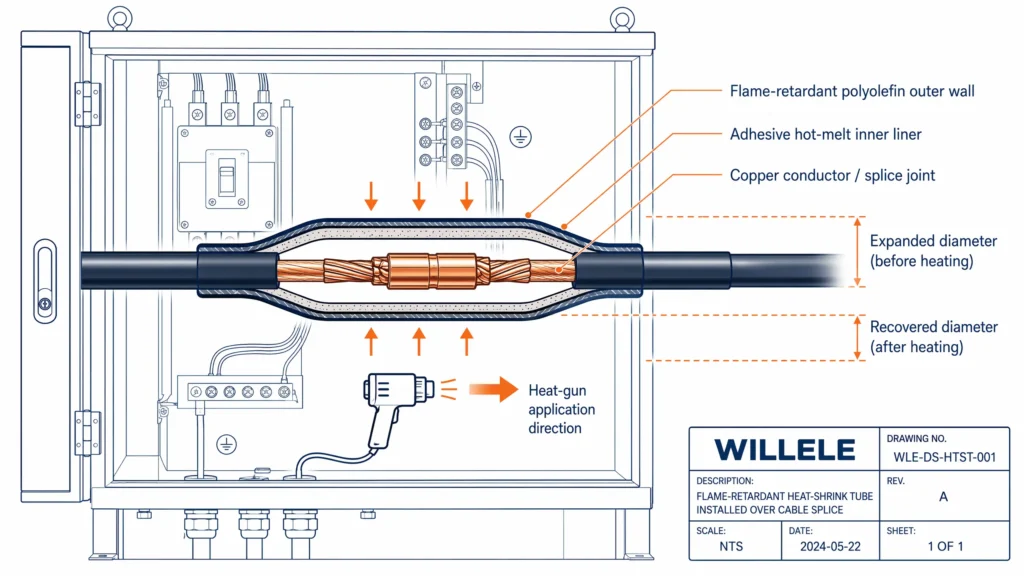
Heat shrink tubing works on a simple material principle. During manufacturing, cross-linked polyolefin is expanded and held at a larger diameter; when a technician later applies heat on site, typically with a heat gun, the polymer relaxes back toward its original, smaller size and grips tightly around whatever it covers, whether that is a splice, a busbar joint, a stripped conductor end, or a cable entry point. Willele’s own guide to how heat shrink tubing is made walks through the cross-linking and thermal-memory process in more detail, but the safety-relevant point is what happens to that polymer under flame.
Standard, non-rated tubing burns and drips like any thermoplastic. A flame-retardant heat shrink tube is compounded differently: it self-extinguishes once the ignition source is removed, and it will not drip flaming material onto components below it. In North America this performance is verified under the VW-1 vertical flame test defined in UL 224, and it is the baseline most panel builders specify for any heat shrink tube used near live connections. A tube that passes VW-1 testing chars and blackens under direct flame, but the fire stops there instead of following the harness to the next joint.
A second, related property matters in enclosed equipment rooms, tunnels, data centers, and vehicles: smoke toxicity. Low Smoke Zero Halogen (LSZH) heat shrink tubing is formulated without chlorine or bromine-based flame retardants, so if it is ever exposed to fire, it releases far less dense, corrosive, and toxic smoke than standard PVC-jacketed materials. For a distribution cabinet inside a confined switchroom or under a raised floor, that difference affects whether occupants and first responders have breathable air during an evacuation.
Dielectric strength, measured in volts per mil, determines how much voltage the tube wall can block before breaking down, and it decides whether the tube actually protects against arcing once it is in place. A properly rated heat shrink tube on a busbar joint does two jobs at once: it restores the electrical clearance the connection needs, and it removes an exposed conductor that could otherwise become the ignition point in the first place.
Flammability and Insulation Ratings at a Glance
Heat shrink tube datasheets rarely use the word “fire” directly; they reference test standards instead. The table below translates the ratings most panel builders encounter into what they actually mean for a distribution cabinet.
| Rating / Property | Standard | What It Verifies | Relevance to Cabinet Fire Safety |
|---|---|---|---|
| VW-1 flame rating | UL 224 vertical flame test | Tube self-extinguishes and does not drip flaming material | Baseline requirement for any tube near live connections |
| LSZH (Low Smoke Zero Halogen) | Halogen-free compounding | No chlorine/bromine flame retardants; low smoke density and toxicity | Critical for enclosed switchrooms, tunnels, and data centers |
| Dielectric strength | Measured in V/mil | Voltage a given wall thickness blocks before breakdown | Prevents arcing at busbar joints and high-voltage splices |
| Shrink ratio (2:1 / 3:1 / 4:1) | Manufacturer specification | How far the tube recovers from supplied to finished diameter | Higher ratios seal irregular splices fully, leaving no exposed conductor |
| Wall thickness | Thin / medium / heavy | Physical protection and insulation margin | Heavy-wall tubing resists abrasion and vibration inside busy cabinets |
Two of these properties, VW-1 and LSZH, speak directly to combustion behavior. The other three determine whether the tube stays sealed around the joint long enough for that combustion behavior to matter at all.
Heat Shrink Tubes vs. Tape, Sealant, and Cold-Shrink Alternatives
Electrical tape and liquid sealants remain common in the field because they are cheap and need no tools, but neither was designed to survive the thermal cycling and vibration a distribution cabinet experiences over a service life measured in decades. Tape adhesive softens as cabinet temperature rises, loosening exactly when the connection is under the most stress. Liquid sealants cure unevenly and are hard to inspect once dry.
| Method | Fire Performance | Sealing / Environmental Protection | Install Time | Long-Term Reliability |
|---|---|---|---|---|
| Electrical tape | Adhesive degrades under heat; rarely flame-tested | Poor, no real moisture seal | Fast | Low, needs periodic re-wrapping |
| Liquid sealant / resin | Varies by formulation; slow, uneven cure | Good once fully cured | Slow | Moderate, hard to inspect once cured |
| Cold-shrink sleeve | Good, but no active flame barrier during install | Very good; rubber compresses onto joint | Fast, no heat tool needed | Good, but bulkier and costlier per joint |
| Flame-retardant heat shrink tube | VW-1 rated, self-extinguishing | Excellent with adhesive-lined types | Fast with a heat gun | High; forms a permanent, inspectable seal |
Cold-shrink sleeves are the closest competitor and remain the right call where an open heat source is genuinely unsafe, near flammable vapors, for example. Inside a standard distribution cabinet, though, a heat gun is a normal part of the panel-building process, and a flame-retardant heat shrink tube adds the fire-stopping benefit of VW-1 compounding plus, in adhesive-lined constructions, a hot-melt liner that flows into gaps and forms a visible fillet at each end: a quick visual check that the seal actually took. That mix of speed, inspectability, and proven flame performance is why heat shrink tube remains the default specification across terminal blocks, busbar joints, and cable entries inside modern panels.
Compliance: IEC, UL, and Regional Standards Panel Builders Must Meet
Fire performance only carries weight when it is verified against a recognized standard, and which standard applies usually depends on where the cabinet will be installed.
| Standard | Primary Region | Governs |
|---|---|---|
| UL 508A | North America | Industrial control panel construction |
| UL 891 | North America | Switchgear-grade equipment |
| NEMA 250 | North America | Enclosure environmental classifications |
| IEC 61439 | International, Europe, Asia, Middle East | Low-voltage switchgear and controlgear assemblies |
| IEC/TR 61641 | International | Internal arc fault containment testing |
None of these standards test heat shrink tube in isolation; they test the finished cabinet. IEC 61439 assemblies, for instance, must withstand a dielectric strength test of 2.5kV AC for one full minute without breakdown, and a temperature-rise limit of under 65K above ambient at rated current, results that depend directly on how well internal splices and busbar joints are insulated and sealed. Panel builders exporting to multiple regions, a common position for EPCs and distributors serving Europe, North America, the Middle East, and Southeast Asia at once, typically specify a single VW-1/LSZH tubing family across the product line so that one bill of materials satisfies UL, CE, and IEC documentation at the same time, rather than re-qualifying wiring materials for every export market.
Specifying the Right Heat Shrink Tube for Your Cabinet
Choosing a tube is a five-variable decision, and getting any one of them wrong undermines the fire performance the other four are meant to provide.
| Decision Factor | Choose This When… | Typical Cabinet Application |
|---|---|---|
| Shrink ratio 2:1 | Wire runs are straight and uniform in diameter | Bundled control wiring, harness runs |
| Shrink ratio 3:1 / 4:1 | Covering irregular shapes: splices, connector bodies, stepped diameters | Busbar joints, multi-conductor splices |
| Single-wall, flame-retardant | Insulation and color-coding are the main needs | General panel wiring, VW-1 baseline protection |
| Adhesive-lined (dual-wall) | Moisture, dust, or chemical ingress is a risk | Cable entries, outdoor enclosures, marine/offshore panels |
| LSZH | Enclosed space with limited ventilation | Switchrooms, tunnels, data centers |
The sizing rule that matters most in practice is straightforward: pick the supplied, expanded diameter so it clears the largest feature the tube must pass over, a connector body or a crimped lug, then confirm the recovered, shrunk diameter is small enough to grip the narrowest point tightly once heated. When a joint sits between two standard sizes, most panel builders size up and choose the next-higher shrink ratio rather than forcing a tight tube over an oversized joint, since a stretched or torn tube loses both its seal and its flame-retardant margin at exactly the point where it is needed most.
Willele’s own catalog illustrates how these variables map onto real parts. The single-wall HTS 2X and HTD 2X tubes cover general panel wiring and color-coded identification at a 2:1 ratio, while the adhesive-lined HST-D 3X and HST-D 4X sleeves add a hot-melt liner for cable entries and outdoor terminations that need a genuine moisture seal. For tight, irregular joints inside crowded enclosures, the semi-rigid HS4X-B holds its shape through installation without extra clamping, and the marine-grade HS-GF 3X&4X family extends the same flame-retardant baseline to salt-fog and offshore environments. Matching a cabinet’s splice list against a catalog like this, rather than sourcing generic tubing part by part, is usually the fastest way to keep every joint on the same fire-rating standard.
Installation Practices That Determine Real-World Fire Performance
A correctly specified heat shrink tube can still underperform if it is installed poorly, and most field failures trace back to a handful of avoidable habits. Slide the tube onto the conductor before the final splice or crimp is made; cutting and slitting a tube after the fact defeats its seal. Center it fully over the joint rather than leaving one end short of the connection point, and apply heat from the middle outward in a slow circular motion so the polymer recovers evenly instead of trapping air pockets that later become weak spots. For adhesive-lined tubing, keep heating until a small, even bead of melted adhesive shows at both ends. That visible fillet is the installer’s confirmation that the seal is complete, not just cosmetic.
Overheating is the most common way to damage flame-retardant tubing during installation. Scorching the wall with a torch or an open flame instead of a temperature-controlled heat gun can pre-degrade the very material that is supposed to resist fire later. A tube that looks fully shrunk but was scorched in the process may pass a casual visual check while carrying only a fraction of its rated flame-retardant performance.
Sourcing Fire-Rated Heat Shrink Tubes from a Qualified Manufacturer
Because heat shrink tube sits directly on live connections, its flame rating is only as trustworthy as the manufacturer’s quality control behind it. Willele Electric manufactures VW-1 rated and LSZH heat shrink tubing at its production facility in Liushi, Zhejiang, alongside the terminal connectors, junction boxes, and cable accessories that typically sit in the same cabinet. Every batch runs through incoming, in-process, and final inspection, tracked as IQC, IPQC, and OQC, with traceable records, and CE, RoHS, and ISO 9001-related documentation is available on request for distributor audits and project submittals.
Willele supplies panel builders, distributors, and EPCs across Europe, North America, the Middle East, and Southeast Asia, with OEM/ODM support for custom lengths, colors, and packaging, and typical production lead times of 10 to 25 days for standard models. For teams specifying flame-retardant heat shrink tube across several export markets, that means one supplier relationship instead of separate qualification cycles for every region. Request a sample or datasheet to match tubing specs to your cabinet’s voltage, environment, and compliance requirements.
Frequently Asked Questions
What makes a heat shrink tube “fire-rated”? A fire-rated heat shrink tube passes the VW-1 vertical flame test under UL 224, meaning it self-extinguishes once the ignition source is removed and does not drip flaming material onto components below.
Is flame-retardant heat shrink tubing required by code inside distribution cabinets? Codes rarely name heat shrink tube directly, but the finished cabinet must pass temperature-rise and dielectric tests under standards like IEC 61439 or UL 508A, and VW-1 or LSZH tubing is the practical way panel builders meet those results on internal splices and joints.
What is the difference between VW-1 and LSZH ratings? VW-1 verifies that the tube self-extinguishes; LSZH verifies that any smoke released during combustion stays low in density and free of toxic halogen gases. A single tube can carry both ratings at once.
Can heat shrink tube replace dedicated busbar insulation sleeves? For many low- and medium-voltage joints, yes: a correctly sized, high-dielectric-strength tube restores full insulation at the connection. Heavily rated or high-voltage busbars may still need purpose-built insulating boots in addition to tubing.
How do I choose the right shrink ratio for a cabinet splice? Use 2:1 for straight, uniform wire runs and 3:1 or 4:1 for irregular shapes such as splices and connector bodies, sizing the expanded diameter to clear the largest feature the tube must pass over.
