
Waterproof Wire Nuts in Solar Power Systems: Application Guide

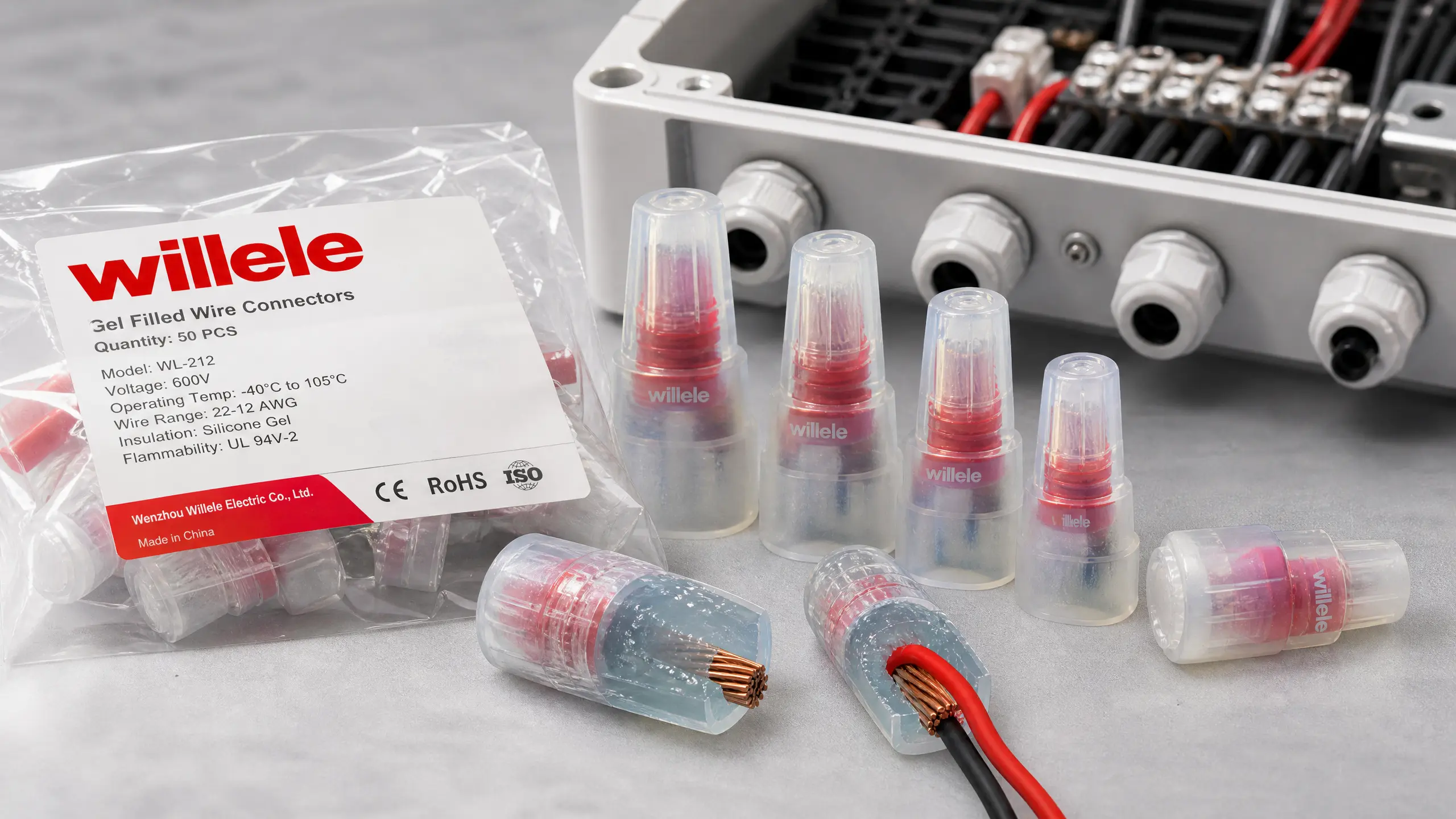
Every solar power system, from a 5 kW residential rooftop array to a 5 MW utility-scale ground-mount plant, depends on hundreds — sometimes thousands — of wire splices. Panels connect to combiner boxes, combiner boxes connect to disconnects, disconnects connect to inverters, and inverters connect to battery banks or the grid. Each of these transitions is a potential entry point for moisture, and moisture is the single most common cause of premature failure in outdoor electrical connections. This is where waterproof wire nuts earn their place as one of the most cost-effective, widely specified components in the entire PV wiring chain.
Unlike sealed connectors such as MC4, which are purpose-built for panel-to-panel string wiring, waterproof wire nuts are the go-to solution wherever installers need a fast, field-serviceable splice inside a junction box, combiner enclosure, or transition point between PV wire and building wire (THHN/THWN). At willele Electric, a B2B manufacturer specializing in electrical connection systems and heat shrink components, we supply installers, EPC contractors, and solar equipment OEMs across North America, the Middle East, Southeast Asia, and Europe with waterproof wire nuts engineered specifically for the thermal cycling, UV exposure, and humidity conditions typical of solar installations. This guide explains where and how these connectors are used across a solar power system, how to select the correct rating, and how to install them for a 25-year service life.
Why Solar Power Systems Demand Waterproof Connections
Solar equipment is installed outdoors by design, and outdoor electrical enclosures are never perfectly airtight. Daily temperature swings between a hot rooftop afternoon and a cool night cause air inside a junction box or combiner cabinet to expand and contract — a process known as “breathing.” Every breathing cycle pulls in a small amount of humid air through gaps in cable glands, knockouts, and gasket seams. Over months and years, that moisture condenses on cold metal surfaces, including the exposed copper inside a standard, dry-rated wire nut.
Once water reaches bare copper, galvanic and oxidative corrosion begins immediately. Corroded copper has higher electrical resistance, and higher resistance under load generates heat. In a DC solar circuit carrying continuous current for six-plus hours a day, a corroding splice can turn into a measurable hot spot within one or two seasons — a well-documented root cause of junction box fires and underperforming strings. Waterproof wire nuts interrupt this failure chain at the source. Their pre-filled, non-hardening silicone or dielectric gel physically displaces air and moisture from the connection cavity the moment the wires are inserted, so there is no air gap left for condensation to form in.
Geographic conditions make this even more critical. Installations in coastal regions face salt-laden humidity that accelerates corrosion; desert climates subject connectors to extreme daytime-to-nighttime temperature swings and intense UV; and cold-climate systems must tolerate repeated freeze-thaw cycles without the sealant becoming brittle. A wire nut rated only for indoor, dry-location use will degrade quickly in any of these environments, which is why solar-specific product selection — not just “any wire nut on hand” — matters for long-term system reliability.
Where Waterproof Wire Nuts Are Used in a Solar Power System
Waterproof wire nuts show up at several distinct points across a typical PV installation, and the application at each point slightly changes the sizing and rating requirements.
Module-to-extension-cable transitions. When a panel’s factory PV leads need to be extended or repaired, installers sometimes splice inside a small inline enclosure rather than replacing the entire cable — a waterproof wire nut inside a sealed splice kit handles this cleanly.
Combiner and junction boxes. This is the highest-volume application. Inside a string combiner box, multiple source-circuit conductors are joined to a common output conductor, and a gel-filled connector rated for the box’s environment (often NEMA 3R or 4X) protects each splice from condensation that collects inside the enclosure.
PV-to-building-wire transitions. Where UV-resistant PV wire (USE-2/RHW-2) transitions to standard THHN/THWN building wire inside a junction box before entering conduit, a waterproof connector prevents moisture from migrating along the conductor strands into the conduit run.
Off-grid and battery-bank wiring. Charge controller, battery, and load-center connections in off-grid cabins, remote telecom sites, and agricultural solar pumping systems are frequently housed in less-controlled enclosures where waterproof splices provide an extra safety margin.
Ground-mount and tracker systems. Ground-level combiner enclosures and tracker motor wiring sit closer to soil moisture, splash, and irrigation overspray, making IP67/IP68-rated connectors the standard specification rather than an optional upgrade.
Technical Construction: What Makes a Wire Nut “Waterproof”
A waterproof wire nut looks similar to a standard twist-on connector from the outside, but its internal engineering is fundamentally different. Three elements work together to create a reliable seal.
| Component | Function | willele Specification |
|---|---|---|
| UV-stabilized shell | Resists cracking and yellowing under years of sunlight exposure | Polypropylene / flame-retardant PC, UL94 V-0 rated |
| Square-wire spring | Maintains constant mechanical contact pressure through thermal cycling | 302/304 stainless steel, live-action coil |
| Dielectric sealant | Displaces air and moisture around the conductors | 100% silicone gel, non-hardening, dielectric strength >15kV/mm |
| Skirt/wire entry | Controls how far the sealant extends around the cable jacket | Tapered skirt for a compression fit against insulation |

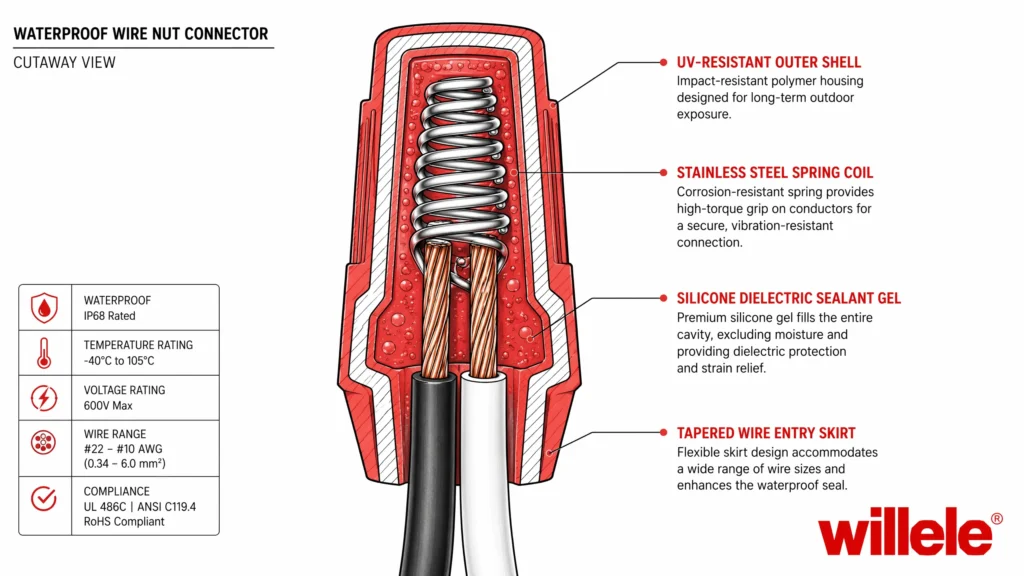
@large
Cross-section schematic of willele waterproof wire nut internal construction
When two stripped conductors are inserted and the connector is twisted clockwise, the spring bites into the copper strands while the surrounding gel is forced backward and outward, filling every void in the cavity, including the microscopic gaps between individual strands of a stranded conductor. This is why manufacturers specify a minimum insertion depth and a minimum number of twist rotations — an under-inserted connection leaves a pocket of the cavity ungelled, and that pocket is exactly where corrosion will start.
IP Ratings and Environmental Classifications
Ingress Protection (IP) codes describe a connector’s resistance to solids and liquids and are the primary spec sheet reference for solar procurement.
| IP Rating | Protection Level | Recommended Solar Application |
|---|---|---|
| IP65 | Protected against water jets from any direction | Rooftop junction boxes under a weatherproof cover |
| IP67 | Protected against temporary immersion (1m / 30 min) | Ground-mount combiner boxes, ballasted array wiring |
| IP68 | Protected against continuous submersion | Below-grade transitions, agrivoltaic/irrigation-adjacent sites, marine-adjacent floating solar |
| IP69K | High-pressure, high-temperature washdown resistant | Solar-powered equipment in food/chemical processing facilities |
For most rooftop and ground-mount residential/commercial systems, IP67-rated gel-filled wire nuts installed inside a properly gasketed enclosure provide the correct balance of protection and cost. IP68 is reserved for connectors that may face standing water or below-grade exposure.
Voltage, Current, and Wire Gauge Compatibility
Solar circuits frequently run at 600V–1000V DC on the source-circuit side, well above typical low-voltage AC branch wiring, so voltage rating is a non-negotiable selection criterion.
| Connector Size | AWG Range | Max Voltage | Current Rating | Typical PV Use |
|---|---|---|---|---|
| Small | 22–16 AWG | 600V | 15A | Sensor/monitoring leads, RSD signal wiring |
| Medium | 18–12 AWG | 600V | 20A | Standard module-to-extension splices |
| Large | 16–10 AWG | 600V | 30A | Combiner box source-circuit input |
| Industrial | 12–6 AWG | 1000V | 40–60A | Output conductors, high-string-count combiners |
Always confirm the connector’s rated voltage meets or exceeds the array’s maximum system voltage with a safety margin, per NEC 690 sizing practice, and never mix copper and aluminum conductors in a connector unless it is explicitly marked AL/CU with an appropriate antioxidant compound.
Waterproof Wire Nuts vs. Other Solar Connection Methods
Procurement teams often need to choose between several splicing technologies for a given application. Each has a distinct performance profile.
| Method | IP Rating | Install Time | Reusable | Vibration Resistance | Best Use Case |
|---|---|---|---|---|---|
| Waterproof gel wire nut | IP67–68 | ~15 sec | Limited | High | Combiner/junction box splices |
| MC4-style connector | IP67–68 | ~30 sec (crimp+lock) | Yes (mated pairs) | Excellent | Module string wiring |
| Standard dry wire nut | IP20 | ~10 sec | Yes | Moderate | Indoor panels only — not for PV |
| Adhesive-lined heat shrink | IP68 | ~60 sec (heat gun) | No | Very high | Permanent, direct-burial-adjacent splices |
| Insulated tap/lug connector | IP65–67 | ~45 sec (crimp) | No | Excellent | Combiner box bus taps, high-current joints |
Waterproof wire nuts occupy a practical middle ground: faster and less tool-intensive than heat shrink or crimped lugs, yet far more reliable in wet environments than a standard dry-rated connector. For high-vibration tracker systems or permanent underground runs, heat shrink or a mechanical lug connection may still be the better long-term choice.
Installation Best Practices for Solar Applications
Correct installation determines whether a waterproof wire nut delivers its rated service life or fails within a single wet season.
- De-energize the circuit and confirm zero voltage before opening any junction box or combiner enclosure.
- Strip conductors to the length printed on the connector packaging — typically 12–15mm (1/2″) — and inspect for nicked or frayed strands.
- Align stripped ends flush and insert both conductors fully into the connector cavity until firm resistance is felt; do not leave bare copper visible outside the shell.
- Twist clockwise through the full number of rotations specified by the manufacturer, until the connector is snug and the spring has fully engaged the strands.
- Inspect the seal — a small bead of silicone gel should be visible at the skirt opening, confirming the cavity is fully packed around the wires.
- Perform a tug test, pulling each conductor with moderate force to confirm mechanical retention before closing the enclosure.
- Route with a drip loop so any water traveling down the cable jacket drips off before reaching the connector body, rather than pooling at the splice.
Avoid two common field mistakes: over-stripping the conductor (which leaves exposed copper beyond the sealed zone) and reusing a connector that has already been fully seated and removed, since the gel does not fully re-seal after disturbance.
Selection Guide by Climate and Installation Type
| Installation Condition | Recommended Rating | Housing Material | Notes |
|---|---|---|---|
| Coastal / high-salinity | IP68, marine-grade | Fluorosilicone seal, PC shell | Add anti-corrosion spray on terminals |
| Desert / high-UV | IP67 minimum | UV-stabilized PA66 | Verify 2000+ hour UV test rating |
| Cold climate (sub-zero) | IP67 | Flexible silicone shell | Confirm cold-flex rating to -40°C |
| Ground-mount / irrigation-adjacent | IP68 | UV-stabilized PC | Elevate combiner box above grade |
| Rooftop residential | IP65–IP67 | Standard PC/nylon | Ensure enclosure gasket is intact |
Quality Standards and Certifications to Verify
When sourcing waterproof wire nuts for a commercial solar project, request documentation confirming compliance with:
- UL 486A/C/D — wire connector construction, splicing, and underground/wet-location use
- IEC 60998 — international low-voltage connecting device standard
- CSA C22.2 No. 65 — North American wire connector certification
- UL94 V-0 — flame-retardant housing classification
willele-manufactured waterproof wire nuts are produced in ISO 9001:2015-certified facilities with 100% dielectric strength testing per batch and sample-based IP67/IP68 leak verification, giving EPC contractors and equipment integrators the documentation needed for code inspections and warranty claims.
Frequently Asked Questions
Q: Can waterproof wire nuts replace MC4 connectors on solar panel strings? A: No. MC4-style connectors are purpose-built, mated pairs designed for panel-to-panel string wiring and carry their own IP67/68 certification for that specific use. Waterproof wire nuts are intended for splices inside junction boxes and combiner enclosures — the transition points between different wire types, not the primary string connection.
Q: What voltage rating do I need for a utility-scale solar combiner box? A: Utility and large commercial arrays commonly operate at 1000V DC or higher, so specify 1000V-rated industrial waterproof wire nuts rather than standard 600V residential-grade connectors. Always confirm against the array’s actual maximum system voltage per NEC 690 calculations.
Q: Are waterproof wire nuts rated for direct burial? A: Generally no. Most twist-on waterproof connectors are rated for wet and damp locations inside an enclosure, not for direct soil burial. For underground runs, use direct-burial-rated splice kits or adhesive-lined heat shrink tubing instead.
Q: How long do quality waterproof wire nuts last in a rooftop solar installation? A: Properly selected and installed connectors from a reputable manufacturer typically perform reliably for 15–20+ years in outdoor rooftop conditions, aligning with the operational lifespan of most PV modules, provided the connector matches the site’s IP rating and temperature requirements.
Q: Can these connectors be reused if I need to service a combiner box? A: Limited reuse is possible if the gel and spring are undisturbed and intact, but reliability drops after the first removal because the sealant does not fully re-flow to close new gaps. For critical circuits, install a fresh connector after any maintenance disconnection.
About willele Electric: willele Electric is a B2B manufacturer of electrical connection systems and heat shrink components serving solar EPC contractors, installers, and equipment OEMs worldwide. Our waterproof wire nuts are engineered and tested for the voltage, temperature, and moisture demands of photovoltaic power systems, backed by full certification documentation and responsive technical support for bulk and project-based procurement.
