
Why Solar Installers Choose Waterproof Wire Nuts for Outdoor Projects

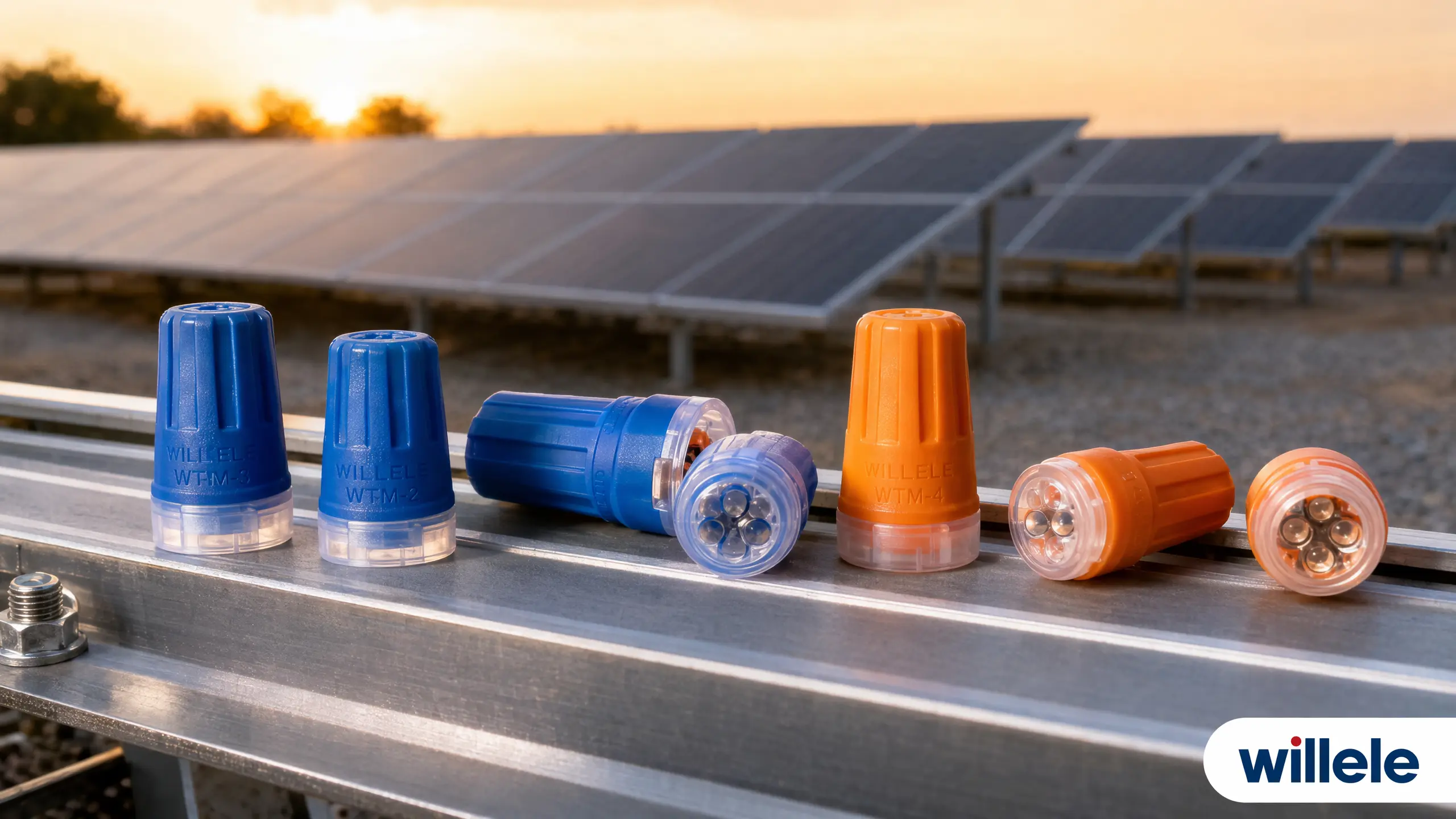
The solar industry has grown at a breakneck pace over the past decade, and with that growth comes a harsh reality: every rooftop array, ground-mount farm, and off-grid battery bank lives outdoors, fully exposed to the elements. Behind every high-performing solar installation is a web of electrical connections that must survive UV radiation, freeze-thaw cycles, torrential rain, and salt-laden coastal air. This is precisely where waterproof wire nuts have become the connective tissue of reliable solar power systems — and why professional installers increasingly specify them over conventional connectors.
At willele, we manufacture waterproof wire nuts engineered for the demanding conditions that solar professionals encounter daily. This guide explains why these components matter, how they outperform alternatives, and what specifications installers should demand when sourcing connectors for outdoor photovoltaic projects.
The Hidden Failure Point in Solar Installations
Solar panels are designed for 25-year service lives. Inverters typically carry 10- to 15-year warranties. But the humble wire connection — the splice joining panel strings to combiner boxes, the junction between trunk cables and home runs — is where field failures most frequently originate. The National Renewable Energy Laboratory (NREL) and other industry researchers have consistently identified connector and splice failures among the leading causes of solar system downtime, often surpassing inverter and module defects.
The mechanism is straightforward. A standard twist-on wire nut or electrical tape splice creates a metal-to-metal contact that is inherently vulnerable to moisture intrusion. Water enters through capillary action, micro-gaps in the connection, or degraded insulation. Once moisture reaches the bare conductor, galvanic corrosion begins — particularly aggressive in systems mixing copper and aluminum, or in coastal environments where dissolved salts accelerate electrochemical degradation. Corrosion increases contact resistance, which generates heat under load, which accelerates further degradation in a runaway cycle that can culminate in arcing, melting, or fire.
Waterproof wire nuts interrupt this failure cascade at its source. By encapsulating the connection in a moisture-impermeable seal, they deny water the entry path it exploits in conventional connectors. For solar installers working in regions with high precipitation, humidity, or seasonal flooding, this single design difference translates to fewer service calls, lower warranty claim rates, and systems that actually deliver on their 25-year performance projections.
What Makes a Wire Nut “Waterproof”
Not every connector marketed for outdoor use delivers genuine moisture protection. The term “waterproof” in this context refers to a specific construction paradigm that combines several engineering elements working in concert.
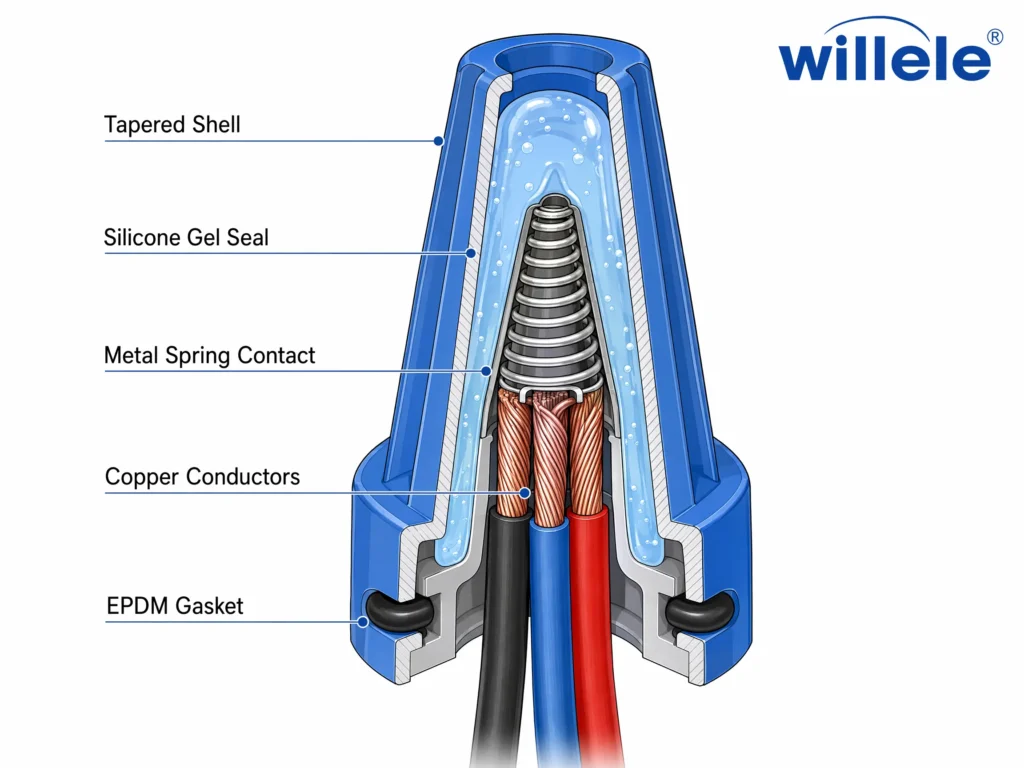
The diagram above illustrates the internal anatomy of a willele waterproof wire nut. Understanding each layer helps installers evaluate competing products on technical merit rather than marketing claims.
The Silicone Gel Core
The defining feature of a true waterproof wire nut is the silicone gel or dielectric grease fill inside the connector shell. This viscous, hydrophobic material surrounds the conductor splice the moment wires are inserted and the nut is twisted or pushed into place. Silicone gel displaces air pockets, coats every metal surface, and forms a continuous barrier that water cannot penetrate. Unlike electrical tape, which degrades, unravels, and loses adhesion in extreme temperatures, silicone gel remains stable across a temperature range typically spanning -40°F to 221°F (-40°C to 105°C).
The gel also serves a secondary function: it inhibits oxidation by excluding oxygen from the contact area. Even if trace moisture were to penetrate the outer shell over decades of service, the gel environment dramatically slows the electrochemical reactions that produce corrosion.
The Tapered Shell and Spring Contact
The outer shell of a waterproof wire nut is precision-molded from UV-stabilized thermoplastic — typically nylon or polypropylene blended with UV inhibitors. This material resists the embrittlement and cracking that sunlight causes in unprotected plastics over years of rooftop exposure. Inside the shell, a metal coil spring (usually tin-plated phosphor bronze or stainless steel) bites into the conductors as the nut is installed, creating a gas-tight mechanical and electrical connection that maintains consistent contact pressure through thermal cycling.
The tapered internal geometry accommodates a range of wire combinations, allowing a single nut size to handle multiple conductor pairings. This versatility simplifies inventory management for installers who work across residential, commercial, and utility-scale projects.
The Environmental Seal
Where the wires enter the nut, an EPDM rubber gasket or integral sealing membrane compresses around the insulation, creating a watertight interface that rated to IP67 or IP68 standards in quality products. This seal flexes with temperature changes without losing compression, accommodating the thermal expansion and contraction that outdoor installations experience daily.
Waterproof Wire Nuts vs. Conventional Connectors: A Comparative Analysis
Solar installers choosing between connector types face a trade-off between upfront cost and long-term reliability. The table below summarizes the key differences that drive professional decision-making.
| Attribute | Conventional Twist-On Wire Nuts | Electrical Tape / Silicone Tape | Waterproof Wire Nuts |
|---|---|---|---|
| Moisture Protection | None — open to environment | Moderate — degrades over time | Excellent — sealed gel barrier |
| IP Rating | IP00 (unrated) | IP54 (typical, when fresh) | IP67 / IP68 |
| UV Resistance | Poor to moderate (shell degrades) | Poor (tape cracks and unravels) | Excellent (UV-stabilized shell) |
| Temperature Range | -14°F to 221°F (-25°C to 105°C) | Limited by adhesive breakdown | -40°F to 221°F (-40°C to 105°C) |
| Installation Speed | Fast | Slow (manual wrapping) | Fast |
| Reusability | Limited | No (single use) | Yes (most gel-filled types) |
| Service Life (Outdoor) | 1–3 years before degradation | 6 months – 2 years | 25+ years |
| Corrosion Resistance | Poor — bare metal exposed | Moderate — until tape fails | Excellent — gel encapsulation |
| Cost per Connection | Lowest | Low | Moderate |
| Total Cost of Ownership | High (frequent replacement) | Very High (labor + failure risk) | Lowest (install once, forget) |
The total cost of ownership row deserves particular attention. While conventional wire nuts cost pennies less per unit, the labor expense of a return service visit — scheduling, truck roll, diagnosis, repair, documentation — easily runs $150 to $400 per incident. A single avoided warranty call pays for years of waterproof connector inventory.
Key Specifications Solar Installers Should Demand
Sourcing waterproof wire nuts for solar projects requires attention to specifications that directly determine field performance. Willele recommends verifying each of the following before committing to a supplier.
IP Rating
Look for connectors rated IP67 minimum, meaning they withstand immersion in water up to 1 meter for 30 minutes. For ground-mount arrays in flood-prone areas or marine environments, IP68 rated connectors provide immersion protection beyond 1 meter and are worth the marginal cost premium.
Wire Range Compatibility
Solar installations commonly use AWG 10 through AWG 14 copper conductors for DC string wiring, with AWG 8 or AWG 6 for home runs and AC tie-ins. Confirm that the waterproof wire nut’s rated range accommodates your actual wire combinations — including solid-to-stranded splices, which are common when transitioning between PV wire and building wiring.
Voltage and Current Ratings
Verify that connectors carry ratings appropriate for your system voltage. Most residential solar systems operate at 600V DC, while commercial and utility systems may reach 1000V or 1500V DC. UL-listed waterproof wire nuts from willele are rated for 600V, suitable for the vast majority of residential and light commercial installations. Always cross-reference the connector’s ampacity rating against your circuit’s maximum continuous current, applying the NEC 125% sizing factor for solar circuits.
Certifications and Listings
For code-compliant installations in North America, specify connectors with UL 486D listing (sealed wire connectors) or equivalent. This standard specifically tests sealed and encapsulated connectors for moisture resistance, dielectric strength, and long-term aging. In European markets, look for CE marking and EN 50381 compliance. willele waterproof wire nuts carry the certifications required for global solar projects, and full documentation is available through our technical resources portal.
Real-World Performance Across Geographic Conditions
Solar installations span dramatically different climates, and connector performance varies accordingly. Understanding these regional challenges helps installers specify the right product for each project location.
Humid Subtropical and Tropical Climates (Florida, Gulf Coast, Southeast Asia, Caribbean)
High ambient humidity combined with intense daily rainfall creates the most aggressive environment for electrical connections. Condensation forms inside conventional connectors during temperature swings between hot days and cooler nights. Waterproof wire nuts with gel encapsulation prevent this condensation cycle from ever reaching the conductors. In post-hurricane field assessments, properly sealed connections are consistently the ones that survive without remediation.
Desert and High-UV Environments (Southwest US, Middle East, Australia)
Extreme UV exposure and temperature swings of 60°F (33°C) or more between day and night stress connector materials relentlessly. UV-stabilized shells prevent the embrittlement that causes cracking, while the gel fill accommodates thermal expansion without losing seal integrity. Installers in Phoenix, Riyadh, and Alice Springs report essentially zero connector-related failures when using properly rated waterproof wire nuts, versus 3-5 year failure cycles with standard connectors.
Freeze-Thaw and Snow Country (Northern US, Canada, Northern Europe)
Water that enters a connection and then freezes expands by approximately 9%, exerting tremendous mechanical force on the connector and conductors. Repeated freeze-thaw cycles physically damage conventional connections, eventually breaking contact or cracking insulation. Waterproof wire nuts that exclude water entirely eliminate this failure mode — a critical advantage for rooftop arrays in Minneapolis, Toronto, or Stockholm where winter conditions persist for half the year.
Coastal and Marine Environments
Salt spray deposits conductive salts on exposed surfaces, dramatically accelerating galvanic corrosion. Within months, unprotected splices in coastal installations can develop visible green corrosion and resistance-related heating. The gel barrier in waterproof wire nuts prevents salt-laden moisture from contacting conductors, making them essential for any installation within 5 miles (8 km) of saltwater.
Installation Best Practices for Maximum Reliability
Even the best waterproof wire nut performs poorly if installed incorrectly. Willele’s technical team has supported thousands of solar projects, and these practices consistently deliver the most reliable field results.
Prepare conductors properly. Strip insulation to the length specified by the connector manufacturer — typically 5/8 inch to 3/4 inch (16-19mm). Under-stripping prevents full insertion; over-stripping leaves bare copper exposed outside the seal. For stranded wire, twist the strands lightly to prevent splaying during insertion.
Match the nut to the wire combination. Every waterproof wire nut carries a published range of acceptable wire combinations. Using a nut outside its rated range risks either loose connections (too large) or damaged conductors (too small). Keep a range of sizes in your installation kit to match field conditions.
Twist or push fully. For twist-on waterproof nuts, continue twisting until the spring bites firmly and the wires begin to twist together — you’ll feel distinct resistance. For push-in types, press firmly until you feel the internal spring engage and the wire bottoms out. A partially installed connector provides neither reliable electrical contact nor effective sealing.
Inspect the seal. After installation, visually confirm that the gel or sealant has fully encapsulated the conductors and that no bare wire is visible outside the connector body. A quick tug test confirms mechanical security.
Document connections. For commercial and utility projects, photograph junction box connections before closing enclosures. This documentation accelerates future troubleshooting and provides evidence of proper installation for warranty purposes.
The Economic Case: ROI of Upgrading to Waterproof Wire Nuts
The decision to specify waterproof wire nuts over conventional connectors is ultimately an economic calculation. Consider a 100 kW commercial rooftop installation with approximately 400 wire connections. The cost difference between standard and waterproof connectors amounts to roughly $200-400 in materials — a negligible fraction of a total project budget that typically exceeds $200,000.
Now consider the downside. A single connector failure that triggers a service call costs $150-400 in labor alone, before accounting for system downtime. If that failure causes arcing that damages a combiner box or inverter, repair costs escalate into thousands of dollars. Insurance claims and fire incidents — rare but catastrophic — can exceed six figures in damages and liability.
The risk-adjusted mathematics overwhelmingly favor waterproof connectors. For an incremental material cost of 0.1-0.2% of project budget, installers eliminate the most common source of field failure, reduce warranty exposure, and protect their reputation. This is why leading solar EPC firms and O&M providers have standardized on waterproof wire nuts for all outdoor connections.
Why Solar Professionals Choose willele
As a B2B electrical equipment manufacturer, willele understands that solar installers need more than a product — they need a supply partner committed to consistency, certification, and technical support. Our waterproof wire nuts are manufactured under ISO 9001 quality systems, with each production lot tested for seal integrity, dielectric strength, and pull-out force.
We offer volume pricing tiers for contractors and distributors, custom packaging for fleet operations, and direct technical support from engineers who understand solar code requirements. Whether you’re wiring a 5 kW residential rooftop or a 50 MW utility farm, willele provides the connector reliability that keeps systems performing for their full design life.
Conclusion
Waterproof wire nuts represent one of the highest value-per-dollar upgrades available in solar installation. By sealing connections against the moisture, UV, and temperature extremes that cause the majority of field failures, they protect system performance, reduce maintenance costs, and safeguard installer reputation. For any outdoor solar project — residential, commercial, or utility-scale — specifying quality waterproof wire nuts from a certified manufacturer like willele is not an upgrade. It is standard practice for professionals who build systems meant to last.
FAQ
Can waterproof wire nuts be reused after removal? Most gel-filled waterproof wire nuts can be reused 2-3 times if the internal gel remains intact and the spring retains its tension. However, for critical outdoor connections, willele recommends installing a fresh connector to ensure optimal sealing. Inspect the gel fill and gasket condition before reusing any connector.
Are waterproof wire nuts required by the NEC for solar installations? The National Electrical Code (NEC Article 690) requires that wiring methods and connections in solar systems be suitable for the environment. While the NEC does not mandate waterproof wire nuts specifically, inspectors increasingly require sealed connectors for outdoor and wet-location splices. Using UL 486D-listed waterproof wire nuts ensures code compliance in these applications.
What wire sizes do willele waterproof wire nuts accommodate? Our standard product line covers AWG 22 through AWG 8, accommodating the conductor sizes most common in residential and commercial solar installations. Technical data sheets detailing exact combinations and pairings are available from our sales team.
Do waterproof wire nuts work with aluminum wire? Yes, when using connectors specifically rated for aluminum conductors and when following proper installation procedures including antioxidant compound application. Willele offers waterproof wire nuts rated for copper-to-aluminum transitions. Always verify the connector’s listing covers your specific wire combination.
How do waterproof wire nuts compare to heat-shrink tubing splices? Both provide moisture protection, but waterproof wire nuts install faster (seconds vs. minutes for heat shrink requiring a heat gun) and allow easier inspection and rework. Heat-shrink splices offer a lower profile for confined spaces. Many installers use both: heat shrink where space is critical, waterproof wire nuts for junction boxes and combiner enclosures where accessibility matters.
