
Industrial Buyer’s Guide to Heat Shrink Tubing: Materials, Standards, and Key Selection Parameters


Heat Shrink Tubing: Fundamentals and Industrial Relevance
Heat shrink tubing is no longer just a consumable. As highlighted in the report, it has become a strategic safeguard for electrical safety, sealing, and reliability. From EV battery packs and aerospace harnesses to offshore cabling, tubing ensures insulation integrity, chemical resistance, and strain relief. Selecting the right tubing type is now an engineering decision with direct cost and safety implications.
Electrical Insulation
Provides high dielectric strength, preventing short circuits and leakage currents in control wiring and high-voltage busbars.
Environmental Sealing
Dual-wall adhesive-lined tubing protects against water, oils, and chemicals, essential for marine and underground systems.
Mechanical Protection
Medium- and heavy-wall tubing resists abrasion, vibration, and impact in demanding automotive and industrial environments.
Material Families at a Glance
| Material | Key Features | Typical Applications |
|---|---|---|
| Polyolefin | Balanced cost, flame retardant, flexible, –55°C to +125°C | General wiring, control panels, electronics |
| PVC | Transparent, low cost, limited cold resistance | Labeling, indoor consumer electronics |
| Fluoropolymers (PTFE, FEP, PVDF) | High chemical resistance, continuous 200°C+ service | Aerospace harnesses, chemical plants, high-voltage |
| Elastomers (Viton, Silicone) | Flexible at extreme temperatures, resistant to fuels/oils | Aviation fuel systems, automotive underhood |
⚠️ Common Misconception
Many procurement teams assume all polyolefin tubes are identical. In reality, UV resistance, adhesive lining, and flame retardant additives vary widely. Always request datasheets with UL 224 or MIL-SPEC compliance before approval.
In summary, heat shrink tubing functions as insulation, environmental seal, and mechanical armor in one step. The next section of this article will detail the technical parameters—from shrink ratios to dielectric strength—that buyers must analyze to match tubing precisely to application risks.
Key Technical Parameters of Heat Shrink Tubing
The following tables summarize the essential parameters presented in the report, including material families, continuous operating temperature, shrink ratios, dielectric strength, flame retardancy, chemical/fluid resistance, and typical applications. These values provide engineers with a professional reference for selection and compliance.
A. Material Families & Performance
| Material Type | Operating Temp (°C) | Shrink Ratio | Dielectric Strength | Flammability / Notes | Typical Applications |
|---|---|---|---|---|---|
| Polyolefin | −55 to 135 | 2:1, 3:1, 4:1 | 15 kV/mm | VW-1 flame retardant | General insulation, harnessing, UV resistant (black grades) |
| PVC | Up to 105 | 2:1, 3:1 | — | Lower flame resistance | Color coding, low-cost indoor electronics |
| PTFE (Fluoropolymer) | −55 to 175 | Up to 4:1 | 600 V/mil | — | Aerospace, medical devices, high-temperature circuits |
| FEP | Up to 205 | Up to 2:1 | 2000 V/mil | Excellent UV resistance | Outdoor cabling, sensors, high-performance sealing |
| PVDF (Kynar) | −55 to 175 | 2:1 | High | Self-extinguishing | Avionics, chemical plants, defense electronics |
| Viton (Elastomer) | −55 to 200 | 2:1 | — | Oil/fuel resistant | Hydraulic systems, underhood automotive |
| Silicone | −50 to 200 | 2:1 | — | Flexible, abrasion resistant | Medical, sensors, high-temp insulation |
B. Shrink Ratios & Longitudinal Shrinkage
| Shrink Ratio | Typical Applications | Notes |
|---|---|---|
| 2:1 | General insulation, equal-diameter harnesses | Shrinks to ~50% of original diameter |
| 3:1 | Irregular joints, connectors, oversized plugs | Wider expanded ID eases installation |
| 4:1 / 6:1 | Repair sleeves, large-to-small transitions | Handles extreme size differentials |
Longitudinal shrinkage typically ranges 5–15%. Always allow extra length to ensure the target section remains fully covered after recovery.
Longitudinal shrinkage typically ranges 5–15%. Always allow extra length to ensure the target section remains fully covered after recovery. For more details on available models, visit our Heat Shrink Tube product page.
Applications and Industry Use Cases
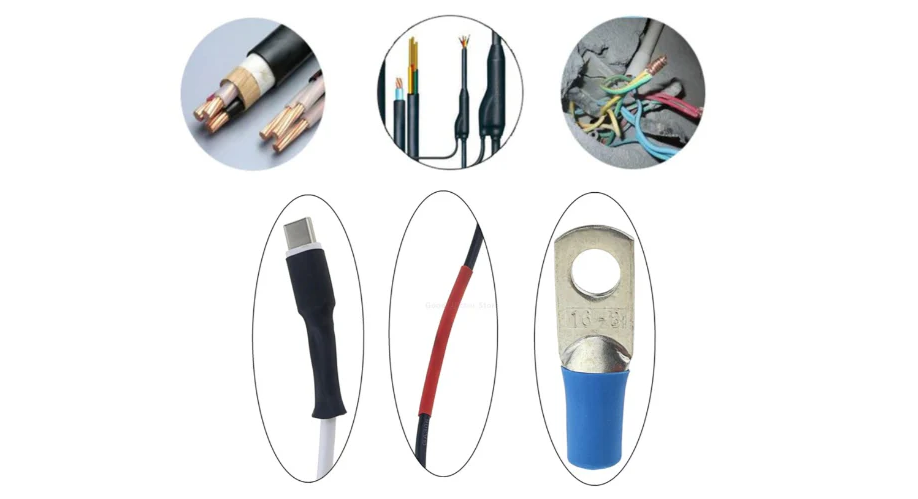
Heat shrink tubing is widely applied across industries that demand insulation, sealing, and mechanical protection. The following cards highlight critical sectors where proper tubing selection directly impacts performance and safety.
Automotive & EV
Used in EV battery packs, wire harnesses, and under-hood cabling to provide insulation, flame retardancy, and chemical resistance against oils and coolants.
- Battery interconnect insulation
- Sensor & connector sealing
- Wire harness abrasion protection
Aerospace & Defense
High-performance fluoropolymer and elastomer tubing withstands extreme temperature swings, fuels, and hydraulic fluids in mission-critical systems.
- Avionics cabling
- Hydraulic/fuel line sealing
- EMI/RFI shielding with conductive shrink
Energy & Power Systems
In solar, wind, and grid infrastructure, heat shrink ensures long-term outdoor durability, dielectric strength, and environmental sealing.
- Photovoltaic (PV) connectors
- Wind turbine nacelle cabling
- Underground distribution joints
Marine & Offshore
Adhesive-lined tubing provides watertight seals against salt spray, humidity, and chemical exposure, critical in marine vessels and offshore oil rigs.
- Shipboard wiring
- Subsea connectors
- Offshore wind turbines
Telecom & Electronics
Provides strain relief and dielectric insulation in fiber-optic terminations, PCBs, and high-density electronic assemblies.
- Fiber optic cable splices
- PCB component insulation
- Consumer electronics connectors

[Insert case study or real-life installation photo here]
Standards & Compliance
Most critical applications require compliance with UL 224, CSA, and RoHS standards. Aerospace and defense projects may demand additional MIL-SPEC qualifications. Always verify certificates with suppliers before approval.
Most critical applications require compliance with UL 224, CSA, and RoHS standards. Aerospace and defense projects may demand additional MIL-SPEC qualifications. Always verify certificates with suppliers before approval. To request compliance documents, please contact our engineering team.
Selection Process and Buyer’s Decision Criteria
Choosing the correct heat shrink tubing requires balancing electrical, mechanical, environmental, and regulatory demands. A systematic approach helps reduce failures, ensure compliance, and optimize cost-to-performance ratio.

1. Electrical Requirements
Consider operating voltage, dielectric strength, and insulation class. Ensure compliance with UL 224 or MIL-SPEC for critical circuits.
2. Mechanical Protection
Wall thickness, abrasion resistance, and flexibility determine suitability for harnessing, abrasion zones, and dynamic movement.
3. Environmental Sealing
Adhesive-lined tubing ensures moisture and chemical resistance for marine, automotive, and outdoor infrastructure.
4. Regulatory Compliance
Verify flame retardancy (UL 224 VW-1), RoHS, REACH, or MIL-SPEC certifications before supplier approval.
5. Installation & Cost
Shrink ratio and recovery temperature affect ease of installation. Balance cost efficiency with long-term reliability.
Decision Matrix: Matching Tubing to Application
| Criteria | Light-Duty | Medium-Duty | Heavy-Duty |
|---|---|---|---|
| Operating Temp | −20 to 85°C | −40 to 125°C | −55 to 200°C |
| Flame Retardancy | Optional | VW-1 rated | MIL-SPEC or advanced flame class |
| Mechanical Stress | Minimal | Moderate | High abrasion, vibration |
| Typical Use | Labeling, consumer electronics | Automotive harnesses, telecom | Aerospace, defense, marine, energy |
⚠️ Buyer’s Tip
Over-specifying tubing adds unnecessary cost and weight, while under-specifying risks insulation failure. Always align tubing choice with the application’s environmental and regulatory profile.
Conclusion, Compliance & Buyer FAQ
The report underscores that heat shrink tubing is a design-level safeguard, not a commodity. Reliability stems from aligning shrink ratio, material family, wall structure, temperature ratings, flame performance, and dielectric strength with the application’s electrical, environmental and mechanical profile.
When specified with traceable documentation (UL 224/UL 94, RoHS, MIL-SPEC where applicable) and validated on the actual hardware, heat shrink tubing reduces rework, leakage currents, corrosion-driven failures and unplanned downtime across EV, aerospace, marine, energy and telecom systems.

[Insert a closing visual: certifications badges or reliability lifecycle graphic]
Documentation
Request current certificates (UL 224/UL 94, RoHS). Ensure lot traceability on C of C and datasheets.
On-Hardware Validation
Verify recovery on the actual jacket/connector, seal integrity (adhesive-lined), and post-recovery wall thickness.
Electrical Safety
Test dielectric withstand on the finished assembly. Confirm creepage/clearance with the final geometry.
Environmental Fit
Match material to chemicals/UV/salt spray/temperature cycling. Prefer dual-wall for moisture/fluids.
Standards & Compliance Mapping
| Standard | What It Covers | Where It’s Commonly Required | Buyer Action |
|---|---|---|---|
| UL 224 / UL 94 | Tubing/insulation; flame performance (e.g., VW-1, V-0) | Electronics, telecom, industrial control panels | Collect current listing and flame class on datasheet; verify part numbers |
| RoHS (EU) | Hazardous substances restriction | Electronics, consumer products, EU shipments | Obtain RoHS declaration and test reports per lot or family |
| MIL-SPEC (as applicable) | Aerospace/defense grade performance & qualification | Avionics, defense electronics, mission-critical wiring | Confirm exact MIL part spec; require C of C with traceability |
FAQ — Buyer’s Common Questions
Q1. When should I choose 3:1 over 2:1?
When connectors or profiles are irregular, 3:1 provides a larger expanded ID and reduces the risk of incomplete recovery. Always account for longitudinal shrink (≈5–15%) in cut length.
Q2. Single-wall vs. adhesive-lined dual-wall?
Use single-wall for identification and light insulation. Choose adhesive-lined dual-wall for moisture/chemical sealing and outdoor use.
Q3. Polyolefin vs. fluoropolymer vs. elastomer?
Polyolefin balances cost and flame performance for general wiring. Fluoropolymers (PTFE/FEP/PVDF) handle chemicals and high heat. Elastomers (e.g., Viton, silicone) tolerate fuels and wide temperature cycling.
Q4. How do I verify flame performance?
Check the datasheet for the exact UL 224/UL 94 rating (e.g., VW-1, V-0) and ensure the certificate maps to the ordered part number and lot.
