
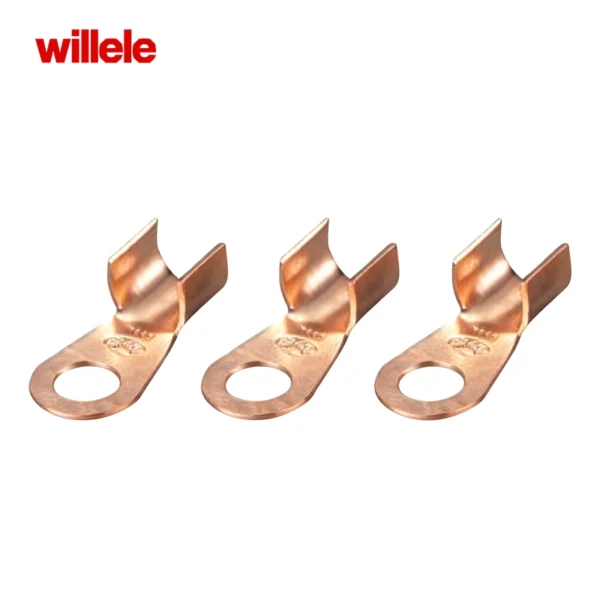
Copper Open Wiring Lugs — OT Series
OT copper open lugs designed for quick wiring terminations in distribution equipment.
Made of high-conductivity copper ensuring low electrical resistance and stable performance.
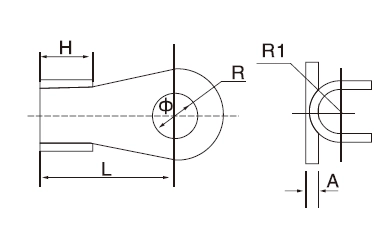
Precise D / d / D1 / L1 / L2 / L dimensions for secure screw connections.
Ideal for switchgear, control panels, and electrical installations where open-end lugs simplify maintenance.
Overview — Copper Open Wiring Lugs
The OT Series Copper Open Wiring Lugs are designed for reliable terminations of copper conductors
in distribution and control equipment. These open-end copper lugs allow easy connection and removal
without complete screw disassembly, reducing wiring time during installation and maintenance.
Each lug is precision-formed from T2 copper and designed with accurate mounting dimensions to ensure
tight, low-resistance electrical contact. They are suitable for wire sizes from 10A to 1000A,
covering most industrial and commercial applications.
Material: T2 copper |
Design: Open-end terminal lug (A-type) |
Range: OT-10A to OT-1000A |
Application: Quick wiring connections in electrical panels
Applications
- Switchboards and power distribution equipment
- Industrial control panels and automation cabinets
- Maintenance systems requiring fast wire replacement
- Suitable for tinned or bare copper conductors
Technical Data
Dimensions (mm): D / d / D1 / L1 / L2 / L — refer to size chart below.
| Type | D | d | D1 | L1 | L2 | L |
|---|---|---|---|---|---|---|
| OT-10A | 5.2 | 6 | 14.5 | 4.5 | 2 | 0.8 |
| OT-20A | 6.2 | 7 | 17 | 5.5 | 2.5 | 1.0 |
| OT-30A | 6.2 | 8.2 | 19 | 5.8 | 3.2 | 1.2 |
| OT-40A | 6.2 | 9 | 19.5 | 6.2 | 3.5 | 1.2 |
| OT-50A | 6.2 | 9 | 21.5 | 6.5 | 3.5 | 1.2 |
| OT-60A | 8.2 | 10 | 23 | 7 | 4 | 1.4 |
| OT-80A | 8.2 | 11 | 25 | 8 | 4.5 | 1.5 |
| OT-100A | 8.2 | 12 | 29 | 8.5 | 5 | 1.5 |
| OT-150A | 10.2 | 12 | 31 | 9 | 5.5 | 1.6 |
| OT-200A | 10.2 | 14 | 33 | 10 | 6 | 1.7 |
| OT-250A | 10.2 | 15.5 | 36 | 10.5 | 6.5 | 2.0 |
| OT-300A | 12.2 | 16 | 40 | 11.5 | 7 | 2.0 |
| OT-400A | 12.2 | 18 | 43 | 13 | 8 | 2.2 |
| OT-500A | 14.2 | 20 | 46 | 14.5 | 8.5 | 2.4 |
| OT-600A | 16.2 | 22 | 50.5 | 16 | 10.5 | 2.8 |
| OT-800A | 18.2 | 26 | 61 | 17.5 | 12.5 | 3.2 |
| OT-1000A | 18.2 | 33 | 66 | 20.5 | 15.5 | 3.8 |
Installation Notes
- Insert stripped conductor fully into the open slot before tightening the screw terminal.
- Ensure good mechanical pressure to achieve low-resistance contact.
- Periodically check terminal torque to maintain secure connection.