
5 Critical Factors to Consider When Choosing a Junction Box Supplier

Introduction
In the electrical equipment industry, junction boxes serve as critical components that protect electrical connections from environmental hazards, ensure safe operations, and maintain system integrity. For B2B buyers, procurement managers, and electrical contractors, choosing the right junction box supplier can significantly impact project timelines, operational safety, and long-term costs. With numerous manufacturers competing in the global market, making an informed supplier selection requires careful evaluation of multiple factors beyond just pricing.
The junction box market has evolved considerably, with suppliers offering varying levels of quality, customization capabilities, and service standards. A poor supplier choice can lead to project delays, safety compliance issues, product failures, and increased total cost of ownership. Conversely, partnering with a reliable supplier like willele—a specialized B2B electrical equipment manufacturer—ensures access to quality products, technical expertise, and dependable service that supports your project success.
This comprehensive guide examines five critical factors that should inform your junction box supplier selection process, providing actionable insights to help you make strategic procurement decisions.
Factor 1: Quality and Certification Standards
Understanding Quality Benchmarks
Quality stands as the foundation of junction box reliability. Premium junction boxes must withstand harsh environmental conditions, maintain electrical integrity, and ensure operator safety throughout their service life. When evaluating suppliers, examine their commitment to internationally recognized quality standards.
Key certifications to verify include:
- ISO 9001: Demonstrates systematic quality management processes
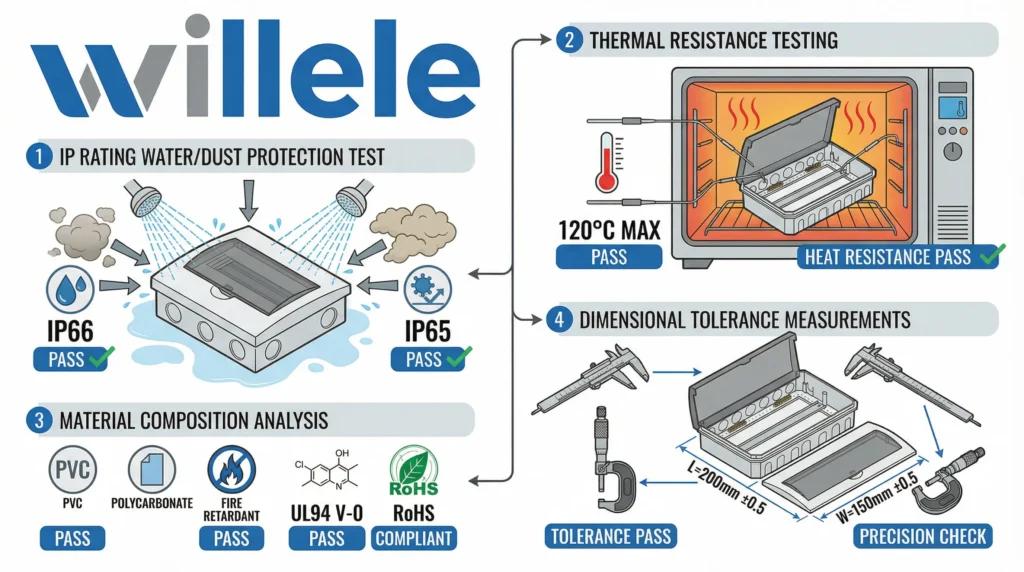
- IEC 60529 (IP Rating): Confirms ingress protection against dust and water
- UL/cUL Certification: Validates compliance with North American safety standards
- CE Marking: Required for European market access
- RoHS Compliance: Ensures restriction of hazardous substances
Material Quality Assessment
Superior junction boxes utilize high-grade materials that resist degradation. Evaluate suppliers based on:
- Housing materials: Polycarbonate, ABS, fiberglass-reinforced polyester, or stainless steel
- UV resistance: Critical for outdoor installations
- Temperature rating: Operating range typically from -40°C to +120°C
- Flame retardancy: UL94 V-0 rating for fire safety
Quality Comparison Table
| Supplier Tier | Certifications | Material Grade | Testing Protocol | Warranty Period |
|---|---|---|---|---|
| Premium (e.g., willele) | ISO 9001, UL, CE, IEC, RoHS | Virgin materials, UV-stabilized | 100% inspection + batch testing | 3-5 years |
| Mid-Range | ISO 9001, CE | Standard materials | Sample testing | 1-2 years |
| Basic | Limited or regional only | Mixed/recycled materials | Minimal testing | 6-12 months |
Quality Verification Process
When assessing a supplier’s quality standards, request:
- Material certificates: Confirm raw material specifications
- Test reports: Review results from IP rating, impact, and thermal tests
- Factory audit reports: Verify manufacturing conditions
- Failure rate data: Understand product reliability metrics
Established manufacturers like willele maintain rigorous quality control systems, conducting multiple inspections throughout production to ensure consistent product excellence.
Factor 2: Manufacturing Capabilities and Customization
Production Scale and Flexibility
A supplier’s manufacturing capabilities directly impact their ability to meet your project requirements. Evaluate:
- Production capacity: Can they handle your order volume?
- Scalability: Ability to increase output for large projects
- Lead time consistency: Track record of on-time delivery
- Batch size flexibility: Minimum order quantities (MOQ)
Customization Options
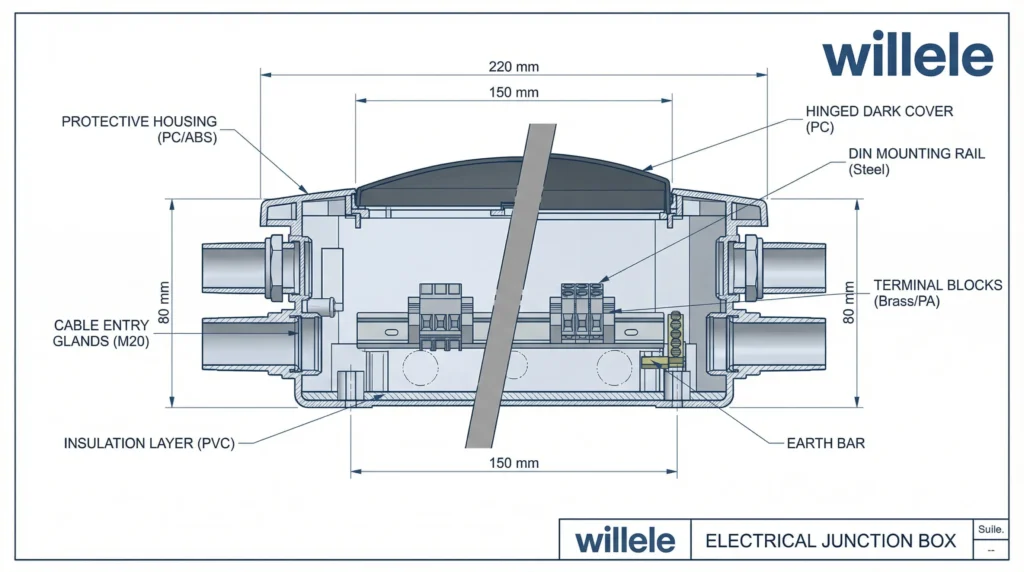
Modern electrical projects often require specialized junction box configurations. Leading suppliers offer:
Standard customization services:
- Custom dimensions and internal layouts
- Multiple cable entry configurations
- Specific mounting options (wall, pole, DIN rail)
- Color customization for brand or safety coding
- Pre-drilled holes and knockouts
Advanced customization capabilities:
- Integrated cable glands or strain reliefs
- Internal component pre-installation
- Custom labeling and marking
- Special material requirements
- Unique IP ratings for specific environments
Manufacturing Technology Assessment
Modern junction box production employs advanced technologies:
- Injection molding: For precise, high-volume plastic enclosures
- CNC machining: For metal junction boxes requiring tight tolerances
- Automated assembly: Ensures consistent quality
- In-house tooling: Enables rapid prototyping and modifications
Customization Comparison
| Feature | Standard Supplier | Advanced Supplier (willele-level) |
|---|---|---|
| Design flexibility | Limited catalog options | Full custom design support |
| Prototype development | 4-6 weeks | 1-2 weeks |
| MOQ for custom items | 1,000-5,000 units | 500-1,000 units |
| Engineering support | Basic | Dedicated technical team |
| Modification speed | Slow (new tooling required) | Fast (in-house capabilities) |
Suppliers with comprehensive manufacturing capabilities can adapt quickly to project changes and deliver solutions tailored to specific application requirements.
Factor 3: Supply Chain Reliability and Lead Times
Supply Chain Robustness
In today’s global manufacturing environment, supply chain reliability determines project success. Assess suppliers based on:
Raw material sourcing:
- Relationships with multiple material suppliers
- Raw material inventory levels
- Geographic diversification of supply sources
- Quality consistency across batches
Production planning:
- Manufacturing capacity utilization
- Inventory management systems
- Order tracking capabilities
- Emergency production protocols
Lead Time Analysis
Understanding realistic lead times prevents project delays:
- Standard products: 2-4 weeks for established suppliers
- Custom products: 4-8 weeks depending on complexity
- Bulk orders: May require extended timelines
- Rush orders: Availability and associated costs
Lead time factors to consider:
- Order processing time: Order confirmation to production start
- Manufacturing time: Actual production duration
- Quality control: Inspection and testing period
- Shipping time: Factory to destination including customs
- Buffer time: Contingency for unexpected delays
Global Logistics Capabilities
For international buyers, evaluate:
- Export experience: Understanding of international shipping requirements
- Customs documentation: Accurate and complete paperwork
- Packaging standards: Protection during long-distance transport
- Freight options: Sea, air, and expedited shipping availability
- Distribution network: Regional warehouses or distribution partners
Risk Mitigation Strategies
Reliable suppliers implement contingency plans:
- Maintaining safety stock for popular items
- Alternative production facilities
- Multiple logistics partners
- Real-time order tracking systems
- Proactive communication about potential delays
Willele’s integrated supply chain management ensures consistent product availability and predictable delivery schedules, critical for project planning and execution.
Factor 4: Technical Support and After-Sales Service
Pre-Sales Technical Assistance
Expert technical support begins before purchase. Evaluate suppliers offering:
Product selection guidance:
- Application analysis and requirements assessment
- IP rating and environmental condition matching
- Size and configuration recommendations
- Compliance and certification verification
Design collaboration:
- CAD drawings and 3D models
- Installation planning assistance
- Integration with existing systems
- Custom solution development
Installation and Application Support
Quality suppliers provide comprehensive installation resources:
- Detailed installation manuals and instructions
- Mounting templates and drilling guides
- Wiring diagrams and connection specifications
- Video tutorials and visual guides
- On-site installation support for large projects
After-Sales Service Excellence
Long-term support distinguishes professional suppliers:
Warranty and claims process:
- Clear warranty terms and coverage
- Straightforward claims procedures
- Quick response times for warranty issues
- Replacement product availability
Ongoing technical support:
- Responsive customer service team
- Technical hotline or email support
- Troubleshooting assistance
- Product upgrade recommendations
Training and Documentation
Leading suppliers invest in customer education:
- Product training sessions for installation teams
- Safety and compliance training
- Comprehensive technical documentation
- Regular updates on new products and technologies
Service Level Comparison
| Service Element | Basic Supplier | Premium Supplier (willele-standard) |
|---|---|---|
| Response time | 48-72 hours | 12-24 hours |
| Technical expertise | General knowledge | Specialized engineers |
| Documentation | Basic specs only | Complete technical library |
| Training availability | None | Regular sessions available |
| Warranty support | Email only | Multi-channel (phone, email, chat) |
| Problem resolution | Slow | Rapid with dedicated account management |
Manufacturers like willele understand that technical support extends beyond product delivery, providing ongoing partnership that ensures optimal product performance throughout its lifecycle.
Factor 5: Pricing and Total Cost of Ownership
Beyond Unit Price
While competitive pricing matters, savvy buyers evaluate total cost of ownership (TCO) rather than focusing solely on initial purchase price. TCO encompasses:
Direct costs:
- Unit price per junction box
- Shipping and handling fees
- Customs duties and taxes (for imports)
- Inspection and quality assurance
Indirect costs:
- Installation labor and time
- Maintenance requirements
- Replacement frequency
- Downtime costs from failures
Price Structure Transparency
Reputable suppliers maintain clear pricing structures:
- Volume discounts: Tiered pricing based on order quantity
- Custom product pricing: Clear methodology for calculating custom orders
- Payment terms: Flexible options including NET 30, 60, or 90
- Currency options: Pricing stability across different currencies
Value-Added Services Impact
Consider services that reduce overall project costs:
- Free sampling: Evaluate products before bulk orders
- Technical design assistance: Reduces engineering costs
- Consolidated shipping: Lower freight costs for multiple products
- Inventory management: Just-in-time delivery reduces storage costs
- Extended warranties: Reduces replacement costs
TCO Calculation Example
| Cost Factor | Low-Price Supplier | Quality Supplier (willele-level) |
|---|---|---|
| Unit price | $15.00 | $22.00 |
| Shipping (per unit) | $2.50 | $1.80 (volume discount) |
| Failure rate (2 years) | 15% ($2.55 replacement cost) | 2% ($0.34 replacement cost) |
| Installation time | 45 min ($18.75 labor) | 30 min ($12.50 labor) |
| Maintenance cost | $5.00 | $1.00 |
| Total 2-Year TCO | $43.80 | $37.64 |
This example demonstrates that premium products often deliver lower TCO despite higher initial costs.
Long-Term Partnership Value
Evaluate suppliers as long-term partners:
- Consistent quality: Reduces inspection costs and returns
- Innovation access: Early access to new technologies
- Preferred customer status: Priority during supply constraints
- Strategic pricing: Volume commitments yield better rates
Payment and Financial Flexibility
Modern suppliers offer varied payment options:
- Traditional terms (NET 30/60/90)
- Letter of credit for international transactions
- Consignment inventory for large customers
- Blanket purchase orders with scheduled releases
Companies like willele work collaboratively with customers to structure pricing and payment terms that support both immediate project needs and long-term business relationships.
Conclusion
Selecting the right junction box supplier requires careful evaluation across multiple dimensions. Quality and certifications ensure product reliability and safety compliance. Manufacturing capabilities and customization options enable tailored solutions for specific applications. Supply chain reliability and consistent lead times support predictable project execution. Technical support and after-sales service provide ongoing value throughout product lifecycle. Finally, analyzing total cost of ownership rather than just unit price reveals the true economic value of supplier partnerships.
When evaluating potential suppliers, create a comprehensive scorecard addressing all five factors. Request samples, visit manufacturing facilities when possible, and speak with existing customers to validate supplier claims. Remember that the lowest price rarely delivers the best value—focus instead on suppliers who demonstrate consistent quality, reliable service, and genuine commitment to customer success.
As a specialized B2B electrical equipment manufacturer, willele exemplifies these principles through rigorous quality standards, advanced manufacturing capabilities, dependable supply chain management, comprehensive technical support, and transparent, value-based pricing. By prioritizing these critical factors in your supplier selection process, you position your projects for success while building partnerships that deliver long-term competitive advantages.
Frequently Asked Questions
Q: What IP rating should I specify for outdoor junction boxes?
A: For outdoor applications, specify minimum IP65 rating, which provides complete dust protection and water jet resistance. For harsh environments or areas with direct water exposure, consider IP66 or IP67. Coastal or industrial environments may require IP68 for submersion protection. Always match the IP rating to specific environmental conditions, including exposure to rain, dust, chemicals, and potential water accumulation.
Q: How do I verify a supplier’s certification claims?
A: Request copies of actual certification documents, not just certificates of conformity. Verify certificate numbers directly with issuing bodies like UL, TÜV, or certification authorities. Ask for test reports showing compliance testing results. For ISO certifications, request the scope document showing which processes and products are covered. Reputable suppliers willingly provide complete documentation.
Q: What’s a reasonable lead time for custom junction boxes?
A: Standard customization (colors, knockouts, dimensions) typically requires 4-6 weeks. Complex custom designs with new tooling may need 8-12 weeks. Prototype samples can often be produced in 1-3 weeks. Always confirm lead times in writing and build buffer time into project schedules. Suppliers with in-house tooling and engineering capabilities generally offer faster turnaround than those outsourcing these functions.
Q: Should I work with local or overseas junction box suppliers?
A: This depends on your priorities. Local suppliers offer shorter lead times, easier communication, and simplified logistics but often at higher costs. Overseas suppliers (particularly from Asia) provide competitive pricing and extensive customization but require longer planning cycles and more complex logistics. Many buyers adopt hybrid strategies: overseas suppliers for standard, high-volume items and local suppliers for urgent needs and highly specialized products.
Q: How important is supplier financial stability?
A: Supplier financial stability is critical but often overlooked. A financially unstable supplier may fail mid-project, leaving you without products or support. Request financial references, check credit ratings if available, and evaluate the company’s market tenure. Long-established manufacturers with diverse customer bases demonstrate greater stability. Financial strength also indicates capacity for R&D investment and long-term support capabilities.
Q: What documentation should I expect with junction box shipments?
A: Professional suppliers provide comprehensive documentation including: commercial invoice and packing list, material certificates and test reports, compliance certificates (CE, UL, etc.), installation instructions and technical specifications, warranty documentation, and product traceability information. For international shipments, expect certificates of origin and customs documentation. Complete documentation streamlines inspection, installation, and compliance verification processes.
