
Busbar Insulators in Low Voltage Switchgear Systems: Complete Application Guide

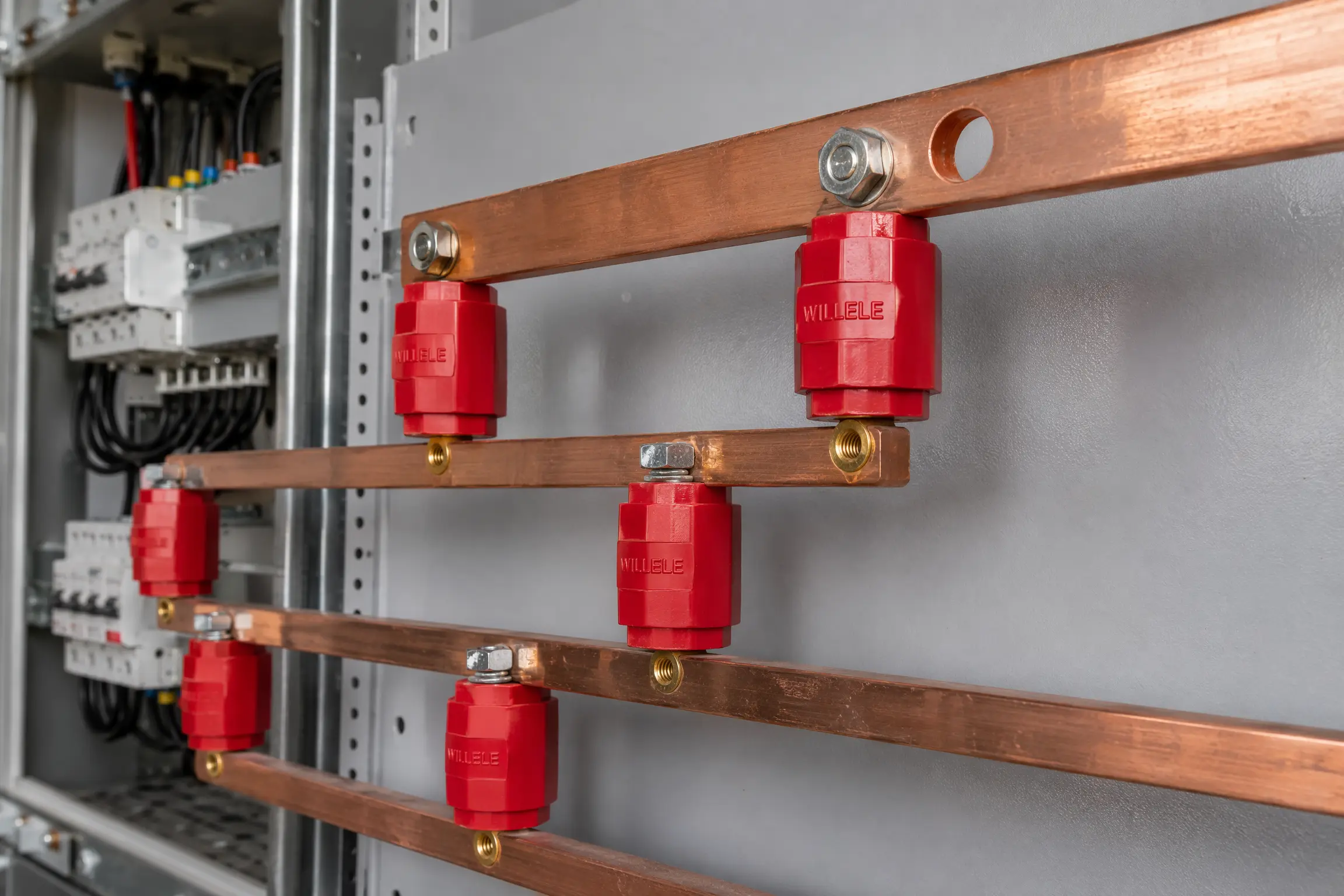
Every low voltage switchgear panel lives or dies on one unglamorous detail: how securely and how safely its busbars stay apart from each other and from the enclosure. Get that detail wrong and a panel that looks finished on the shop floor turns into a flashover risk on site. Get it right, and the busbar insulator you barely notice quietly does its job for twenty years without a callback.
This guide focuses on one specific, widely specified component family for that job: the JYZ Series Busbar Insulator, a compact column-type standoff insulator built for low voltage switchgear, distribution boards, PDUs, and battery/DC cabinets. We’ll walk through what it is, how it’s built, where it fits against other insulator types, and how to select and install it correctly — with the technical detail a procurement engineer or panel builder actually needs before releasing a drawing.
What Is a JYZ Series Busbar Insulator?
A busbar insulator — also called a standoff insulator or busbar support insulator — is a small, rigid component that does two jobs at once: it holds a copper or aluminum busbar in a fixed position, and it electrically isolates that busbar from the mounting surface, the enclosure, and neighboring conductors. Without it, a busbar has nowhere safe to sit.
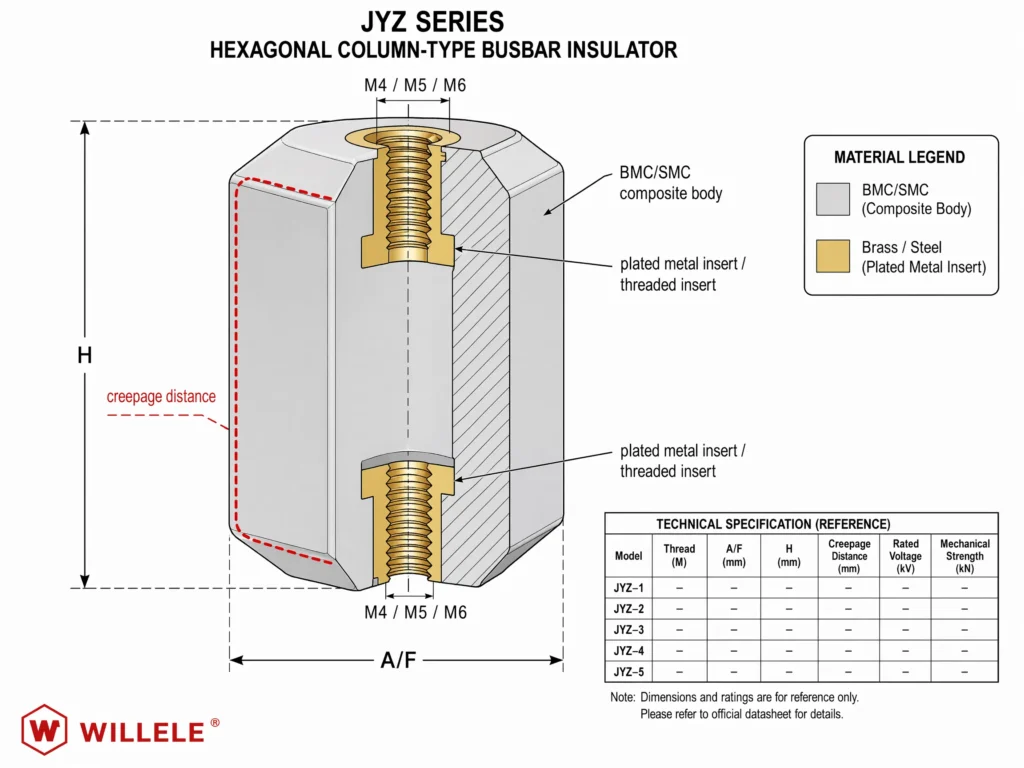
The JYZ series is a slim, hexagonal column-type insulator built around a standard Ø14 mm body, with overall heights running from 14 mm up to 75 mm in fixed steps, and metric threaded inserts in M4, M5, or M6. The model code follows a simple logic — JYZ[Diameter]×[Height] — so a JYZ14×30 is a 14 mm-diameter unit with a 30 mm overall height, excluding any protruding stud. That naming consistency matters more than it sounds: it lets a panel builder standardize jigs, drawings, and spare-parts inventory across an entire product line instead of re-specifying hardware for every cabinet variant.
Each insulator is compression-molded from fiberglass-reinforced BMC/SMC (bulk/sheet molding compound), with a plated brass or steel insert set into the mold before curing. That construction gives the part three things a panel builder actually cares about: dimensional stability under vibration and thermal cycling, repeatable tightening torque over the life of the installation, and a smooth, burr-free surface that won’t nick wiring or gloves during assembly. The hexagonal outer profile isn’t decorative — it gives a wrench or socket a firm grip during both initial installation and later maintenance, which matters on a panel where dozens of these parts get torqued down in sequence.
Why Busbar Insulators Matter in Switchgear Design
A busbar carrying hundreds of amps generates real mechanical and thermal stress, and a low voltage switchgear cabinet packs several of these bars into a tight, often unventilated enclosure. The insulator has to absorb that stress without letting the electrical isolation degrade. In practice, that means five things happening at once inside every well-designed panel:
- Electrical isolation — maintaining the clearance and creepage distance between live conductors and earthed metalwork, even as pollution and humidity accumulate over years of service.
- Mechanical support — carrying the static weight of copper or aluminum busbars plus the dynamic electromagnetic forces that appear during a short-circuit event, when parallel conductors briefly repel each other with significant force.
- Arc and tracking resistance — resisting surface carbonization (“tracking”) that can otherwise create a slow-forming conductive path across the insulator’s surface.
- Environmental resistance — tolerating humidity, dust, and the mild chemical exposure common in industrial and commercial power rooms.
- Vibration dampening — absorbing mechanical vibration near motors, transformers, or rotating machinery so connections don’t loosen over time.
Any insulator that fails at even one of these jobs shortens the switchgear’s service life, and in the worst case, it fails during a fault — exactly when the panel most needs it to hold.
JYZ Series Specification Table (Ø14 mm)
The table below covers the standard JYZ14 range and available thread options. Non-standard heights, diameters, and mixed-end configurations (one threaded female end, one protruding stud) are available as custom builds.
| Model | Body Diameter (mm) | Overall Height H (mm) | M4 | M5 | M6 |
|---|---|---|---|---|---|
| JYZ14×14 | 14 | 14 | ✔ | ✔ | ✔ |
| JYZ14×16 | 14 | 16 | ✔ | ✔ | ✔ |
| JYZ14×20 | 14 | 20 | ✔ | ✔ | ✔ |
| JYZ14×25 | 14 | 25 | ✔ | ✔ | ✔ |
| JYZ14×30 | 14 | 30 | ✔ | ✔ | ✔ |
| JYZ14×40 | 14 | 40 | ✔ | ✔ | ✔ |
| JYZ14×50 | 14 | 50 | ✔ | ✔ | ✔ |
| JYZ14×60 | 14 | 60 | ✔ | ✔ | ✔ |
| JYZ14×75 | 14 | 75 | ✔ | ✔ | ✔ |
The consistent Ø14 mm body across every height means a panel designer can change the standoff height for creepage or layout reasons without re-qualifying the mounting footprint — one of the more practical advantages of the series for compact cabinet layouts.
Materials Used in Busbar Insulators
Material choice drives everything downstream — dielectric strength, temperature tolerance, tracking resistance, and cost. The table compares the three material families most commonly specified for low voltage busbar insulators, including the BMC/SMC composite used in the JYZ series.
| Material | Dielectric Strength | Working Temperature | Tracking Resistance | Typical Use Case |
|---|---|---|---|---|
| BMC/SMC (fiberglass-reinforced) | High | −40°C to +130°C | Very Good | General-purpose LV switchgear, PDUs, MCCs, ESS — the JYZ series’ base material |
| Epoxy Resin | High | −40°C to +155°C | Excellent | Higher-current panels, humid or lightly polluted indoor environments |
| Porcelain/Ceramic | Very High | Wide range, high compressive strength | Excellent | Outdoor or high-mechanical-stress installations, medium voltage transitions |
For most indoor low voltage switchgear work, BMC/SMC hits the practical sweet spot: strong enough dielectrically, dimensionally stable under repeated torque and thermal cycling, and far more cost-effective at volume than epoxy or porcelain alternatives. That’s why it remains the default material across low voltage standoff and column insulators, JYZ included.
Choosing Between JYZ and Other Willele Insulator Series
Not every panel calls for the same insulator geometry. The table below positions the JYZ series against willele’s cylindrical C Series, which is built for higher mechanical and dielectric loads.
| Feature | JYZ Series | C Series |
|---|---|---|
| Body shape | Hexagonal column, Ø14 mm | Cylindrical, larger diameter (C25–C70) |
| Height range | 14–75 mm | Model-dependent, larger overall envelope |
| Thread options | M4 / M5 / M6 | M6, M8, M10 depending on model |
| Typical tensile rating | Suited to light-to-medium busbar loads | 500–1,500 lbs depending on model |
| Typical dielectric withstand | Standard LV range | 6–22 kV depending on model |
| Best fit | Compact panels, PDUs, dense layouts, MCCs | LV/MV switchgear, inverter cabinets, higher-current stacked busbars |
If a panel layout is tight and the busbar loads are modest, JYZ’s smaller footprint and simpler thread options usually win on space and cost. If the design calls for heavier busbars, higher fault currents, or a step up toward medium-voltage clearance requirements, the C Series’ larger body and higher tensile/withstand ratings are the better starting point.
Selection Criteria for Low Voltage Switchgear Applications
Choosing the right busbar insulator is a five-step check, not a guess:
- Voltage and insulation class. Pick a rating that comfortably exceeds the system’s operating voltage plus any switching transients, and confirm the creepage distance suits the installation’s pollution degree per IEC 61439.
- Mechanical load. Calculate the static load from busbar weight plus the dynamic electromagnetic force expected during a short-circuit event, then choose a model with margin above that figure.
- Thread and insert type. Match the M4/M5/M6 insert to the fastener already specified in the panel’s bill of materials; confirm insert depth is adequate for the expected torque.
- Environmental exposure. Indoor, temperature-stable panels can run standard BMC/SMC; installations with higher humidity, UV exposure, or chemical contact may call for epoxy or a protective coating.
- Layout and clearance. Use the height options to hit the target phase-to-phase and phase-to-earth clearance without over-sizing the cabinet.
Typical Clearance Reference for Low Voltage Systems
| Rated Voltage | Minimum Phase-to-Phase Clearance | Minimum Phase-to-Earth Clearance | Typical Insulator Class |
|---|---|---|---|
| 230V single phase | ~3 mm | ~3 mm | Compact standoff (JYZ, short height) |
| 400V three phase | ~12 mm | ~10 mm | Standard standoff (JYZ, mid height) |
| 690V three phase | ~14 mm | ~14 mm | Heavier-duty standoff or post insulator |
| 1000V AC | ~20 mm | ~16 mm | Reinforced post insulator (C Series or higher) |
Always verify final clearance and creepage figures against the applicable IEC 61439 tables and the specific pollution degree of the installation site — these values are a starting reference, not a substitute for the standard.
Installation Best Practices
Getting the insulator right on the drawing means nothing if the installation undoes it. A few habits separate a panel that performs for decades from one that needs rework within a year:
- Clean mounting surfaces before fitting — oil film, dust, and oxidation on the panel wall reduce tracking resistance right from day one.
- Torque to spec, not to feel. Overtightening is the single most common cause of stress cracks in molded insulator bodies; use a calibrated driver and the manufacturer’s recommended torque value.
- Space supports to prevent sag. Under-supported busbars sag over time under their own weight and thermal cycling, gradually closing the clearance gap the insulator was sized to maintain.
- Inspect before commissioning. Check for cracks, surface contamination, or misalignment, and verify insulation resistance (commonly >1000 MΩ) before energizing the panel.
- Keep phase identification consistent. Color-coded insulators or heat shrink tube overlays at connection points make later maintenance faster and reduce the chance of a miswire.
Applications Across Low Voltage Systems
The same core design — compact, threaded, dielectrically stable — makes the JYZ series a fit across a wide range of low voltage equipment:
| Application | Why JYZ Fits |
|---|---|
| Distribution boards & switchboards | Compact footprint suits dense multi-circuit layouts |
| Motor control centers (MCCs) | Vibration resistance handles proximity to rotating machinery |
| PDUs (power distribution units) | Standard heights simplify repeatable panel assembly |
| Inverter and rectifier cabinets | Stable dielectric performance under thermal cycling |
| Battery/ESS DC bus assemblies | Reliable isolation for stacked DC busbar configurations |
| Solar and renewable energy junction cabinets | Consistent torque retention over long unattended service life |
Why Source JYZ Series Busbar Insulators from WILLELE
WILLELE manufactures its JYZ series and full busbar insulator range from its own compression-molding facility in Liushi, Yueqing — a city in Zhejiang Province, China, widely known within the industry as a center of low voltage electrical component production. That concentration of tooling, insert-plating, and molding expertise in one location is a large part of why the JYZ series holds tight, repeatable dimensions across production runs.
For panel builders, distributors, and EPCs sourcing internationally — across Europe, North America, the Middle East, and Southeast Asia — that translates into three concrete advantages:
- Engineering response on real drawings. WILLELE’s team reviews layout and clearance requirements directly, rather than pointing buyers to a generic catalog page.
- Custom builds when standard heights don’t fit. Non-standard diameters, heights, thread combinations, and mixed male/female ends are available without a full custom-tooling cycle.
- Documented, traceable production. Incoming, in-process, and final inspection records support the compliance documentation (CE, RoHS) that project submittals typically require.
For a switchgear build where dimensional consistency and creepage performance can’t be left to chance, sourcing the JYZ series directly from its manufacturer keeps the specification, the drawing, and the delivered part aligned.
Frequently Asked Questions
Q: What is the maximum operating voltage for the JYZ series? A: The JYZ series is designed for low voltage switchgear applications, typically within standard LV distribution ranges. Confirm the exact dielectric withstand for your target voltage and pollution degree directly with WILLELE before finalizing a design, since creepage requirements vary by installation environment.
Q: What’s the difference between the JYZ series and a post-type insulator? A: JYZ is a compact, hexagonal column standoff optimized for space-constrained panels with light-to-medium mechanical loads. Post-type insulators are generally larger and rated for heavier busbars or higher fault currents — the C Series comparison table above outlines when to step up.
Q: Can JYZ insulators be custom-made for non-standard heights? A: Yes. While the Ø14 mm body covers 14–75 mm in standard steps, WILLELE offers custom diameters, heights, thread types, and mixed-end configurations for project-specific requirements.
Q: What torque should be applied when installing JYZ insulators? A: Torque depends on the thread size (M4/M5/M6) and insert material. Always use the manufacturer-specified torque value rather than tightening by feel — overtightening is the leading cause of stress cracking in molded insulator bodies.
Q: How long do BMC/SMC busbar insulators typically last in service? A: Properly specified and installed BMC/SMC insulators commonly provide decades of reliable service in indoor low voltage panels. Actual lifespan depends on operating temperature, mechanical loading, and environmental exposure at the installation site.
