
Circuit Breaker Busbar: Complete Product Guide


Introduction
In modern electrical distribution systems, the circuit breaker busbar serves as the critical backbone for power transmission and distribution in panel assemblies. These copper or aluminum conductors provide reliable, low-impedance pathways for electrical current, connecting miniature circuit breakers (MCBs) to incoming power sources in distribution panels and consumer units. As electrical infrastructure demands continue to grow, selecting the right circuit breaker busbar configuration becomes increasingly vital for ensuring system reliability, safety, and operational efficiency.
This comprehensive guide explores everything you need to know about circuit breaker busbars for MCB applications, from fundamental design principles to advanced selection criteria. Whether you’re designing a new electrical installation, upgrading existing infrastructure, or specifying components for residential, commercial, or industrial applications, understanding the technical specifications, connection types, and configuration options will help you make informed decisions. We’ll examine pin-type and fork-type busbars, phase configurations (1P, 2P, 3P, 4P), material properties, industry standards, and installation best practices to equip you with the knowledge necessary for optimal system performanc
What is a Circuit Breaker Busbar?
A circuit breaker busbar (also known as a comb busbar or MCB busbar) is a metallic conductor strip specifically designed to interconnect multiple miniature circuit breakers within distribution panels and consumer units. These busbars facilitate the distribution of electrical power from a main incoming source to multiple circuit breakers, which then protect individual circuits or loads. Unlike traditional point-to-point wiring methods, MCB busbars offer superior installation efficiency, reduced connection points, and enhanced mechanical stability.
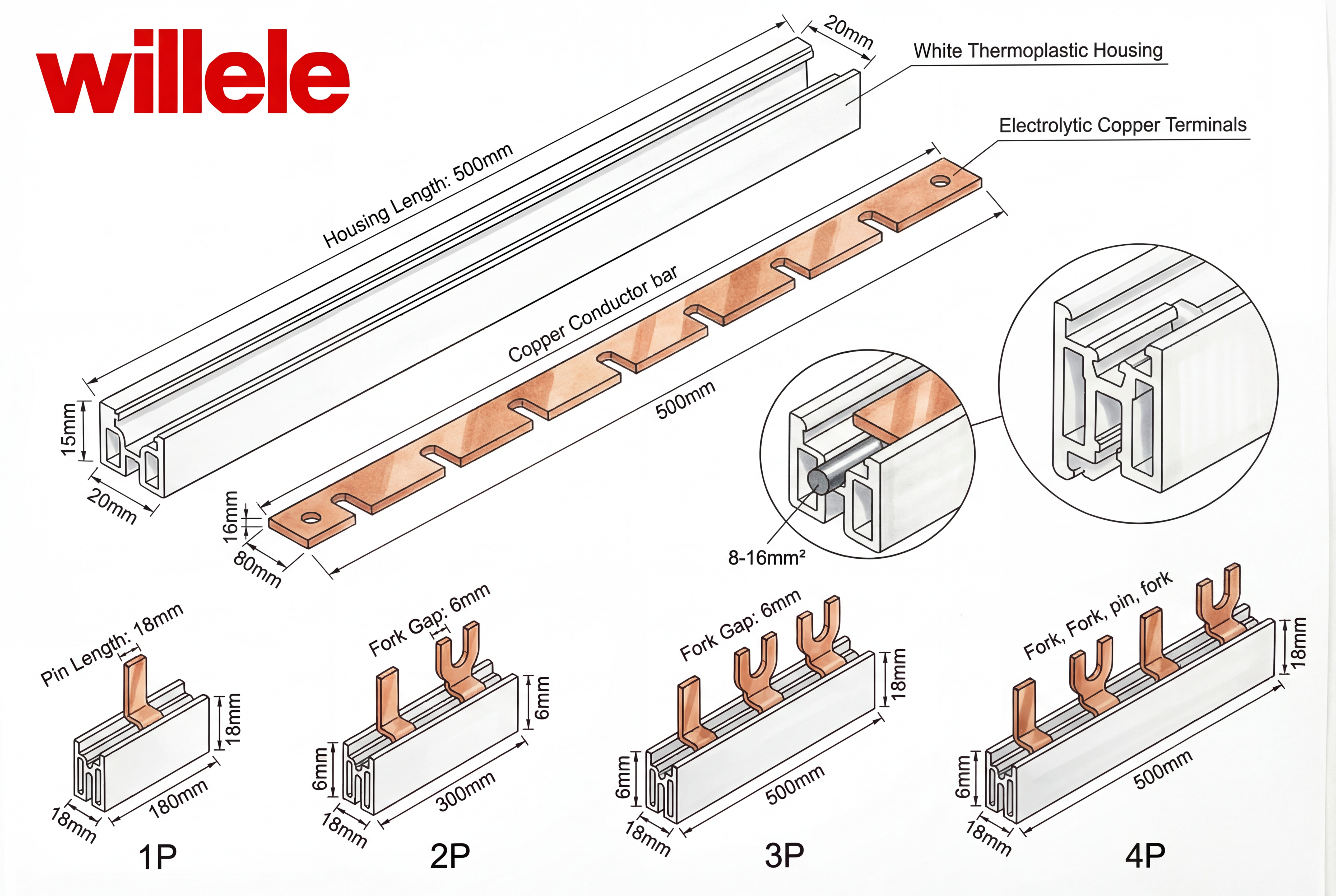
The fundamental design consists of flat copper or aluminum conductors with either pin-type connections (vertical pins that insert into MCB terminals) or fork-type terminals (M5/M6 forked connectors that bolt to MCB terminals). These conductors typically feature cross-sections of 8–16 mm² and are mounted with proper phase spacing to accommodate standard MCB mounting on DIN rails. The busbar system integrates seamlessly with circuit breakers through standardized connection methods, creating a robust and serviceable electrical distribution architecture.
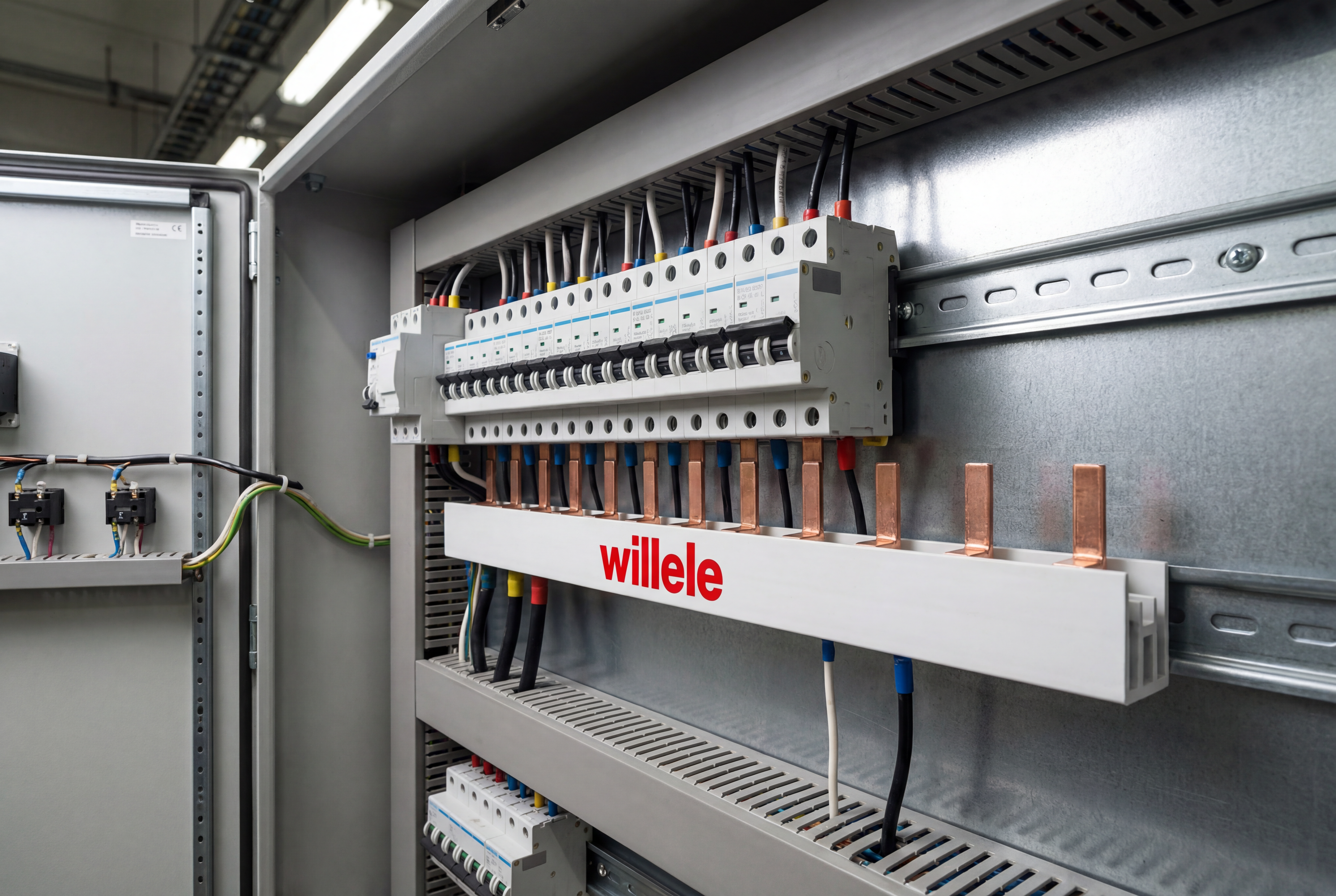
Circuit breaker busbars play an essential role in residential, commercial, and light industrial power distribution by providing a centralized connection system that simplifies installation, reduces labor costs, improves system organization, and facilitates maintenance activities. Their rigid construction offers mechanical strength, consistent phase spacing, and long-term reliability that conventional individual wire connections cannot match in multi-breaker installations.
Types and Configurations of Circuit Breaker Busbars
Pin-Type MCB Busbars
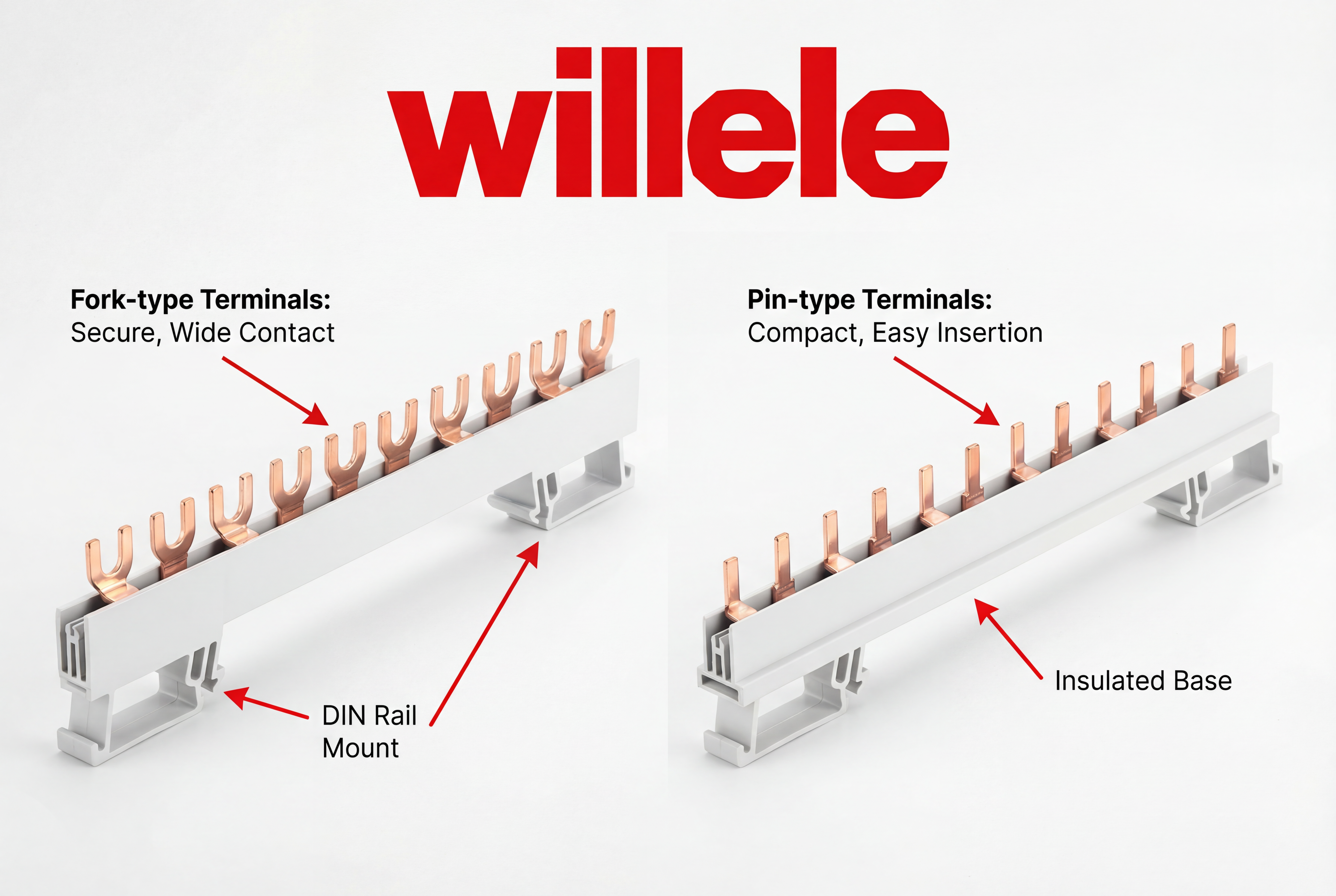
Pin-type circuit breaker busbars feature vertical copper pins that insert directly into the terminals of compatible MCBs, creating a plug-in connection system. This design enables rapid installation without requiring individual screwed connections for each breaker, significantly reducing panel assembly time. The pins are precisely spaced to match standard MCB pitches (typically 9mm or 18mm modules), ensuring accurate alignment and reliable electrical contact.
Pin-type busbars work best with MCBs specifically designed for pin connection systems, where the breaker terminals accept vertical pin insertion. This configuration provides excellent contact pressure through spring-loaded terminal mechanisms, maintaining consistent connection integrity over time. The system supports quick breaker replacement and simplified maintenance, as individual MCBs can be removed and reinstalled without disturbing adjacent connections.
Available in 1P, 2P, 3P, and 4P configurations, pin-type busbars accommodate single-phase, split-phase, three-phase, and three-phase with neutral applications. Common models include P-1L (single phase), P-2L (two phase), P-3L (three phase), and P-4L (four phase), with additional options like P-1+N and P-3+N for neutral connections.
Fork-Type MCB Busbars
Fork-type circuit breaker busbars utilize forked terminals (typically M5 or M6) that bolt directly to MCB terminal screws, providing a bolted connection method suitable for a wider range of breaker types. This configuration offers universal compatibility with most standard MCBs, making it highly versatile for panel builders working with various breaker brands and models.
The fork terminals create robust mechanical and electrical connections through proper torque application, ensuring low contact resistance and reliable performance under thermal cycling conditions. Fork-type busbars support higher fault current capabilities compared to some pin-type systems, making them suitable for applications requiring enhanced short-circuit withstand.
Fork-type configurations include F-1L (single phase), F-2L (two phase), F-3L (three phase with M6 or M5), F-4L (four phase), and G-series models with similar phase options. The G-series typically features enhanced specifications for demanding applications, while maintaining the same fork terminal connection method.
Phase Configuration Options
MCB busbars accommodate various phase configurations to match different electrical system requirements:
1P (Single Phase): Serves single-phase circuits in residential and light commercial applications, providing one active conductor connection.
2P (Two Phase/Split Phase): Accommodates two-pole MCBs for 230V split-phase systems or higher-voltage single-phase circuits requiring both poles switching.
3P (Three Phase): Distributes three-phase power (L1, L2, L3) for industrial equipment, motors, and three-phase distribution systems.
4P (Four Phase): Provides three phases plus neutral (L1, L2, L3, N) with all four poles switching, commonly used in systems requiring neutral disconnection.
Special Configurations: Include 1P+N (single phase with neutral), 3P+N (three phase with neutral), and 1P+N-LE (with line-earth connection) for specific safety requirements.
Comparison of Busbar Connection Types
| Connection Type | Installation Speed | MCB Compatibility | Typical Application | Maintenance | Current Rating |
|---|---|---|---|---|---|
| Pin-Type | Very Fast | Pin-compatible MCBs | Residential, light commercial | Easy plug/unplug | 50–80 A |
| Fork-Type (M6) | Moderate | Universal MCBs | Commercial, industrial | Requires tools | 50–80 A |
| Fork-Type (M5) | Moderate | Specific MCB types | Compact panels | Requires tools | 50–80 A |
[…]
Current Rating and Sizing
MCB busbar current ratings depend on conductor cross-sectional area, material, ambient temperature, and mounting configuration. Standard WILLELE busbars feature cross-sections of 8–16 mm² and accommodate current ratings of 50–80 A depending on specific configuration and installation conditions.
| Phase Configuration | Cross Section (mm²) | Length Options (mm) | Current Rating (A) | Typical Application |
|---|---|---|---|---|
| 1P (Single Phase) | 8–16 | 210, 1000, 1016 | 50–80 | Residential distribution |
| 2P (Two Phase) | 8–16 | 210, 1000, 1016 | 50–80 | Split-phase systems |
| 3P (Three Phase) | 8–16 | 210, 1000, 1016 | 50–80 | Light commercial/industrial |
| 4P (Four Phase) | 8–16 | 210, 1016 | 50–80 | Industrial with neutral |
| 1P+N | 8–16 | 210, 1000 | 50–80 | Residential with neutral |
| 3P+N | 8–16 | 210, 1000 | 50–80 | Commercial three-phase |
Note: Ratings assume proper ventilation, ambient temperature ≤40°C, and installation per manufacturer guidelines. Voltage rating up to 415V AC.
[…]
Preventive Maintenance
Implement scheduled maintenance programs including visual inspections, thermographic surveys, and connection torque verification. Inspect connections for signs of overheating, discoloration, or loosening. For fork-type busbars, verify terminal screw torque values (typically 2 N·m / 17.5 in-lb maximum) annually or as specified by manufacturers.
Clean insulator surfaces and contacts to remove dust and contaminants. For aluminum conductors, check for oxide formation and apply conductive compound as needed. Verify proper alignment and seating of pin-type connections. Maintain detailed records of maintenance activities and measurements for trend analysis.
Q: What’s the difference between pin-type and fork-type MCB busbars?
A: Pin-type busbars feature vertical copper pins that plug directly into compatible MCB terminals, enabling rapid tool-free installation ideal for residential and light commercial panels. Fork-type busbars utilize M5 or M6 forked terminals that bolt to MCB terminal screws, providing universal compatibility with most standard breakers and enhanced mechanical connection strength. Choose pin-type for speed and simplicity with compatible MCBs, or fork-type for versatility and wider MCB brand compatibility.
Q: How do I determine the correct busbar configuration for my application?
A: First identify your system voltage and phase requirements (single-phase, split-phase, three-phase, or three-phase with neutral). Select the appropriate phase configuration (1P, 2P, 3P, 4P, or specialized options like 1P+N or 3P+N). Calculate total continuous current requirement for all connected MCBs, ensuring it remains within the busbar’s 50–80 A rating for 8–16 mm² cross-sections. Choose length based on panel width (210 mm for small panels, 1000 mm or 1016 mm for standard distribution boards). Verify MCB compatibility with selected connection type (pin or fork).
Q: What maintenance is required for MCB circuit breaker busbars?
A: Conduct annual visual inspections checking for discoloration, overheating signs, or physical damage. Perform thermographic surveys to identify hot spots indicating loose connections or increased resistance. For fork-type installations, verify terminal screw torque values (maximum 2 N·m) annually. Clean contacts and insulators as needed. For pin-type systems, verify proper pin insertion depth and contact engagement. Check for corrosion, particularly in humid environments, and address any oxide formation on aluminum conductors. Document all findings and corrective actions.
Q: Can I use copper cables with aluminum busbars, or vice versa?
A: Direct copper-to-aluminum connections require proper techniques to prevent galvanic corrosion. For fork-type busbars, use tin-plated terminals on both copper and aluminum sides. Apply appropriate anti-oxidant compound on aluminum surfaces before connection. Ensure proper torque application and periodic retorque checking, as aluminum experiences greater thermal expansion. For critical applications, consider using bi-metallic transition plates or maintaining single-material systems throughout. Follow manufacturer guidelines and local electrical codes for dissimilar metal connections.
Q: What are the typical lifespan expectations for MCB busbars?
A: Properly installed and maintained MCB busbars typically provide 25–30 years of reliable service in residential and commercial applications. Lifespan depends on operating conditions, load cycling, environmental factors (humidity, temperature, contamination), and maintenance quality. Installations in controlled environments with proper ventilation and regular maintenance may exceed these expectations. Harsh conditions, frequent high-load cycling, or inadequate maintenance can reduce service life. Pin-type and fork-type systems show similar longevity when installed and maintained according to specifications.
Q: How do MCB busbars improve installation efficiency compared to individual wiring?
A: MCB busbars eliminate the need for individual wire terminations at each circuit breaker’s incoming side, reducing installation time by 40–60% in typical panels. Pin-type systems enable plug-in breaker installation without tools, while fork-type systems still simplify wiring compared to point-to-point connections. Busbars ensure consistent phase spacing, reduce connection errors, minimize panel congestion, and create cleaner, more organized installations. This efficiency translates to lower labor costs, faster project completion, and reduced potential for wiring mistakes during initial installation or future modifications.
