
Data Center Power Distribution with Low Voltage Busbar Insulators

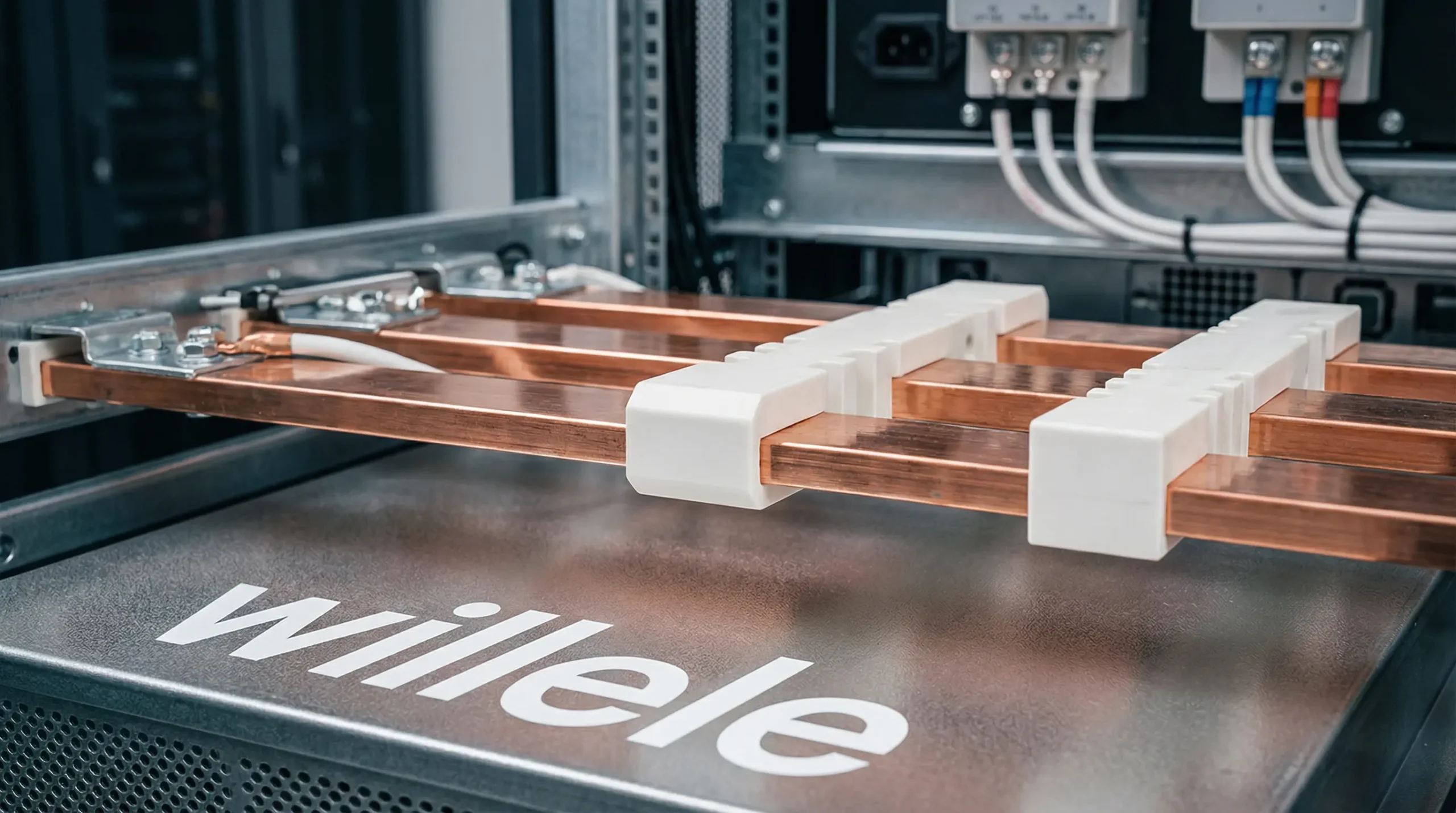
In the high-stakes world of modern data infrastructure, uptime is the only metric that truly matters. As data centers evolve from traditional raised-floor facilities to hyperscale and edge computing environments, the demand for efficient, reliable, and safe power distribution systems has never been higher. At the heart of these systems lies a critical, often overlooked component: Data Center Power Distribution with Low Voltage Busbar Insulators.
For facility managers and electrical engineers, understanding the nuances of busbar insulation is key to optimizing Power Usage Effectiveness (PUE) and ensuring operational safety. Willele Electric, a leader in electrical insulation solutions and heat shrink technology, provides the high-performance components necessary to maintain the integrity of these complex power networks.
What Are Low Voltage Busbar Insulators?
Low voltage busbar insulators are specialized electromechanical components designed to support and electrically isolate busbars—the metallic strips or bars (usually copper or aluminum) that conduct electricity within a switchboard, distribution board, or other electrical apparatus.
In the context of data centers, “low voltage” typically refers to systems operating up to 1000V AC, which covers the standard 400V/230V or 480V/277V distribution architectures used globally. These insulators serve two primary functions:
- Mechanical Support: They rigidly hold the heavy conductive busbars in place, resisting the immense mechanical forces generated during short-circuit faults.
- Electrical Isolation: They prevent the flow of current between the live busbars and the grounded enclosure, or between phases, thereby preventing arc flashes and short circuits.
The Critical Role in Data Center Power Distribution
Data centers require power distribution systems that are modular, scalable, and incredibly dense. Traditional cabling is often replaced by overhead busway systems or bus ducts to handle high amperage loads with minimal voltage drop.
1. Ensuring Structural Integrity Under Fault Conditions
During a short circuit event, the electromagnetic forces between busbars can be catastrophic. Willele busbar insulators are engineered with high tensile and cantilever strength to withstand these dynamic stresses, preventing the bars from clashing and causing an explosion.
2. Thermal Management and Airflow
Unlike bundled cables that can trap heat, busbars supported by insulators allow for better heat dissipation. The insulators are designed to maintain precise spacing, facilitating natural convection cooling—a critical factor in maintaining the efficiency of the data center’s cooling infrastructure.
3. Modularity for Scalability
As server densities increase, power needs change. Busbar systems utilizing high-quality insulators allow for tap-off boxes to be added or moved safely, often without shutting down the main power rail (hot-swappable), providing the agility modern data centers require.
Material Specifications and Heat Shrink Integration
At Willele Electric, we understand that the insulation system is a composite solution. While the standoff insulator provides the mechanical separation, the busbar itself often requires additional insulation to reduce clearance requirements and prevent accidental contact.
Insulator Materials
Most modern low voltage insulators are manufactured from BMC (Bulk Moulding Compound) or SMC (Sheet Moulding Compound) polyester resins reinforced with fiberglass. These materials offer superior electrical properties compared to traditional ceramics or phenolics.
- High Dielectric Strength: Resists voltage breakdown.
- Track Resistance: Prevents the formation of conductive paths on the surface.
- UL 94 V-0 Flammability Rating: Self-extinguishing materials are non-negotiable in data center environments.
The Role of Heat Shrink Tubes
To further enhance safety and reduce the footprint of the switchgear, Willele recommends pairing busbar insulators with our premium Busbar Heat Shrink Tubes.
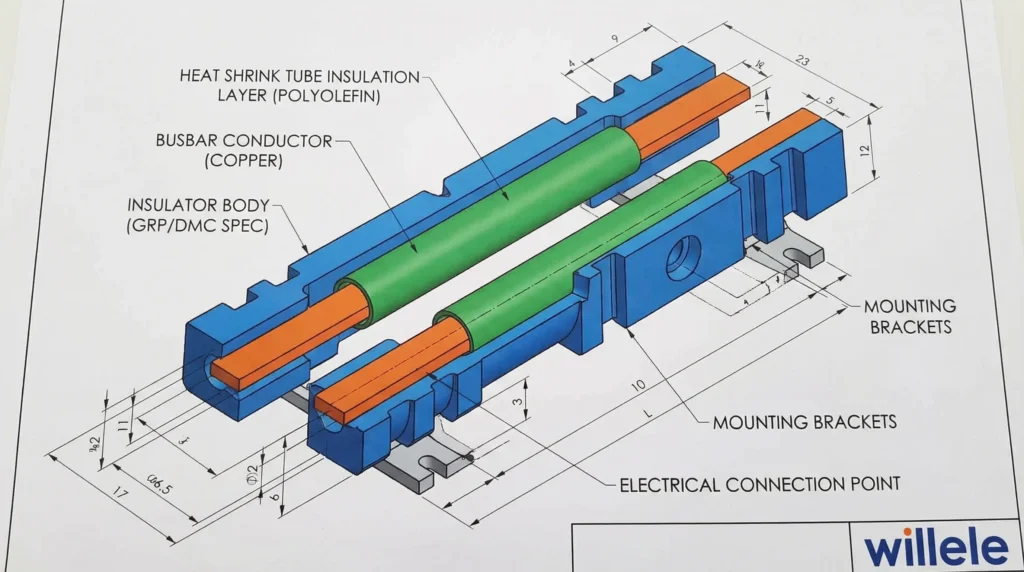
By applying heat shrink insulation directly to the copper bars between the insulator supports, engineers can:
- Reduce the required air gap between phases (phase-to-phase) and to ground.
- Protect against flashovers caused by dust, humidity, or rodent ingress.
- Color-code phases (Red, Yellow, Blue) for easier maintenance and safety identification.
Key Benefits of Willele Insulator Solutions
Implementing high-grade low voltage busbar insulators from Willele Electric offers distinct advantages for data center operators:
- Space Optimization: High dielectric strength allows for compact designs, freeing up white space for server racks.
- Reduced Maintenance: Unlike cable systems that require regular re-tightening of lugs due to thermal cycling, rigid busbar systems supported by quality insulators are virtually maintenance-free.
- Enhanced Safety: Non-hygroscopic materials prevent moisture absorption, maintaining insulation resistance even in humid cooling aisle environments.
- Customization: Willele offers various insert sizes (M6, M8, M10, M12) and heights to match specific busway designs.
Technical Comparison: Insulator Materials
Choosing the right material is essential for longevity. Below is a comparison of common materials used in data center power distribution.
| Feature | Willele BMC/SMC (Polyester/Fiberglass) | Phenolic (Bakelite) | Porcelain/Ceramic |
|---|---|---|---|
| Impact Strength | High (Resists shattering) | Low (Brittle) | Low (Very Brittle) |
| Dielectric Strength | 10-15 kV/mm | 5-10 kV/mm | 3-5 kV/mm |
| Weight | Lightweight | Medium | Heavy |
| Precision | High (Moulded to tight tolerances) | Medium | Low (Firing deformation) |
| Moisture Resistance | Excellent | Good | Excellent |
| Cost Efficiency | High | Medium | Low |
Specifications: Busbar Insulation & Heat Shrink
When designing your system, consider these specifications for optimal compatibility between the standoff insulators and heat shrink protection.
| Parameter | Standard Busbar Insulator | Willele Heat Shrink Tube |
|---|---|---|
| Voltage Rating | 600V – 1000V (Low Voltage) | Up to 36kV (Medium Voltage capable) |
| Operating Temperature | -40°C to +130°C | -55°C to +125°C |
| Flammability | UL 94 V-0 | UL 224 VW-1 |
| Standard Color | Red, White, Brown | Red, Yellow, Blue, Green, Black |
| Insert Material | Brass or Steel (Zinc Plated) | N/A |
| Application | Structural Support | Surface Insulation |
Installation and Maintenance Best Practices
To ensure the longevity of your data center power distribution with low voltage busbar insulators, follow these best practices recommended by Willele technical experts.
Installation
- Surface Preparation: Ensure the mounting surface within the switchgear is clean and flat to prevent stress on the insulator base.
- Torque Settings: Do not over-torque the mounting bolts. Excessive force can crack the threaded inserts or the insulator body. Refer to the specific datasheet for torque values (typically 10-20 Nm depending on size).
- Alignment: Busbars must be perfectly aligned before tightening. Forcing a busbar into position using the insulator as a lever will compromise the mechanical integrity.
- Heat Shrink Application: Apply Willele heat shrink tubing to the busbars before mounting them to the insulators, ensuring a clean cut-back area where the bar contacts the insulator face.
Maintenance
- Visual Inspection: Annually inspect for signs of tracking (carbon paths), cracks, or thermal discoloration.
- Thermographic Scans: Use infrared cameras to detect hot spots at connection points. An insulator running significantly hotter than the ambient busbar temperature may indicate internal failure or loose connections.
- Cleaning: In air-cooled data centers, dust accumulation can lead to tracking. Clean insulators with a dry, lint-free cloth and approved solvent if necessary during scheduled shutdowns.
FAQ: Busbar Insulators in Data Centers
1. Why are BMC insulators preferred over porcelain in data centers?
BMC (Bulk Moulding Compound) insulators are significantly lighter, more durable against mechanical shock, and can be moulded to much tighter tolerances than porcelain. This precision is crucial for the compact, high-density designs of modern data center PDUs.
2. Can Willele busbar insulators withstand the high temperatures of a data center hot aisle?
Yes. Our standard insulators are rated for continuous operation up to 130°C. Since data center hot aisles rarely exceed 50°C, our insulators operate well within their thermal safety margins.
3. How do I choose the right size insulator for my busbar?
Selection depends on three factors: the voltage rating (determines height/creepage distance), the mechanical short-circuit strength required, and the bolt size needed to secure your specific busbar width.
4. Do I need heat shrink tubing if I use standoff insulators?
While insulators isolate the busbar from the frame, heat shrink tubing isolates the busbar along its entire length. Using both provides a layered safety approach, reducing the risk of accidental contact and allowing for closer phase spacing to save space.
5. What is the expected lifespan of these insulators?
Under normal operating conditions within a controlled data center environment, Willele low voltage busbar insulators are designed to last 20+ years, matching the lifecycle of major capital equipment.
6. Does Willele offer custom insulator designs?
Yes. As a manufacturer, Willele Electric can develop custom moulds for specific mounting requirements or unique busbar configurations found in specialized server racks or power modules.
Conclusion
Reliable data center power distribution with low voltage busbar insulators is not just about keeping the lights on; it’s about protecting millions of dollars in hardware and ensuring the continuity of the digital world. By choosing Willele Electric’s high-performance insulators and heat shrink solutions, you are investing in a foundation of safety, efficiency, and scalability.
For more information on our product specifications or to request a quote for your facility, contact the Willele technical team today.
