
DIN vs Non-DIN Cable Lugs — What’s the Difference?


DIN vs Non-DIN Cable Lugs — What’s the Difference? As a senior application engineer, I’ve seen my share of preventable failures. I once traced an intermittent fault on a critical production line back to a single, badly-overheated connection. The lug looked fine, the crimp felt solid, but under load, it was failing. The issue wasn’t a faulty lug; it was the wrong type of lug for the job. This brings us to a crucial question many engineers face: when is a standard cable lug “good enough,” and when do you need the guaranteed performance of a DIN-standard lug?
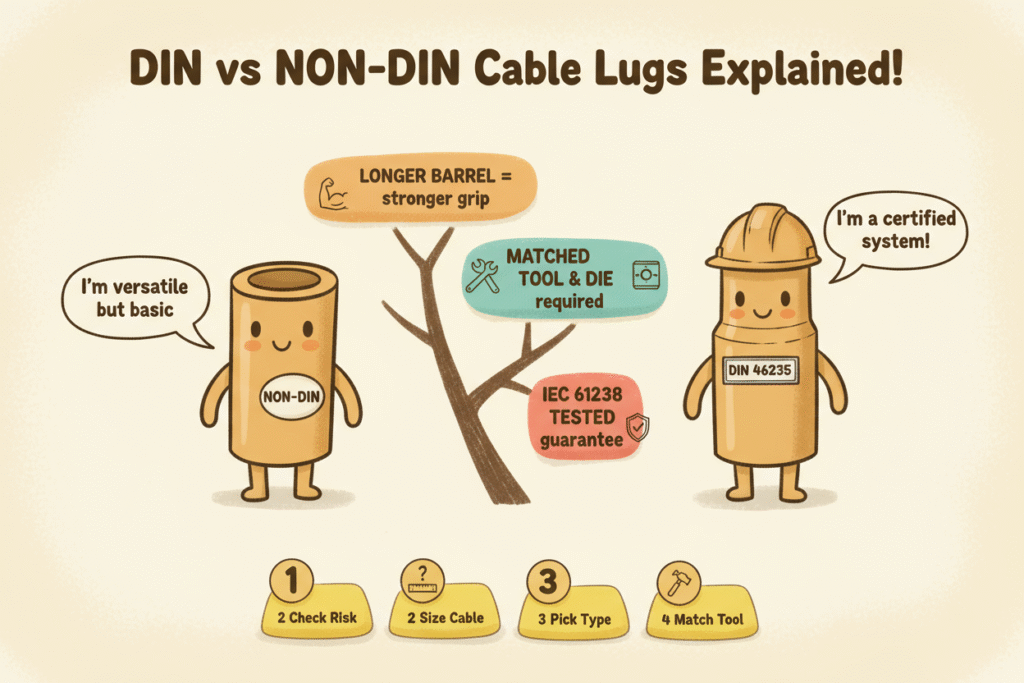
The answer lies in understanding the fundamental difference between the two. Think of it this way: a standard, non-DIN tubular lug is like a generic bolt from a hardware store. It’s a versatile component that works for countless general-purpose jobs. A DIN 46235-compliant lug, however, is like an OEM engine bolt—it’s not just a component, it’s part of a complete, engineered, and tested system.
The most important takeaway is this: When you choose a DIN 46235 lug, you’re not just buying a piece of copper; you are specifying a complete termination system where the lug, crimping tool, and die are designed to work together to produce a scientifically-proven result.
Decoding the Standards: DIN 46235 vs. Standard Tubular Lugs
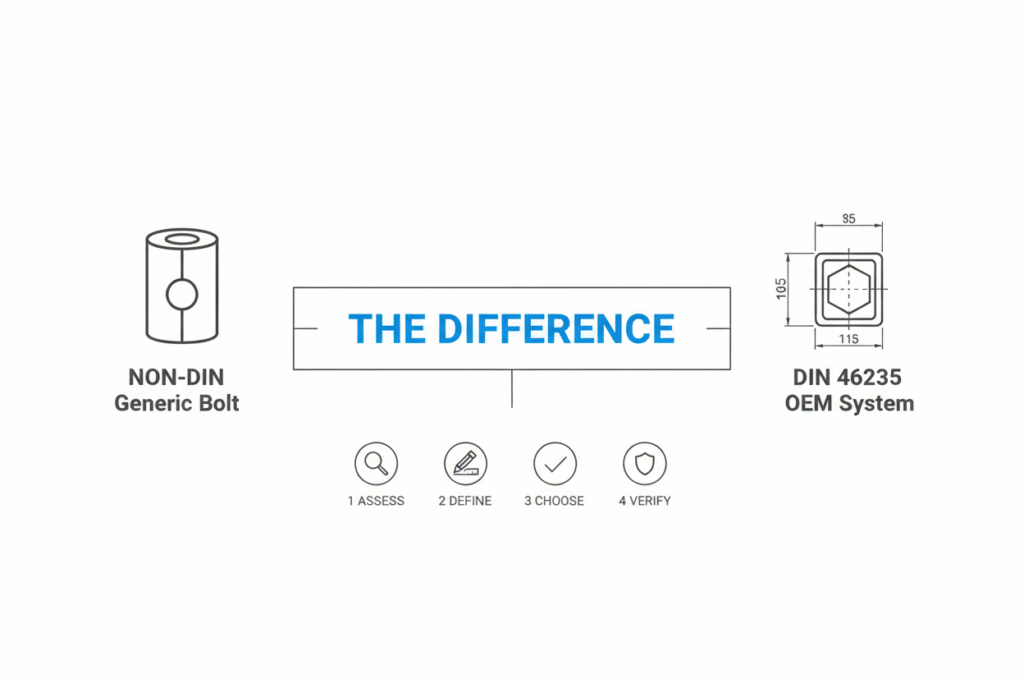
So what makes this “system” approach so different? While a standard tubular lug is a perfectly suitable component for many connections 1, a DIN lug is manufactured and tested to a much stricter set of rules defined by the Deutsches Institut für Normung (DIN), a German standards organization 2.
Let’s break down the key differences:
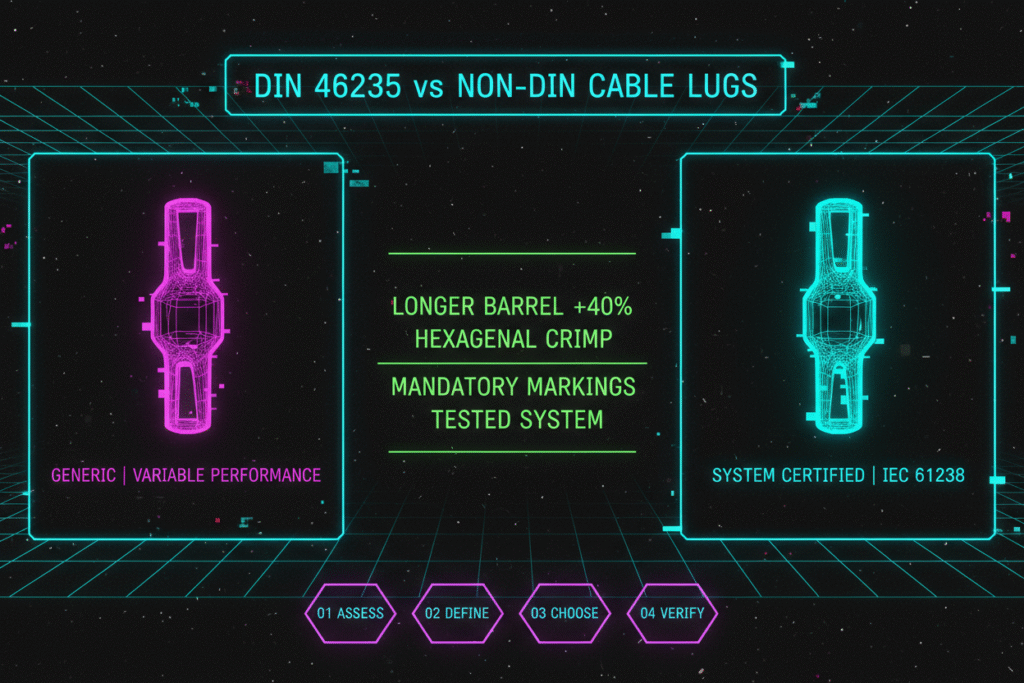
- Dimensions and Barrel Length: DIN 46235 specifies a longer barrel compared to most standard lugs. This increased length allows for more crimps on the same lug, creating a larger contact area with the cable conductor. This results in superior mechanical strength (pull-out resistance) and better electrical conductivity, which is crucial for handling high currents and resisting vibration.
- Material and Markings: DIN lugs must be made from electrolytic copper with a specific purity. They also feature mandatory markings that provide critical information directly on the lug: the manufacturer, the cross-sectional area (in mm²), and the correct die set size and crimp location. This built-in traceability is a hallmark of the DIN system.
- The Crimping System: This is where the concept truly comes together. A termination made with a DIN 46235 lug is designed to be crimped with a specific tool and die profile (often a hexagonal crimp) to meet the performance requirements of international standards like IEC 61238 3. This standard subjects the connection to rigorous mechanical and electrical tests (like heat cycling) to ensure a safe, reliable, and gas-tight connection for its entire service life. A standard lug offers no such system guarantee; the performance of the crimp is entirely dependent on the unverified combination of lug, tool, and operator skill.
A 4-Step Method for Choosing the Right Lug
Deciding between a DIN and a non-DIN lug is a risk-based decision. Use this simple method to make the right call.
Step 1: Assess Application Criticality
Is the connection part of a safety system? Will it be subjected to high vibration (e.g., on a generator or heavy machinery)? Is it in a corrosive or outdoor environment? Is the cost of failure (downtime, safety incidents) extremely high? If you answer “yes” to any of these, you should be leaning heavily toward DIN.
Step 2: Define Your Cable and Termination Specs
Identify your cable’s cross-sectional area in mm², conductor type (e.g., fine-stranded class 5 or 6), and the stud size for the lug’s palm. Standard lugs are often sized in AWG, while DIN lugs are in mm², so ensure you have the correct conversion.
Step 3: Make the Call: DIN vs. Non-DIN
- Choose DIN 46235 when: The application is critical, subject to vibration or thermal cycling, requires the highest degree of safety and reliability, or is specified by the end-client or a governing standard (e.g., in rail, marine, or wind power).
- Choose a high-quality non-DIN (standard tubular) lug when: The application is static, non-critical, in a protected indoor environment, and where cost is a primary driver. Even here, it’s vital to choose a quality component from a reputable manufacturer 4.
Step 4: Verify the Matched System
If you choose the DIN route, your job isn’t done. You must ensure you have the manufacturer-specified crimping tool and the exact die set for the lug you are using. Using a DIN lug with a generic crimper completely invalidates the “system” and its performance guarantees.
Installation Best Practices
An engineered component is only as good as its installation. Whether you use a DIN or non-DIN lug, following best practices is non-negotiable.
- Proper Wire Preparation: Strip the cable insulation to the correct length without nicking the conductor strands. The conductor should be fully inserted into the lug barrel, and you can use the inspection hole (if available) to verify this.
- Use the Correct Tool: For DIN lugs, this is mandatory. For standard lugs, using the tool recommended by the lug manufacturer is still the best practice. Never use pliers or a hammer.
- Ensure Tool Calibration: Crimping tools, especially hydraulic ones, must be calibrated regularly to ensure they are delivering the correct force. An uncalibrated tool produces an unreliable crimp 3.
- Post-Crimp Inspection: A correct crimp should be symmetrical and, in the case of a DIN hexagonal crimp, show clear imprints from the die. There should be no sharp edges or excessive flash.
The Foundation of Reliability
That overheating lug I found on the production line was a standard lug used in a high-vibration, high-current application where a DIN 46235 lug was clearly needed. The connection eventually worked itself loose on a microscopic level, increasing resistance and generating heat. The failure was inevitable.
Choosing a cable lug is more than just matching a cable size. It’s about understanding the demands of the application and mitigating risk. While a high-quality standard lug has its place, only a DIN-compliant system gives you a certified, repeatable, and engineered connection you can trust for your most critical applications. Building a reliable electrical system starts from the foundation, and there is no more fundamental connection than the lug on the end of the cable.
To know more ablout cable lug , can reference below video :
