Flame Retardant Heat Shrink Tube Standards: The Engineer’s Complete Guide to Preventing Costly Failures

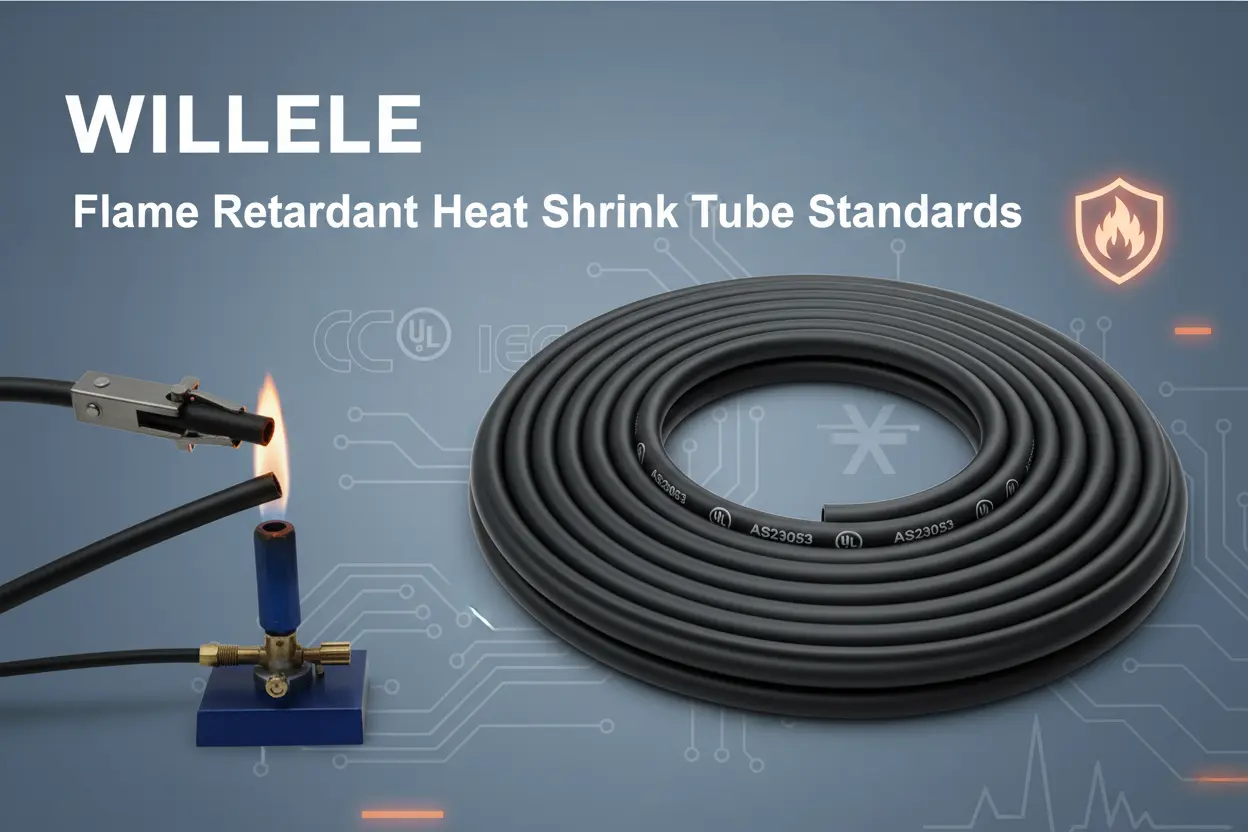
Understanding Flame Retardant Heat Shrink Tube Standards: Why This Guide Exists
When engineers search for information about flame retardant heat shrink tube standards, they’re often facing a critical decision point in their design process. You might be here because a certification body has questioned your component choices, or perhaps you’re proactively trying to avoid the costly mistakes that have derailed other projects.
The landscape of flame retardant heat shrink tube standards is complex, spanning multiple regulatory bodies, test methods, and application-specific requirements. UL 224, AS23053, IEC 60684, ASTM D2671—these aren’t just bureaucratic acronyms. Each standard represents a specific set of validated performance criteria that can mean the difference between a product that passes certification and one that fails spectacularly.
This guide cuts through the confusion. We’ll give you a practical framework for understanding and selecting the right flame retardant heat shrink tubing based on recognized industry standards. But first, let’s look at why getting this wrong can be catastrophic.
The Midnight Call No Engineer Wants
It’s 11 PM on a Friday. You’re about to close your laptop when the phone rings. It’s the lead from the compliance lab. Your company’s flagship industrial control panel—the one you spent six months designing—has failed its final certification test. Worse, it caught fire.
The preliminary report points to a tiny, overlooked component: a piece of heat shrink tubing over a terminal lug. It wasn’t rated for the application. A minor voltage spike caused it to overheat, smolder, and ignite nearby wiring. The fire was small, but the result is catastrophic. The product launch is on hold, a redesign is imminent, and months of work are up in smoke, literally.
This scenario isn’t just a bad dream; it’s a preventable reality for engineers who underestimate the importance of component-level standards. When it comes to something as critical as flame retardancy, choosing the right heat shrink tubing isn’t just a part of the design process—it’s the first line of defense against costly, dangerous failures.
This guide is written from the perspective of a senior application engineer who has seen these failures firsthand. We’ll move beyond datasheets to give you a practical framework for selecting the right flame retardant heat shrink tubing, ensuring your next project passes certification with confidence.
Understanding the Language of Safety: Why Standards Matter
In the rush of product development, it’s tempting to view standards as bureaucratic hurdles. We often hear engineers ask, “Why can’t I just use this generic tubing? It’s cheaper and the specs look similar.” This thinking is a dangerous gamble.
Think of flame retardant standards as a universal language of safety, like building codes for a skyscraper. You wouldn’t let a contractor use “pretty good” cement for a foundation; you’d demand materials certified to meet specific structural loads. Electrical components are no different. Standards ensure that a component’s performance is predictable, repeatable, and verified by an independent third party. They are your “quality checkpoints” that guarantee a material will behave as expected under stress.
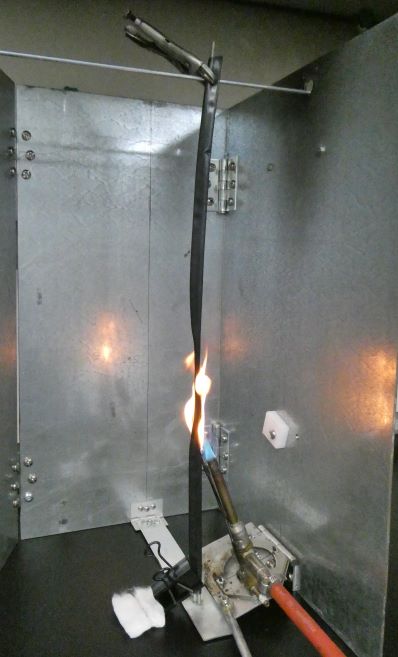
Figure 1: VW-1 flame test being conducted on heat shrink insulation material
When you select a tube with a UL, AS, or IEC rating, you aren’t just buying a piece of plastic. You’re buying validated proof that it has been subjected to rigorous, standardized tests for ignition, flame spread, and self-extinguishing properties.
Key Takeaway: Focusing on upfront component cost over certified performance is a gamble that can cost you the entire project. A $0.05 tube that fails certification can trigger a six-figure redesign and product delay.
Decoding the Standards: A Practical Field Guide
The world of standards is a confusing alphabet soup of acronyms. Let’s demystify the most common ones you’ll encounter for flame retardant heat shrink tubing.
Standards Comparison Overview
Before diving into each standard, here’s a comprehensive comparison to help you quickly identify which standard applies to your application:
| Standard | Test Method | Self-Extinguish Time | Flaming Drips Allowed | Typical Application |
|---|---|---|---|---|
| UL 224 (VW-1) | Vertical wire flame test, 5× 15-second intervals | 60 seconds after flame removal | Must not ignite cotton indicator | General-purpose electronics, consumer devices |
| UL 94 V-2 | Vertical burn test on material | ≤30 seconds | Yes (flaming drips allowed) | Low-risk, open-frame applications |
| UL 94 V-1 | Vertical burn test on material | ≤30 seconds | Yes (non-flaming drips only) | Moderate-risk enclosed devices |
| UL 94 V-0 | Vertical burn test on material | ≤10 seconds | No | High-density electronics, industrial control |
| AS23053 | References ASTM D2671/D8355 | Varies by class | Typically no | Aerospace, military, high-reliability |
| IEC 60684 | Series-specific protocols | Harmonized with other standards | Varies by type | International markets, European compliance |
UL 224 and the VW-1 Flame Test
The VW-1 (Vertical Wire) flame test, defined within the broader ANSI/UL 224 standard, is one of the most common ratings you’ll see. It’s a baseline for flammability performance.
- What it is: A test where a finished tube is mounted vertically and subjected to a flame five times for 15-second intervals.
- What it measures: The tube’s ability to self-extinguish within a set time after the flame is removed. It also checks if flaming particles drip and ignite a cotton indicator below.
- Analogy: Think of VW-1 as basic fire insurance. It’s good, necessary, and suitable for many general-purpose applications where the risk of fire is moderate. However, it’s not the highest level of protection available.
UL 94: The Critical Material Benchmark
While VW-1 tests the finished tube, UL 94 is a standard that classifies the raw plastic material itself. This is where the most critical distinctions are made, especially for components inside an enclosure.
The test involves applying a flame to a vertical sample of the material and observing its behavior. The three most common ratings you’ll encounter are V-2, V-1, and V-0.
UL 94 Rating Comparison
Understanding the differences between UL 94 ratings is critical for proper selection:
| UL 94 Rating | Extinguish Time (After Each Flame Application) | Flaming Drips | Burn Through (5VA/5VB Only) | Best For |
|---|---|---|---|---|
| V-2 | ≤30 seconds | Yes (flaming drips permitted) | N/A | Open assemblies, low component density, minimal fire hazard |
| V-1 | ≤30 seconds | Only non-flaming drips | N/A | General enclosures, moderate component density |
| V-0 | ≤10 seconds | No flaming drips | N/A | High-density electronics, industrial control cabinets |
| 5VA | ≤60 seconds | No | No burn-through | Extreme fire protection, structural enclosures |
| 5VB | ≤60 seconds | No | Burn-through allowed | High-temperature applications with extreme flame exposure |
- UL 94 V-2: The material self-extinguishes within 30 seconds. However, flaming drips are permitted. These drips can ignite other components, making V-2 unsuitable for densely packed electronics or applications where components are located above sensitive materials.
- UL 94 V-1: The material self-extinguishes within 30 seconds, and while drips are allowed, they must not be flaming. This offers a significant step up in safety from V-2.
- UL 94 V-0: This is the gold standard for many commercial and industrial applications. The material must self-extinguish within 10 seconds, with no flaming drips allowed.
Key Takeaway: The difference between UL 94 ratings is not trivial. A UL 94 V-0 rating offers significantly more protection than V-2, especially against the spread of fire within an enclosure.
For extreme environments, you might also see 5VA and 5VB ratings, which involve a much more intense flame source—about five times more severe than the V-0 test. 5VA is the highest rating, allowing no burn-through of the material.
AS23053 (formerly MIL-DTL-23053): The Aerospace Mandate
When you see AS23053, think high-stakes. This is an aerospace standard managed by the Society of Automotive Engineers (SAE) that originated from a military specification. It covers heat shrinkable tubing for use in military and aerospace applications where reliability is non-negotiable.
- What it is: A comprehensive specification that covers not just flammability, but also temperature ratings, fluid resistance, and physical durability.
- Its Relationship to Other Standards: AS23053 doesn’t invent its own tests. For flammability, it explicitly calls for testing to be performed in accordance with ASTM D2671. This demonstrates how standards build upon each other.
ASTM D2671 and ASTM D8355: The ‘How-To’ for Testing
If AS23053 is the “what,” then ASTM D2671 is the “how.” It’s a procedural standard that details the methods for testing heat shrinkable tubing. It doesn’t set pass/fail criteria itself; it just ensures the test is conducted the same way every time. For flammability, it references ASTM D8355, which specifies the exact apparatus and procedure for flame testing sleeving and tubing materials. Knowing this distinction shows a deeper level of expertise and is critical when evaluating test reports.
IEC 60684: The Global Passport
The IEC (International Electrotechnical Commission) standards are your passport to global markets, particularly in Europe. IEC 60684 is a series of standards for flexible insulating sleeving. While it has its own testing protocols, it often harmonizes with UL and other standards, ensuring a degree of global interoperability. If your product is shipping internationally, ensuring your components meet relevant IEC standards is crucial.
The 4-Step Framework for Bulletproof Selection
With an understanding of the key standards, you can now approach selection with a clear, repeatable process.
Step 1: Define Your Application’s Risk Profile
First, forget about parts lists. Think like an insurance underwriter. What is the true cost of a failure in this specific location?
- Environment: Will the tube be in a hot, vibration-prone engine bay or a climate-controlled server room?
- Proximity to Ignition: Is it insulating a high-voltage terminal next to a power supply or simply bundling low-voltage data cables?
- Consequence of Failure: If this tube fails, does it cause a minor short, or could it lead to a fire that destroys a $1 million machine or endangers human life?
Answering these questions will tell you if you need basic “fire insurance” (VW-1) or a premium, multi-layered policy (UL 94 V-0 or AS23053).
Step 2: Identify the Governing Industry Standard
Every industry has its own set of rules. Your application will dictate which standard takes precedence.
- Automotive: Look for specifications from SAE (Society of Automotive Engineers).
- Aerospace/Defense: AS23053 is your starting point.
- Industrial/Consumer Electronics: UL standards (224, 94) are typically the primary requirement.
- Medical Devices: ISO standards, often in conjunction with UL, will be required.
Start with the highest-level requirement for your end product and work your way down to the component level.
Step 3: Match the Flame Rating to the Risk
Now, connect your risk profile from Step 1 to the standards we decoded.
- Low Risk (e.g., cable management in an open-air frame): A VW-1 rated tube is likely sufficient.
- Moderate Risk (e.g., inside a consumer electronics device): A UL 94 V-1 rating is a good starting point, but V-0 provides a higher safety margin.
- High Risk (e.g., inside an industrial power cabinet, near a power source): Demand nothing less than UL 94 V-0. The prohibition of flaming drips is non-negotiable here.
- Extreme/Mandated Risk (e.g., aviation, military): Your choice will be dictated by AS23053. The specific “slash sheet” (e.g., AS23053/5 for flexible polyolefin) will define the exact performance required.
Step 4: Verify, Don’t Assume (The Senior Engineer’s Checklist)
A datasheet is a promise; verification is proof. Before you commit to a part, run through this final checklist.
- Check the UL Yellow Card: This is the official certification document from Underwriters Laboratories. Ask your supplier for it. It proves the material has been tested and certified.
- Confirm the Rating for Your Thickness: A material might be rated V-0 at 3mm thickness but fail at 1mm. Ensure the certification covers the specific wall thickness of the tube you are using.
- Remember Color Matters: The additives used to create colors can affect flammability. A V-0 rating for a black material does not automatically apply to the same material in red or white unless it has been separately tested and certified.
- Always Get Samples: Test the physical fit and feel on your actual application. Does it shrink properly without splitting? Does it provide the strain relief you need?
Real-World Application Scenarios
Let’s apply this framework to a few common situations.
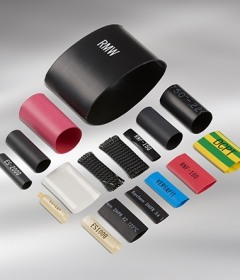
Figure 2: Professional heat shrink tubing application in industrial control systems
- Scenario 1: Automotive Engine Bay Harness: An engineer is bundling wires near the engine block.
- Challenge: High temperatures, exposure to oils and fluids, constant vibration.
- Standard: SAE standards are key. The high-risk environment also points towards robust flammability requirements.
- Solution: A flexible, highly flame-retardant polyolefin tubing meeting AS23053/5 Class 3 would be an excellent choice. It’s designed for these harsh conditions.
- Scenario 2: High-Density Industrial Control Cabinet: An engineer is insulating terminal lugs on a DIN rail power distribution block.
- Challenge: High component density, risk of arcing, and the need to prevent fire from spreading to adjacent components.
- Standard: UL standards are paramount.
- Solution: A tubing with a UL 94 V-0 rating is mandatory. A V-2 rated tube with flaming drips would be a recipe for disaster in this environment.
- Scenario 3: Avionics Bay in an Aircraft: An engineer is providing strain relief for connectors on a flight control module.
- Challenge: Extreme reliability is required. Failure is not an option. The component must resist aerospace fluids and meet strict smoke and toxicity regulations.
- Standard: AS23053 is the only acceptable answer.
- Solution: The choice will be a specific part number under AS23053, likely a high-temperature, fluid-resistant material like a cross-linked fluoroelastomer (AS23053/13).
Common Mistakes That Lead to Five-Alarm Failures
- Confusing “Flame Retardant” with “Flame Resistant”: Retardant materials are designed to slow ignition and self-extinguish (UL 94). Resistant materials are designed to resist ignition entirely and are typically used for textiles or PPE.
- The Thickness Fallacy: Assuming a material’s flame rating applies to all thicknesses. Always verify the rating for your specific dimensions.
- Ignoring Flaming Drips: Selecting a UL 94 V-2 tube for an application directly above other sensitive components is one of the most common and dangerous mistakes.
- Forgetting Additives: Assuming a flame rating for a base resin applies after colorants or other additives have been introduced. Always verify the full formulation.
From Specification to Confidence
Mastering flame retardant standards isn’t about memorizing acronyms. It’s about adopting a risk-based mindset and understanding the language of safety that protects your design, your company, and your end-users. By moving from a cost-first to a safety-first approach, you transform standards from a compliance burden into your most powerful tool for building reliable, robust, and successful products.
Final Takeaway: The right heat shrink tube is the one that meets the specific, verified standard your application demands—no exceptions.
Navigating these specifications for a critical design can be daunting. If you need absolute certainty, the application engineering team at WILLELE is ready to help you select, verify, and implement the right solution. Contact us today to ensure your next project is built for success, not for failure.
