
Heat Shrink Tube: Complete Guide to Types, Sizes, and Applications

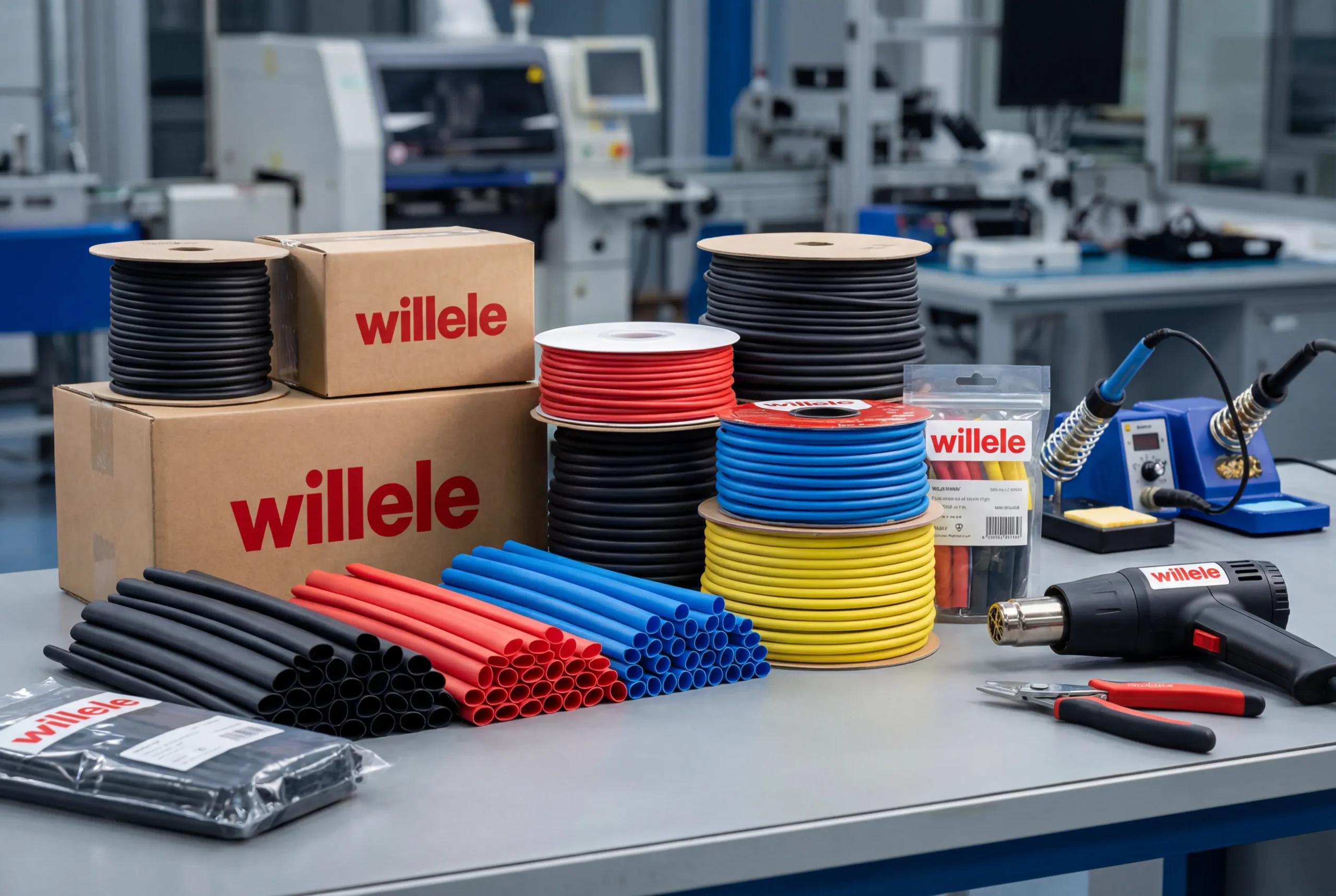
Heat shrink tube is an essential component in electrical insulation, wire protection, and cable management across industries worldwide. As thermal protection technology continues to advance, selecting the right heat shrink tubing for your specific application becomes increasingly critical. WILLELE Electric, a leading B2B manufacturer of electric equipment, offers comprehensive solutions for industrial, automotive, aerospace, and electronics applications. This guide provides manufacturers, engineers, and procurement professionals with detailed specifications, comparison data, and selection criteria to make informed decisions.
What is Heat Shrink Tube?
Heat shrink tube, also known as heat shrinkable tubing or heat shrink sleeving, is a thermoplastic tube that contracts radially when exposed to heat. Manufactured through a cross-linking process, these tubes are expanded during production and retain their enlarged diameter until heat application triggers the “memory effect,” causing them to shrink tightly around the substrate.
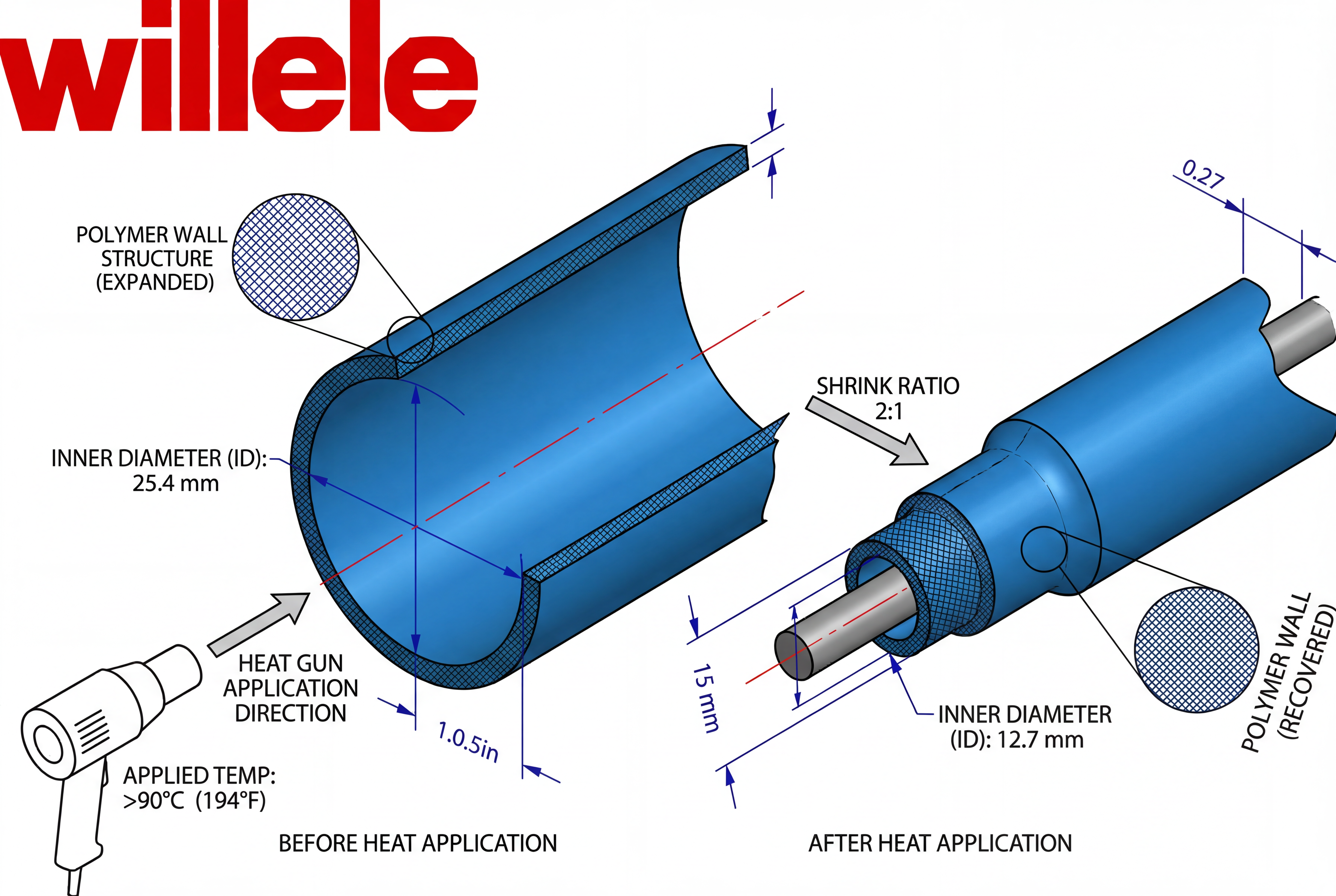
The cross-linking process creates molecular bonds that provide enhanced mechanical strength, chemical resistance, and thermal stability. When heated to the specified activation temperature (typically 90°C to 150°C depending on material), the tube shrinks to approximately 50% of its expanded diameter, conforming precisely to the shape of wires, cables, or components.
Types of Heat Shrink Tubing
Understanding the various types of heat shrink tube materials and constructions is essential for optimal application performance.
Material Classifications
EVA Heat Shrink Tube – WILLELE’s Specialty Material\
Ethylene-Vinyl Acetate (EVA) heat shrink tube represents WILLELE’s core material expertise, offering superior performance characteristics for demanding applications. EVA combines exceptional flexibility with outstanding clarity, making it ideal for applications requiring visual inspection of underlying components. With an operating temperature range of -40°C to 105°C, EVA demonstrates superior low-temperature performance compared to standard polyolefin materials.
Key advantages of WILLELE’s EVA heat shrink tubes include:
- Exceptional Flexibility: Maintains pliability even at low temperatures, preventing cracking or brittleness
- Low Shrink Temperature: Activates at 70-90°C, reducing energy consumption and enabling heat-sensitive component protection
- Outstanding Clarity: Transparent and semi-transparent options allow wire identification without removal
- Soft Touch: Comfortable handling with reduced stiffness compared to traditional polyolefin
- Superior Elongation: Up to 500% elongation properties provide excellent mechanical stress resistance
- Environmental Friendliness: RoHS and REACH compliant, halogen-free formulations available
- Enhanced Adhesion: Better surface bonding when used with adhesive liners
Polyolefin Heat Shrink Tube\
Polyolefin represents the most widely used heat shrink tube material, offering excellent electrical insulation properties, flexibility, and cost-effectiveness. Operating temperature ranges from -55°C to 125°C, with exceptional flame retardancy meeting UL224 and CSA standards.
PVC Heat Shrink Tube\
Polyvinyl chloride (PVC) heat shrink tubing provides economical solutions for low-temperature applications. With an operating range of -20°C to 85°C, PVC tubes are ideal for consumer electronics and light-duty industrial applications.
PTFE Heat Shrink Tube\
Polytetrafluoroethylene (PTFE) heat shrink tube delivers superior performance in extreme environments, withstanding temperatures from -65°C to 260°C. This material offers exceptional chemical resistance and low dielectric constant, making it ideal for aerospace and high-frequency applications.
Fluoropolymer Heat Shrink Tube\
Including FEP, PVDF, and Kynar materials, fluoropolymer tubes provide outstanding chemical resistance, high-temperature performance, and excellent electrical properties for demanding industrial applications.
Wall Thickness Categories
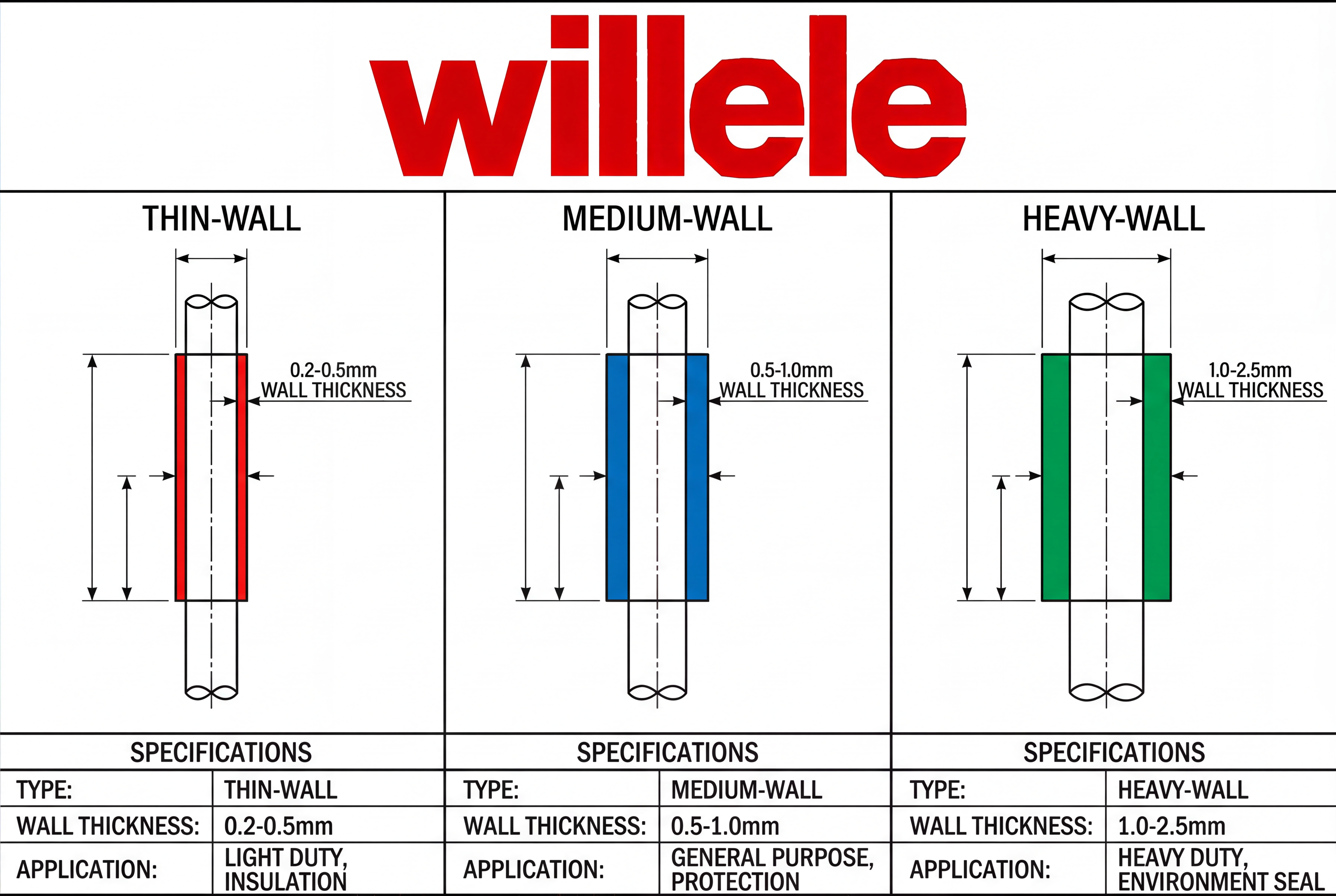
| Wall Type | Thickness Range | Primary Applications | Key Benefits |
|---|---|---|---|
| Thin-Wall | 0.2-0.5mm | Wire identification, light insulation | Flexibility, minimal space requirements |
| Medium-Wall | 0.5-1.0mm | General wire protection, cable bundling | Balanced protection and flexibility |
| Heavy-Wall | 1.0-2.5mm | Harsh environments, mechanical protection | Maximum durability and abrasion resistance |
Adhesive-Lined vs. Non-Adhesive
Adhesive-Lined (Dual-Wall)\
Features an inner thermoplastic adhesive layer that melts during heating, creating a watertight seal. Ideal for outdoor applications, marine environments, and moisture-sensitive connections. Provides superior environmental sealing with moisture resistance ratings up to IP67.
Non-Adhesive (Single-Wall)\
Standard heat shrink tube without adhesive lining, suitable for general insulation and identification purposes. Offers easier repositioning during installation and lower cost for applications where environmental sealing is not critical.
Heat Shrink Tube Sizes and Specifications
Proper sizing is crucial for optimal performance. Heat shrink tubes are specified by their supplied (expanded) diameter and recovered (shrunk) diameter.
| Supplied Diameter (mm) | Recovered Diameter (mm) | Typical Cable Range (mm) | Wall Thickness (mm) | Standard Length (m) |
|---|---|---|---|---|
| 1.6 | 0.8 | 0.5-1.2 | 0.30 | 200 |
| 3.2 | 1.6 | 1.0-2.4 | 0.35 | 200 |
| 6.4 | 3.2 | 2.0-4.8 | 0.40 | 100 |
| 9.5 | 4.8 | 3.5-7.5 | 0.45 | 100 |
| 12.7 | 6.4 | 5.0-10.0 | 0.50 | 100 |
| 19.1 | 9.5 | 8.0-15.0 | 0.60 | 50 |
| 25.4 | 12.7 | 10.0-20.0 | 0.70 | 50 |
| 38.1 | 19.1 | 16.0-30.0 | 0.80 | 25 |
| 50.8 | 25.4 | 22.0-40.0 | 1.00 | 25 |
Shrink Ratio and Performance Specifications
Shrink ratio indicates the relationship between the expanded and recovered diameters, directly affecting the range of substrates a single tube size can accommodate.
| Material | Shrink Ratio | Shrink Temperature | Operating Temperature | Dielectric Strength | Tensile Strength |
|---|---|---|---|---|---|
| EVA | 2:1, 3:1 | 70-90°C | -40°C to 105°C | 14-18 kV/mm | ≥12.5 MPa |
| Polyolefin | 2:1, 3:1, 4:1 | 90-120°C | -55°C to 125°C | 15-20 kV/mm | ≥10.4 MPa |
| PVC | 2:1 | 70-100°C | -20°C to 85°C | 12-15 kV/mm | ≥8.5 MPa |
| PTFE | 1.7:1, 2:1 | 327-343°C | -65°C to 260°C | 20-25 kV/mm | ≥27.6 MPa |
| FEP | 1.6:1 | 175-205°C | -65°C to 200°C | 18-22 kV/mm | ≥20.7 MPa |
| PVDF | 2:1 | 170-190°C | -55°C to 175°C | 16-20 kV/mm | ≥34.5 MPa |
Common Shrink Ratios:
- 2:1 Ratio: Standard for most applications, offering moderate substrate range coverage
- 3:1 Ratio: Increased versatility, accommodating wider diameter variations
- 4:1 Ratio: Maximum flexibility for complex shapes and irregular substrates
Applications of Heat Shrink Tubes
Heat shrink tubing serves critical functions across diverse industries, providing insulation, protection, identification, and strain relief.
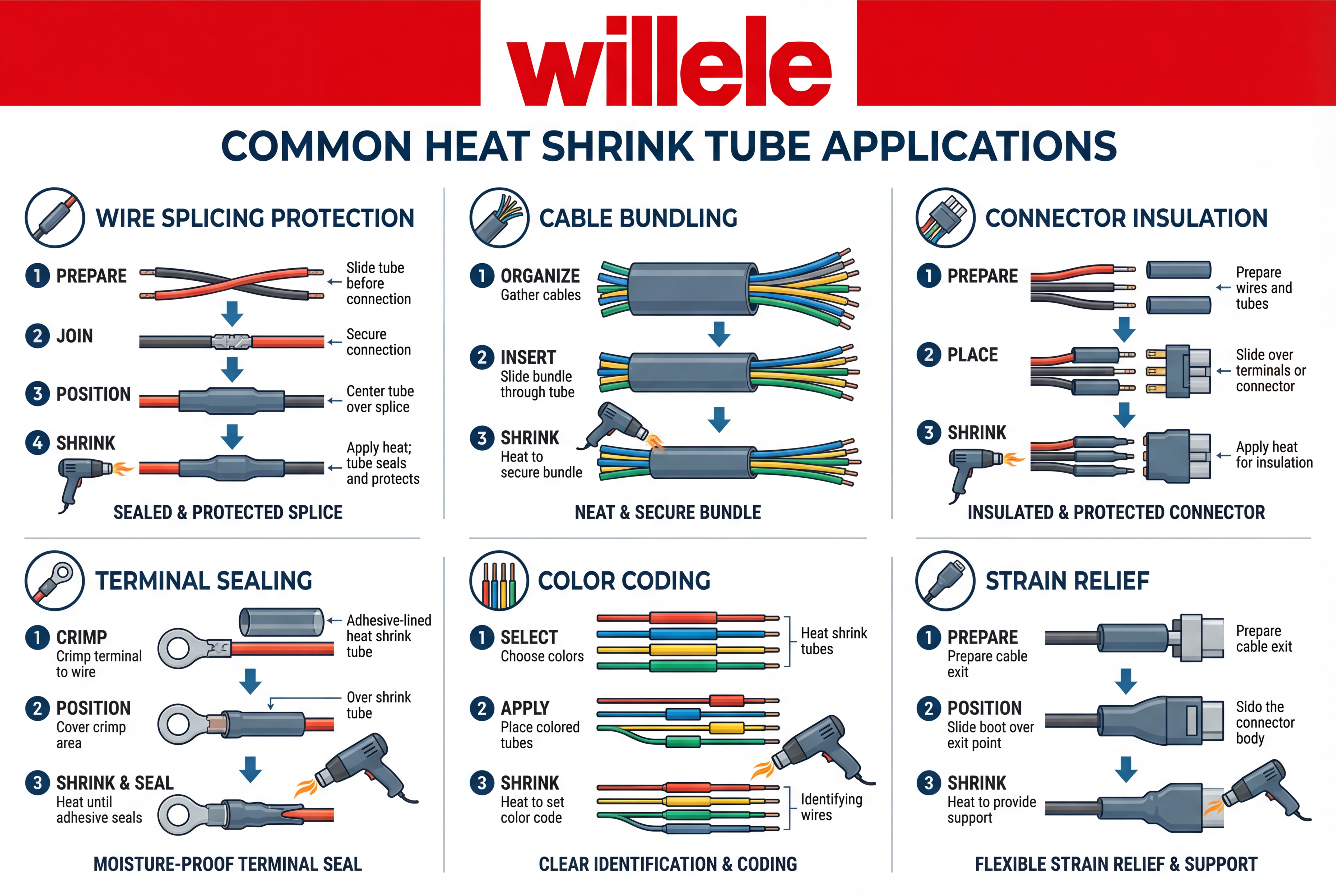
Industrial Applications
Electrical Equipment Manufacturing
- Motor lead terminations and connections
- Control panel wiring organization
- Cable harness assembly and bundling
- Transformer and switchgear insulation
Telecommunications
- Fiber optic cable protection
- Splice enclosures and breakout assemblies
- Network equipment wire management
- Environmental sealing for outdoor installations
Automotive and Transportation
Vehicle Wiring Systems
- Wire harness protection against abrasion
- Connector insulation and sealing
- Battery terminal protection
- Sensor cable reinforcement
Aerospace Applications
- Aircraft wire bundling and identification
- High-temperature engine compartment wiring
- Avionics system connections
- Lightweight, flame-retardant insulation solutions
Electronics and Consumer Products
Circuit Board Assembly
- Component lead insulation
- Wire-to-board connections
- EMI/RFI shielding applications
- Battery pack assembly
Power Tools and Appliances
- Cord strain relief
- Internal wiring protection
- Handle grip enhancement
- Temperature-resistant connections
How to Select the Right Heat Shrink Tube
Selecting appropriate heat shrink tubing requires evaluating multiple technical and environmental factors.
| Selection Criteria | Considerations | Recommended Action |
|---|---|---|
| Substrate Diameter | Measure maximum diameter of cable/component | Select tube with supplied diameter 20-30% larger |
| Shrink Ratio | Range of diameters to cover | Use 2:1 for uniform sizes, 3:1 or 4:1 for varied diameters |
| Operating Temperature | Minimum and maximum service temperatures | Choose material rated 20°C above maximum operating temp |
| Environmental Exposure | Chemicals, moisture, UV, abrasion | Select material with appropriate resistance properties |
| Electrical Requirements | Voltage rating, dielectric strength needed | Verify tube dielectric strength exceeds application voltage |
| Certification Needs | Industry standards (UL, CSA, MIL-SPEC, RoHS) | Confirm certifications match application requirements |
| Adhesive Requirement | Need for environmental sealing | Use adhesive-lined for outdoor/moisture exposure |
| Color Coding | Identification and organization needs | Standard colors: black, red, blue, yellow, green, white, clear |
Installation Best Practices
- Surface Preparation: Ensure substrate is clean, dry, and free from sharp edges
- Proper Sizing: Allow 5-10mm overlap beyond the area requiring coverage
- Heat Application: Use heat gun, oven, or hot air system with controlled temperature
- Even Heating: Apply heat uniformly, moving heat source continuously to prevent burning
- Cooling Period: Allow tube to cool naturally for complete material recovery
Why Choose WILLELE Heat Shrink Tubes
WILLELE Electric provides comprehensive heat shrink tube solutions engineered for demanding B2B applications:
EVA Material Expertise: As a specialized manufacturer of EVA-based heat shrink tubing, WILLELE has developed advanced formulation technology and precision extrusion processes to deliver consistent quality and performance. Our EVA heat shrink tubes are manufactured using premium-grade copolymer resins with optimized vinyl acetate content (typically 18-28%) to achieve the ideal balance of flexibility, clarity, and thermal properties. WILLELE’s state-of-the-art cross-linking technology ensures superior mechanical strength while maintaining the soft-touch characteristics that make EVA ideal for consumer electronics, medical devices, and applications requiring frequent handling or visual inspection.
Quality Assurance: All products manufactured under ISO 9001 quality management systems with rigorous testing protocols including dielectric strength, shrink ratio verification, and accelerated aging tests.
Technical Support: Dedicated engineering team provides application consulting, custom sizing solutions, and material selection guidance for specialized requirements.
Certification Compliance: Complete portfolio meets international standards including UL224, CSA C22.2, MIL-I-23053, AMS-DTL-23053, RoHS, and REACH compliance.
Global Supply Chain: Reliable inventory management, flexible order quantities, and efficient logistics ensuring on-time delivery for production schedules.
Custom Solutions: Private labeling, custom colors, pre-cut lengths, and specialized material formulations available for OEM partners and large-volume purchasers.
Frequently Asked Questions (FAQ)
Q1: What temperature should I use to shrink heat shrink tubing?
Most polyolefin heat shrink tubes activate at 90-120°C (194-248°F). Apply heat gradually, maintaining a distance of 15-20cm from the heat source. For PTFE and fluoropolymer materials, higher temperatures (170-343°C) are required. Always consult manufacturer specifications for optimal shrinking temperature ranges.
Q2: Can heat shrink tube be reused or removed?
No, heat shrink tubing cannot be reused once activated. The cross-linking and shrinking process is irreversible. To remove, carefully cut along the length with a sharp blade, taking care not to damage the underlying substrate.
Q3: What is the difference between 2:1 and 3:1 shrink ratios?
A 2:1 shrink ratio means the tube shrinks to half its supplied diameter (e.g., 12mm to 6mm), while 3:1 shrinks to one-third (12mm to 4mm). Higher ratios provide greater flexibility in covering varied substrate diameters but may have slightly different mechanical properties.
Q4: How do I determine the correct size for my application?
Measure the largest diameter of your cable or component, including any connectors. Select a heat shrink tube with a recovered (shrunk) diameter slightly smaller than this measurement and a supplied (expanded) diameter 20-30% larger to facilitate easy installation.
Q5: Are adhesive-lined heat shrink tubes necessary for outdoor applications?
For outdoor, marine, or moisture-prone environments, adhesive-lined (dual-wall) heat shrink tubes are strongly recommended. The thermoplastic adhesive creates a waterproof seal, providing IP67-rated environmental protection and preventing moisture ingress that could cause corrosion or electrical failure.
Q6: What is the shelf life of heat shrink tubing?
When stored properly in a cool, dry environment away from direct sunlight and extreme temperatures, heat shrink tubing typically has a shelf life of 3-5 years. PTFE and fluoropolymer materials generally have longer shelf lives compared to polyolefin or PVC materials.
For technical specifications, custom quotations, or bulk ordering inquiries, contact WILLELE Electric’s B2B sales team. Our application engineers are available to assist with material selection, performance validation, and integration support for your manufacturing requirements.
