
Heat Shrink Tubing for Electrical Busbar Protection

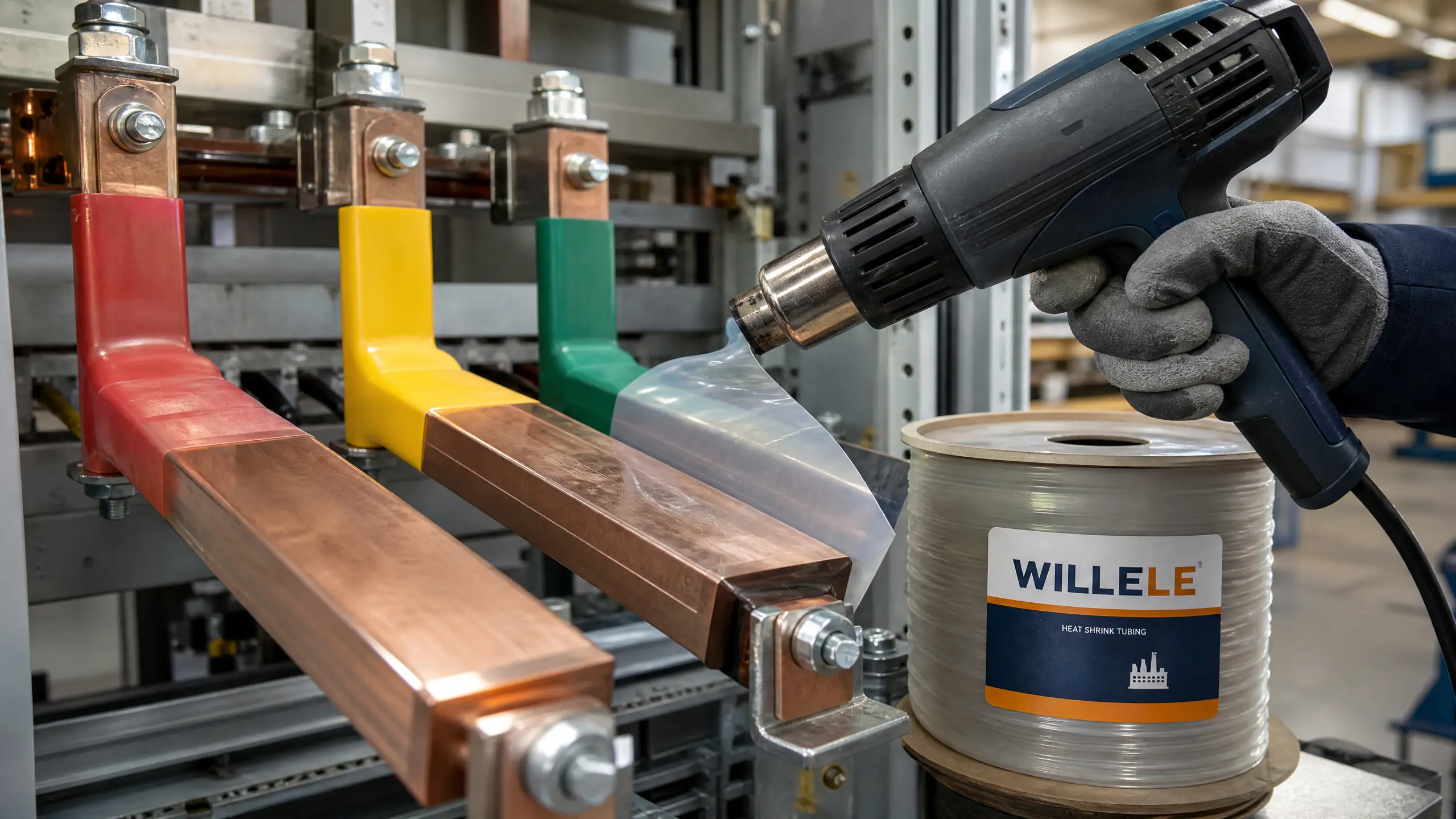
A bare copper or aluminum busbar carrying hundreds of amps is only as safe as the air around it. Dust, condensation, a dropped tool, or a curious rodent can turn a clearance gap into a flashover path in milliseconds, and the resulting arc fault rarely stays contained to one phase. That risk is why panel builders, switchgear OEMs, and EPC contractors across North America, Europe, the Middle East, and Southeast Asia increasingly specify heat shrink tubing as the primary insulation layer on busbars, rather than relying on rigid boots, wrapped tape, or dip coating alone. Unlike bolted or molded insulators, heat shrink tubing forms one continuous, void-free jacket that follows the exact profile of the conductor — straight runs, bends, and bolted joints alike — and it does so without adding a separate part for every geometry on the busbar run. This guide covers how heat shrink tubing insulates a busbar, the voltage classes and wall thicknesses that matter, how it compares with rigid and tape-based alternatives, where it gets specified across industries, and how to choose the right grade for a project regardless of which region it ships to.
What Is Heat Shrink Tubing, and Why Busbars Need It
Busbars are deliberately left bare or lightly painted in many panel designs, because paint alone can’t guarantee a consistent dielectric barrier and does nothing to reduce the phase-to-phase or phase-to-ground clearance a panel needs. Left uninsulated, a busbar depends entirely on air gap and physical barriers for safety, which means every millimeter of clearance has to be engineered in, inspected during commissioning, and kept clean for the life of the installation. Contamination, condensation inside an outdoor enclosure, or a stray strand of wire bridging two phases can defeat that air gap without warning, and once tracking starts across a contaminated surface, it tends to get worse rather than self-correct.
Heat shrink tubing solves this by adding a dedicated dielectric layer directly on the conductor instead of depending on air alone. It ships as an oversized polymer sleeve — typically cross-linked polyolefin — that slides over the busbar with plenty of clearance to spare. Applying heat with a hot air gun, gas torch, or industrial oven triggers the material to recover toward a smaller, preset diameter, gripping the busbar’s profile tightly enough to eliminate the air pockets that would otherwise let partial discharge start at a sharp edge or bolt head. Because the sleeve is flexible before it shrinks, it follows bends, offsets, and bolted lap joints that a rigid molded insulator would need a separate matched piece to cover.
Inside the Tubing: Material, Layers, and Shrink Ratio
Most busbar-grade heat shrink tubing is cross-linked polyolefin. The cross-linking step, usually done by electron-beam radiation during manufacturing, gives the polymer a kind of molecular memory: heat it once during installation and it recovers toward the diameter set in that process, then holds that shape afterward instead of slowly relaxing back under heat, vibration, or age. That same cross-linked structure is what gives the tubing its resistance to tracking and surface erosion, which matters over years of exposure to dust, humidity, and repeated switching transients — the slow degradation modes that eventually undermine a busbar’s insulation long before any single fault event does.
Two constructions cover most busbar work. Single-wall tubing gives fast insulation and phase-color identification along straight runs with minimal added diameter. Adhesive-lined (double-wall) tubing adds an inner hot-melt layer that flows during heating and fills the gaps around cut ends, bolted lugs, and branch joints — the places most exposed to moisture ingress and contamination in the first place. Picking between the two comes down to whether the joint needs a dielectric barrier only, or a dielectric barrier plus an environmental seal.
Shrink ratio is the other variable that determines fit. A 2:1 ratio suits straight, uniformly sized busbar runs; 3:1 and 4:1 ratios accommodate bolted connectors, lugs, and irregular transitions where the tubing has to clear a larger feature before recovering down onto the narrower busbar body behind it. The rule of thumb carried over from general heat-shrink practice applies here too: size the supplied (expanded) diameter to clear the largest feature on the joint, then confirm the recovered diameter is small enough to grip the busbar itself once fully shrunk, with no gap left underneath.
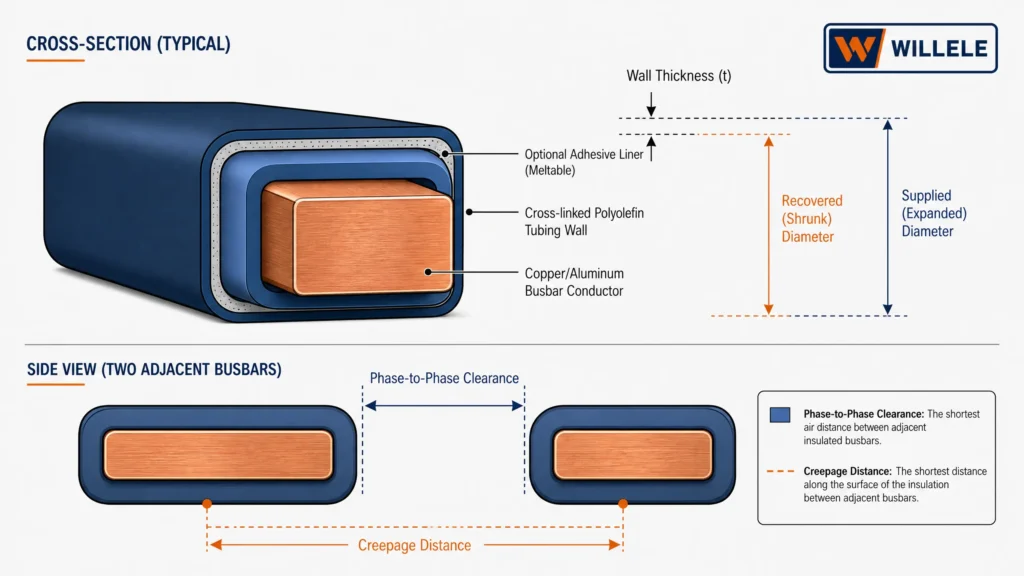
A cross-linked polyolefin wall recovers around the conductor to close the void that would otherwise sit between a rigid insulator and the busbar surface, and it does so while preserving the phase-to-phase clearance the panel was designed around.
Key Technical Specifications
Busbar heat shrink tubing is generally sold by voltage class, since that determines the minimum wall thickness and the material formulation needed to hold off a given dielectric stress without derating the busbar underneath.
| Voltage Class | Wall Category | Typical Shrink Ratio | Primary Use Case |
|---|---|---|---|
| Up to 1 kV | Thin wall | 2:1 / 3:1 | LV panelboards, control cabinets, wiring-harness busbars |
| 1 kV – 10 kV | Thin/medium wall | 2:1 / 3:1 | LV–MV switchboards, motor control center bus risers |
| 15 kV – 36 kV | Medium/heavy wall | 2:1 | MV switchgear, ring main units, transformer bus connections |
| Up to 66–72 kV | Heavy wall | 2:1 | HV substation busbars, heavy industrial and mining equipment |
Continuous operating temperature depends on the specific grade, but cross-linked polyolefin busbar tubing commonly spans roughly -55°C to +125°C, with flame-retardant ratings such as VW-1 available on automotive and industrial-grade lines. Always confirm the exact figures against the manufacturer’s datasheet for the voltage class and wall type you’re specifying, since thicker, higher-voltage grades trade off some of that temperature headroom for added dielectric margin.
Heat Shrink Tubing vs. Other Busbar Insulation Methods
Rigid molded insulators and hand-applied tape or dip coatings were the default long before heat shrink tubing became widely available, and both are still specified today. The table below lays out where each method holds up and where it tends to fall short.
| Criterion | Heat Shrink Tubing (Cross-linked Polyolefin) | Rigid BMC/Epoxy Insulators | Insulating Tape / Dip Coating |
|---|---|---|---|
| Fit on bends & bolted joints | Conforms directly, no extra parts needed | Needs a separately molded piece per shape | Hand-wrapped; gaps common at overlaps |
| Air gaps / voids | Minimal once correctly shrunk | Depends on mold-to-conductor tolerance | Frequent, especially around corners |
| Installation method | Heat gun, hot air, gas torch, or oven | Bolted or mechanically fitted | Hand-wrapped or dip-tank |
| Typical dielectric strength | High — commonly above 20 kV/mm for cross-linked polyolefin | High | Moderate |
| Behavior under vibration & thermal cycling | Flexible; resists cracking | Can develop stress fractures over years | Can loosen; needs periodic rewrap |
| Rework / field repair | Cut off and re-shrink a fresh sleeve | Often requires replacing the molded part | Strip and rewrap or recoat |
Rigid insulators still make sense where a busbar needs to double as a mechanical standoff rather than just an insulating jacket. Tape and dip coating remain a low-cost option for short runs or field repairs where downtime doesn’t allow a proper recovery cycle. For most switchgear, panelboard, and busbar riser applications, though, the combination of a continuous dielectric layer, fast installation, and resistance to vibration is why heat shrink tubing has become the default specification on new builds and retrofits alike.
Where Busbar Heat Shrink Tubing Is Used
Switchgear and panel building. Main switchboards and distribution panels route the highest currents in a building’s electrical system, and insulating the bus risers and joints inside them is one of the most common places heat shrink tubing gets specified, often alongside color-coded phase identification.
Substations and utility infrastructure. Outdoor busbars face UV exposure, pollution, and weather cycling that degrade rigid coatings faster than they degrade cross-linked polyolefin, particularly on aging equipment where added insulation restores dielectric margin that the original surface has lost.
EV and battery/ESS systems. Laminated busbars inside battery packs and energy storage cabinets run in tight, vibration-heavy enclosures, where thin-wall automotive-grade tubing insulates connections and reduces corrosion at solder and crimp joints over the vehicle or system’s service life.
Data centers and UPS rooms. Facilities that can’t tolerate an unplanned outage lean on halogen-free tubing grades specifically because they don’t release corrosive, toxic gas onto sensitive server hardware if a fire ever does start nearby.
Mining and heavy industry. Mobile and fixed switchgear in mines and processing plants deals with dust, moisture, and mechanical shock that make a flexible, conformal insulation layer more durable in practice than a rigid one that can crack under repeated impact.
Marine and offshore. Salt fog and constant vibration push installers toward adhesive-lined grades that seal cut ends and connector transitions against moisture ingress, not just insulate them electrically.
Standards, Compliance, and Sourcing for Global Projects
Busbar heat shrink tubing sits in the extruded insulating tubing product category that UL 224 addresses in North America, while insulation-level testing elsewhere generally follows IEC practice for the relevant voltage class. Flame-retardant classifications such as VW-1 apply to specific grades — Willele’s automotive/EV busbar tubing, for example, carries a VW-1 rating alongside RoHS compliance. Halogen-free formulations are worth specifying wherever the enclosure is occupied or hard to ventilate, since they reduce the corrosive and toxic gas released if the material is ever exposed to fire, a detail that matters as much in a hospital basement panel room as it does in a data center.
Sourcing gets more complicated once a project spans regions. A Gulf-region substation, a European MV switchgear room, and a Southeast Asian battery pack line don’t share the same ambient temperature range, code references, or even phase-color convention — North American panels commonly follow NEC-based color practice, while IEC-influenced installations often use a different scheme entirely. Confirm the local color and voltage-marking convention with the project’s inspecting authority before ordering pre-colored tubing, rather than assuming one region’s habit applies everywhere else. Working with a manufacturer that stocks multiple voltage classes and wall thicknesses, and that can ship under flexible EXW, FOB, or CIF terms, removes one variable from projects that source equipment for several countries at once.
Choosing the Right Heat Shrink Tubing for Your Busbar Project
Start with the system’s phase-to-phase voltage and add a margin rather than specifying to the exact rated voltage — insulation exposed to switching transients needs headroom that the nameplate figure alone doesn’t show. From there, match the wall category to the installation environment: thin wall for indoor panels and control cabinets, medium wall for MV switchgear, and heavy wall for outdoor substations or heavy industrial equipment where mechanical and environmental stress runs higher.
Decide between single-wall and adhesive-lined tubing based on where the joint sits, not on habit. A straight busbar run inside a dry, indoor cabinet rarely needs more than single-wall insulation and color coding. A cut end, a bolted lug, or any joint exposed to moisture is a better candidate for an adhesive-lined sleeve that seals as it shrinks instead of just insulating. Pick the supplied (expanded) diameter so it clears the largest feature on the joint — a bolt head or connector lug — and confirm the recovered diameter grips the busbar itself once fully shrunk; a mismatch in either direction leaves either a poor fit or a void underneath.
Finally, treat color and voltage marking as a specification detail rather than an afterthought. Confirm the convention your project’s inspecting authority expects before the tubing ships, and ask suppliers about sample lead times and minimum order quantities early enough that a color or size mismatch doesn’t stall a build once installation is already underway.
FAQ
What voltage rating do I need for busbar heat shrink tubing?
Match the tubing’s rated voltage to your system’s phase-to-phase voltage with a safety margin, not the exact nameplate figure. Thin-wall grades typically cover up to 1 kV, medium wall extends into the 10–36 kV range, and heavy-wall grades reach 66–72 kV for substation and heavy industrial busbars.
Can heat shrink tubing be installed on bent or irregular busbars?
Yes. The material is flexible before shrinking, so it follows bends and offsets without extra parts. Use a higher shrink ratio, such as 3:1 or 4:1, at bolted joints and irregular transitions, and a 2:1 ratio for straight, uniform runs.
Is busbar heat shrink tubing halogen-free?
Cross-linked polyolefin is generally low in halogen content, and dedicated halogen-free grades are available for enclosed, high-occupancy spaces such as data centers, hospitals, and airports, where reduced smoke toxicity matters if a fire ever occurs.
Does insulating a busbar reduce its current-carrying capacity?
Adding any insulation layer slightly affects heat dissipation, but modern cross-linked polyolefin has higher thermal conductivity than older insulating plastics, which limits the derating effect. Check the manufacturer’s datasheet for the specific derating factor at your ampacity.
What tools are needed to shrink the tubing onto a busbar?
A variable-temperature heat gun or hot air tool covers most field installation, and gas torches are also used on site. Manufacturing lines applying large volumes typically use an oven instead, for more even and repeatable recovery.
Single-wall or adhesive-lined — which one for a bolted busbar joint?
Use adhesive-lined (double-wall) tubing at cut ends, bolted lugs, and any joint exposed to moisture or contamination, since the hot-melt liner seals as it shrinks. Reserve single-wall tubing for straight runs where color identification and basic dielectric insulation are the only requirements.
