
Heat Shrinkable Tubes in Solar Panel Installation: A Practical Guide

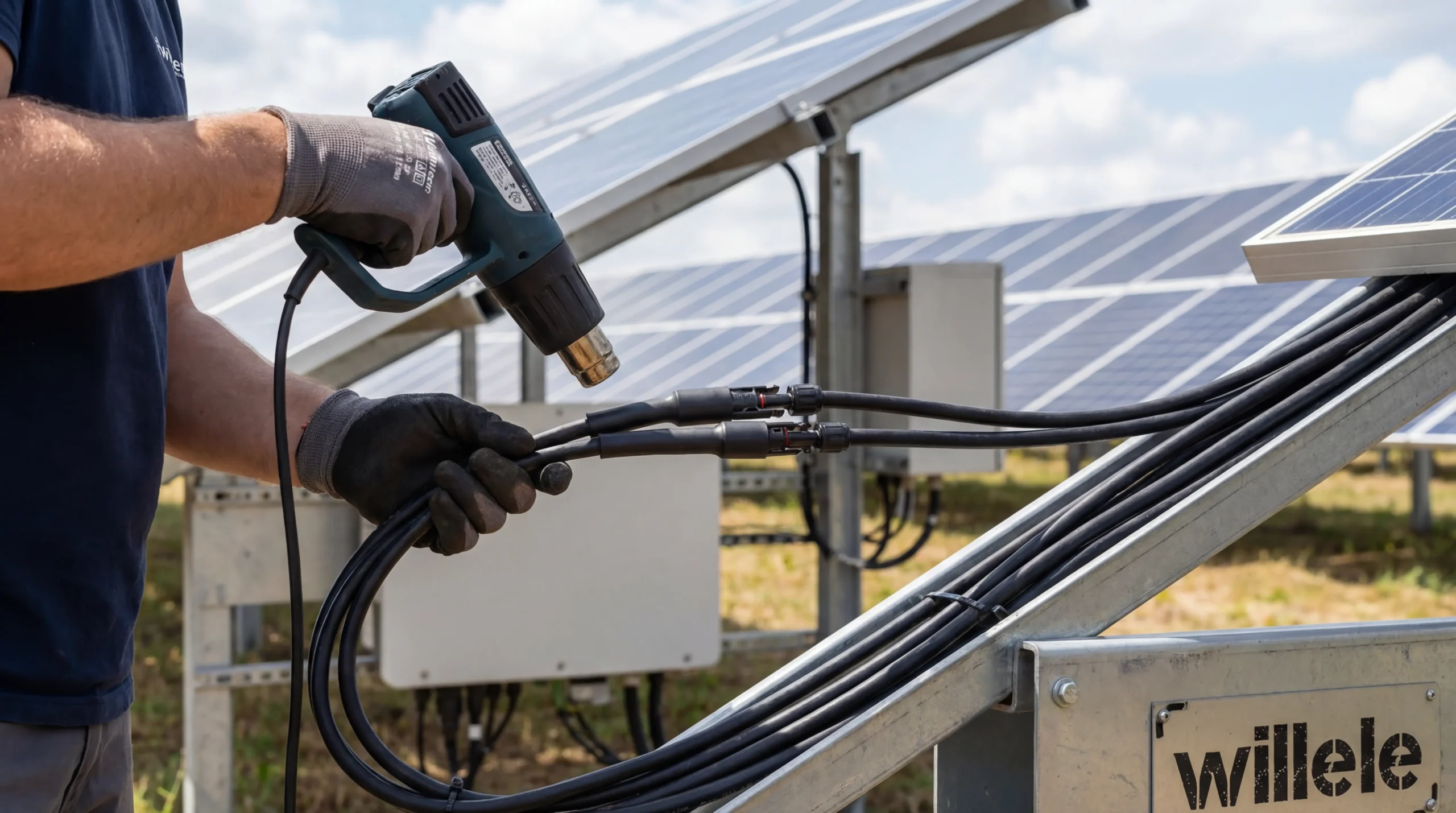
The durability of any photovoltaic (PV) system is defined not just by the quality of the panels, but by the resilience of its cabling infrastructure. As the renewable energy market matures, installers are increasingly focusing on the longevity of connection points. Implementing high-quality Heat Shrinkable Tubes in Solar Panel Installation is essential for maintaining system performance and safety against harsh outdoor conditions over decades of operation.
For procurement officers and solar technicians, the choice of insulation is a critical risk management decision. willele Electric stands at the forefront of this industry, manufacturing industrial-grade insulation solutions engineered to survive the toughest environments. This article outlines the essential criteria for selecting and applying heat shrink technology in solar projects.
The Strategic Importance of Cable Protection in Solar
Unlike indoor wiring, solar arrays operate in an uncontrolled environment. The connections between combiners, inverters, and modules fight a constant battle against three main threats: moisture intrusion, ultraviolet degradation, and physical stress.
1. Defending Against Moisture
Ground faults triggered by water ingress are a leading cause of system downtime. Traditional electrical tape offers only temporary protection before peeling. In contrast, adhesive-lined heat shrink tubing creates a permanent, hermetic seal. Upon heating, the inner adhesive layer flows into the cable interstices, effectively waterproofing the connection against rain, humidity, and condensation.
2. Combating UV Exposure
Solar cables are bathed in UV radiation daily. Without proper protection, insulation materials degrade, crack, and fail. Premium heat shrink tubes for solar use are engineered with UV stabilizers—typically carbon black—allowing them to remain pliable and intact for the 25-year lifespan of the PV modules.
3. Alleviating Mechanical Stress
Wind loads and thermal expansion cause cables to shift. Heat shrink tubing acts as a rigid exoskeleton for the connection, providing vital strain relief that prevents wires from being pulled out of crimped terminals.
Anatomy of a Solar-Grade Tube
To ensure long-term reliability, one must look beyond standard tubing. The industry benchmark for solar is the dual-wall construction.
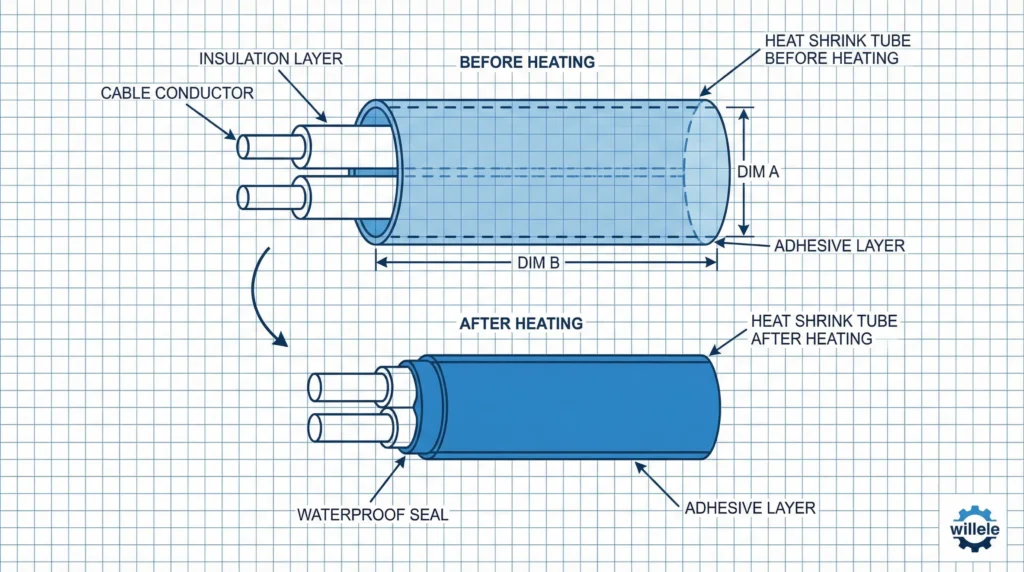
Dual-Layer Technology
- Protective Jacket: A cross-linked polyolefin outer layer that resists abrasion, chemicals, and weathering.
- Sealing Liner: An inner hot-melt adhesive that bonds the tube to the wire, filling gaps to block moisture.
Material Performance Matrix
Choosing the right material for Heat Shrinkable Tubes in Solar Panel Installation is non-negotiable. Here is how common materials stack up:
| Property | Cross-linked Polyolefin (Preferred) | Standard PVC | Fluoropolymer (High Temp) |
|---|---|---|---|
| Temp Range | -55°C to +125°C | -20°C to +80°C | -55°C to +175°C |
| UV Stability | Excellent (Black) | Low | Excellent |
| Shrink Ratios | 2:1, 3:1, 4:1 | Typically 2:1 | 2:1 |
| Moisture Seal | Yes (w/ Adhesive) | No | No |
| Durability | High | Low | Extreme |
Verdict: For general PV wire applications, Adhesive-Lined Cross-linked Polyolefin offers the best balance of performance and value.
Mastering Shrink Ratios and Sizing
A common pitfall in solar installation is using a tube with an insufficient shrink ratio. Solar connectors (e.g., MC4s) often have a much larger diameter than the cable itself.
- Standard 2:1: Suitable for uniform cable splices.
- High Ratio 3:1 or 4:1: Mandatory for sealing over connectors. The tube must expand enough to clear the plug but shrink enough to seal the wire.
Quick Sizing Reference
| Use Case | Wire Size (AWG) | Connector Style | Ideal Ratio | Tube Size (Expanded) |
|---|---|---|---|---|
| Module Connection | 10-12 AWG | Butt Splice | 3:1 | 6mm – 9mm |
| Inverter Leads | 8-10 AWG | Ring Terminal | 3:1 | 9mm – 12mm |
| Storage Systems | 2/0 – 4/0 AWG | Heavy Duty Lug | 2:1 / 3:1 | 25mm – 40mm |
| Earthing | 6-8 AWG | Bonding Lug | 3:1 | 12mm |
Application Protocols
Even superior materials fail if applied incorrectly. Follow this process to ensure a secure bond with willele Electric tubing.
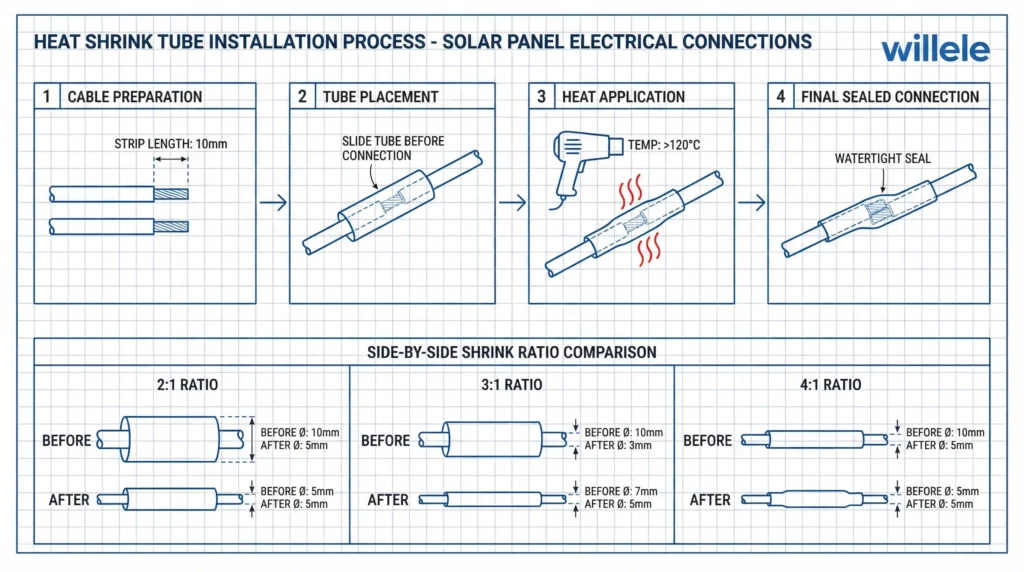
1. Clean Surface
Remove any grease, dust, or moisture from the cable and connector. Contaminants prevent the adhesive from bonding.
2. Proper Placement
Position the tube over the wire before terminating. After crimping, slide the tube to cover the connection, ensuring at least 15mm of overlap onto the cable insulation on both sides.
3. Controlled Heating
Utilize a heat gun set between 110°C and 130°C.
- Pro Tip: Begin shrinking at the center and move outward. This technique forces air out, preventing bubbles.
4. Visual Inspection
Check for a small ring of clear adhesive extruding from the ends of the tube. This confirms a waterproof seal.
5. Cool Down
Let the assembly cool undisturbed. Movement while hot can compromise the adhesive bond.
Troubleshooting Installation Faults
| Symptom | Probable Cause | Corrective Action |
|---|---|---|
| Scorched Surface | Excessive heat or stationary gun. | Reduce temp; keep heat gun in motion. |
| Trapped Air Bubbles | Sealed ends before center. | Heat from the middle outward. |
| Tube Rupture | Tube too small or sharp burrs. | Use higher shrink ratio; smooth sharp edges. |
| Sliding/Loose | Tube too large. | Choose a smaller recovered diameter. |
The willele Electric Difference
In the B2B solar sector, supply chain reliability and product consistency are paramount. willele Electric is dedicated to manufacturing heat shrink products that meet the rigorous demands of electrical infrastructure.
- Compliance: Our products adhere to UL and IEC safety standards.
- Bespoke Solutions: We provide custom cutting and marking services for utility-scale projects.
- Direct Manufacturing: We control the quality from raw material to finished product, ensuring you get consistent performance every time.
Installer FAQ
1. Is electrical tape a viable alternative for solar connections?
No. Electrical tape degrades rapidly under UV light and rain, losing its adhesion. It cannot provide the permanent waterproof seal required for solar safety and will eventually lead to system faults.
2. Why is dual-wall tubing recommended over single-wall?
Single-wall tubing lacks the inner adhesive layer. Dual-wall tubing melts an internal glue when heated, creating a moisture-proof barrier that is critical for preventing corrosion in outdoor environments.
3. Which shrink ratio fits MC4 connectors best?
A 3:1 or 4:1 ratio is usually necessary. The tubing needs a large expanded diameter to fit over the connector body, but a small recovered diameter to tightly seal the thinner PV wire.
4. How long do willele heat shrink tubes last outdoors?
Our solar-specific black tubing is formulated with carbon black for maximum UV resistance, designed to match the 20+ year lifespan of standard solar panels.
5. What temperature rating should I look for?
Given the heat on rooftops and in solar farms, tubing should be rated for -55°C to +125°C. This ensures flexibility in freezing conditions and stability during peak heat.
6. Can I use a lighter instead of a heat gun?
It is strongly discouraged. Open flames cause uneven shrinking, can damage the cable insulation, and leave conductive soot. A heat gun ensures a controlled, professional application.
Build Better with willele Electric
Ensure your solar installations stand the test of time. For dependable, weather-resistant Heat Shrinkable Tubes in Solar Panel Installation, partner with willele Electric. Reach out to our team today to discuss specifications, request samples, or secure stock for your upcoming projects.
