
How JYZ Series Busbar Insulator Improve Switchgear Safety

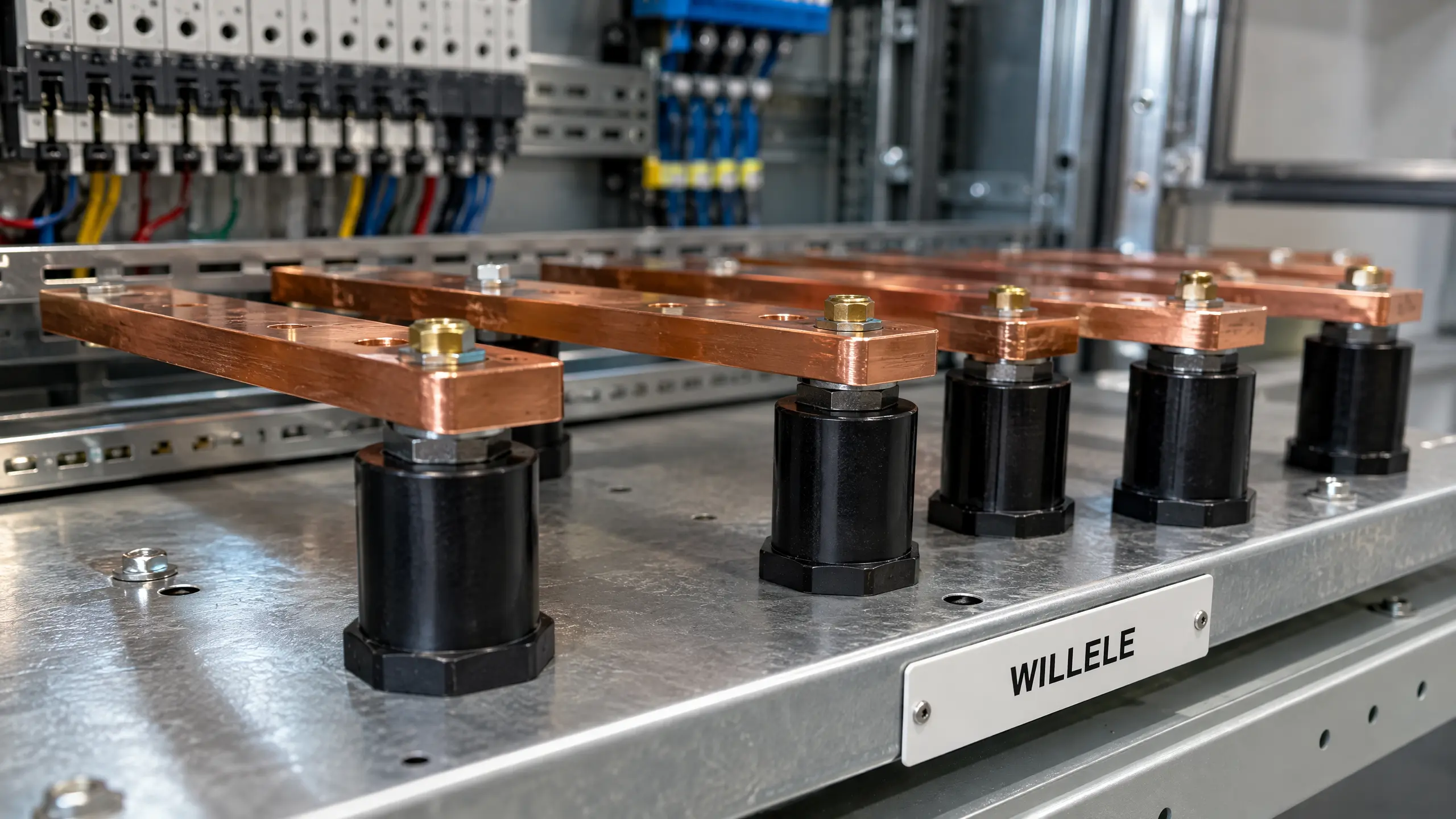
A busbar insulator is a small part with a big job. Inside any switchgear panel, distribution board, or ESS cabinet, it is the only thing standing between an energized copper bar and a grounded metal enclosure. When that part is undersized, poorly molded, or installed with the wrong torque, the failure mode is not cosmetic — it is arc flash, phase-to-phase fault, or a fire that starts inside a cabinet nobody was watching. This is why panel builders, OEMs, and EPC contractors sourcing busbar insulators for LV and MV switchgear treat the component as a safety specification, not a commodity fastener.
Willele’s JYZ Series busbar insulator was engineered around that reality. It is a slim, column-type standoff insulator built to hold copper or aluminum busbars in precise alignment while keeping them electrically isolated from the panel structure, and it is one of the most widely specified support types in low-voltage switchgear, power distribution units, motor control centers, and energy storage assemblies shipped to markets across North America, Europe, and Southeast Asia. This article explains what the JYZ series actually does inside a cabinet, how its geometry and material choices translate into measurable safety margins, and how to select the right model for a given voltage class and mechanical load.
Why Busbar Insulation Is a Safety-Critical Decision
Copper and aluminum busbars carry the full fault current of a distribution system, and switchgear standards such as IEC 61439-1/-2 require that this current stay confined to a defined electrical path at all times. A busbar insulator enforces that path in two ways at once: it maintains a fixed air clearance and creepage distance between the conductor and any grounded surface, and it physically anchors the bar so vibration, thermal cycling, and short-circuit electromagnetic forces cannot pull it out of position. Lose either function and the other collapses with it — a cracked insulator body lets moisture and dust into the gap, dielectric strength drops, and tracking begins long before anyone notices a problem on a maintenance walk-through.
That interdependence is why insulator selection is never just about voltage rating on a datasheet. A part rated for 20 kV withstand that snaps under normal bolt torque is not a safe part; it is a liability with a good spec sheet. Willele designs the JYZ series so the mechanical and dielectric performance are verified together, not in isolation.
What Makes the JYZ Series Different
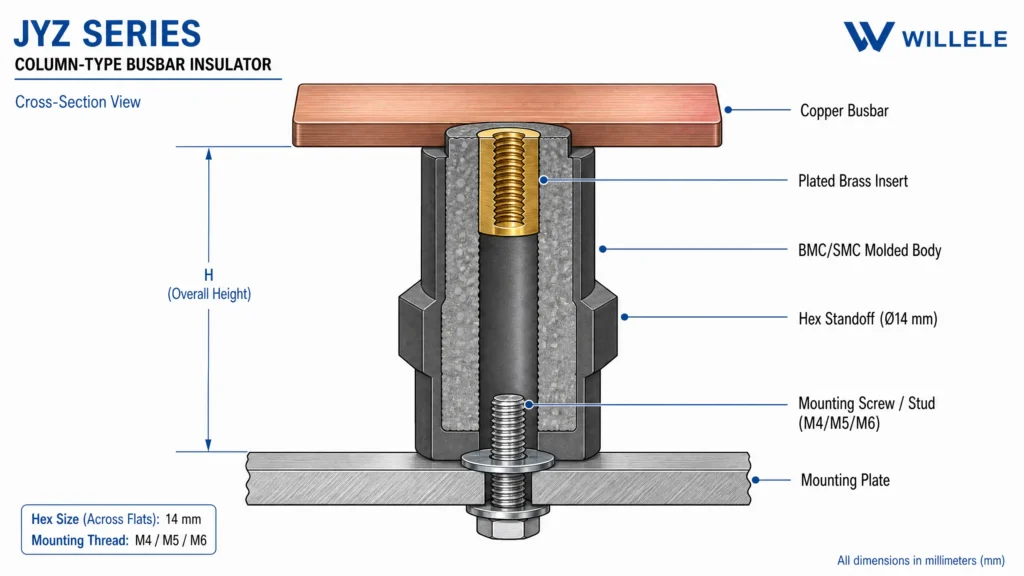
The JYZ series uses a compact Ø14 mm cylindrical body, compression-molded from fiberglass-reinforced BMC/SMC composite around a plated brass or steel insert. That combination gives three safety-relevant properties at once.
Consistent creepage and clearance. Because every JYZ unit shares the same Ø14 mm body diameter across all standard heights, panel designers can standardize hole spacing and bar-to-bar distance across an entire product line without re-verifying clearance on every drawing revision. This uniformity matters more than it sounds — most field insulation failures trace back to a one-off substitution that quietly shrank the clearance a design assumed.
A threaded insert that keeps its torque. The plated metal insert is set into the mold to tight tolerances before curing, so the thread does not loosen or strip after repeated tightening during commissioning or maintenance. An insulator that holds torque is an insulator that keeps its rated air gap for the life of the panel, rather than drifting closer to a grounded surface after the third field service visit.
A smooth, deburred hex standoff. Each unit is integrally molded and deburred so installers get a clean grip surface for a wrench or socket, and there is no sharp flash left on the body that could puncture wire insulation or cut an installer’s hand during a tight panel build. It is a small detail, but it is the kind of detail that shows up in incident reports when it is missing.
Reading the JYZ Model Code
Willele uses a straightforward naming convention: JYZ[Diameter]×[Height]. Standard production runs on a 14 mm diameter body, so a part marked JYZ14×30 is a 14 mm body with a 30 mm overall height, measured excluding any protruding stud. Thread size is called out separately as M4, M5, or M6, and each can be supplied as female-female, or as a mixed female-plus-stud configuration for panels that need one end pre-fitted for a quick drop-in assembly. Reading the code correctly before ordering avoids the single most common cause of on-site rework: a part that fits the busbar hole pattern but arrives with the wrong thread depth for the panel’s mounting screws.
JYZ Series Specification Table (Ø14 mm)
The table below lists the standard height and thread combinations Willele stocks for the JYZ Ø14 mm platform. Non-standard diameters, mixed-end configurations, and special compound grades are available on request.
| Model | Diameter A/F (mm) | Height H (mm) | M4 | M5 | M6 |
|---|---|---|---|---|---|
| JYZ14×14 | 14 | 14 | ✔ | ✔ | ✔ |
| JYZ14×16 | 14 | 16 | ✔ | ✔ | ✔ |
| JYZ14×20 | 14 | 20 | ✔ | ✔ | ✔ |
| JYZ14×25 | 14 | 25 | ✔ | ✔ | ✔ |
| JYZ14×30 | 14 | 30 | ✔ | ✔ | ✔ |
| JYZ14×35 | 14 | 35 | ✔ | ✔ | ✔ |
| JYZ14×40 | 14 | 40 | ✔ | ✔ | ✔ |
| JYZ14×50 | 14 | 50 | ✔ | ✔ | ✔ |
| JYZ14×60 | 14 | 60 | ✔ | ✔ | ✔ |
| JYZ14×75 | 14 | 75 | ✔ | ✔ | ✔ |
Confirm final ratings, thread depth, and tolerances with Willele’s engineering team before design-in; values are typical for standard production.
JYZ vs. Other Common Support Insulator Families
Switchgear designers rarely choose in a vacuum — a JYZ column insulator is usually being weighed against a wider-bodied support like Willele’s C series, or against porcelain and epoxy alternatives used in older panel designs. The comparison below is meant to make that trade-off explicit rather than leave it to guesswork.
| Feature | JYZ Series (column-type) | C Series (cylindrical support) | Porcelain / Ceramic |
|---|---|---|---|
| Typical body diameter | Ø14 mm | 25–70 mm range | Larger, shed-style |
| Typical use case | Compact panels, dense bar spacing | Higher mechanical load, MV distribution | High-voltage outdoor substations |
| Tensile strength | Optimized for compact LV layouts | Up to ~1500 lbs depending on model | Very high compressive strength |
| Material | BMC/SMC composite, plated insert | BMC/SMC composite, plated brass/steel insert | Fired ceramic |
| Installation | Lightweight, easy hand/tool torque | Lightweight, easy hand/tool torque | Heavy, brittle, careful handling required |
| Best fit | Switchgear, PDUs, MCCs, ESS/DC cabinets | LV/MV switchgear, rectifier & inverter cabinets | Outdoor substations, high-pollution or coastal sites |
For most indoor LV switchgear, PDU, and ESS cabinet work, the JYZ series wins on footprint and layout flexibility — its slim profile lets panel builders pack more support points into a tight bar run without sacrificing the creepage distance the design calls for. When busbar mass or fault-current loading climbs into MV territory, the wider C series or a porcelain/composite HV insulator becomes the better fit.
Material and Compliance Notes
The BMC/SMC composite used in the JYZ series is a fiberglass-reinforced thermosetting polymer chosen specifically because low-voltage switchgear demands high dielectric strength in a compact, cost-effective package. Standard grades carry heat resistance in the Class B range, which supports the temperature-rise limits that IEC 61439-1/-2 verification requires for LV switchgear and controlgear assemblies. RoHS and REACH statements, along with third-party test reports, can be supplied for the exact model ordered, which matters when a panel build has to clear a customer or regulatory audit rather than just a visual inspection.
Selecting the Right JYZ Insulator
- Confirm voltage and creepage requirements. Match the insulator’s insulation class to the system voltage plus a realistic transient margin, and check that the resulting creepage distance meets the pollution degree assumed in the panel’s IEC or UL compliance file.
- Check mechanical load. Account for busbar weight, span between supports, and the electromagnetic force a short-circuit event would generate — this is what keeps the bar aligned rather than just insulated.
- Match the thread to the mounting hardware. Decide between M4, M5, or M6, and confirm whether the application needs female-female or a mixed female-plus-stud end before placing the order.
- Account for the operating environment. Ambient temperature, humidity, and any chemical exposure inside the enclosure should guide whether standard BMC/SMC is sufficient or a higher-grade compound is warranted.
- Standardize where possible. Using the same Ø14 mm body across a product line simplifies inventory, speeds up panel assembly, and reduces the chance of a clearance error creeping in during a design revision.
Why Panel Builders Work With Willele
Willele supplies both standard and build-to-spec busbar insulators from fiberglass-reinforced DMC/BMC, backed by documented incoming-material checks, dimensional inspection, and batch traceability through IQC→IPQC→OQC. Panel builders and OEMs across North America, Europe, and Asia-Pacific rely on the JYZ series specifically because it ships with consistent tightening torque, full 2D/3D drawings for design-in review, and RoHS/REACH documentation ready for audit — the kind of engineering-grade support that keeps a switchgear build on schedule instead of stalled on a compliance question. For non-standard heights, threads, or creepage distances, Willele’s engineering team works directly from a customer drawing or sample to release fast sampling before committing to production volume.
FAQ
What voltage range is the JYZ series rated for? The JYZ series is built for low-voltage applications, in line with the 660V–4500V range typical of BMC/SMC busbar insulators used in distribution boxes, switchgear, and inverter cabinets. Confirm the exact withstand rating for your target model with Willele before design-in.
What is the difference between JYZ14×30 and other height codes? The number after the “×” is the overall body height in millimeters, excluding any protruding stud. JYZ14×30 is a 14 mm diameter body at 30 mm height; taller codes give more clearance for wider spacing between the busbar and mounting surface.
Can the JYZ series be used outdoors? It is designed primarily for indoor panels, PDUs, MCCs, and ESS/DC cabinets. For outdoor or high-pollution environments, a polymer composite or porcelain insulator with a longer creepage path is usually the better fit.
Does Willele offer custom thread or height options? Yes. Beyond the standard M4/M5/M6 and 14–75 mm height range, Willele produces custom diameters, mixed female-plus-stud ends, and special compound grades from a customer drawing or sample.
What documentation comes with a JYZ order? Willele provides 2D/3D drawings, RoHS/REACH statements, and certificates of conformity with batch traceability, so the part can clear both internal design review and external compliance audits.
