
How to Choose the Right Size Heat Shrink Tubing for Your Wire

Selecting the improper tubing size creates two main risks: production bottlenecks and reliability issues. Tubing that is too tight increases application time, slowing down manual or automated assembly lines due to friction. Conversely, tubing that is too loose after recovery fails to provide adequate strain relief, leading to potential warranty claims down the road.
Core Definitions: The “As-Supplied” vs. “Recovered” Dynamic
Unlike fixed-dimension conduits, heat shrink tubing is a dynamic material. To select the correct product, you must analyze two distinct states:
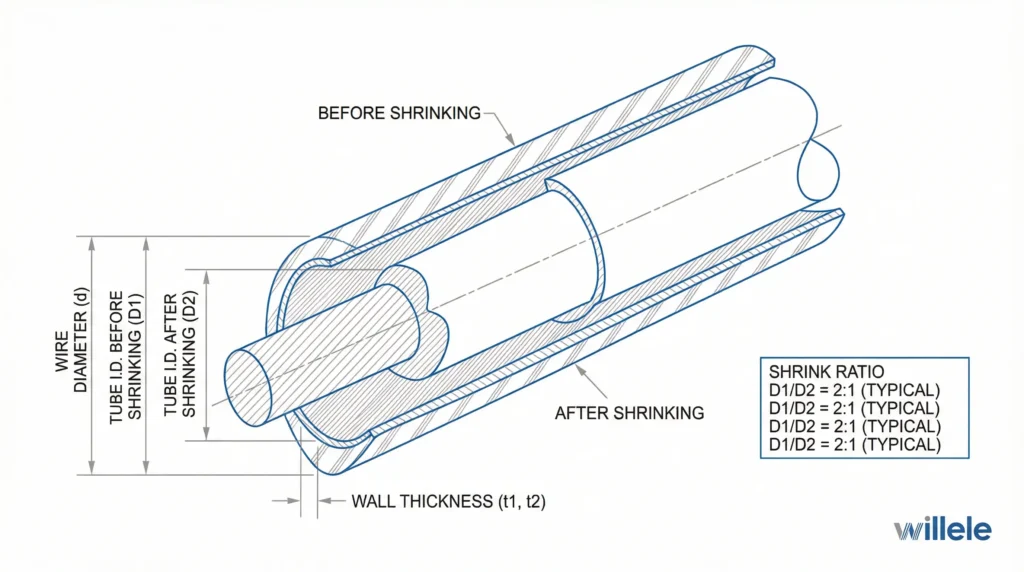
- As-Supplied ID (Internal Diameter): The expanded diameter of the tube as delivered. This determines the ease of installation.
- Recovered ID: The diameter of the tube after being heated and allowed to shrink freely. This determines the seal quality.
The Safety Margin Rule
Reliability lies in the margins. A common industry standard recommended by Willele engineers is the “20/20 Rule”:
- Clearance: The As-Supplied ID should be at least 20% larger than the component to ensure easy installation.
- Compression: The Recovered ID should be at least 20% smaller than the wire diameter to ensure a tight, void-free grip.
Decoding Shrink Ratios for Specific Applications
The shrink ratio dictates the versatility of the tubing. While a higher ratio offers more flexibility, it often comes at a higher cost. Aligning the ratio with your application is key to cost-effective manufacturing.
| Application Scenario | Recommended Ratio | Why? |
|---|---|---|
| Uniform Wire Runs | 2:1 | Most economical. Ideal for consistent wire diameters where no large connectors are involved. |
| Connector Sealing | 3:1 | Provides clearance to pass over terminals while shrinking tight enough to seal the wire jacket behind them. |
| Cable Repair & Retrofit | 4:1 | Essential when repairing damaged jacketing on cables with large pre-installed connectors. |
| High-Vibration Zones | Dual-Wall (3:1 or 4:1) | The adhesive lining requires a higher shrink force to fill voids effectively. |
The 3-Step Sizing Protocol
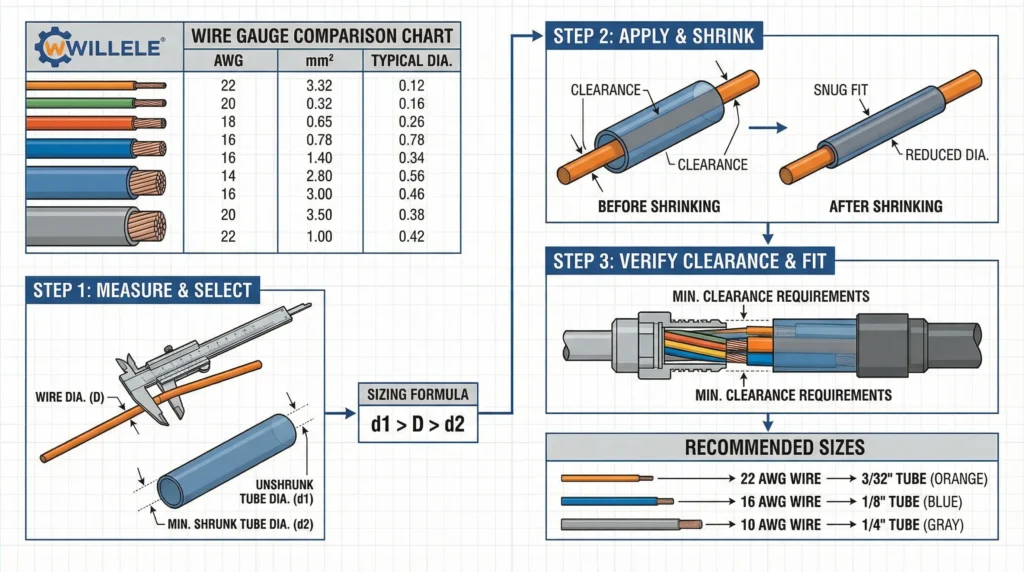
To answer “how to choose the right size heat shrink tubing for your wire” accurately, follow this measurement protocol before ordering.
Step 1: Define the Substrate Geometry
Measure the diameter of the bare wire or cable jacket (D-substrate) and the largest component the tube must slide over, such as a lug or plug (D-clearance).
Step 2: Calculate Required Supplied ID
- Formula: D-clearance × 1.20 = Minimum Supplied ID.
- Example: If your connector is 10mm wide, you need a supplied ID of at least 12mm.
Step 3: Calculate Maximum Recovered ID
- Formula: D-substrate × 0.80 = Maximum Recovered ID.
- Example: If your wire is 5mm wide, the tube’s recovered ID must be 4mm or smaller to grip it tight.
Reference Table: Metric & Imperial Sizing Guide
This table helps convert standard wire sizes to recommended tubing dimensions based on the safety margins discussed.
| Wire Size (AWG) | Wire Diameter (mm) | Min. Supplied ID (mm) | Max. Recovered ID (mm) | Recommended Size (inch) |
|---|---|---|---|---|
| 20 – 18 AWG | 0.8 – 1.0 | 1.2 | 0.6 | 1/16″ or 3/32″ |
| 16 – 14 AWG | 1.3 – 1.6 | 2.0 | 1.0 | 1/8″ |
| 12 – 10 AWG | 2.0 – 2.6 | 3.2 | 1.6 | 3/16″ or 1/4″ |
| 8 AWG | 3.3 | 4.0 | 2.6 | 1/4″ |
| 6 – 4 AWG | 4.1 – 5.2 | 6.4 | 3.3 | 3/8″ or 1/2″ |
| 2 – 1/0 AWG | 6.5 – 8.3 | 9.5 | 5.2 | 3/4″ |
Advanced Engineering Considerations
Longitudinal Shortening
Engineers often overlook that tubing shrinks lengthwise (typically 5-7%). For precise harnessing, calculate this loss. If you need 50mm of coverage, cut the tube to approximately 54mm.
Wall Thickness & Dielectric Strength
As the tube shrinks, the wall thickness increases. This is beneficial for electrical isolation.
- Thin Wall: Flexible, space-saving. Good for control panels.
- Medium/Heavy Wall: Enhanced abrasion resistance. Ideal for direct-bury or exposed machinery.
FAQ: Solving Common Application Challenges
Q1: Does the storage environment affect sizing?
Yes. Heat shrink tubing should be stored below 30°C (86°F). Extended exposure to heat during storage can cause partial pre-recovery, reducing the supplied diameter and making it difficult to fit over wires.
Q2: How do I size tubing for a square bar or rectangular busbar?
Calculate the perimeter of the rectangular object. The supplied circumference of the tubing (ID × π) must be at least 20% larger than the object’s perimeter to fit over the corners.
Q3: Does printing or text on the tube distort when shrunk?
Yes. Because the tube shrinks diameter-wise but not much lengthwise, text will condense vertically. Willele Electric offers pre-shrunk printing simulation to ensure legibility after recovery.
Q4: Can I overlap multiple layers of tubing?
Absolutely. This is common for building up diameter or adding extra stiffness. Ensure the outer tube’s recovered ID is smaller than the inner tube’s recovered OD.
Q5: What is the impact of color on sizing?
Standard colors (Black, Red, Blue) generally have identical shrink characteristics. However, clear tubing often has slightly different material properties and may have different longitudinal shrinkage rates. Always check the Willele spec sheet.
Partner with Willele Electric
Choosing the right size is just the beginning. Willele Electric provides comprehensive support for B2B partners, including custom cutting, printing, and material selection for extreme environments.
Ensure your projects meet global safety standards by sourcing your heat shrink tubing from a trusted manufacturer. Contact our technical team today to discuss your specifications.
