
Integrating Junction Boxes in Smart Home Automation Systems

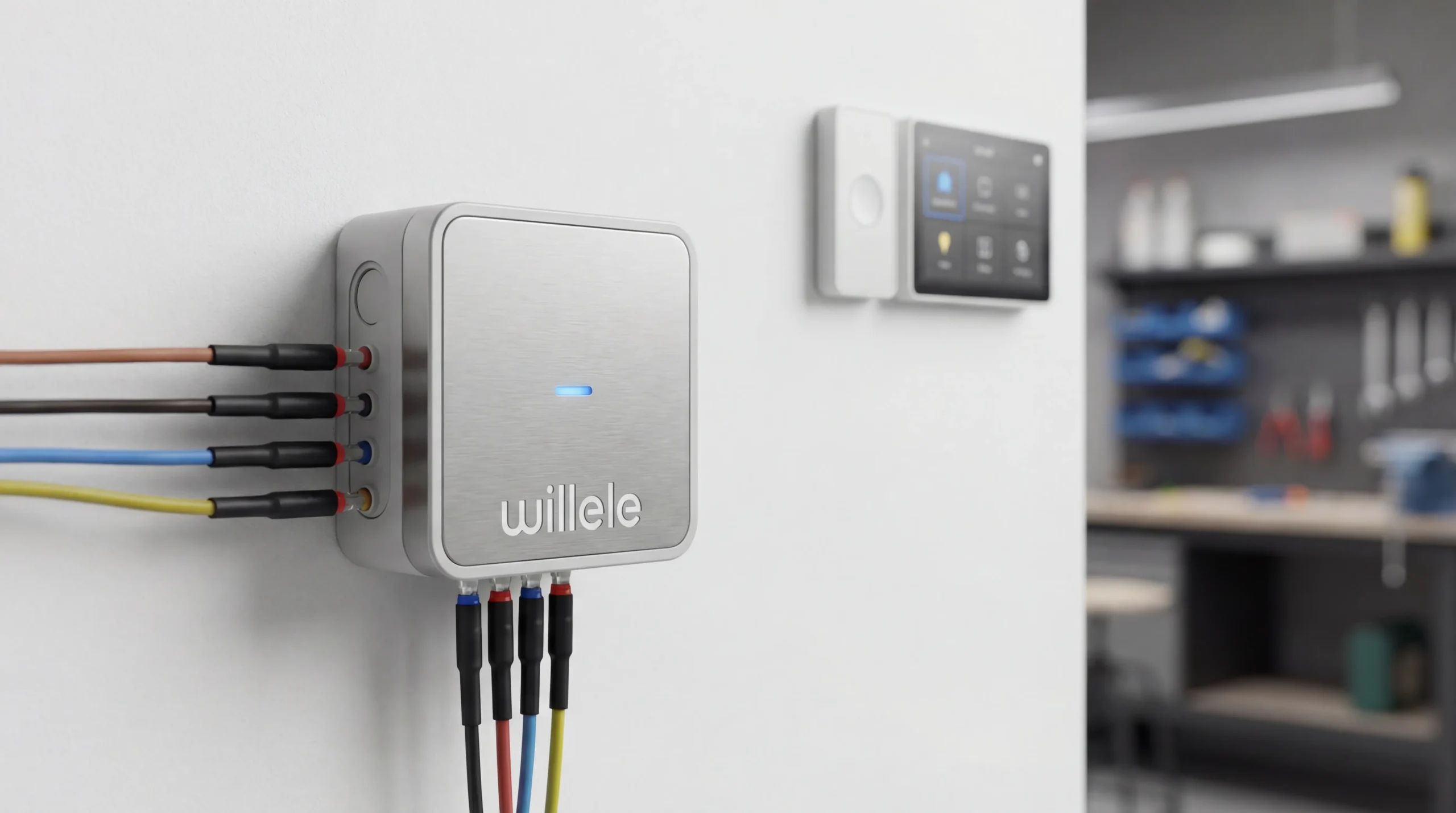
The rapid evolution of residential technology has shifted the focus from simple electrical wiring to complex, data-driven ecosystems. For electrical contractors and system integrators, integrating junction boxes in smart home automation systems is no longer just about connecting wires; it is about creating a robust infrastructure that supports the Internet of Things (IoT).
At Willele Electric, we understand that the reliability of a smart home depends heavily on the quality of its foundational components. From high-grade junction boxes to precision-engineered heat shrink tubes, the hidden hardware determines the longevity and safety of the visible technology.
The Critical Role of Junction Boxes in Modern Automation
In traditional electrical setups, junction boxes served a singular purpose: to house wire splices and protect against electric shock. In the era of smart home automation, their role has expanded significantly. They now act as decentralized hubs for sensors, actuators, and smart relays.
Proper integration ensures signal integrity, thermal management, and accessibility for future upgrades. A poorly planned junction box layout can lead to signal interference—a critical failure point for wireless smart devices—and make troubleshooting a nightmare for integrators.
Types of Junction Boxes for Smart Systems
Selecting the right enclosure is the first step in successful integration. Unlike standard wiring, smart home systems often require boxes that can accommodate larger devices (like Shelly or Sonoff relays) and mitigate interference.
Material Considerations: Metal vs. Non-Metallic
The choice of material impacts both durability and connectivity.
| Feature | Metal Junction Boxes | Non-Metallic (PVC/Polycarbonate) |
|---|---|---|
| Durability | Extremely High (Fire resistant) | High (Impact resistant) |
| Signal Transmission | Blocks RF/WiFi signals (Faraday cage effect) | Allows RF/WiFi signals to pass through |
| Grounding | Requires bonding/grounding | No grounding of box required |
| Best Application | Hardwired control panels, high-voltage splices | Wireless smart relays, WiFi-enabled modules |
Size and Depth
Smart home modules often require “deep” boxes (typically 2.5 inches or deeper) to accommodate the added bulk of smart switches and the associated neutral wires required for automation.
Strategic Integration Methods
When integrating junction boxes in smart home automation systems, integrators typically employ one of two strategies: centralized or decentralized.
1. Decentralized (Point-of-Use) Integration
This involves installing smart modules directly behind switches or outlets in standard junction boxes.
- Pros: easier retrofit, less wire consumption.
- Cons: Space constraints, potential for overcrowding (box fill violations), heat buildup.
2. Centralized (Star Topology) Integration
All circuits run back to a large, central junction enclosure or panel.
- Pros: Easy maintenance, superior thermal management, clean aesthetics in living spaces.
- Cons: Higher wire costs, labor-intensive installation.
Comparison: Traditional vs. Smart Integration
| Parameter | Traditional Wiring | Smart Home Integration |
|---|---|---|
| Wire Volume | Low (Hot, Neutral, Ground) | High (Includes Data, Low-voltage, Redundant Neutrals) |
| Heat Dissipation | Minimal concern | Critical (Smart dimmers/relays generate heat) |
| Labeling | Basic Circuit ID | Detailed (Device ID, IP, Protocol) |
| Connections | Wire nuts/Wagos | DIN Rail terminals, Heat Shrink protection |
The Willele Advantage: Heat Shrink Tubes in Automation
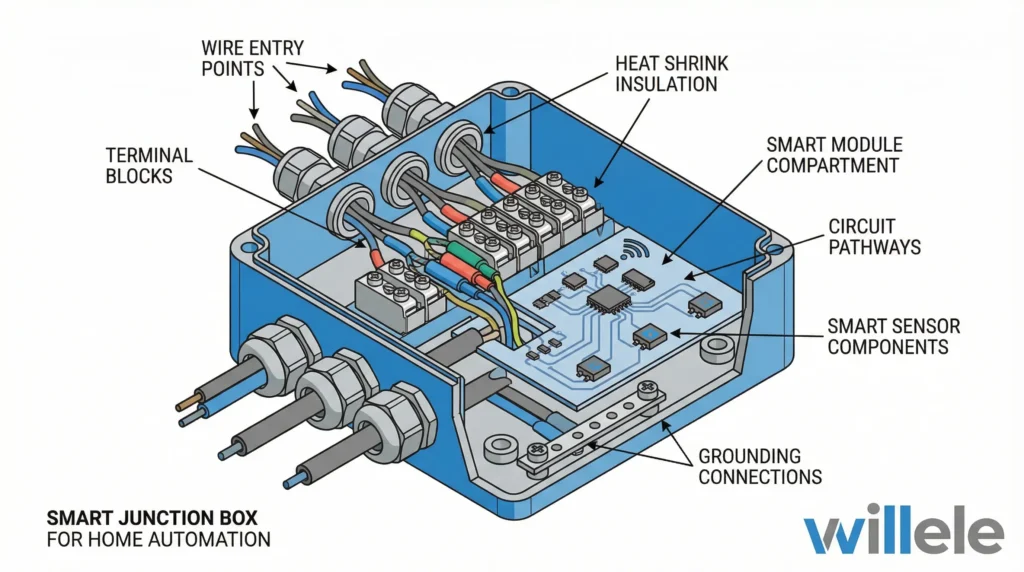
One of the most overlooked aspects of integrating junction boxes in smart home automation systems is the quality of wire termination and insulation. Smart homes rely on hundreds of connections; a single loose or corroded wire can disrupt an entire automation sequence.
This is where Willele’s expertise in heat shrink technology becomes essential.
Applications of Heat Shrink Tubes
- Insulation & Safety: Smart modules often crowd junction boxes. Using high-quality heat shrink tubing prevents accidental short circuits between bare wires and PCB components.
- Strain Relief: Automation wires are frequently moved during maintenance. Heat shrink provides mechanical strength at the connection point.
- Identification: Color-coded heat shrink tubes are vital for distinguishing between high-voltage lines (110V/220V) and low-voltage control wires (12V/24V) within the same enclosure.
Heat Shrink Specifications for Integrators
| Tube Type | Shrink Ratio | Primary Application | Willele Recommendation |
|---|---|---|---|
| Single Wall Polyolefin | 2:1 | General insulation, wire bundling | Standard internal wiring |
| Dual Wall (Adhesive Lined) | 3:1 or 4:1 | Moisture sealing, sensor connections | Outdoor/Basement J-boxes |
| Identification Sleeves | 2:1 | Labeling complex control circuits | Panel organization |
Installation Best Practices
To ensure a professional grade installation that meets code and performance standards, follow these guidelines:
1. Adhere strictly to Box Fill Calculations
Smart devices take up volume. The National Electrical Code (NEC) dictates the maximum volume of conductors and devices in a box. Always oversize the junction box when anticipating smart integration to allow for heat dissipation and ease of maintenance.
2. Separate High and Low Voltage
Interference is the enemy of automation. If a junction box must house both high voltage (power) and low voltage (data/signal), use a box with a built-in partition or barrier. Never run Cat6 cable parallel to Romex without shielding, as induction can corrupt data signals.
3. Thermal Management
Smart dimmers and power supplies generate heat. Ensure the junction box is not installed in an area with existing high ambient temperature (like directly above a heating vent). For centralized panels, consider vented covers.
4. Professional Wire Management
Use Willele heat shrink tubes to bundle related wires. This not only looks professional but prevents “spaghetti wiring” that makes future servicing dangerous and difficult.
Future Trends in Junction Box Integration
As the industry moves toward Matter and Thread protocols, the physical infrastructure is evolving.
- Hybrid Enclosures: We are seeing a rise in junction boxes designed specifically with compartments for IoT modules, featuring transparent fronts for status LED visibility without opening the box.
- DIN Rail Integration: Residential junction boxes are increasingly adopting industrial DIN rail standards, allowing for snap-in mounting of smart relays and terminal blocks, a standard Willele supports with compatible accessories.
- Pre-Wired Solutions: Manufacturers are beginning to offer “smart-ready” junction boxes pre-fitted with pigtails and heat shrink connectors to reduce installation time.
Frequently Asked Questions (FAQ)
1. Can I use metal junction boxes for WiFi smart switches?
It is generally not recommended. Metal boxes act as a Faraday cage and can significantly block or weaken WiFi and Z-Wave signals. For wireless devices, use PVC or non-metallic boxes. If metal is required by code, use an external antenna or a hardwired control solution.
2. How do I calculate box fill when adding a smart relay?
You must account for the volume of the relay device in addition to the wires and wire nuts. A standard rule of thumb is to treat a smart module as equivalent to two internal conductor volume allowances, but always check the manufacturer’s spec sheet and local NEC guidelines.
3. Why is heat shrink tubing preferred over electrical tape in smart panels?
Electrical tape can degrade over time, especially in environments with fluctuating temperatures common in attics or basements where junction boxes are located. Willele heat shrink tubes provide a permanent, moisture-resistant seal that does not unravel, ensuring long-term system reliability.
4. Is it safe to mix 12V and 120V in the same junction box?
Only if the insulation rating of the low-voltage wire is equal to or greater than the maximum voltage present (e.g., the 12V wire must be rated for 600V if sharing a box with 120V). Additionally, physical separation or a barrier is highly recommended to prevent interference.
5. What is the best way to label wires in a crowded smart junction box?
Using printable heat shrink marker sleeves is the industry standard. Unlike stick-on flags that can fall off, heat shrink markers are permanent and remain legible, which is crucial for complex automation systems.
Willele Electric provides high-quality solutions for industrial and residential electrical integration. For more information on our range of heat shrink tubes and electrical equipment, visit our product catalog.
