
Junction Box Solutions for Commercial Signage and Billboards

Commercial signage and billboard installations demand robust electrical infrastructure that can withstand harsh environmental conditions while maintaining reliable performance. At the heart of these systems lies a critical component often overlooked: the junction box. As outdoor advertising continues to evolve with LED technology and digital displays, the role of properly engineered junction box solutions has never been more important.
Junction boxes serve as the nerve center for electrical connections in commercial signage applications, protecting sensitive wiring from moisture, dust, temperature extremes, and physical damage. For B2B electrical equipment manufacturers and installation contractors, selecting the right junction box solution directly impacts system longevity, maintenance costs, and overall safety compliance.
Understanding Junction Box Requirements for Outdoor Signage
Commercial signage installations face unique challenges that residential or indoor applications never encounter. Billboard structures sit exposed to direct sunlight, driving rain, snow accumulation, and temperature swings that can range from -40°F to 140°F in extreme climates. These conditions place extraordinary demands on electrical enclosures.
The primary function of a junction box in signage applications extends beyond simple wire connection. These enclosures must provide environmental sealing, facilitate thermal management, accommodate multiple cable entries, and allow for future maintenance access—all while maintaining electrical code compliance. Modern LED signage adds another layer of complexity, as these systems often require power distribution to multiple zones, dimming controls, and data signal management within the same enclosure.
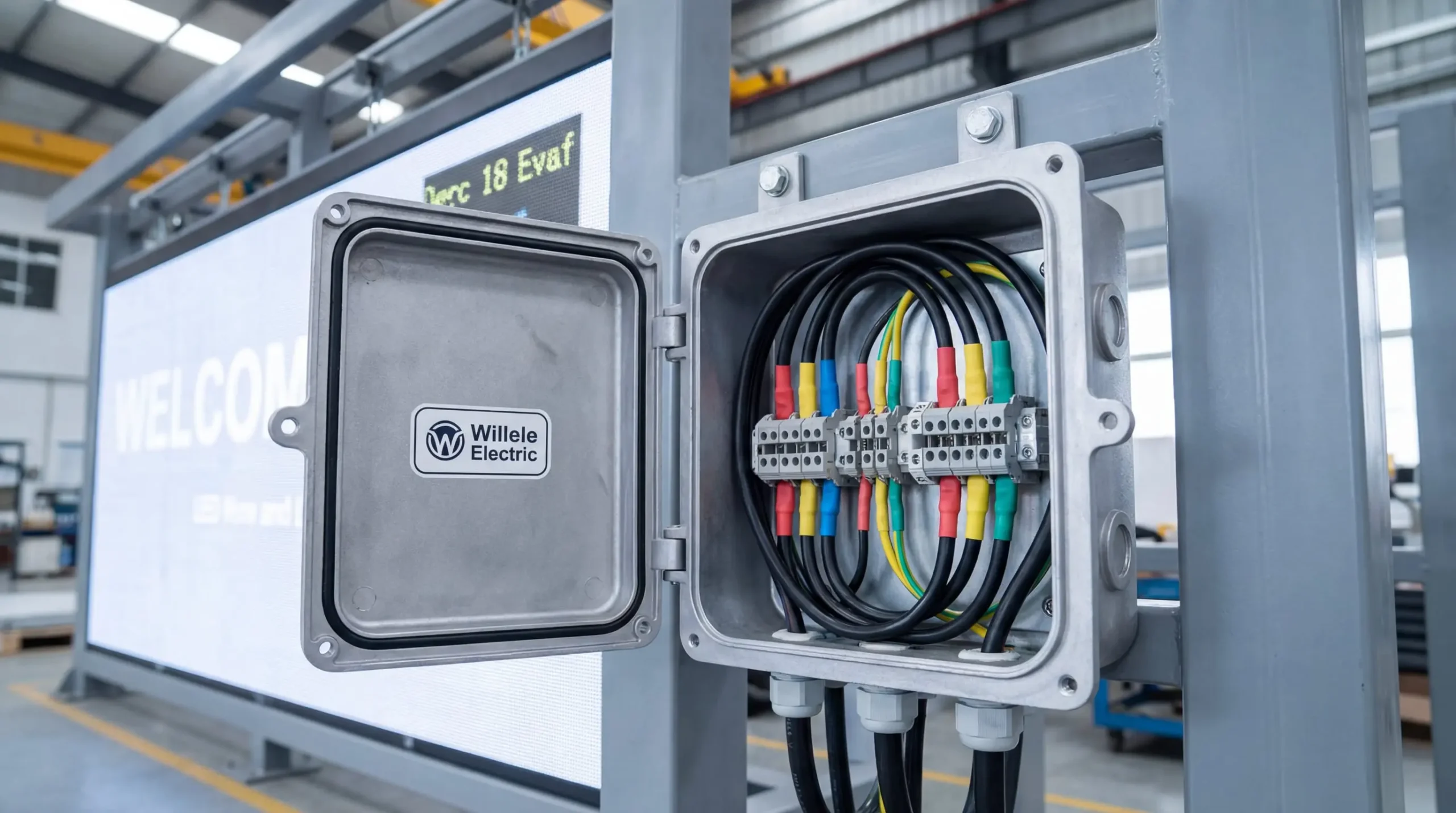
Professional installation of a Willele junction box for commercial LED signage, featuring integrated heat shrink tube protection for enhanced connection reliability
Material selection proves critical in outdoor environments. Standard steel enclosures may corrode within months when exposed to coastal salt air or industrial pollutants. Aluminum offers better corrosion resistance but requires proper grounding considerations. Polycarbonate and fiberglass-reinforced polyester provide excellent weather resistance and electrical insulation but may degrade under prolonged UV exposure without proper additives.
IP Rating Requirements and Environmental Protection
The Ingress Protection (IP) rating system provides standardized classification for enclosure protection against solid objects and liquids. For commercial signage applications, understanding these ratings is essential for proper specification.
| IP Rating | Solid Particle Protection | Liquid Protection | Typical Signage Application |
|---|---|---|---|
| IP54 | Protected against dust | Protected against water spray | Indoor signage, covered outdoor locations |
| IP65 | Dust-tight | Protected against water jets | Standard outdoor billboards, general signage |
| IP66 | Dust-tight | Protected against powerful water jets | High-exposure locations, coastal installations |
| IP67 | Dust-tight | Protected against temporary immersion | Ground-level signage, flood-prone areas |
| IP68 | Dust-tight | Protected against continuous immersion | Below-grade installations, extreme weather zones |
For most commercial billboard applications, IP65 represents the minimum acceptable standard. This rating ensures complete dust protection and guards against water jets from any direction—critical for locations exposed to wind-driven rain or pressure washing during maintenance. High-traffic urban environments or coastal installations often warrant IP66 or IP67 ratings to account for more severe exposure conditions.
The gasket system within the junction box plays a crucial role in maintaining IP ratings over time. Silicone and EPDM rubber gaskets offer excellent weather resistance and maintain flexibility across wide temperature ranges. However, gasket compression and UV degradation can compromise sealing effectiveness after several years. Quality junction box solutions incorporate replaceable gasket systems and multiple sealing barriers to ensure long-term protection.
Cable Management and Heat Shrink Tube Integration
Proper cable management within junction boxes directly impacts system reliability and maintenance efficiency. Commercial signage installations typically involve multiple cable types: main power feeds, branch circuits to individual LED modules, control signals, and grounding conductors. Without organized termination and routing, troubleshooting becomes time-consuming and connection integrity suffers.
Heat shrink tube technology has revolutionized connection protection in outdoor electrical applications. Unlike traditional electrical tape or wire nuts, heat shrink tubing provides a permanent, moisture-proof seal around wire connections and terminations. When properly applied, heat shrink creates a protective barrier that prevents corrosion, resists vibration, and maintains insulation integrity even under extreme conditions.
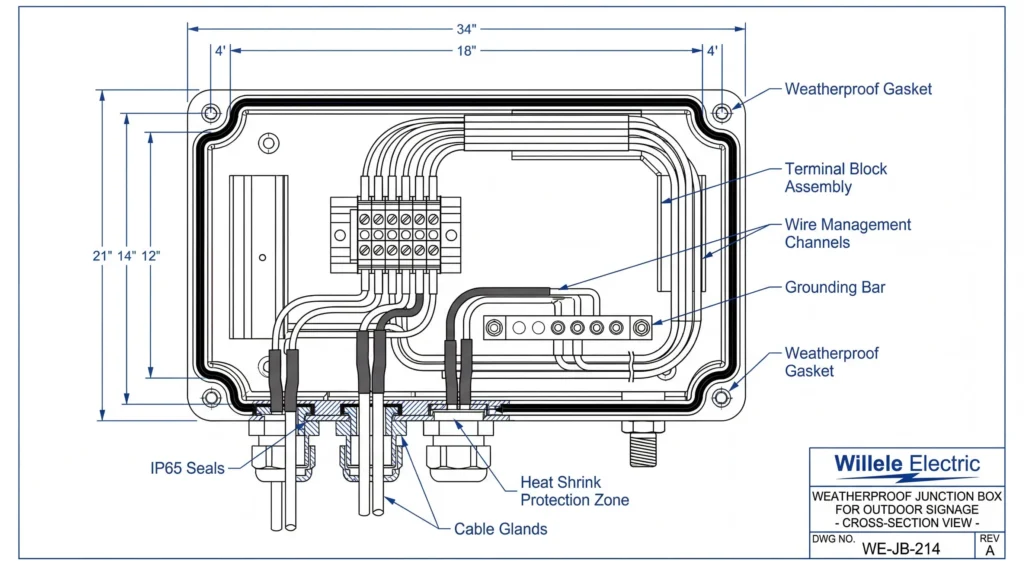
Detailed technical drawing illustrating the internal architecture of a Willele junction box with integrated heat shrink tube protection system
Willele Electric specializes in junction box solutions that integrate seamlessly with heat shrink tube protection systems. Our enclosures feature dedicated heat shrink application zones that provide adequate clearance for proper tube installation and heat gun access during field assembly. Internal mounting rails accommodate both traditional terminal blocks and heat shrink-protected splice connections, offering installation flexibility while maintaining organized wire routing.
The synergy between quality junction boxes and heat shrink protection becomes particularly evident in high-vibration environments. Billboard structures experience constant movement from wind loading, and this mechanical stress can gradually loosen traditional wire connections. Heat shrink tubing adds mechanical reinforcement to splices and terminations, effectively distributing stress and preventing connection failure. For LED signage applications where individual module failures create visible dark spots, this added reliability translates directly to reduced maintenance costs and improved customer satisfaction.
Thermal Management Considerations
LED technology has transformed commercial signage, offering superior brightness, energy efficiency, and longevity compared to traditional lighting. However, LED drivers and power supplies generate significant heat, and this thermal energy must be managed effectively within junction box enclosures.
Heat accumulation inside a sealed junction box can dramatically reduce component lifespan. LED drivers typically operate optimally below 140°F (60°C), with performance degrading and failure rates increasing at higher temperatures. In direct sunlight, a sealed metal enclosure can easily exceed 160°F (71°C) internally, creating conditions that accelerate component failure.
| Thermal Management Strategy | Benefits | Considerations | Best Applications |
|---|---|---|---|
| Passive ventilation (louvered design) | No moving parts, low cost | Reduces IP rating, allows dust entry | Covered locations, mild climates |
| Heat sink integration | Effective heat dissipation, maintains IP rating | Increases enclosure size and cost | High-power LED installations |
| Reflective coatings | Reduces solar heat gain by 30-40% | Coating durability, aesthetics | Direct sun exposure, hot climates |
| Active cooling (fans) | Maximum heat removal | Requires power, moving parts fail | Extreme heat, high-density installations |
| Oversized enclosures | Increased air volume reduces temperature | Larger mounting footprint | Space-available applications |
Willele junction boxes incorporate thermal design principles that balance environmental protection with heat dissipation. Our enclosures feature internal mounting configurations that maintain air gaps around heat-generating components, promoting natural convection even in sealed designs. Aluminum construction provides excellent thermal conductivity, effectively spreading heat across the enclosure surface for radiation to the environment.
For high-power signage applications exceeding 1000W, thermal modeling becomes essential during the design phase. Junction box placement relative to LED arrays, internal component layout, and cable routing all influence thermal performance. Strategic use of heat shrink tubing with thermal management properties can also contribute to overall system cooling by improving heat transfer from conductors to the enclosure walls.
Sizing and Capacity Planning
Proper junction box sizing ensures adequate space for current connections while accommodating future expansion or modifications. Undersized enclosures lead to wire congestion, difficult maintenance access, and increased risk of connection failures. Oversized boxes waste materials and create unnecessarily large mounting footprints.
The National Electrical Code (NEC) provides specific requirements for box fill calculations based on conductor sizes, device counts, and connection methods. However, commercial signage applications often benefit from exceeding minimum code requirements to facilitate field installation and future servicing.
Junction Box Sizing Guidelines for LED Signage:
| Signage Size | Power Requirement | Recommended Box Size | Typical Cable Entries | Terminal Block Capacity |
|---|---|---|---|---|
| Small (under 50 sq ft) | Up to 500W | 8″ x 8″ x 4″ | 4-6 entries | 12-position |
| Medium (50-200 sq ft) | 500W – 2000W | 12″ x 12″ x 6″ | 6-10 entries | 24-position |
| Large (200-500 sq ft) | 2000W – 5000W | 16″ x 16″ x 8″ | 8-14 entries | 36-position |
| Billboard (over 500 sq ft) | Over 5000W | 20″ x 20″ x 10″ or multiple boxes | 12-20 entries | 48-position or multiple |
These guidelines assume LED technology with typical power densities of 8-12 watts per square foot for standard brightness applications. High-brightness installations or video-capable digital billboards may require larger enclosures or multiple junction points distributed across the structure.
Cable entry planning deserves particular attention during specification. Each power feed, branch circuit, and control cable requires a dedicated entry point with appropriate sealing. Liquid-tight conduit connectors or cable glands maintain IP ratings while accommodating various cable diameters. Quality junction boxes provide knockout patterns or pre-drilled entry points positioned to minimize internal wire crossing and facilitate organized routing.
Installation Best Practices and Code Compliance
Proper installation techniques determine whether a well-specified junction box delivers its intended performance. Even the highest-quality enclosure will fail prematurely if mounting, sealing, or wiring practices compromise its design integrity.
Mounting location significantly impacts junction box longevity and maintenance accessibility. Whenever possible, position enclosures on the rear or side of signage structures rather than top surfaces where water accumulation occurs. Orient enclosures with cable entries facing downward or sideways to prevent water intrusion even if sealing fails. Maintain adequate clearance around the enclosure for cover removal and service access—typically 18-24 inches on the opening side.
The mounting surface must provide solid support capable of withstanding wind loads and the weight of cables entering the box. Billboard structures often use steel I-beams or channel members as mounting surfaces. Through-bolting with lock washers provides more secure attachment than self-tapping screws, particularly in high-vibration environments. Stainless steel hardware resists corrosion and maintains clamping force over time.
Grounding and bonding requirements for commercial signage follow NEC Article 600, which mandates specific practices for electric signs and outline lighting. All metal junction boxes must be bonded to the equipment grounding system, and a separate grounding conductor must be provided to each enclosure. The junction box often serves as the grounding hub where multiple equipment grounds converge before connecting to the main grounding electrode system.
Heat shrink tube application within junction boxes requires attention to proper sizing and heating technique. Select tubing with a shrink ratio appropriate for the conductor bundle—typically 3:1 for general applications or 4:1 where greater size variation exists. Apply heat evenly using a heat gun with temperature control, moving continuously to avoid overheating any single area. Properly shrunk tubing should conform tightly to the conductor without gaps, wrinkles, or burned areas.
Maintenance Access and Serviceability
Commercial signage represents a significant capital investment, and ongoing maintenance costs directly impact total cost of ownership. Junction box design profoundly influences maintenance efficiency, affecting everything from routine inspections to emergency repairs.
Transparent or translucent covers allow visual inspection without opening the enclosure, enabling technicians to verify LED driver status lights or check for obvious problems like water intrusion or loose connections. However, UV-resistant polycarbonate covers may yellow over time, reducing visibility. Some designs incorporate small inspection windows in opaque covers as a compromise solution.
Internal organization systems—such as DIN rail mounting, cable management channels, and labeled terminal blocks—dramatically reduce troubleshooting time. When a technician can quickly identify which terminal connects to which LED zone, repair time drops from hours to minutes. Color-coded heat shrink tubing serves dual purposes: providing connection protection while creating a visual identification system that survives years of outdoor exposure.
Modular junction box designs offer particular advantages for large installations. Rather than routing all circuits through a single large enclosure, distributed junction points allow isolation of individual signage zones. This approach limits the scope of failures and enables partial system operation during repairs. Multiple smaller boxes also distribute weight and reduce mounting stress on support structures.
Comparing Junction Box Materials and Construction
Material selection for junction box construction involves balancing multiple factors: corrosion resistance, thermal properties, weight, cost, and electrical characteristics. No single material excels in all categories, making application-specific selection essential.
| Material | Corrosion Resistance | Thermal Conductivity | Weight | Cost | Best Applications |
|---|---|---|---|---|---|
| Powder-coated steel | Good (coating-dependent) | Moderate | Heavy | Low | Budget-conscious, mild environments |
| Stainless steel 304 | Excellent | Moderate | Heavy | High | Coastal, industrial, corrosive environments |
| Aluminum | Very good | Excellent | Light | Moderate | General outdoor, thermal management critical |
| Polycarbonate | Excellent | Poor | Light | Moderate | Corrosive environments, electrical isolation |
| Fiberglass (GRP) | Excellent | Poor | Moderate | Moderate-High | Chemical exposure, extreme environments |
Aluminum has emerged as the preferred material for commercial signage junction boxes due to its optimal balance of properties. The material’s natural oxide layer provides inherent corrosion protection, while its light weight simplifies installation on elevated structures. Excellent thermal conductivity helps dissipate heat from LED drivers and power supplies, extending component life. Aluminum’s electrical conductivity requires proper grounding but also provides electromagnetic shielding benefits for sensitive control circuits.
Willele Electric manufactures junction boxes using marine-grade aluminum alloys with additional protective treatments for extended service life. Our powder-coating process applies a durable finish that resists UV degradation, scratching, and chemical exposure while maintaining the underlying aluminum’s thermal properties. This multi-layer protection approach ensures reliable performance across diverse installation environments, from desert heat to coastal salt exposure.
Polycarbonate and fiberglass enclosures excel in highly corrosive environments where even stainless steel may degrade. Chemical plants, wastewater treatment facilities, and marine applications often specify non-metallic enclosures. However, these materials’ poor thermal conductivity makes them less suitable for high-power LED applications unless oversized to compensate for reduced heat dissipation.
Integration with Modern Digital Signage Systems
Digital billboards and programmable LED displays have transformed outdoor advertising, but they’ve also complicated electrical infrastructure requirements. Modern signage systems incorporate network connectivity, content management computers, environmental sensors, and sophisticated power management—all requiring accommodation within the electrical distribution system.
Junction boxes for digital signage must address several additional requirements beyond traditional static sign installations. Data cable management becomes critical, as Ethernet, fiber optic, or wireless communication links must be protected and properly segregated from power conductors. Many installations require separate junction boxes or compartmentalized enclosures that maintain physical separation between power and data systems.
Power quality and surge protection take on greater importance with digital displays. LED drivers and control computers are sensitive to voltage transients, and lightning strikes or utility switching events can destroy expensive components. Junction boxes increasingly incorporate surge protective device (SPD) mounting provisions, allowing transient voltage protection at the point of use. Heat shrink tubing with built-in strain relief helps protect sensitive control wiring from vibration and mechanical stress that could interrupt data signals.
Remote monitoring capabilities are becoming standard in commercial signage installations. Cellular or network-connected monitoring devices track power consumption, operating hours, and fault conditions, alerting maintenance teams to problems before complete failures occur. These monitoring systems require their own power supplies and communication links, adding to junction box complexity. Forward-thinking junction box designs include dedicated mounting provisions and cable entries for monitoring equipment, recognizing these systems as essential rather than afterthoughts.
Cost Analysis and Return on Investment
Junction box selection involves balancing initial equipment costs against long-term operational expenses. While premium enclosures command higher purchase prices, their superior durability and reduced maintenance requirements often deliver better total cost of ownership.
Consider a typical commercial billboard installation with an expected 15-year service life. A budget junction box might cost $150 versus $400 for a premium solution like those from Willele Electric. However, if the budget enclosure requires replacement after 7 years due to corrosion or seal failure, the total equipment cost reaches $300 plus installation labor for the replacement. More significantly, the failure may cause LED driver damage ($500-1000) and require emergency service calls ($200-500 per visit).
Premium junction boxes with integrated heat shrink tube protection systems reduce connection failures by approximately 60-80% compared to traditional wire nut connections in outdoor environments. For a large billboard with 50 LED zones, preventing even two or three zone failures annually saves $1000-2000 in service calls and component replacements. Over a 15-year installation life, this difference can amount to $15,000-30,000 in avoided costs—far exceeding the initial premium for quality enclosures.
Energy efficiency considerations also factor into the cost equation. Junction boxes with superior thermal management keep LED drivers operating at optimal temperatures, where they deliver maximum efficiency. A 5% efficiency improvement across a 3000W signage installation saves approximately 150W continuously, or 1,314 kWh annually. At typical commercial electricity rates of $0.12-0.15 per kWh, this translates to $160-200 in annual savings, recovering the premium for a thermally-optimized junction box within 2-3 years.
Environmental Sustainability and Compliance
Sustainability concerns are reshaping electrical equipment manufacturing, and junction boxes are no exception. B2B buyers increasingly evaluate products based on environmental impact, recyclability, and compliance with international environmental standards.
Aluminum junction boxes offer inherent sustainability advantages. Aluminum is infinitely recyclable without quality degradation, and recycled aluminum production requires only 5% of the energy needed to produce primary aluminum from ore. At end of life, aluminum enclosures retain significant scrap value, providing economic incentive for proper recycling rather than landfill disposal.
Heat shrink tube technology contributes to sustainability by extending connection life and reducing maintenance-related waste. Traditional connection methods using electrical tape or wire nuts often fail in outdoor environments, requiring replacement of not just the connection materials but potentially the damaged conductors as well. Heat shrink protection prevents these failures, reducing material waste and the environmental impact of service vehicle trips for repairs.
Regulatory compliance extends beyond electrical codes to environmental standards. RoHS (Restriction of Hazardous Substances) compliance ensures junction boxes and associated components don’t contain lead, mercury, cadmium, or other restricted materials. REACH (Registration, Evaluation, Authorization, and Restriction of Chemicals) regulations in Europe impose similar requirements. Willele Electric maintains full compliance with these standards, providing documentation and material declarations that facilitate our customers’ own compliance efforts.
Frequently Asked Questions
What IP rating do I need for a standard outdoor billboard?
For most commercial billboard applications, IP65 represents the minimum recommended rating. This provides complete dust protection and guards against water jets from any direction. Coastal installations, areas with severe weather, or locations subject to pressure washing should specify IP66 or IP67 for additional protection.
How does heat shrink tube protection improve junction box reliability?
Heat shrink tubing creates a permanent, moisture-proof seal around wire connections that prevents corrosion, resists vibration, and maintains insulation integrity. In outdoor signage applications, heat shrink protection reduces connection failures by 60-80% compared to traditional methods, significantly lowering maintenance costs over the installation’s lifetime.
Can I use a standard electrical junction box for LED signage?
Standard residential or light commercial junction boxes typically lack the environmental protection, thermal management, and capacity needed for commercial signage. LED signage requires weatherproof enclosures with appropriate IP ratings, adequate space for multiple connections, and thermal design that prevents heat-related component failures.
What size junction box do I need for my signage installation?
Junction box sizing depends on total power requirements, number of LED zones, and cable entry needs. As a general guideline, installations under 500W typically use 8″x8″x4″ boxes, 500-2000W installations need 12″x12″x6″ boxes, and larger installations require 16″x16″x8″ or multiple distributed junction points. Always exceed minimum NEC requirements to facilitate installation and future maintenance.
How often should junction boxes be inspected?
Annual inspections are recommended for most commercial signage installations. Check gasket condition, verify all connections remain tight, look for signs of water intrusion or corrosion, and confirm proper grounding. High-exposure locations or critical installations may warrant semi-annual inspections.
What’s the expected lifespan of a quality junction box?
Premium junction boxes manufactured from marine-grade aluminum with proper protective coatings typically last 15-25 years in outdoor signage applications. Lifespan depends on environmental exposure, installation quality, and maintenance practices. Gaskets may require replacement every 7-10 years to maintain optimal sealing.
Conclusion
Junction box selection represents a critical decision in commercial signage and billboard installations, with implications extending far beyond the initial equipment cost. Properly engineered enclosures protect expensive LED components, reduce maintenance requirements, ensure code compliance, and deliver reliable performance across diverse environmental conditions.
The integration of heat shrink tube protection within junction box systems has emerged as a best practice for outdoor electrical connections, providing superior moisture protection and mechanical reinforcement compared to traditional methods. As LED technology continues advancing and digital signage becomes increasingly sophisticated, junction box solutions must evolve to accommodate higher power densities, thermal management challenges, and integrated monitoring systems.
Willele Electric specializes in junction box solutions engineered specifically for the demanding requirements of commercial signage applications. Our products combine marine-grade aluminum construction, thermal optimization, and seamless integration with heat shrink tube protection systems to deliver maximum reliability and longevity. By partnering with experienced manufacturers who understand the unique challenges of outdoor signage electrical infrastructure, contractors and sign companies can ensure their installations deliver years of trouble-free operation while minimizing total cost of ownership.
For B2B customers seeking junction box solutions that combine proven reliability with innovative thermal and connection protection technologies, Willele Electric offers the expertise and product quality that commercial signage installations demand. Contact our technical team to discuss your specific application requirements and discover how our junction box solutions can enhance your next project’s performance and profitability.
