
Landscape Lighting Applications: Why Waterproof Wire Nuts Matter

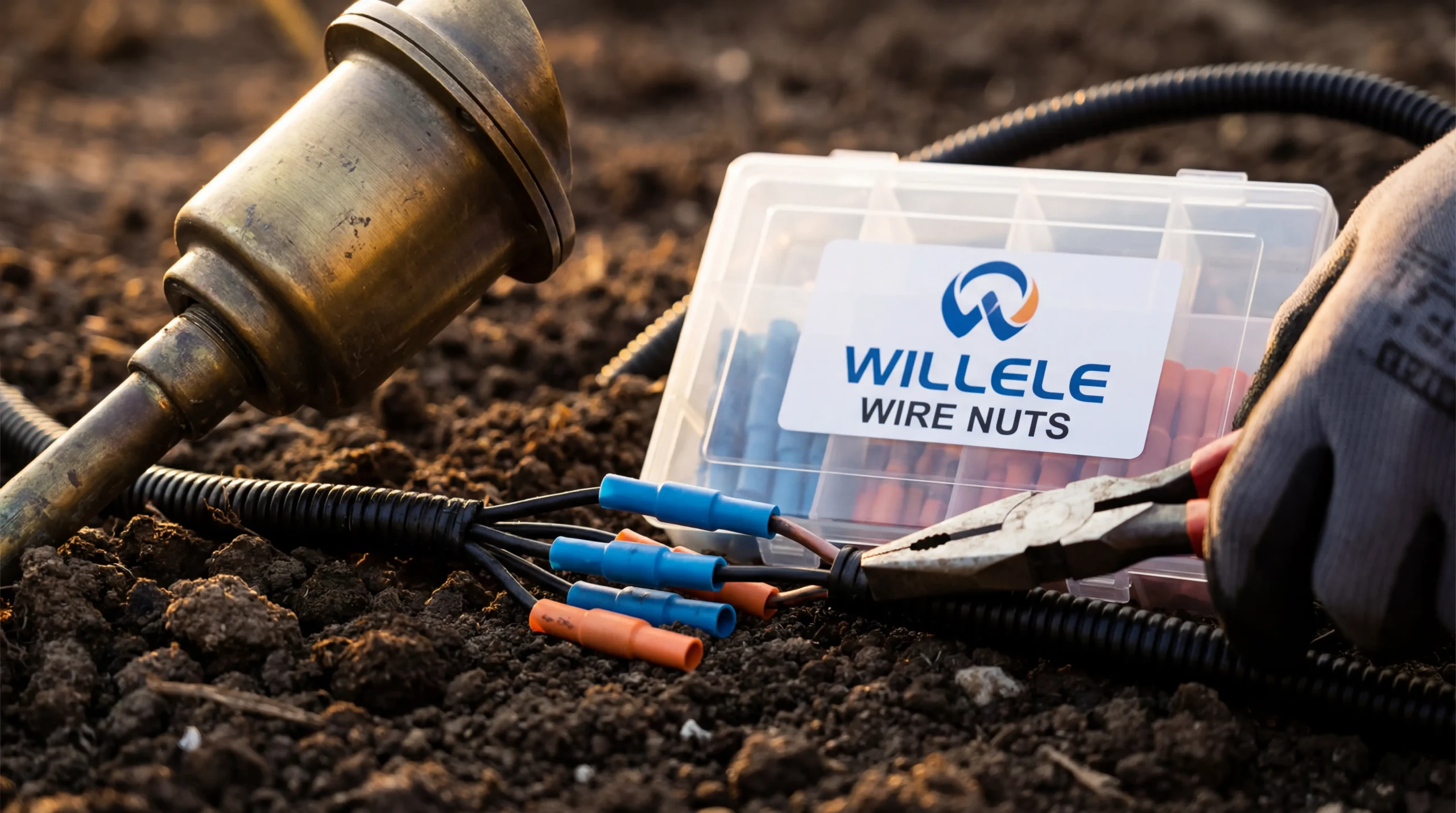
Landscape lighting transforms outdoor spaces into stunning nighttime showcases while enhancing security and functionality. However, the beauty and reliability of these systems depend heavily on one often-overlooked component: waterproof wire nuts. As a leading B2B manufacturer specializing in heat shrink tubes and electrical connection solutions, Willele Electric understands that proper wire connections are the foundation of durable landscape lighting installations.
Understanding Waterproof Wire Nuts in Outdoor Lighting
Waterproof wire nuts are specialized electrical connectors designed to create secure, moisture-resistant connections between wires in outdoor environments. Unlike standard wire nuts used in indoor applications, waterproof variants incorporate advanced sealing technologies—including heat shrink tubing, silicone sealants, and gel-filled chambers—to protect connections from water infiltration, corrosion, and environmental degradation.
The Critical Role in Landscape Lighting Systems
Landscape lighting systems face unique challenges that indoor electrical installations never encounter:
- Constant moisture exposure from rain, irrigation systems, and ground humidity
- Temperature fluctuations ranging from freezing winters to scorching summers
- Soil contact exposing connections to corrosive minerals and microorganisms
- UV radiation degrading standard insulation materials over time
- Physical stress from ground settlement, landscaping activities, and wildlife
Each of these factors can compromise wire connections, leading to system failures, safety hazards, and costly repairs. Waterproof wire nuts serve as the first line of defense against these environmental threats.
Alt text: Willele brand waterproof wire nuts and heat shrink connectors for landscape lighting applications in industrial photography style
Technical Specifications: What Makes Them Waterproof
The effectiveness of waterproof wire nuts lies in their multi-layer protection system. Understanding these technical features helps electrical contractors and landscape professionals select the right products for specific applications.
Construction Components
Outer Heat Shrink Layer: The exterior heat shrink tubing provides the primary waterproof barrier. When heated, this specialized polymer shrinks tightly around the connection, creating a seamless seal that prevents water ingress. Willele Electric’s heat shrink tubes utilize cross-linked polyolefin materials with shrink ratios of 3:1 or 4:1, ensuring complete coverage even on irregular connection profiles.
Internal Wire Spring: High-quality copper or phosphor bronze springs maintain constant pressure on wire connections, preventing loosening due to thermal expansion and contraction cycles.
Silicone Sealant or Gel: Many premium waterproof wire nuts incorporate silicone-based sealants or dielectric gels that fill microscopic gaps, providing secondary moisture protection and preventing corrosion at the molecular level.
Insulation Rating: Professional-grade waterproof wire nuts carry voltage ratings from 600V to 1000V, with temperature tolerances ranging from -40°F to 221°F (-40°C to 105°C).
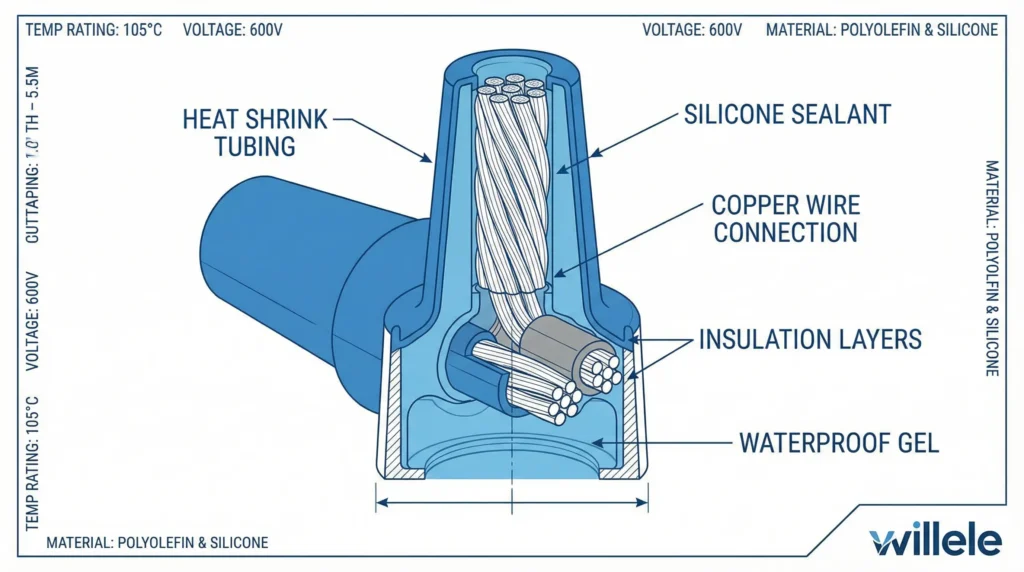
Alt text: Willele technical diagram showing cross-section of waterproof wire connector with heat shrink tubing and internal sealing components
Comparison: Waterproof vs. Standard Wire Nuts
| Feature | Standard Wire Nuts | Waterproof Wire Nuts | Impact on Landscape Lighting |
|---|---|---|---|
| Moisture Resistance | None to minimal | IP67-IP68 rated | Prevents short circuits and corrosion in wet conditions |
| Seal Type | Threaded plastic cap only | Heat shrink + gel/silicone | Complete environmental protection |
| Lifespan (Outdoor) | 1-3 years | 10-25+ years | Reduces maintenance costs by 70-80% |
| Temperature Range | 32°F to 176°F | -40°F to 221°F | Reliable operation in extreme climates |
| UV Resistance | Poor (degrades rapidly) | Excellent (UV-stabilized) | Maintains integrity under sun exposure |
| Corrosion Protection | Minimal | Advanced (sealed environment) | Prevents connection degradation |
| Installation Time | 30 seconds | 2-3 minutes | Slightly longer but saves long-term service calls |
| Cost per Unit | $0.10-$0.30 | $0.50-$2.00 | Higher upfront cost, lower total ownership cost |
| Vibration Resistance | Moderate | Excellent | Maintains connections near pathways and driveways |
| Chemical Resistance | Poor | Good to excellent | Withstands fertilizers and soil treatments |
Application-Specific Considerations
Low-Voltage Landscape Lighting (12V-24V Systems)
Most residential and commercial landscape lighting operates on low-voltage systems, typically 12V or 24V. While lower voltage reduces shock hazards, moisture infiltration remains problematic:
Wire Gauge Compatibility: Landscape lighting typically uses 12 AWG to 16 AWG wire. Waterproof wire nuts must accommodate these gauges while maintaining proper contact pressure. Willele Electric manufactures connectors specifically sized for common landscape lighting wire combinations.
Voltage Drop Prevention: Poor connections contribute significantly to voltage drop in low-voltage systems. Waterproof wire nuts with superior conductivity minimize resistance, ensuring lights at the end of runs receive adequate power.
Burial Depth Requirements: Direct-burial connections require IP68-rated waterproof wire nuts capable of withstanding submersion. These applications demand gel-filled connectors with complete hermetic sealing.
LED vs. Halogen Considerations
The shift from halogen to LED landscape lighting has changed connection requirements:
Heat Generation: While LEDs produce less heat than halogens, transformer connections and high-density LED arrays still generate significant warmth. Waterproof wire nuts must dissipate heat without compromising the seal.
Surge Sensitivity: LED drivers are more sensitive to voltage fluctuations caused by poor connections. High-quality waterproof wire nuts maintain stable connections, protecting expensive LED components.
Dimming Compatibility: Many modern landscape lighting systems incorporate dimming. Waterproof connections must maintain low resistance to ensure smooth dimming performance without flickering.
Installation Best Practices
Proper installation maximizes the protective benefits of waterproof wire nuts:
Step-by-Step Installation Process
- Wire Preparation: Strip wires to the manufacturer’s specified length (typically 3/8″ to 1/2″). Remove oxidation from copper conductors using a wire brush if necessary.
- Pre-Assembly: For heat shrink wire nuts, slide the heat shrink tubing onto one wire before making the connection.
- Connection: Twist wires together clockwise, ensuring all strands are engaged. For pre-filled gel connectors, insert wires fully into the connector body.
- Mechanical Security: Thread the wire nut onto the twisted connection, turning until firm resistance is felt. Over-tightening can damage internal springs.
- Heat Application: Using a heat gun (not an open flame), apply even heat to shrink tubing until it conforms tightly to the connection. The tubing should appear glossy and wrinkle-free when properly shrunk.
- Inspection: Verify complete sealing with no gaps or exposed wire. Gently tug each wire to confirm mechanical integrity.
- Documentation: Record connection locations for future maintenance reference.
Common Installation Mistakes to Avoid
- Insufficient wire stripping: Inadequate bare wire length prevents proper contact
- Uneven wire twisting: Creates high-resistance points and potential failure zones
- Overheating: Excessive heat can damage internal components or melt wire insulation
- Skipping pre-installation: Forgetting to slide heat shrink tubing before connecting wires
- Mixing wire types: Connecting copper and aluminum without proper bi-metal connectors
- Inadequate burial protection: Failing to use junction boxes for below-grade connections
Performance in Different Environmental Conditions
Coastal and High-Humidity Environments
Salt air and constant humidity accelerate corrosion in coastal installations. Waterproof wire nuts for these applications should feature:
- Marine-grade materials resistant to salt water exposure
- Stainless steel internal springs instead of standard copper alloys
- Enhanced gel formulations specifically designed for high-salinity environments
- UV stabilizers to combat intense sun exposure common in coastal areas
Cold Climate Considerations
Freezing temperatures present unique challenges:
- Thermal cycling: Repeated freeze-thaw cycles stress connections. Waterproof wire nuts must maintain flexibility and seal integrity across temperature extremes.
- Ice expansion: Moisture trapped in inadequate seals expands when frozen, rupturing connections. Proper waterproof wire nuts prevent moisture infiltration entirely.
- Cold-weather installation: Some heat shrink materials become brittle in cold weather. Professional installers should use heat guns capable of achieving proper shrink temperatures even in freezing conditions.
Desert and High-UV Environments
Arid climates with intense sun exposure require:
- UV-stabilized materials that resist photodegradation
- Heat-resistant compounds maintaining integrity in temperatures exceeding 140°F
- Dust and sand protection preventing abrasive particle infiltration
- Thermal expansion accommodation as daily temperature swings can exceed 50°F
Economic Analysis: Total Cost of Ownership
While waterproof wire nuts cost 3-10 times more than standard connectors, the total cost of ownership strongly favors waterproof solutions:
Cost Breakdown Over 10 Years
| Cost Factor | Standard Wire Nuts | Waterproof Wire Nuts | Savings with Waterproof |
|---|---|---|---|
| Initial Material Cost (100 connections) | $20 | $100 | -$80 |
| Installation Labor ( @ $75/hour) | $125 | $150 | -$25 |
| Failure Rate (10 years) | 60-80% | 5-10% | – |
| Service Calls (average 3 @ $200 each) | $600 | $100 | +$500 |
| Replacement Materials | $60 | $10 | +$50 |
| Replacement Labor | $375 | $50 | +$325 |
| System Downtime Cost | $200 | $25 | +$175 |
| Total 10-Year Cost | $1,380 | $435 | +$945 savings |
| Cost per Connection | $13.80 | $4.35 | 68% reduction |
This analysis demonstrates that waterproof wire nuts reduce total ownership costs by approximately 68% over a decade, even with higher initial investment.
Regulatory Compliance and Safety Standards
Professional landscape lighting installations must comply with various electrical codes and standards:
National Electrical Code (NEC) Requirements
- Article 680: Covers swimming pool, spa, and fountain lighting requiring waterproof connections
- Article 411: Addresses low-voltage lighting systems including connection requirements
- Article 300.5: Specifies underground wiring methods and protection standards
Industry Certifications
Quality waterproof wire nuts should carry certifications from recognized testing laboratories:
- UL (Underwriters Laboratories): UL 486C for splicing wire connectors
- CSA (Canadian Standards Association): CSA C22.2 for Canadian installations
- IP Rating: IP67 (dust-tight, protected against immersion up to 1 meter) or IP68 (dust-tight, protected against continuous immersion)
- RoHS Compliance: Restriction of Hazardous Substances for environmental safety
Willele Electric ensures all products meet or exceed these international standards, providing B2B partners with certified solutions for compliant installations.
Selecting the Right Waterproof Wire Nut
Choosing appropriate connectors requires evaluating several factors:
Wire Gauge Compatibility Chart
| Wire Nut Size | Wire Gauge Range | Typical Applications | Max Wires |
|---|---|---|---|
| Small | 18-14 AWG | LED fixture connections, sensor wiring | 2-3 wires |
| Medium | 16-12 AWG | Standard landscape lighting runs | 2-4 wires |
| Large | 14-10 AWG | Main line connections, transformer outputs | 2-5 wires |
| Extra Large | 12-8 AWG | High-power runs, commercial installations | 2-6 wires |
Application Selection Guide
Direct Burial Applications: Choose IP68-rated, gel-filled connectors with complete hermetic sealing. These should be installed within approved junction boxes even when rated for direct burial.
Above-Ground Connections: IP67-rated heat shrink connectors provide adequate protection for connections in fixture housings or protected junction boxes.
Transformer Connections: High-current applications require larger wire nuts with enhanced heat dissipation. Look for connectors rated for continuous duty at expected amperage levels.
Temporary or Seasonal Installations: While waterproof wire nuts excel in permanent installations, their reusability is limited. For frequently reconfigured systems, consider waterproof lever connectors as an alternative.
Maintenance and Troubleshooting
Even with waterproof wire nuts, periodic inspection ensures long-term reliability:
Inspection Schedule
- Annual visual inspection: Check for physical damage, UV degradation, or signs of moisture infiltration
- Bi-annual electrical testing: Measure voltage at various points to detect high-resistance connections
- Post-storm inspection: Verify system integrity after severe weather events
- Pre-season check: Test all connections before peak usage seasons
Troubleshooting Common Issues
Intermittent Operation: Often indicates loose connections or partial moisture infiltration. Test connections with a multimeter and replace suspect wire nuts.
Voltage Drop: Measure voltage at the transformer and at distant fixtures. Significant drops suggest poor connections or undersized wire. Waterproof wire nuts with superior conductivity can reduce resistance-related voltage loss.
Corrosion: Green or white deposits on wires near connections indicate moisture infiltration. Replace affected wire nuts and verify proper installation technique.
Physical Damage: Landscaping equipment, animals, or ground settlement can damage buried connections. Use deeper burial or protective conduit in high-risk areas.
Future Trends in Waterproof Connection Technology
The landscape lighting industry continues evolving, driving innovation in connection technology:
Smart Lighting Integration
Modern landscape lighting systems increasingly incorporate smart controls, sensors, and communication protocols. Waterproof wire nuts must now accommodate:
- Low-voltage data lines alongside power conductors
- Shielded connections preventing electromagnetic interference
- Color-coded systems for complex multi-wire installations
Sustainable Materials
Environmental concerns are driving development of:
- Recyclable heat shrink materials reducing environmental impact
- Bio-based sealants replacing petroleum-derived compounds
- Lead-free solders in pre-soldered connector variants
Enhanced Diagnostics
Next-generation waterproof wire nuts may incorporate:
- Moisture indicators changing color when seal integrity is compromised
- RFID tags for digital installation documentation and maintenance tracking
- Integrated temperature sensors warning of overheating conditions
Why Willele Electric for Waterproof Connection Solutions
As a specialized B2B manufacturer of heat shrink tubes and electrical connection products, Willele Electric offers distinct advantages for landscape lighting professionals:
Technical Expertise
Our engineering team understands the unique challenges of outdoor electrical connections. We design products specifically for landscape lighting applications, not generic solutions adapted from other uses.
Quality Assurance
Every Willele product undergoes rigorous testing including:
- Accelerated aging simulations
- Thermal cycling tests (-40°F to 221°F)
- Immersion testing (IP67/IP68 verification)
- UV exposure testing (equivalent to 10+ years outdoor exposure)
- Mechanical stress testing
B2B Partnership Benefits
- Custom specifications for unique project requirements
- Technical support from application engineers
- Bulk pricing for contractors and distributors
- Fast lead times supporting project schedules
- Comprehensive documentation including installation guides and compliance certificates
Conclusion: The Foundation of Reliable Landscape Lighting
Waterproof wire nuts represent a small fraction of landscape lighting system costs but play an outsized role in long-term reliability, safety, and performance. The choice between standard and waterproof connections ultimately determines whether a system provides decades of trouble-free operation or becomes a source of ongoing maintenance headaches.
For electrical contractors, landscape professionals, and facility managers, investing in quality waterproof wire nuts—particularly those utilizing advanced heat shrink technology—delivers measurable returns through reduced service calls, extended system life, and enhanced client satisfaction.
Willele Electric’s commitment to manufacturing excellence in heat shrink tubes and waterproof connection solutions ensures that landscape lighting systems built with our products meet the highest standards of durability and performance. In an industry where reputation depends on installations that work flawlessly year after year, the right waterproof wire nuts aren’t just components—they’re the foundation of professional success.
FAQ: Waterproof Wire Nuts for Landscape Lighting
Q: Can I use regular wire nuts with electrical tape for outdoor landscape lighting?
A: While electrical tape provides minimal moisture protection, it’s inadequate for landscape lighting applications. Tape degrades rapidly under UV exposure, loses adhesion in temperature extremes, and cannot prevent moisture infiltration in buried or ground-level connections. Professional waterproof wire nuts with heat shrink technology provide reliable, long-term protection that tape cannot match. The small additional cost prevents expensive failures and service calls.
Q: How long do waterproof wire nuts last in outdoor applications?
A: Quality waterproof wire nuts from manufacturers like Willele Electric typically last 15-25+ years in outdoor landscape lighting applications when properly installed. Lifespan depends on environmental factors including UV exposure, burial depth, soil chemistry, and temperature extremes. Regular inspection and using appropriately rated connectors for specific conditions maximizes longevity.
Q: What’s the difference between IP67 and IP68 ratings for waterproof wire nuts?
A: IP67-rated connectors are dust-tight and protected against immersion up to 1 meter depth for 30 minutes—suitable for above-ground connections and protected junction boxes. IP68-rated connectors offer protection against continuous immersion beyond 1 meter, making them necessary for direct-burial applications or areas subject to flooding. For most landscape lighting, IP67 suffices for above-ground connections while IP68 is essential for buried connections.
Q: Can waterproof wire nuts be reused if I need to reconfigure my landscape lighting?
A: Heat shrink waterproof wire nuts are generally single-use products. Once the heat shrink tubing is activated, cutting it away to access the connection destroys the waterproof seal. For systems requiring frequent reconfiguration, consider waterproof lever-style connectors that allow reconnection while maintaining environmental protection. However, for permanent installations, heat shrink wire nuts provide superior long-term reliability.
Q: Do I need special tools to install waterproof wire nuts with heat shrink?
A: Installation requires a heat gun capable of reaching 250-350°F for proper heat shrink activation. Standard hair dryers don’t generate sufficient heat. Avoid using open flames (lighters, torches) as they can damage internal components, melt wire insulation, or create uneven shrinking. Professional-grade heat guns cost $30-$100 and are essential for proper installation. Wire strippers and a multimeter for testing connections complete the basic toolkit.
Q: Are waterproof wire nuts compatible with both copper and aluminum landscape lighting wire?
A: Most waterproof wire nuts are designed for copper wire, which is standard in landscape lighting. If connecting aluminum wire (rare in landscape applications), you must use connectors specifically rated for aluminum or copper-aluminum (CU-AL) connections. Mixing metals without proper connectors causes galvanic corrosion, leading to connection failure. Always verify wire nut specifications match your wire type. Willele Electric offers specialized connectors for various wire material combinations.
Q: What size waterproof wire nut do I need for typical 12V landscape lighting?
A: Most residential 12V landscape lighting uses 12 AWG or 14 AWG wire for main runs and 16 AWG for fixture connections. Medium-sized waterproof wire nuts accommodate 2-4 wires in the 16-12 AWG range, covering most landscape lighting applications. For transformer output connections or high-current runs, large or extra-large wire nuts rated for 12-10 AWG may be necessary. Always check the wire nut’s gauge rating chart to ensure compatibility with your specific wire combination.
Q: How do I know if a waterproof wire nut has failed?
A: Signs of waterproof wire nut failure include: intermittent light operation (especially in wet conditions), visible corrosion or green deposits on wires near the connection, melted or cracked heat shrink tubing, voltage drop exceeding 10% from transformer to fixture, or moisture visible inside the connector. Regular testing with a multimeter can detect high-resistance connections before complete failure. If you suspect failure, replace the connector immediately to prevent further system damage.
