
MRK Terminal Blocks in Building Automation: HVAC and Lighting Control Applications

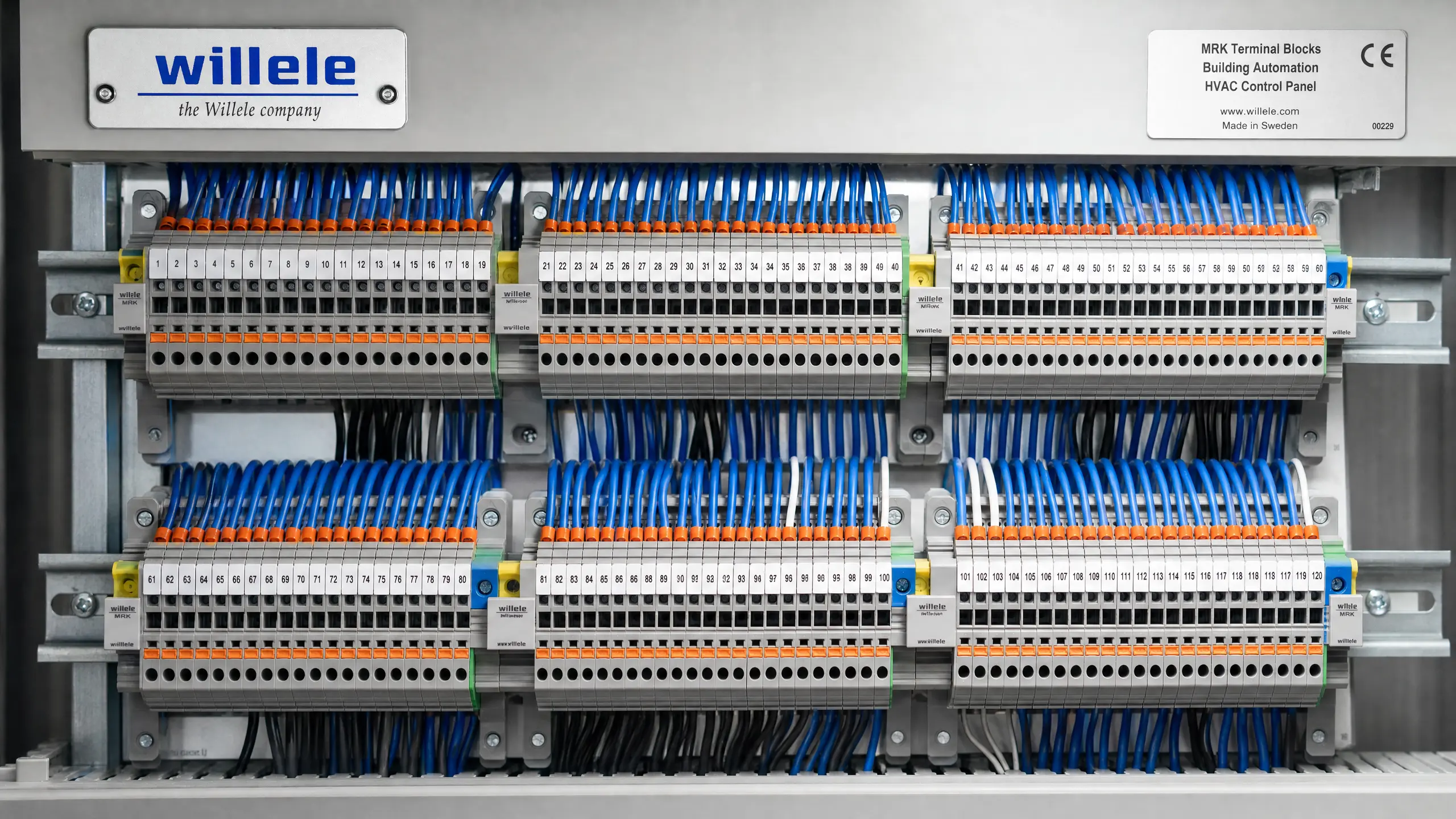
Modern building automation systems demand reliable, efficient electrical connections that can handle complex control circuits while maintaining safety and ease of maintenance. MRK terminal blocks have emerged as a critical component in these systems, particularly for HVAC (Heating, Ventilation, and Air Conditioning) and lighting control applications. This comprehensive guide explores how MRK terminal blocks enhance building automation performance and why they’re the preferred choice for electrical professionals worldwide.
Understanding MRK Terminal Blocks in Building Automation
MRK terminal blocks are modular connection devices designed to create secure, organized electrical terminations in control panels and junction boxes. In building automation contexts, these terminal blocks serve as the nerve center where sensors, actuators, controllers, and power supplies interconnect to form intelligent building systems.
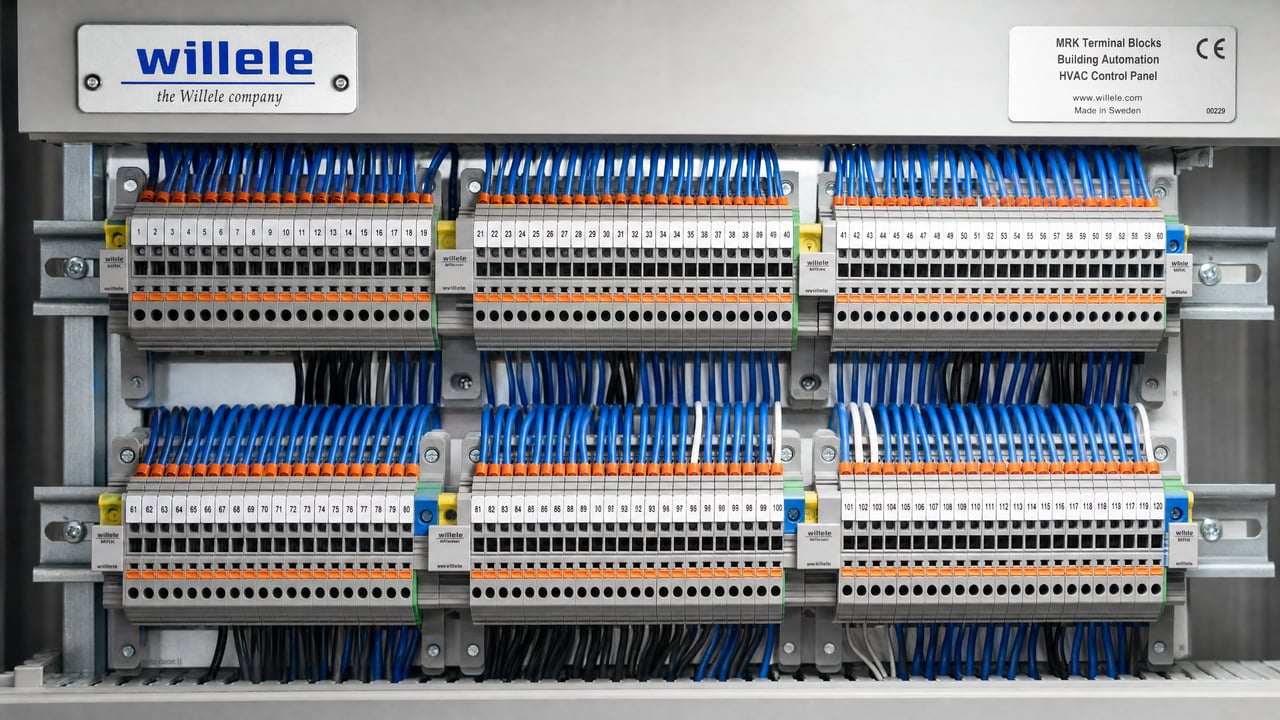
The “MRK” designation typically refers to multi-conductor rail-mounted terminal blocks featuring spring-cage or screw-clamp connection technology. These devices mount on standard 35mm DIN rails, allowing rapid installation and reconfiguration as building systems evolve. Their modular design enables technicians to add, remove, or replace individual terminal points without disrupting adjacent connections—a crucial advantage in occupied buildings where downtime must be minimized.
Key Features of MRK Terminal Blocks for Building Systems
Electrical Specifications
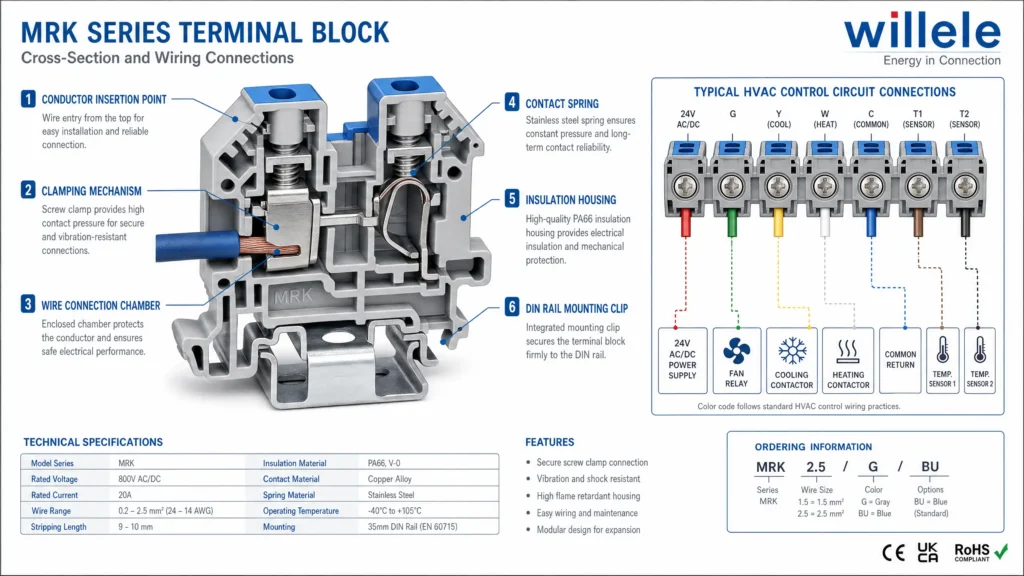
MRK terminal blocks used in building automation typically handle voltage ranges from 24V DC control circuits up to 600V AC power distribution. Current ratings vary from 10A for signal-level connections to 41A or higher for power circuits. The conductor acceptance range usually spans 28 AWG to 12 AWG (0.08mm² to 4mm²), accommodating both fine instrumentation wiring and heavier power conductors.
Physical Construction
The insulation housing of MRK terminal blocks uses flame-retardant polyamide materials rated for UL 94 V-0 flammability classification. Internal contact elements are manufactured from copper alloy with tin, nickel, or silver plating to resist corrosion in diverse environmental conditions. The DIN rail mounting mechanism provides tool-free installation with secure mechanical retention that withstands vibration and thermal cycling.
Safety and Compliance
Quality MRK terminal blocks carry certifications from UL, CSA, VDE, and IEC standards bodies, ensuring compliance with electrical codes across North America, Europe, and international markets. Finger-safe designs prevent accidental contact with live conductors, while integrated test points allow voltage measurement without disconnecting wires—essential features for maintaining building automation systems safely.
MRK Terminal Blocks in HVAC Control Systems
HVAC systems represent one of the most demanding applications for terminal blocks in building automation. These systems integrate multiple subsystems—chillers, boilers, air handling units, variable air volume boxes, damper actuators, and countless sensors—all requiring reliable electrical connections.
Temperature Control Circuits
MRK terminal blocks organize the complex wiring between thermostats, temperature sensors, and zone controllers. A typical multi-zone HVAC system might employ dozens of terminal blocks to separate supply voltage, control signals, and sensor returns. Color-coded terminal blocks or integrated marking systems help technicians quickly identify circuit functions during troubleshooting or system modifications.
The low thermal resistance of properly selected MRK terminal blocks prevents heat buildup that could affect adjacent temperature sensors or introduce measurement errors. Terminal blocks with built-in isolation barriers prevent electrical noise from power circuits from coupling into sensitive analog temperature signals, maintaining control accuracy.
Actuator and Damper Control
Variable air volume systems rely on motorized dampers and valve actuators that require both power and control signals. MRK terminal blocks with multiple levels or integrated jumpers simplify the distribution of common power rails while maintaining separate control channels for each actuator. This architecture reduces wiring complexity and installation time while improving system reliability.
Integration with Building Management Systems
Modern HVAC systems connect to centralized Building Management Systems (BMS) through communication protocols like BACnet, Modbus, or LonWorks. MRK terminal blocks provide organized termination points for communication cables, power supplies, and I/O modules that interface between field devices and the BMS network. Proper terminal block selection ensures signal integrity across these critical communication links.
Lighting Control Applications
Intelligent lighting systems have evolved from simple on-off switching to sophisticated networks that adjust illumination based on occupancy, daylight availability, and user preferences. MRK terminal blocks play a vital role in these systems by organizing the electrical connections between lighting fixtures, sensors, controllers, and power sources.
Dimming Control Circuits
0-10V analog dimming, DALI (Digital Addressable Lighting Interface), and DMX lighting control protocols all require clean signal paths and proper grounding. MRK terminal blocks with integrated shielding or separate ground terminals help maintain signal quality in environments with electrical noise from motors, transformers, and switching power supplies.
A well-designed lighting control panel uses MRK terminal blocks to separate low-voltage control circuits from line-voltage power distribution, reducing the risk of damaging sensitive electronic ballasts or LED drivers through voltage transients or wiring errors.
Emergency Lighting Integration
Building codes require emergency lighting systems to operate independently during power failures. MRK terminal blocks organize the complex wiring between normal lighting circuits, emergency battery systems, and automatic transfer switches. Terminal blocks with clear visual indicators or test points enable rapid verification that emergency lighting circuits function correctly during routine inspections.
Occupancy and Daylight Sensor Connections
Modern lighting systems incorporate numerous sensors throughout a building. MRK terminal blocks consolidate sensor wiring at strategic locations, reducing the number of home-run cables to central controllers. This distributed architecture improves system reliability—a wiring fault affects only the local zone rather than the entire building—and simplifies troubleshooting by creating logical groupings of related circuits.
Comparison: MRK Terminal Blocks vs. Alternative Connection Methods
| Connection Method | Installation Time | Maintenance Access | Circuit Density | Modification Ease | Long-term Reliability |
|---|---|---|---|---|---|
| MRK Terminal Blocks | Fast (DIN rail mount) | Excellent (accessible terminals) | High (modular stacking) | Easy (individual replacement) | Excellent (proven technology) |
| Wire Nuts | Slow (individual connections) | Poor (buried in boxes) | Low (space-consuming) | Difficult (rewiring required) | Good (if properly installed) |
| Punch-Down Blocks | Moderate (specialized tools) | Good (organized layout) | Very High (compact design) | Moderate (re-termination needed) | Good (telecom-grade) |
| Soldered Connections | Very Slow (labor-intensive) | Very Poor (permanent) | Low (inflexible) | Very Difficult (desoldering required) | Excellent (if done properly) |
| Crimp Connectors | Moderate (tooling required) | Poor (enclosed connections) | Moderate | Difficult (destructive removal) | Excellent (vibration-resistant) |
This comparison demonstrates why MRK terminal blocks have become the standard for building automation applications. They balance installation efficiency, maintenance accessibility, and long-term reliability better than alternative connection methods.
Selection Criteria for Building Automation Applications
Current and Voltage Requirements
Begin terminal block selection by identifying the maximum current and voltage for each circuit type in your building automation system. HVAC control circuits typically operate at 24V AC/DC with currents under 5A, while lighting power circuits may require 120-277V AC handling 15-20A. Select MRK terminal blocks rated at least 125% of the expected maximum current to provide thermal margin and ensure long service life.
Wire Gauge Compatibility
Building automation systems often mix wire gauges—18 AWG for sensor signals, 14 AWG for control circuits, and 12 AWG for power distribution. Choose MRK terminal blocks with conductor acceptance ranges that accommodate your smallest and largest wire sizes. Universal terminal blocks that accept a wide range of conductor sizes reduce inventory complexity but may not provide optimal clamping force across the entire range.
Environmental Considerations
HVAC equipment rooms may experience temperature extremes, humidity, and vibration that exceed typical office environment conditions. Select MRK terminal blocks rated for the actual environmental conditions, not just the ambient office temperature. Terminal blocks with enhanced creepage and clearance distances provide additional safety margins in humid environments where condensation may occur.
Color Coding and Marking
Large building automation systems may contain hundreds of terminal points. MRK terminal blocks with integrated color coding (blue for neutral, green/yellow for ground, gray for general circuits) or customizable marking strips dramatically reduce installation errors and troubleshooting time. Some manufacturers offer terminal blocks with printed circuit designations or the ability to insert custom labels.
Installation Best Practices
Panel Layout and Organization
Organize MRK terminal blocks in logical groups that mirror the physical or functional layout of the building automation system. For example, group all terminal blocks serving a particular air handling unit together, or separate input circuits from output circuits. This organization reduces wiring congestion and makes circuit tracing more intuitive.
Maintain consistent terminal block orientation throughout the panel. Position all terminal screws or actuators facing the same direction to simplify access during maintenance. Leave adequate spacing between terminal block rows to accommodate wire bending radius requirements and allow multimeter probe access.
Wiring Techniques
Strip conductor insulation to the minimum length required for the terminal block—typically 8-10mm for screw terminals and 10-12mm for spring-cage terminals. Excessive exposed conductor creates shock hazards and potential short-circuit risks, while insufficient stripping prevents proper contact engagement.
Use ferrules on stranded conductors to prevent wire strand breakage and ensure consistent contact pressure. Ferrules are particularly important for spring-cage MRK terminal blocks, where loose strands can prevent proper insertion or create intermittent connections.
Route wiring in organized bundles using wire duct or cable ties. Separate power wiring from control and communication cables to minimize electrical noise coupling. Maintain proper bend radius—typically 6-8 times the cable diameter—to prevent conductor damage and insulation stress.
Testing and Documentation
After installation, perform continuity testing on all circuits before energizing the system. Verify that each terminal block connection is mechanically secure by gently tugging on each conductor. Measure insulation resistance between adjacent terminals and between terminals and ground to confirm proper isolation.
Document the terminal block layout with detailed panel schedules that identify each terminal’s function, connected device, and wire number. Photograph the completed panel from multiple angles and store these images with the building automation system documentation. This documentation proves invaluable during future troubleshooting or system expansions.
Maintenance and Troubleshooting
Routine Inspection
Building automation systems require periodic inspection to maintain reliability. Annual inspection of MRK terminal blocks should include visual examination for signs of overheating (discoloration, melted insulation), physical damage, or loose connections. Thermal imaging cameras can identify high-resistance connections before they cause failures.
Check terminal screw torque on critical circuits annually, as thermal cycling can cause connections to loosen over time. Spring-cage terminal blocks generally require less maintenance than screw terminals but should still be inspected for conductor movement or damage.
Common Issues and Solutions
Intermittent connections often result from inadequate conductor stripping, loose terminal screws, or vibration in mechanical equipment rooms. Re-terminate affected circuits with proper technique and consider upgrading to spring-cage MRK terminal blocks in high-vibration environments.
Overheating terminals indicate undersized terminal blocks, loose connections, or excessive current draw. Measure actual circuit current and compare to terminal block ratings. If current exceeds 80% of the terminal block rating, upgrade to a higher-capacity model.
Electrical noise interference in control circuits may result from inadequate separation between power and signal wiring. Reorganize terminal block layout to increase physical separation, or install terminal blocks with integrated shielding between power and control sections.
Integration with Heat Shrink Tubing Solutions
Willele’s expertise in heat shrink tubing technology complements MRK terminal block installations in building automation systems. Heat shrink tubing provides several benefits when used in conjunction with terminal blocks:
Wire identification: Color-coded heat shrink tubing applied to conductors before termination creates a permanent, durable marking system that survives harsh environmental conditions better than adhesive labels. This identification remains legible throughout the system’s lifetime, simplifying maintenance and modifications.
Strain relief: Heat shrink tubing applied at the point where conductors exit wire bundles provides strain relief that protects terminal block connections from mechanical stress. This is particularly valuable in applications where vibration or cable movement could otherwise fatigue connections.
Insulation enhancement: In applications where conductors with damaged insulation must be reused, heat shrink tubing provides a reliable repair method that restores insulation integrity. This capability reduces waste and allows selective conductor replacement rather than complete cable runs.
Environmental protection: Heat shrink tubing seals conductor terminations against moisture, dust, and chemical exposure in harsh environments. For building automation equipment located in mechanical rooms, rooftops, or outdoor enclosures, this protection extends system reliability and reduces maintenance requirements.
Willele’s comprehensive range of heat shrink tubing products—from thin-wall identification tubing to heavy-wall adhesive-lined environmental protection—provides building automation professionals with complete solutions for creating reliable, maintainable electrical systems.
Future Trends in Building Automation Connectivity
The building automation industry continues to evolve, and MRK terminal block technology adapts to meet emerging requirements. Several trends are shaping the future of electrical connectivity in intelligent buildings:
Push-in spring technology is replacing traditional screw terminals in many applications, reducing installation time by up to 50% while maintaining equivalent or superior connection reliability. These tool-free connections are particularly valuable in large projects where labor costs dominate total installation expenses.
Integrated electronics are appearing in advanced terminal blocks, with built-in surge protection, circuit monitoring, or communication interfaces. These “smart terminal blocks” provide diagnostic capabilities that help building operators identify failing connections before they cause system downtime.
Compact designs respond to the increasing density of building automation panels as systems incorporate more sensors, actuators, and control points. Narrow-profile MRK terminal blocks allow more circuits in the same panel space, reducing enclosure costs and simplifying installation in space-constrained locations.
Sustainable materials are becoming standard as manufacturers respond to environmental concerns and green building certifications. Terminal blocks manufactured from recycled materials or designed for easy disassembly and recycling support the building industry’s sustainability goals.
Conclusion
MRK terminal blocks form the foundation of reliable building automation systems, providing organized, maintainable electrical connections for HVAC and lighting control applications. Their modular design, safety features, and proven reliability make them the preferred choice for electrical professionals worldwide.
Proper selection, installation, and maintenance of MRK terminal blocks ensure building automation systems deliver optimal performance throughout their service life. When combined with complementary technologies like Willele’s heat shrink tubing solutions, these terminal blocks create electrical systems that meet the demanding requirements of modern intelligent buildings.
As building automation systems grow more sophisticated, the fundamental need for reliable electrical connections remains constant. MRK terminal blocks will continue to evolve, incorporating new technologies while maintaining the core attributes that have made them indispensable in building automation applications.
Frequently Asked Questions
Q: What wire sizes do MRK terminal blocks accept for building automation applications?
A: Most MRK terminal blocks used in building automation accept conductors from 28 AWG to 12 AWG (0.08mm² to 4mm²). This range accommodates fine instrumentation wiring for sensors and heavier conductors for power circuits. Always verify the specific terminal block model’s specifications before installation.
Q: Can I mix different voltage levels on the same terminal block?
A: No. Electrical codes require separation between different voltage classes. Use separate terminal blocks for low-voltage control circuits (under 50V) and line-voltage power circuits (120V and above). Some manufacturers offer terminal blocks with integrated barriers for this purpose, but verify compliance with local electrical codes.
Q: How often should MRK terminal blocks be inspected in HVAC systems?
A: Annual inspection is recommended for most building automation applications. Systems in harsh environments (high temperature, humidity, vibration) may require more frequent inspection. Check for signs of overheating, loose connections, and physical damage during each inspection.
Q: What’s the difference between screw-type and spring-cage MRK terminal blocks?
A: Screw-type terminals use a screw to clamp conductors and require periodic retightening. Spring-cage terminals use a spring mechanism that maintains constant pressure and typically requires no maintenance. Spring-cage terminals offer faster installation but may have higher initial costs.
Q: Are MRK terminal blocks suitable for outdoor building automation equipment?
A: MRK terminal blocks can be used outdoors when installed in properly rated enclosures (NEMA 3R, 4, or 4X). The terminal blocks themselves should have appropriate environmental ratings, and all connections should be protected from direct weather exposure. Consider using heat shrink tubing for additional environmental protection on exposed conductors.
