
Railway Electrification: Specialized Busbar Insulator Requirements

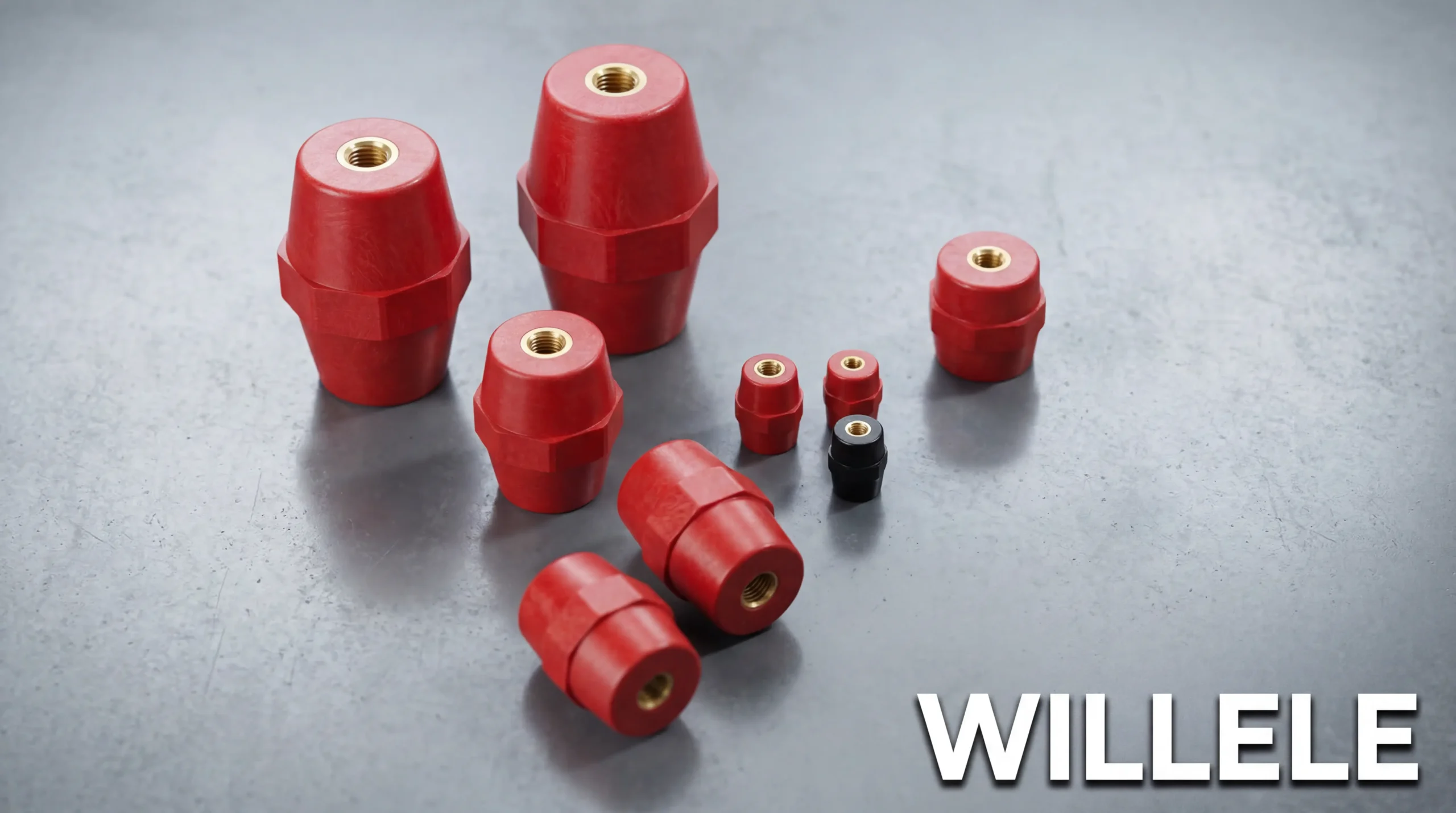
Railway electrification represents one of the most demanding applications in modern electrical engineering, where safety, reliability, and performance converge under extreme operational conditions. At the heart of these systems lie busbar insulators—critical components that ensure electrical isolation, mechanical stability, and long-term durability in high-voltage traction environments. Understanding the specialized requirements for railway busbar insulators is essential for engineers, procurement specialists, and infrastructure developers working on electrified rail projects worldwide.
The Critical Role of Busbar Insulators in Railway Systems
Railway electrification systems operate under uniquely challenging conditions that distinguish them from conventional industrial applications. Trains draw massive currents—often exceeding 3,000 amperes—while subjected to constant vibration, thermal cycling, and environmental exposure ranging from arctic cold to desert heat. Within this demanding context, busbar insulators serve as the foundational safety barrier between high-voltage conductors and grounded metallic structures in substations, switchgear cabinets, and power distribution assemblies.
Unlike standard industrial insulators, railway-grade busbar supports must withstand not only electrical stress but also mechanical forces generated by electromagnetic fields during fault conditions, where short-circuit currents can reach 50 kA or higher. The consequences of insulator failure in railway applications extend beyond equipment damage—they pose direct risks to passenger safety, operational continuity, and regulatory compliance. citation
Modern railway systems typically operate at voltages ranging from 600V DC for urban metro systems to 25 kV AC for high-speed intercity rail. Each voltage class imposes distinct insulation requirements, with creepage distances, air clearances, and dielectric strength specifications carefully calibrated to prevent flashover and tracking under contaminated or humid conditions. The selection of appropriate busbar insulators thus becomes a critical design decision that influences system reliability, maintenance intervals, and total lifecycle costs.
International Standards Governing Railway Busbar Insulators
Railway busbar insulators must comply with a comprehensive framework of international standards that address electrical performance, fire safety, mechanical strength, and environmental durability. The primary standard governing low-voltage switchgear assemblies—including busbar systems—is IEC 61439-1 and IEC 61439-2, which establishes design verification requirements, temperature rise limits, and insulation class ratings critical for safe operation. citation
For railway-specific applications, EN 45545-2 emerges as the definitive European standard for fire performance in rolling stock and fixed installations. This standard classifies materials according to hazard levels (HL1, HL2, HL3) and requirement sets (R22, R23), with railway busbar insulators typically required to meet HL2 or HL3 classification for R22/R23 categories. Compliance ensures that insulators exhibit low smoke emission, minimal toxicity, and limited flame spread—critical factors in confined railway environments where evacuation may be challenging. citation
Additional standards that shape railway busbar insulator specifications include:
- IEC 60085: Thermal evaluation and designation of electrical insulation, defining temperature classes that determine maximum continuous operating temperatures
- IEC 60664-1: Insulation coordination for low-voltage systems, specifying minimum creepage and clearance distances based on pollution degree and overvoltage category
- EN 50155: Electronic equipment used on rolling stock, addressing vibration resistance and electromagnetic compatibility
- UL 94: Flammability classification, with railway insulators typically requiring V-0 rating (self-extinguishing within 10 seconds)
The convergence of these standards creates a demanding qualification framework that separates railway-grade insulators from general industrial products. Manufacturers must demonstrate compliance through rigorous testing protocols that simulate decades of operational stress within accelerated timeframes. citation citation
Material Selection: DMC, BMC, and Advanced Composites
The material composition of railway busbar insulators fundamentally determines their performance under electrical, thermal, and mechanical stress. Three primary material families dominate railway applications: Dough Molding Compound (DMC), Bulk Molding Compound (BMC), and advanced epoxy composites, each offering distinct advantages for specific operational requirements.
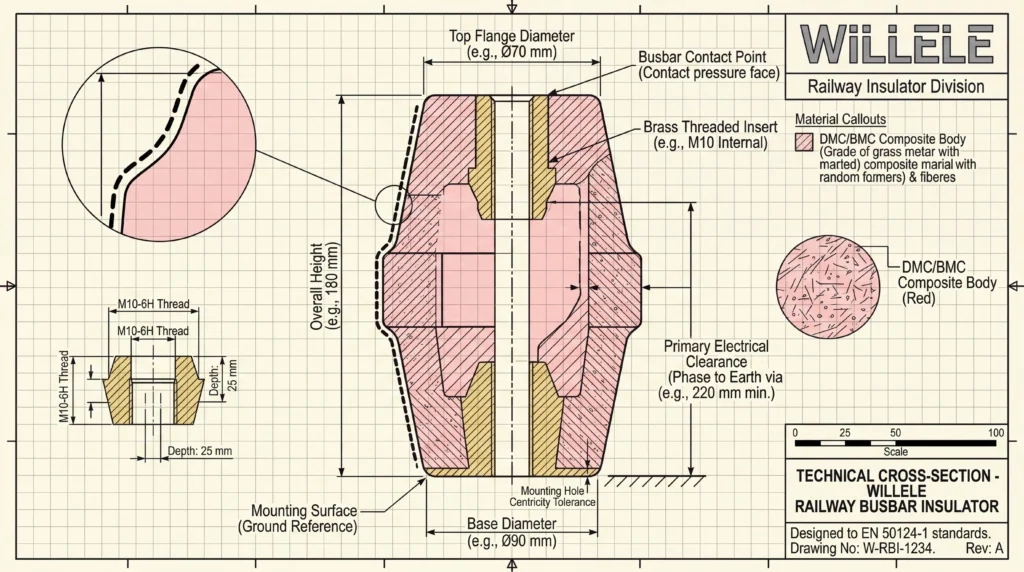
DMC (Dough Molding Compound) represents the most widely adopted material for railway busbar insulators, combining polyester resin with fiberglass reinforcement to achieve an optimal balance of electrical insulation, mechanical strength, and thermal stability. DMC insulators exhibit excellent arc resistance, maintaining structural integrity even when exposed to electrical discharges that would carbonize organic materials. The material’s low moisture absorption—typically below 0.3% by weight—ensures stable dielectric properties across varying humidity conditions, critical for outdoor substations and tunnel installations.
BMC (Bulk Molding Compound) offers enhanced moldability and surface finish quality compared to DMC, making it ideal for complex geometries and high-precision applications. BMC formulations typically incorporate shorter glass fibers, resulting in superior flow characteristics during compression molding while maintaining comparable electrical and mechanical properties. Railway applications favor BMC for insulators requiring intricate thread patterns, tight dimensional tolerances, or integrated mounting features that simplify installation in space-constrained switchgear cabinets.
Advanced epoxy-based composites serve specialized railway applications where superior thermal conductivity or extreme mechanical strength is required. Epoxy insulators dissipate heat more effectively than polyester-based materials—a critical advantage in high-current busbar systems where thermal management directly impacts conductor ampacity. However, epoxy materials command premium pricing and require more complex manufacturing processes, limiting their use to critical applications such as traction converter assemblies and high-speed rail substations.
The metallic inserts embedded within busbar insulators—typically brass or stainless steel—must be carefully selected to match the thermal expansion characteristics of the composite body. Brass inserts offer excellent electrical conductivity and machinability, while stainless steel provides superior corrosion resistance in coastal or industrial environments where salt spray and chemical exposure accelerate degradation. citation
Electrical Performance Requirements
Railway busbar insulators must satisfy stringent electrical performance criteria that ensure safe operation under both normal and fault conditions. The fundamental electrical parameters include voltage rating, dielectric strength, creepage distance, and tracking resistance—each carefully specified to prevent insulation breakdown across the insulator’s operational lifetime.
Voltage Rating and Dielectric Strength: Railway insulators are typically rated for system voltages ranging from 600V to 1500V DC for urban transit, and 15 kV to 25 kV AC for mainline electrification. The dielectric strength—measured as breakdown voltage per unit thickness—must exceed the system voltage by a substantial safety margin, typically 3:1 or greater. Standard testing per IEC 61489-2 applies AC test voltages of 2.5 kV for 600V-rated insulators, escalating to 50 kV or higher for medium-voltage applications. citation
Creepage and Clearance Distances: Creepage distance—the shortest path along the insulator surface between conductive parts—must be sized according to IEC 60664-1 requirements, which account for pollution degree and overvoltage category. For railway applications in Pollution Degree 3 environments (industrial atmospheres with conductive dust), minimum creepage distances are:
- ≤690V systems: 14 mm minimum
- 1000V systems: 22 mm minimum
- 1500V systems: 32 mm minimum
Air clearance—the shortest direct distance through air—must similarly meet minimum values of 10 mm for ≤690V systems and 18 mm for 1000V systems, with increased margins for outdoor installations subject to transient overvoltages from lightning or switching operations. citation
Tracking Resistance: Surface tracking—the formation of conductive carbon paths due to partial discharges in contaminated conditions—represents a primary failure mode for railway insulators. Materials must demonstrate Comparative Tracking Index (CTI) values exceeding 400 for railway applications, with premium grades achieving CTI 600 for severe service environments. Regular surface contamination from brake dust, diesel particulates, and industrial pollutants makes tracking resistance a critical long-term reliability factor.
| Voltage System | Min. Creepage Distance | Min. Air Clearance | Dielectric Test Voltage | CTI Requirement |
|---|---|---|---|---|
| 600V DC | 14 mm | 10 mm | 2.5 kV AC | ≥400 |
| 750V DC | 18 mm | 12 mm | 3.0 kV AC | ≥400 |
| 1500V DC | 32 mm | 18 mm | 5.0 kV AC | ≥600 |
| 25 kV AC | 180 mm | 120 mm | 50 kV AC | ≥600 |
Mechanical and Thermal Performance
The mechanical demands imposed on railway busbar insulators exceed those of stationary industrial applications by orders of magnitude. Insulators must withstand continuous vibration from train movements, shock loads from switching operations, and electromagnetic forces during short-circuit events—all while maintaining precise dimensional stability to preserve electrical clearances.
Mechanical Strength Requirements: Railway-grade busbar insulators typically must withstand axial tensile forces of 4,000 N and bending loads exceeding 5,000 N without permanent deformation or cracking. These specifications ensure that insulators maintain busbar alignment within ±0.5 mm tolerances even under maximum fault current conditions, where electromagnetic repulsion forces between parallel conductors can generate instantaneous mechanical stresses equivalent to several times the conductor weight. citation
Vibration resistance testing per EN 50155 subjects insulators to sinusoidal vibration across 5-150 Hz frequency range, with acceleration levels reaching 5g for carbody-mounted equipment and 10g for bogie-mounted installations. Insulators must complete 10 million cycles without degradation in electrical or mechanical properties—a requirement that eliminates materials prone to fatigue cracking or stress relaxation.
Thermal Performance: Railway busbar systems experience significant temperature variations, both from ambient environmental changes and internal I²R heating from high current loads. Busbar insulators must operate reliably across temperature ranges from -40°C to +125°C, maintaining dimensional stability and electrical properties throughout this extreme span.
The thermal class of insulation materials—defined by IEC 60085—determines maximum continuous operating temperatures:
- Class E (120°C): Suitable for moderate-current applications
- Class F (155°C): Standard for railway traction systems
- Class H (180°C): Required for high-power converter assemblies
Heat dissipation becomes critical in high-current applications, where standard DMC/BMC materials with thermal conductivity around 0.3 W/m·K may require active cooling or upgraded to thermally conductive formulations achieving 1.2 W/m·K—a 300% improvement that reduces busbar operating temperatures by 20-30°C. citation
Fire Safety and Environmental Resistance
Fire safety requirements for railway busbar insulators reflect the catastrophic consequences of electrical fires in passenger-carrying vehicles and underground stations. The EN 45545-2 standard establishes a comprehensive framework evaluating flame spread, heat release, smoke opacity, and toxic gas emission—with railway insulators required to meet the most stringent hazard levels.
Fire Performance Classification: Railway applications typically mandate HL2 (Hazard Level 2) or HL3 classification for requirement sets R22 (electrical equipment) and R23 (electrical cables and components). Achieving these classifications requires materials that:
- Self-extinguish within 10 seconds of flame removal (UL 94 V-0)
- Generate smoke density below 300 Ds(4) per IEC 61034-2
- Exhibit oxygen index (OI) exceeding 28%
- Produce minimal toxic gases (CO, HCl, HCN) during combustion
Halogen-free formulations—specified by IEC 62821-1—eliminate chlorine and bromine-based flame retardants that generate corrosive and toxic gases during fires. Modern railway insulators achieve fire performance through intumescent additives and mineral fillers that form protective char layers, maintaining structural integrity while limiting flame propagation. citation
Environmental Durability: Railway insulators face aggressive environmental exposure including UV radiation, ozone, industrial chemicals, and salt spray in coastal installations. Material degradation testing per IEC 62217 demonstrates that premium DMC/BMC formulations exhibit surface erosion below 0.1 mm/year even under 1000-hour salt fog exposure—ensuring decades of reliable service without electrical property degradation. citation
UV resistance certification per UL 2556 and UL 854 confirms that outdoor railway insulators maintain mechanical strength and surface insulation resistance despite years of solar exposure. This durability proves essential for overhead catenary system components and outdoor substation equipment where insulator replacement requires costly service interruptions.
Selection Criteria for Railway Applications
Selecting appropriate busbar insulators for railway electrification projects requires systematic evaluation of electrical, mechanical, environmental, and regulatory factors. Engineers must balance performance requirements against cost constraints while ensuring long-term reliability and compliance with applicable standards.
Voltage and Current Ratings: Begin by establishing system voltage (including transient overvoltages) and maximum continuous current. Select insulators with voltage ratings exceeding system voltage by minimum 50% margin, and verify that thermal class supports anticipated temperature rise from busbar heating. For systems exceeding 1000A continuous current, consider thermally enhanced materials or active cooling integration.
Environmental Classification: Assess installation environment according to IEC 60664-1 pollution degrees:
- Pollution Degree 2: Controlled indoor environments (climate-controlled substations)
- Pollution Degree 3: Industrial environments with conductive dust (typical railway applications)
- Pollution Degree 4: Outdoor installations with heavy contamination (coastal or industrial areas)
Higher pollution degrees mandate increased creepage distances and materials with superior tracking resistance (CTI ≥600).
Mechanical Loading: Evaluate vibration exposure, shock loads, and electromagnetic forces under fault conditions. Carbody-mounted equipment requires minimum 5g vibration rating, while bogie-mounted installations demand 10g certification per EN 50155. Verify that insulator mechanical strength exceeds maximum anticipated electromagnetic forces by minimum 2:1 safety factor.
Fire Safety Requirements: Confirm EN 45545-2 hazard level and requirement set applicable to specific installation location. Passenger compartments and escape routes typically require HL3 classification, while equipment compartments may accept HL2. Specify halogen-free materials for enclosed spaces to minimize toxic gas generation during fires.
Dimensional Constraints: Railway switchgear cabinets impose strict space limitations. Select insulator heights (typically 16-70 mm for low-voltage applications) that provide required electrical clearances while accommodating busbar routing and maintenance access. Verify thread specifications match busbar mounting holes and panel thicknesses. citation
WILLELE Railway Busbar Insulator Solutions
WILLELE specializes in manufacturing high-performance busbar insulators engineered specifically for railway electrification applications. Our railway-grade product line combines advanced DMC/BMC composite materials with precision compression molding to deliver insulators that meet the most demanding international standards including EN 45545-2, IEC 61439, and UL 94 V-0.
Standard Railway Product Range: WILLELE offers comprehensive busbar insulator families covering voltage ratings from 600V to 1500V DC and mechanical heights from 16 mm to 70 mm. All standard products feature nickel-plated brass inserts for optimal electrical conductivity and corrosion resistance, with stainless steel options available for severe marine or industrial environments.
Custom Engineering Capabilities: Railway projects frequently require non-standard specifications for creepage distances, thread configurations, or mounting geometries. WILLELE’s engineering team provides custom design services, developing application-specific insulators that integrate seamlessly with client busbar systems while maintaining full regulatory compliance. Our in-house tooling capabilities enable rapid prototyping and cost-effective production of custom designs.
Quality Assurance and Certification: Every WILLELE railway insulator undergoes rigorous testing including dielectric strength verification per IEC 61489-2, mechanical load testing, thermal cycling, and fire performance validation. Our manufacturing facility maintains ISO 9001 quality management certification, ensuring consistent product quality and traceability throughout production.
Technical Support: WILLELE provides comprehensive technical support throughout project lifecycles, from initial specification development through installation and commissioning. Our applications engineers assist with insulator selection, electrical clearance calculations, and thermal management analysis to optimize system performance and reliability.
For railway electrification projects demanding proven reliability, regulatory compliance, and long-term durability, WILLELE busbar insulators deliver the specialized performance that modern rail infrastructure requires.
Frequently Asked Questions
Q: What is the difference between railway-grade and standard industrial busbar insulators?
A: Railway-grade insulators must meet significantly more stringent requirements including EN 45545-2 fire performance (HL2/HL3 for R22/R23), enhanced vibration resistance per EN 50155 (5-10g), superior tracking resistance (CTI ≥600), and extended temperature range (-40°C to +125°C). They also require halogen-free materials to minimize toxic gas emission during fires.
Q: How do I determine the required creepage distance for my railway application?
A: Creepage distance depends on system voltage and pollution degree per IEC 60664-1. For typical railway applications (Pollution Degree 3): 600V systems require minimum 14 mm, 1000V systems need 22 mm, and 1500V systems require 32 mm. Outdoor or heavily contaminated environments may require 50-100% additional margin.
Q: Can standard busbar insulators be used in railway applications?
A: Standard industrial insulators typically lack the fire performance certification (EN 45545-2), vibration resistance (EN 50155), and environmental durability required for railway service. Using non-compliant components risks regulatory rejection, premature failure, and safety hazards. Always specify railway-certified products for electrified rail projects.
Q: What maintenance is required for railway busbar insulators?
A: Railway insulators require periodic visual inspection for cracks, tracking marks, or contamination buildup. Cleaning with approved solvents removes conductive deposits that reduce surface insulation resistance. Insulators showing visible damage, carbonization, or tracking should be replaced immediately. Typical inspection intervals range from 6-24 months depending on environmental severity.
Q: How do I select between DMC, BMC, and epoxy insulators for railway applications?
A: DMC offers the best cost-performance balance for most railway applications, providing excellent electrical properties and mechanical strength. BMC suits complex geometries requiring tight tolerances. Epoxy composites are reserved for high-current applications (>2000A) where superior thermal conductivity justifies premium cost. For standard railway switchgear, DMC or BMC materials meet all performance requirements.
