
Role of Flame Retardant Tubing in Smart Grid Infrastructure

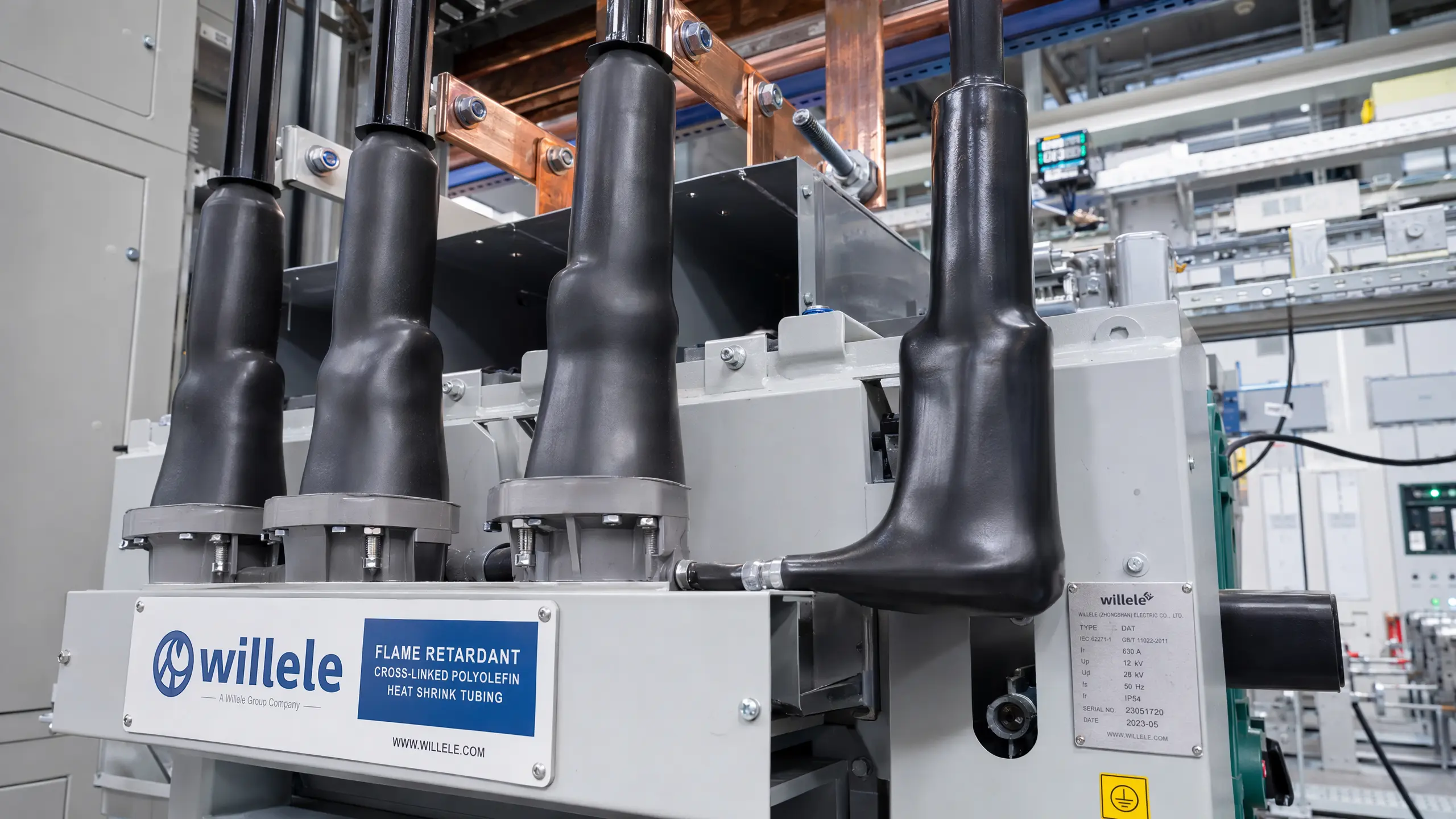
The modernization of global power systems into smart grids has introduced an unprecedented density of sensors, communication nodes, and distributed energy resources onto the electrical network. Every new connection point is a potential failure point, and every failure point is a potential ignition source. In this environment, flame retardant tubing has evolved from a commodity consumable into a critical safety barrier—one that protects not just the cable it covers, but the continuity of the grid itself. For B2B electrical equipment manufacturers like willele, supplying flame retardant tubing that meets the stringent demands of smart grid infrastructure is about engineering resilience into the system at the molecular level.
Why Flame Retardant Tubing Matters in Smart Grids
Smart grid infrastructure differs from conventional power distribution in both scale and sensitivity. A traditional substation might house dozens of cable terminations; a smart substation can contain hundreds, each connected to monitoring equipment that must remain online to feed SCADA and distribution management systems. When a single cable fault propagates as fire, the damage extends beyond the burned conductor: it can disable communication links, trigger cascading protection schemes, and black out entire feeders. Flame retardant tubing acts as the first line of containment, preventing flame propagation along cable runs and giving protective relays time to isolate the fault.
The tubing achieves this through chemical and mechanical mechanisms that interrupt the combustion triangle. Halogen-free flame retardant (HFFR) compounds—typically based on cross-linked polyolefin with metal hydroxide additives—release water vapor when heated, diluting combustible gases and cooling the substrate. Intumescent formulations swell to form a carbonaceous char layer that insulates underlying material from heat. These mechanisms allow the tubing to self-extinguish after the ignition source is removed, a property quantified by standards such as UL 94 V-0 and IEC 60332-1[[citation:{“links”:[“https://www.te.com/en/product-CAT-FCSM.html”]}]].
Core Material Technologies
Cross-Linked Polyolefin (XLPO)
Cross-linked polyolefin is the workhorse material for flame retardant heat shrink tubing in smart grid applications. The cross-linking process—whether through electron beam irradiation or chemical means—creates a three-dimensional molecular network that resists melting at high temperatures. Unlike thermoplastic materials that soften and drip when exposed to flame, XLPO maintains its structural integrity, holding its shape around the cable joint even as the surrounding temperature rises. This dimensional stability is what allows the tubing to continue providing insulation and mechanical protection during a thermal event[[citation:{“links”:[“https://www.electroinsulation.com/blog/2026/04/15/polyolefin-vs.-other-heat-shrink-tubing-materials/”]}]].
XLPO tubing typically operates across a temperature range of −55°C to 135°C, with shrink activation around 90°C. The lower shrink temperature compared to PTFE alternatives reduces installation time and energy costs on large projects, while the material’s flexibility accommodates the bending radii required in dense switchgear assemblies. Shrink ratios of 2:1, 3:1, and 4:1 allow a single tubing size to cover a range of cable diameters, simplifying inventory management for utility contractors.
PTFE and Fluoropolymer Tubing
For the most demanding environments—high-voltage cable joints, transformer bushings, and areas exposed to chemical contaminants—PTFE (Teflon) tubing offers superior thermal and chemical resistance. PTFE withstands temperatures from −90°C to 260°C, far exceeding the ceiling of polyolefin. Its inherently low flammability means it does not require additive flame retardants, and its chemical inertness resists degradation from oils, solvents, and corrosive atmospheres found in industrial substations[[citation:{“links”:[“https://www.aokai-ptfe.com/which-is-more-flame-retardant-pvc-or-teflon”]}]]. The trade-off is cost: PTFE tubing is significantly more expensive than polyolefin, and its higher shrink temperature (around 327°C for full crystalline melt) requires specialized installation equipment. For most smart grid applications, XLPO provides sufficient performance at a fraction of the cost, with PTFE reserved for the highest-stress connection points.
PVC Tubing
Polyvinyl chloride remains a cost-effective option for low-voltage applications within smart grid systems, such as internal wiring of smart meters and communication gateways. PVC’s natural flame retardancy—due to its chlorine content—gives it a limiting oxygen index (LOI) of around 45%, meaning it will not sustain combustion in normal atmospheric conditions. However, PVC has notable limitations: it becomes brittle at low temperatures, ages relatively quickly under UV exposure, and releases toxic hydrogen chloride gas when burned. For outdoor or confined-space installations typical of smart grid infrastructure, halogen-free alternatives are increasingly preferred[[citation:{“links”:[“https://www.shhampool.com/news/heat-shrink-tubing-material-types-polyolefin-85053714.html”]}]].
Material Comparison for Smart Grid Applications
Selecting the right tubing material requires balancing thermal performance, mechanical durability, regulatory compliance, and total project cost. The following table compares the three primary materials across the properties that matter most for smart grid infrastructure.
| Property | XLPO (Cross-Linked Polyolefin) | PTFE (Teflon) | PVC |
|---|---|---|---|
| Operating Temperature | −55°C to 135°C | −90°C to 260°C | −20°C to 105°C |
| Shrink Temperature | ~90°C | ~327°C | ~90°C–120°C |
| Shrink Ratio | 2:1 to 6:1 | 2:1 to 4:1 | 2:1 to 3:1 |
| Flame Retardancy Rating | UL 94 V-0, IEC 60332-1 | UL 94 V-0 (inherent) | UL 94 V-2 to V-0 |
| Halogen Content | Halogen-free (HFFR) | Halogen-free (fluorinated) | Contains chlorine |
| Flexibility | High | Low–moderate | Moderate |
| Chemical Resistance | Good | Excellent | Fair |
| UV Resistance | Good (with stabilizers) | Excellent | Poor (degrades) |
| Relative Cost | Moderate | High | Low |
| Best Smart Grid Use Case | Cable joints, terminations, medium-voltage accessories | High-voltage bushings, chemical environments | Internal smart meter wiring, low-voltage gateways |
Standards and Compliance Framework
Smart grid infrastructure operates under layered regulatory requirements that vary by region. The following table maps the key standards that govern flame retardant tubing selection across major markets.
| Standard | Scope | Region | Key Requirement |
|---|---|---|---|
| UL 94 V-0 | Vertical burn test for plastics | North America (global reference) | Self-extinguishing within 10 seconds; no flaming drips |
| IEC 60332-1 | Vertical flame propagation on single cable | International (IEC member states) | Flame spread limited to upper region of 425 mm sample |
| IEC 60332-3 | Vertical flame propagation on bundled cables | International | Category A/B/C/D based on fuel load and duration |
| IEC 61386 | Conduit systems for cable management | International | Impact, bending, and fire resistance classification |
| NFPA 70 (NEC) | National Electrical Code | United States | Article 358, conduit and tubing installation rules |
| EN 50399 | Common test methods for cables under fire | European Union | Heat release and smoke production measurement |
| GB/T 18380 | Flame retardant cable tests | China | Equivalent to IEC 60332 series, national adaptation |
For manufacturers serving international markets, willele aligns its flame retardant tubing product lines to multiple standards simultaneously. A single XLPO tubing specification can carry UL 94 V-0, IEC 60332-1, and RoHS compliance, simplifying cross-border procurement for EPC contractors building smart grid projects in different jurisdictions.
Smart Grid Application Scenarios
Substation Cable Jointing and Termination
In smart substations, flame retardant heat shrink tubing serves as primary insulation and mechanical protection on medium-voltage cable joints (typically 10 kV to 35 kV). The tubing is applied over the connector and cable insulation, then heated to shrink into a tight, seamless sleeve. Dual-wall tubing with an inner adhesive layer creates a moisture-proof seal that prevents water ingress—a leading cause of joint failure in underground distribution networks. The flame retardant properties ensure that if a joint overheats due to loose connections or overload conditions, the tubing will not propagate flame to adjacent cables[[citation:{“links”:[“https://www.te.com/en/products/energy-and-power/arresters-insulators-and-insulation/electrical-heat-shrink-tubing.html”]}]].
Communication and Control Wiring
The “smart” in smart grid depends on communication infrastructure: fiber optic links, IEC 61850 Ethernet networks, and wireless sensor mesh networks. The low-voltage control cables and fiber drop wires that carry this data are often routed through the same cable trays and conduits as power cables. Flame retardant tubing protects these communication pathways from thermal damage caused by adjacent power cable faults, ensuring that protection signaling and SCADA telemetry remain functional during emergencies. This is not a theoretical concern: during the 2019 California wildfire investigations, post-event analysis showed that communication cable integrity was a decisive factor in utilities’ ability to execute emergency load shedding.
Distributed Energy Resource (DER) Connections
Solar inverters, wind turbine nacelles, and battery energy storage systems (BESS) all require flame retardant tubing at their grid interconnection points. BESS installations are particularly sensitive, as lithium-ion battery thermal runaway events can generate temperatures exceeding 600°C. While no tubing can survive direct exposure to battery cell venting, flame retardant tubing on interconnecting cables prevents flame spread from the battery rack to the inverter and grid connection equipment—buying critical seconds for fire suppression systems to activate and for protection relays to isolate the affected unit[[citation:{“links”:[“https://www.etkkablo.com/en/blog/what-are-fire-resistant-cables/”]}]].
Underground Distribution Network Sealing
Underground cable vaults and manholes accumulate moisture, gases, and debris that accelerate cable degradation. Flame retardant tubing with environmental sealing adhesive is used to create watertight closures at cable entry points into pad-mounted transformers and switchgear. The flame retardant rating ensures that even if a fault arc occurs within the vault, the sealing material will not contribute to fire propagation through the cable penetration.
Technical Cross-Section: Understanding Tubing Construction
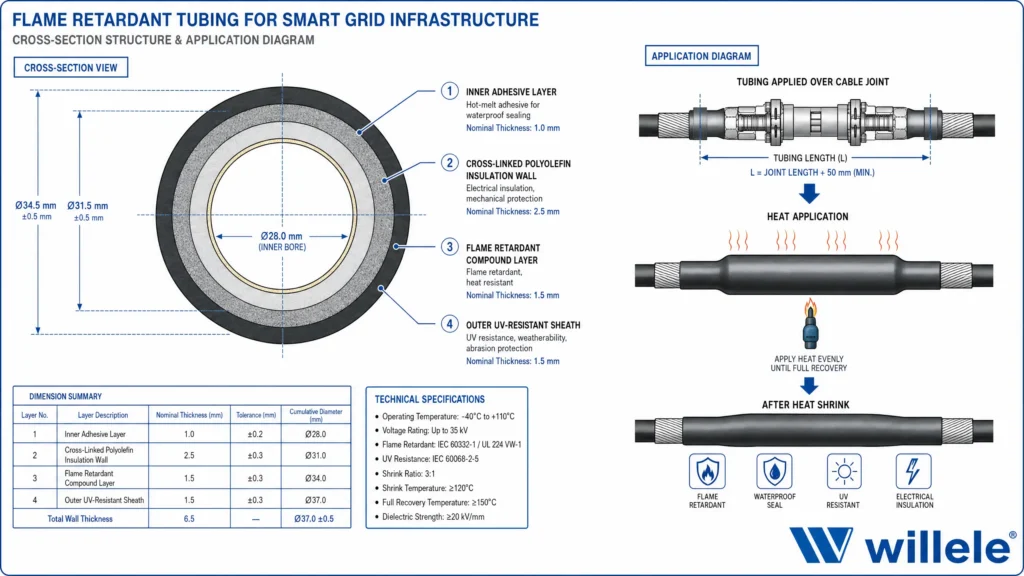
Modern flame retardant tubing for smart grid use is not a single-layer product. The cross-section diagram above illustrates the engineered layer structure that gives the tubing its fire performance and environmental sealing capabilities.
| Layer | Material | Function |
|---|---|---|
| Inner Adhesive Layer | Hot-melt polyamide or ethylene-vinyl acetate | Flows during shrink to fill gaps, creating moisture and gas seal |
| Primary Insulation Wall | Irradiated cross-linked polyolefin | Provides dielectric strength (typically 10–20 kV/mm) and mechanical protection |
| Flame Retardant Compound | Metal hydroxide-loaded polyolefin (HFFR) | Releases water vapor at high temperature, forms protective char, self-extinguishes flame |
| Outer Sheath | UV-stabilized XLPO | Resists weathering, ozone, and chemical exposure over 20+ year service life |
The synergy between these layers is what distinguishes engineered flame retardant tubing from generic shrink sleeving. The adhesive layer ensures that even if the outer layers are compromised, the environmental seal maintains cable insulation integrity. The flame retardant compound’s intumescent behavior means the tubing actively resists combustion rather than merely slowing it.
Installation Best Practices for Grid Operators
Proper installation determines whether flame retardant tubing performs as specified. Several practices distinguish reliable installations from those that will fail under stress.
Surface preparation is the first critical step. Cables must be cleaned with approved solvents to remove grease, dirt, and oxidation products that would prevent the adhesive from bonding. The cable surface should be smooth, with semiconducting shields removed cleanly at the specified distance from the connector. Any surface irregularity becomes a stress concentration point under thermal cycling, and over years of service, those stress points can initiate tracking that defeats the tubing’s insulation.
Heating technique matters as much as preparation. Installers should use calibrated propane torches or hot-air guns with reflectors, applying heat evenly from the center of the tubing outward to drive air out and prevent trapped pockets. Overheating degrades the cross-linked structure and can destroy the flame retardant additives; underheating leaves the tubing partially expanded, with poor adhesive flow and reduced wall thickness. The target is full recovery to the specified wall thickness, with adhesive visible at both ends of the sleeve.
Quality verification should include visual inspection for full recovery, adhesive extrusion at both ends, and absence of burn marks or carbonized spots. For critical medium-voltage joints, partial discharge testing at the rated voltage confirms that the installation is free of voids that could lead to long-term insulation failure.
The B2B Supply Perspective: Why willele
For EPC contractors and utility procurement teams, flame retardant tubing is not purchased per meter—it is specified per project, with lot-level traceability and certification packages. willele’s manufacturing approach addresses the realities of B2B electrical equipment supply: consistent material formulation across production lots, documented compliance with multiple international standards, and technical support that extends from specification through installation.
The global flame retardant tubing market is projected to grow at over 6% annually through 2028, driven by smart grid investment, renewable energy integration, and tightening fire safety codes[[citation:{“links”:[“https://www.accio.com/plp/electrical-wire-tubing”]}]]. The Asia-Pacific region accounts for nearly half of demand, reflecting both rapid grid modernization in China and India and the concentration of tubing manufacturing capacity in the region. North American growth is propelled by building code upgrades and wildfire mitigation mandates that require flame retardant materials in utility infrastructure.
willele’s product portfolio spans the material spectrum from economical PVC for low-voltage smart meter wiring to high-performance XLPO for medium-voltage cable accessories, with PTFE options available for specialized high-temperature applications. This breadth allows a single supplier relationship to cover the full range of tubing requirements on a smart grid project, simplifying procurement and ensuring consistent quality across the installation.
Future Directions: Smart Tubing and Embedded Monitoring
The trajectory of smart grid technology points toward tubing that does more than passively resist fire. Embedded fiber optic sensors within heat shrink tubing can monitor temperature and strain at cable joints in real time, feeding data into predictive maintenance systems. Conductive polymer layers can detect insulation degradation before it reaches the failure threshold. While these technologies are still emerging, the infrastructure being installed today—using high-quality flame retardant tubing from suppliers like willele—will form the physical foundation that makes future smart monitoring layers possible.
The convergence of fire safety and digital intelligence in grid infrastructure means that flame retardant tubing is no longer a behind-the-scenes consumable. It is an engineered system component, selected through careful material comparison, installed to exacting standards, and relied upon to maintain both physical safety and grid operability. For B2B buyers navigating this landscape, partnering with a manufacturer that understands both the polymer science and the grid architecture is not a luxury—it is a procurement necessity.
FAQ
What is flame retardant tubing and how does it differ from fire resistant tubing? Flame retardant tubing is designed to self-extinguish after the ignition source is removed, limiting flame spread along cables. Fire resistant tubing (or cable) goes further: it maintains circuit integrity and continues to carry current for a specified duration under direct flame exposure, typically 15 to 180 minutes depending on the standard. Flame retardant tubing prevents fire propagation; fire resistant tubing keeps the circuit alive during a fire. Most smart grid applications require flame retardant tubing, with fire resistant grades reserved for life-safety circuits such as emergency lighting and fire alarm systems.
Which flame retardant tubing material is best for outdoor smart grid installations? Cross-linked polyolefin (XLPO) with UV stabilizers is the most common choice for outdoor smart grid applications. It offers a wide operating temperature range (−55°C to 135°C), good UV resistance, halogen-free flame retardancy rated to UL 94 V-0, and a moderate cost. PTFE is superior for extreme temperature or chemical exposure but is significantly more expensive and typically reserved for specialized high-voltage components. PVC is generally not recommended for outdoor use due to poor UV resistance and low-temperature brittleness.
What certifications should I look for when specifying flame retardant tubing for smart grid projects? At minimum, look for UL 94 V-0 (vertical burn test) and IEC 60332-1 (single cable flame test). For bundled cable installations, IEC 60332-3 Category A through D applies. In the European Union, EN 50399 measures heat release and smoke production. For projects in China, GB/T 18380 is the national equivalent of the IEC 60332 series. Additionally, RoHS and REACH compliance confirms the absence of hazardous substances, which is increasingly required by utility procurement specifications. Reputable manufacturers like willele provide lot-specific certification documents for all applicable standards.
Can flame retardant tubing be used on medium-voltage cable joints in substations? Yes, flame retardant heat shrink tubing is widely used on medium-voltage cable joints (10 kV to 35 kV) in smart substations. Dual-wall tubing with adhesive lining provides both insulation and environmental sealing. The tubing must be selected with a dielectric strength appropriate to the voltage rating—typically 10–20 kV/mm for XLPO—and installed following the cable manufacturer’s jointing instructions. For voltages above 35 kV, specialized multi-layer heat shrink or cold-applied joints are generally used, with flame retardant tubing applied as an outer protective layer.
