
Shipbuilding Industry: Marine-Grade Flame-Retardant Heat-Shrink Tubing

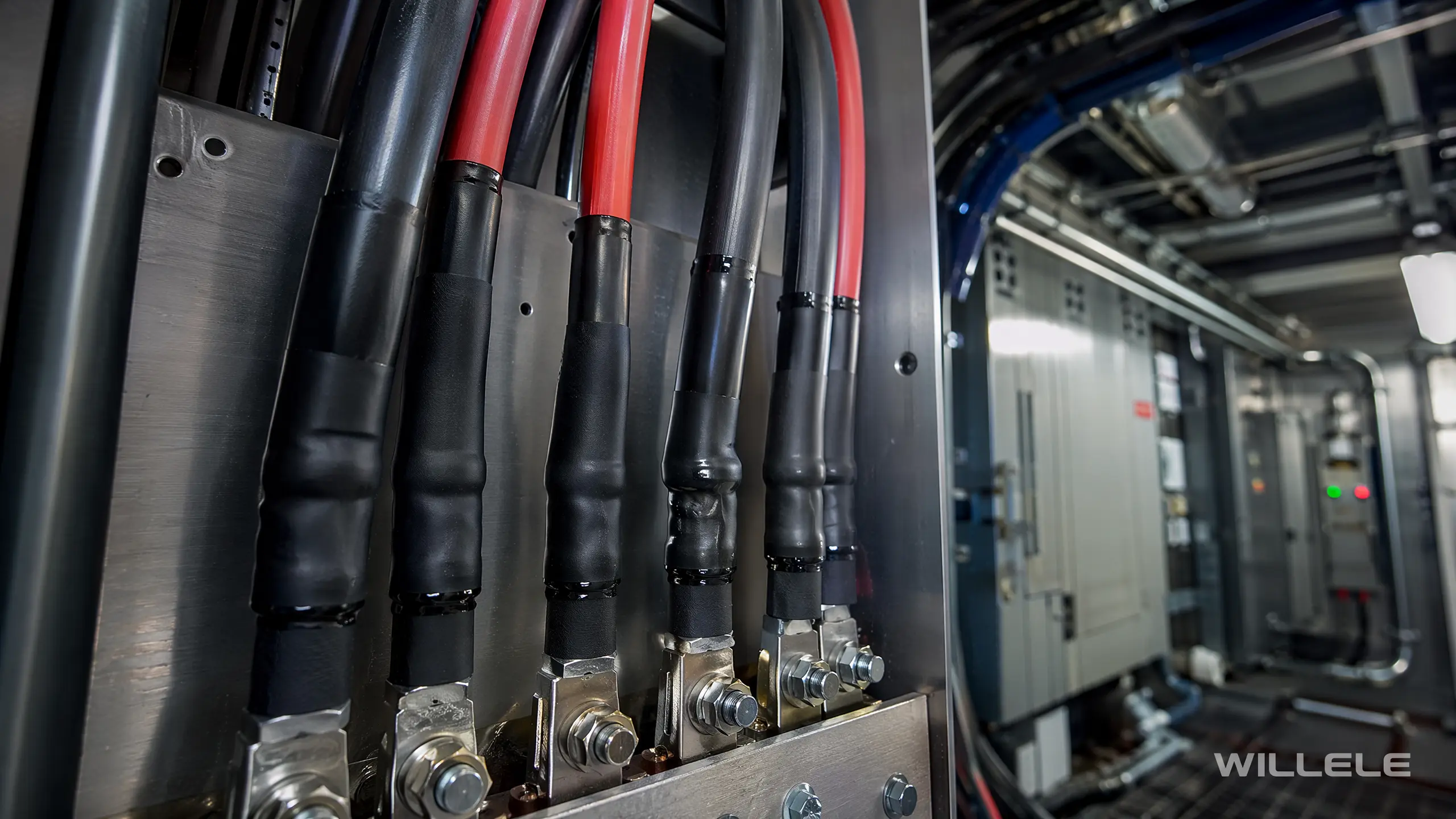
Meta Description: Marine-grade flame-retardant heat-shrink tubing is a non-negotiable layer of electrical protection in shipbuilding. This guide covers regulatory requirements, material selection, and what procurement teams across Asia-Pacific, European, and North American yards need to verify before sourcing.
Electrical failure at sea is not an inconvenience. It is a safety event with compounding consequences: fire in an enclosed compartment, loss of navigation, a propulsion blackout in a narrow channel. The shipbuilding industry has learned this lesson across decades of casualty investigations, and the resulting regulatory framework leaves little room for compromise on cable protection. Among the components that make a ship’s electrical system survivable, heat-shrink tubing occupies a quietly decisive role. It seals, insulates, and fire-hardens every splice, termination, and repair point in thousands of meters of shipboard wiring. When the specification calls for marine-grade flame-retardant heat-shrink tubing, the difference between a compliant product and a generic one can be the difference between a localized insulation fault and a class-survey failure — or worse.
Why Marine-Grade Is a Distinct Category
Heat-shrink tubing used in commercial buildings or land-based industrial plants operates in a forgiving environment. Shipboard installations do not. The marine environment combines salt-laden humidity, continuous vibration from engines and sea motion, wide temperature swings between deck and machinery spaces, and the ever-present risk of fire in compartments where crew evacuation paths are limited. A standard polyolefin tube that performs adequately in a factory control panel will embrittle under UV exposure on an open deck, lose adhesion in a diesel-soaked bilge, or emit dense toxic smoke when exposed to flame in an enclosed passageway.
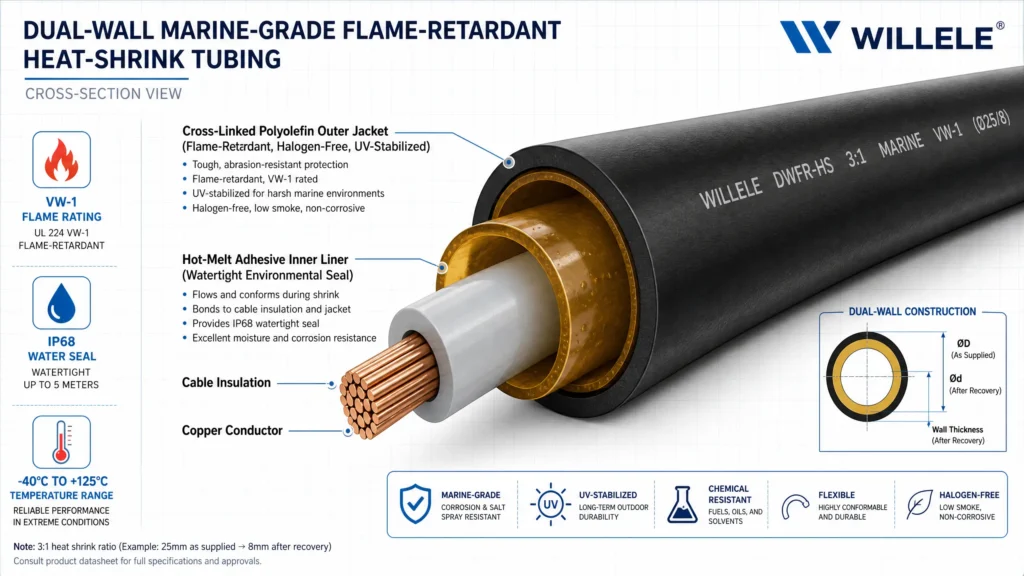
Marine-grade flame-retardant heat-shrink tubing is therefore a purpose-built category. It typically uses a cross-linked polyolefin formulation modified with halogen-free flame-retardant additives, often paired with a hot-melt adhesive inner layer that creates a watertight seal when the tube is recovered with heat. The outer jacket is formulated to resist diesel, hydraulic oil, and cleaning solvents — fluids that are ubiquitous in engine rooms and on deck. UV stabilization prevents cracking after years of tropical sun exposure. The flame-retardant chemistry is specifically tuned for low smoke density and low toxicity, because in a shipboard fire, visibility and breathable air matter as much as flame spread.
The Regulatory Framework That Shapes the Specification
Shipboard electrical installations are governed by a layered set of requirements. At the top sits the International Convention for the Safety of Life at Sea (SOLAS), which mandates that electrical equipment be constructed and installed so as to minimize the risk of fire, electric shock, and electromagnetic interference. SOLAS Chapter II-1, Part D references IEC 60092 — the comprehensive series of standards covering electrical installations in ships — as the recommended practice.
IEC 60092-350 and IEC 60092-351 define construction and test methods for shipboard cables and insulating materials. While these standards primarily address cable construction, the requirements for insulating and sheathing materials — flame retardancy, halogen content, smoke density, and temperature rating — apply with equal force to the heat-shrink tubing used to protect cable joints and terminations. IEC 60092-359 specifies sheathing compounds, many of which are halogen-free and cross-linked, setting a performance benchmark that marine-grade tubing must meet or exceed.
Below the IEC layer, classification societies enforce these standards through their own rules. DNV (Det Norske Veritas), Lloyd’s Register, the American Bureau of Shipping (ABS), Bureau Veritas, ClassNK, and the China Classification Society (CCS) each publish electrical installation rules that reference IEC 60092 and often add supplementary requirements. A heat-shrink tube that lacks type-approval documentation from at least one major classification society will not survive a survey inspection in a newbuild or major retrofit project. Procurement teams at yards in Shanghai, Ulsan, Singapore, or Hamburg routinely require manufacturers to produce certificates of compliance with IEC 60092-series standards, RoHS and REACH declarations, and batch-traceable certificates of conformance.
Additional standards apply depending on the vessel’s flag state and operating profile. Naval and coast guard vessels often invoke MIL-SPEC or equivalent national defense standards. Offshore oil and gas platforms add the requirements of IEC 61892 (mobile and fixed offshore units) and often the Norwegian NORSOK standards for the North Sea sector. Passenger vessels, particularly those operating in European waters, face heightened scrutiny under the EU Marine Equipment Directive (MED), which requires type approval by a notified body for fire-protective materials installed on EU-flagged ships.
Material Science and Key Performance Parameters
The dominant material family for marine-grade heat-shrink tubing is cross-linked polyolefin. The cross-linking process — typically achieved through electron-beam irradiation or chemical cross-linking — transforms a thermoplastic into a thermoset with shape memory: the tube can be expanded during manufacturing and will shrink back to its original dimensions when heated above its crystalline melting point, typically in the range of 90°C to 125°C. The cross-linked structure also improves resistance to solvents, stress cracking, and elevated temperatures.
Flame retardancy in polyolefin tubing is achieved through additive chemistry. Traditional halogenated flame retardants (brominated or chlorinated compounds) are highly effective at suppressing flame but release dense, corrosive, and toxic smoke when they burn. In a ship’s confined compartments, that smoke is often more dangerous than the fire itself. The marine industry has therefore driven a decisive shift toward halogen-free flame-retardant (HFFR) formulations, which use metal hydroxide fillers — typically aluminum trihydroxide (ATH) or magnesium dihydroxide (MDH) — that absorb heat and release water vapor when exposed to flame, cooling the material and diluting combustible gases. These formulations achieve VW-1 ratings under UL 224 while producing dramatically less smoke and no halogen acid gases.
The table below summarizes the key performance parameters that distinguish marine-grade tubing from general-purpose alternatives.
| Parameter | Marine-Grade Requirement | General-Purpose Typical | Relevance at Sea |
|---|---|---|---|
| Flame Retardancy | VW-1 (UL 224), self-extinguishing within 60 s | VW-1 or none | Enclosed compartments, limited evacuation |
| Halogen Content | Zero halogen (IEC 60754-1), HCl emission ≤ 0.5% | May contain halogens | Prevents toxic gas and equipment corrosion |
| Smoke Density | Low smoke (IEC 61034), typically ≥ 60% light transmission | Not specified | Preserves visibility for crew evacuation |
| Shrink Ratio | 2:1, 3:1, or 4:1 | 2:1 common | Higher ratios cover irregular connector geometries |
| Operating Temperature | -40°C to +125°C continuous (polyolefin) | -55°C to +135°C typical but without marine validation | Deck-to-engine-room thermal swing |
| UV Resistance | Stabilized for extended outdoor exposure | Often unstabilized | Open-deck cable runs, tropical service |
| Chemical Resistance | Diesel, hydraulic oil, bilge water, cleaning agents | Limited or unspecified | Engine-room and deck fluid exposure |
| Adhesive Liner | Hot-melt adhesive, watertight seal | Often single-wall only | Prevents moisture ingress and corrosion |
Single-Wall vs. Dual-Wall Construction
One of the first decisions in specifying marine heat-shrink tubing is whether single-wall or dual-wall construction is required. The choice is driven by the level of environmental sealing the application demands.
Single-wall tubing consists of one extruded and cross-linked layer. It provides electrical insulation, mechanical protection, and flame retardancy. In shipbuilding, single-wall tubing is typically used for color-coding, light-duty harness bundling, and insulation of connections inside watertight enclosures where additional moisture sealing is not needed. It is lighter, more flexible, and generally lower in cost than its dual-wall counterpart.
Dual-wall tubing adds a second, co-extruded inner layer of hot-melt adhesive. When the tube is heated and shrinks, the adhesive melts and flows into the voids around the connection, then solidifies to form a permanent environmental seal. This seal resists water ingress, salt spray, and corrosive fluids — exactly the conditions found in bilge areas, on weather decks, and at through-bulkhead penetrations. The adhesive also provides strain relief, reducing the risk of wire fatigue at the termination point in high-vibration environments. For any connection exposed to the marine environment, dual-wall adhesive-lined tubing is the standard choice.
| Feature | Single-Wall | Dual-Wall (Adhesive-Lined) |
|---|---|---|
| Insulation | Yes | Yes |
| Moisture Seal | No | Yes — permanent watertight seal |
| Strain Relief | Limited | Yes — adhesive bonds to cable jacket |
| Corrosion Protection | Wire surface exposed to environment | Encapsulated and sealed |
| Typical Shipbuilding Use | Internal panel wiring, color coding | Deck connections, bilge areas, penetrations |
| Shrink Ratio Availability | 2:1, 3:1 | 3:1, 4:1 |
Selecting the Right Product for Shipbuilding Applications
Procurement teams and specifying engineers should evaluate heat-shrink tubing against the specific zone of the vessel where it will be installed. A uniform specification across all shipboard zones is rarely cost-effective; instead, match the tubing grade to the environmental severity.
Machinery spaces (engine rooms, generator rooms) demand maximum fluid resistance — diesel, lubricating oil, and hydraulic fluid are always present. Operating temperatures can exceed 80°C near exhaust systems and turbochargers. Dual-wall, HFFR polyolefin tubing rated for continuous operation at 125°C is the baseline choice here. Verify that the adhesive liner is formulated for sustained elevated temperature without creep or degradation.
Weather decks and exposed areas add UV radiation and salt spray to the requirement set. The outer jacket must be UV-stabilized; unstabilized polyolefin will chalk, crack, and lose dielectric strength within two to three years of tropical exposure. Black tubing generally offers the best UV resistance because carbon black acts as an effective UV absorber, but colored tubing with UV-stabilizer packages is available for the identification schemes required by many shipyards.
Accommodation and bridge spaces are environmentally benign compared to machinery spaces, but they are also where crew live and work. Fire performance here shifts toward low smoke and low toxicity as the dominant criteria. LSZH (low-smoke zero-halogen) formulations are essential because in a fire, the smoke from burning cable insulation and tubing in ventilation ducts can incapacitate crew before the flames reach them. Many European ferry and cruise ship operators now mandate LSZH materials throughout the accommodation block as a condition of their safety management systems, even where flag-state regulations have not yet caught up.
Hazardous areas (tanker pump rooms, battery rooms on hybrid vessels, fuel cell compartments) require tubing that meets the additional requirements of IEC 60079-series standards for explosive atmospheres. Anti-static properties — achieved through conductive carbon loading or surface treatments — may be necessary to prevent electrostatic discharge. Specifying engineers should confirm with the tubing manufacturer that the product has been tested under the relevant ATEX or IECEx scheme before installation in a classified zone.
What to Verify Before Sourcing
The gap between a datasheet claim and verified performance is where procurement risk concentrates. Before approving a supplier of marine-grade heat-shrink tubing, request the following documentation as a minimum:
- Type-approval certificate from at least one IACS-member classification society (DNV, LR, ABS, BV, ClassNK, CCS, RINA, RS, KR, IRS, or PRS). This confirms the product has been evaluated against the society’s rules for marine electrical installations.
- Third-party flammability test reports to UL 224 VW-1 or IEC 60332-1, not manufacturer self-declarations.
- Halogen content verification per IEC 60754-1/2, with HCl emission below the 0.5% threshold.
- Smoke density test data per IEC 61034, ideally showing light transmission above 60% for LSZH grades.
- Batch-level certificate of conformance with traceability to raw-material lots, enabling audit trails during class surveys.
- RoHS and REACH compliance declarations covering the full product, including the adhesive liner in dual-wall products.
- Shelf-life documentation — cross-linked polyolefin tubing has a finite shelf life, typically five to ten years from the date of manufacture when stored under recommended conditions. Shipyards building for stock or with long project timelines need to verify that delivered product will remain within shelf life through the commissioning phase.
Willele Electrical, as a B2B supplier of heat-shrink tubing, terminal blocks, busbar insulators, and power distribution accessories, provides full documentation packages with every shipment, including batch-traceable certificates of conformance, RoHS/REACH statements, and third-party test reports. Products are manufactured under an IQC→IPQC→OQC quality assurance chain that ensures consistency from sample approval through production delivery.
The Cost of Getting It Wrong
Selecting the wrong heat-shrink tubing does not announce itself immediately. A non-marine-grade tube installed in a newbuild looks identical to a compliant one at the time of installation. The failure emerges later: a brittle tube cracks around a terminal after two seasons of thermal cycling, exposing the conductor to salt-laden air. An adhesive liner without marine-formulated chemistry delaminates in diesel-contaminated bilge water, allowing capillary creep of moisture into the cable core. A halogenated tube involved in a minor electrical fire fills an engine-room compartment with corrosive hydrogen chloride gas, damaging adjacent switchgear far beyond the original fault zone.
Each of these failure modes has been documented in marine casualty reports. The common thread is that the procurement decision was made on unit price alone, without verifying that the product met the specific demands of the installation environment. For a component that typically represents less than half a percent of a vessel’s electrical installation budget, the risk-reward calculus of specification shortcuts is extraordinarily unfavorable.
Frequently Asked Questions
What is the difference between marine-grade and standard heat-shrink tubing?
Marine-grade heat-shrink tubing is formulated for the shipboard environment: it is halogen-free and low-smoke, UV-stabilized for deck exposure, resistant to diesel and hydraulic fluids, and tested to the fire-performance standards referenced by classification societies. Standard industrial tubing typically lacks one or more of these properties and is not accepted by marine surveyors for newbuild or major retrofit installations.
Which shrink ratio should I specify for shipboard connections?
A 3:1 ratio covers most shipboard applications, including connectors with moderate diameter variation. For terminations involving large step-changes in diameter — such as sealing a cable breakout or transitioning from a connector backshell to a cable jacket — a 4:1 ratio provides the necessary range. A 2:1 ratio is adequate for uniform-diameter insulating and color-coding inside protected enclosures.
Does marine-grade heat-shrink tubing require classification society type approval?
In practice, yes. While the tubing itself may not carry a standalone type-approval certificate in every jurisdiction, the electrical installation as a whole must satisfy the classification society’s rules, which reference IEC 60092-series standards for insulating materials. Surveyors will require documentation demonstrating that installed insulating components meet the fire-performance, halogen-content, and smoke-density requirements of those standards. Sourcing from a manufacturer that provides classification-society-recognized test documentation eliminates this survey risk.
Can heat-shrink tubing be used to repair damaged shipboard cable jackets?
Yes — this is one of the most common shipboard applications. Dual-wall adhesive-lined tubing in particular is well suited to cable jacket repair because the adhesive liner bonds to the existing cable sheath and restores the environmental seal. The repair must be documented in the vessel’s electrical maintenance records, and for classed vessels, any repair affecting the cable’s fire-performance characteristics should be reviewed with the attending surveyor.
What is the operating temperature limit for marine-grade polyolefin tubing?
Standard cross-linked polyolefin tubing is rated for continuous operation from -40°C to +125°C, with short-term excursions to higher temperatures during the heat-shrink recovery process. For applications near exhaust systems or other high-temperature sources, fluoropolymer-based tubing (PTFE or FEP) offers continuous ratings up to 200°C or 260°C respectively, though at a higher unit cost.
How long does marine-grade heat-shrink tubing remain usable in storage?
Manufacturers typically specify a shelf life of five to ten years from the date of manufacture when stored in original packaging at temperatures below 35°C and away from direct sunlight and UV sources. Exceeding the shelf life does not necessarily make the product unusable, but recovery ratio and adhesive performance may degrade. Shipyards should incorporate received-date tracking into their warehouse management systems and rotate stock accordingly.
