
Stadium Lighting Project: Waterproof Wire Nut Application

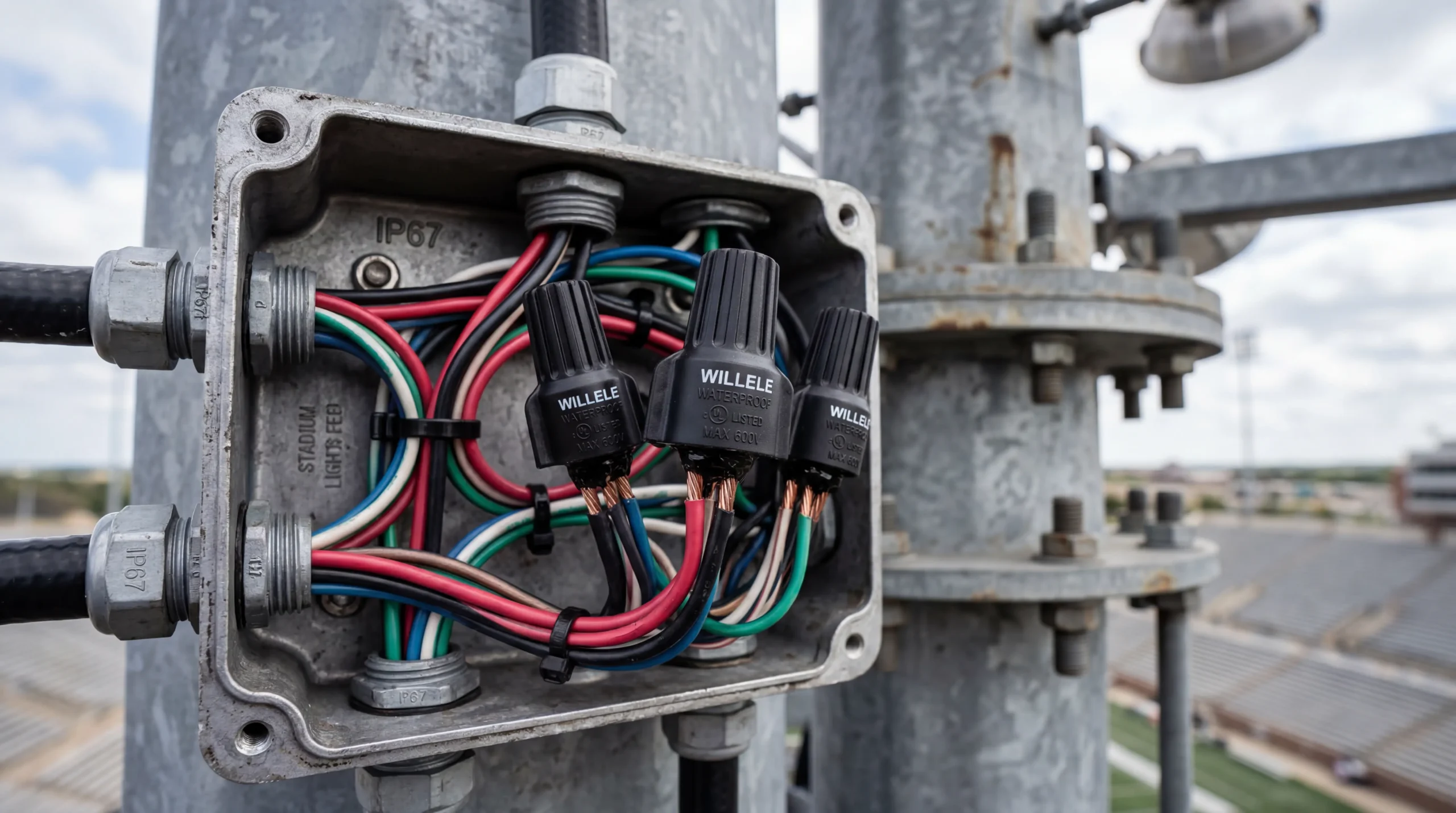
Stadium lighting systems represent one of the most demanding electrical installations in modern infrastructure. These high-powered illumination networks must deliver consistent performance under extreme weather conditions, temperature fluctuations, and constant exposure to environmental elements. At the heart of reliable stadium lighting installations lies a critical component often overlooked: waterproof wire nuts. Understanding their application, selection, and installation is essential for electrical contractors, facility managers, and project engineers working on large-scale outdoor lighting projects.
Understanding Waterproof Wire Nuts in Stadium Applications
Waterproof wire nuts are specialized electrical connectors designed to create moisture-resistant, corrosion-proof connections in outdoor and harsh environment applications. Unlike standard wire nuts used in indoor installations, waterproof variants incorporate advanced sealing technologies that prevent water infiltration, dust accumulation, and environmental degradation.
In stadium lighting projects, these connectors serve multiple critical functions. They secure electrical connections between main power feeds and individual light fixtures, protect junction points from rain and humidity, maintain consistent electrical conductivity despite temperature swings, and ensure long-term reliability in installations that may remain operational for decades. The stakes are particularly high in stadium environments where lighting failure during events can result in significant financial losses and safety concerns.
Stadium lighting systems typically operate at voltages ranging from 120V to 480V, with some specialized installations reaching even higher voltages. The electrical loads involved are substantial, with modern LED stadium lighting systems drawing considerable current despite their energy efficiency improvements over traditional metal halide fixtures. This combination of high voltage, significant current flow, and constant environmental exposure makes waterproof wire nuts not just recommended but essential for proper installation.
Technical Specifications and IP Rating Requirements
The Ingress Protection (IP) rating system provides standardized classification for the sealing effectiveness of electrical enclosures and connectors. For stadium lighting applications, understanding these ratings is fundamental to selecting appropriate waterproof wire nuts.
IP Rating Breakdown for Stadium Lighting
| IP Rating | Solid Particle Protection | Liquid Ingress Protection | Stadium Application Suitability |
|---|---|---|---|
| IP65 | Dust tight | Protected against water jets | Suitable for covered junction boxes |
| IP67 | Dust tight | Protected against temporary immersion (up to 1m, 30 min) | Recommended for most outdoor installations |
| IP68 | Dust tight | Protected against continuous submersion | Required for direct burial and flood-prone areas |
For most stadium lighting projects, IP67-rated waterproof wire nuts represent the optimal balance between protection level and cost-effectiveness. These connectors can withstand temporary submersion, making them ideal for installations in areas that may experience heavy rainfall, snow accumulation, or occasional flooding. However, installations in coastal stadiums or facilities with known drainage issues should specify IP68-rated connectors for maximum protection.
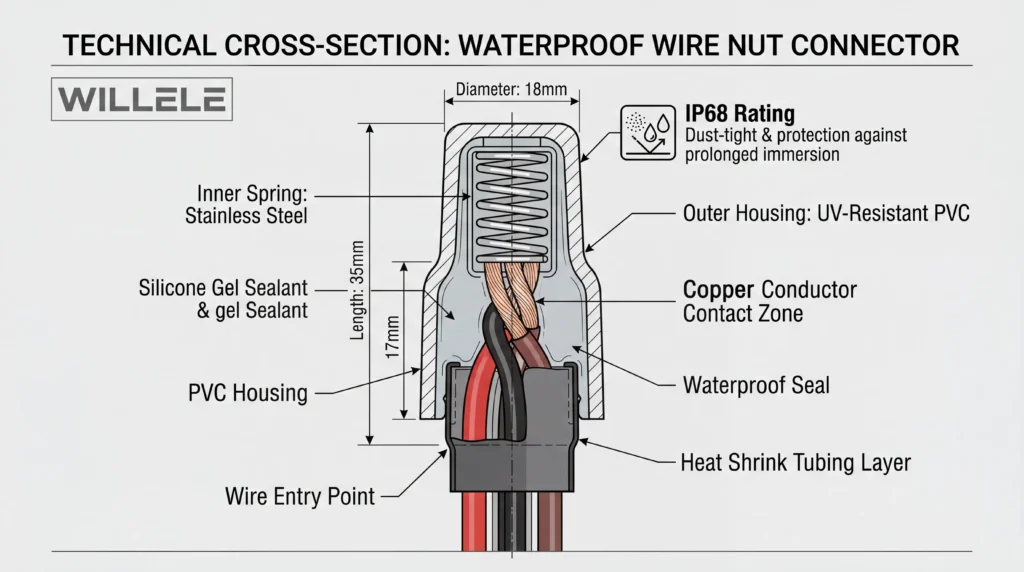
The internal construction of waterproof wire nuts typically includes multiple protective layers. A silicone gel or petroleum-based sealant fills the interior cavity, surrounding the wire connection points and displacing any air or moisture. The outer housing, usually constructed from UV-resistant PVC or similar polymer, provides mechanical protection and additional environmental sealing. Many premium waterproof wire nuts also incorporate heat-shrink tubing elements that activate during installation, creating an additional barrier against moisture infiltration.
Wire Gauge Compatibility and Electrical Specifications
Stadium lighting installations involve a wide range of wire gauges depending on the specific application, distance from power source, and electrical load requirements. Waterproof wire nuts must be carefully matched to the wire gauges being connected to ensure proper mechanical grip and electrical conductivity.
Wire Gauge Compatibility Chart
| Wire Gauge (AWG) | Typical Stadium Application | Recommended Connector Size | Maximum Voltage Rating |
|---|---|---|---|
| 22-18 AWG | Control circuits, sensors | Small (Red/Yellow) | 600V |
| 16-14 AWG | Individual fixture connections | Medium (Blue) | 600V |
| 12-10 AWG | Branch circuit feeds | Large (Yellow/Orange) | 600V |
| 8-6 AWG | Main distribution lines | Extra Large (Gray) | 1000V |
The color-coding system used by most manufacturers provides quick visual identification of connector size, reducing installation errors and improving efficiency during large-scale projects. However, installers should always verify compatibility by checking the wire gauge markings printed on the connector body rather than relying solely on color recognition. citation
Stadium lighting circuits typically operate at 600V or less for building wire applications, though some specialized sign and luminaire circuits may reach 1000V. Waterproof wire nuts used in these applications must be rated for the maximum voltage present in the system, with an appropriate safety margin. Most quality waterproof wire nuts carry ratings of 600V for standard applications and 1000V for specialized lighting circuits.
Installation Best Practices for Stadium Lighting Projects
Proper installation technique is critical to achieving the full protective benefits of waterproof wire nuts. Even the highest-quality connectors will fail prematurely if installed incorrectly, making adherence to best practices essential for long-term system reliability.
Pre-Installation Preparation
Before beginning any connection work, verify that power is completely disconnected at the circuit breaker and use a non-contact voltage tester to confirm the absence of electrical current. This fundamental safety step cannot be skipped, regardless of project timeline pressures. Stadium lighting circuits carry substantial electrical loads that can cause severe injury or death if proper lockout/tagout procedures are not followed.
Wire preparation begins with careful stripping of insulation. Most waterproof wire nuts require 13-16mm (0.5-0.63 inches) of exposed conductor. Strip length is critical—too little exposed wire results in poor electrical contact, while excessive stripping leaves vulnerable conductor exposed outside the protective connector housing. Use quality wire strippers calibrated for the specific gauge being worked with to ensure clean cuts without nicking the conductor strands.
Clean the exposed conductor thoroughly before insertion into the waterproof wire nut. Outdoor environments often leave oxidation, dirt, or moisture on wire surfaces. A quick wipe with a clean cloth or light abrasion with fine sandpaper ensures optimal electrical contact. For connections in coastal stadiums or industrial areas with high pollution levels, consider using contact cleaner spray to remove any chemical residues that might interfere with conductivity.
Connection Process
Insert the prepared wires into the waterproof wire nut, ensuring they reach the bottom of the connector cavity. Most quality connectors feature a transparent or translucent housing that allows visual verification of proper insertion depth. The wires should bottom out against the internal stop, with all conductor strands fully contained within the connector body.
Twist the connector clockwise with firm, steady pressure. Unlike standard wire nuts that require multiple rotations, waterproof variants typically need only 2-3 complete turns to achieve proper connection. Over-tightening can damage the internal seal or crack the housing, while under-tightening fails to achieve adequate mechanical and electrical contact. The connector should feel snug without requiring excessive force.
For connectors incorporating heat-shrink elements, apply heat evenly around the entire circumference using a heat gun set to the manufacturer’s recommended temperature (typically 280-350°F). Move the heat source continuously to avoid overheating any single spot, which could damage the connector or wire insulation. The heat-shrink tubing should contract uniformly, and any internal adhesive should be visible flowing slightly from the ends, indicating complete seal activation.
Post-Installation Verification
After completing the connection, perform a gentle pull test on each wire to verify mechanical security. The wires should remain firmly seated with no movement or slippage. Any wire that pulls free indicates improper installation and must be reconnected using a fresh waterproof wire nut.
Visual inspection should confirm that no bare conductor is visible outside the connector housing and that the seal appears intact with no cracks or gaps. For heat-shrink connectors, verify that the tubing has contracted fully and that adhesive has sealed both wire entry points.
Comparing Waterproof Wire Nuts to Alternative Connection Methods
Stadium lighting projects may employ various connection technologies depending on specific requirements, budget constraints, and engineering preferences. Understanding the comparative advantages and limitations of each approach enables informed decision-making during project planning.
Connection Method Comparison
| Connection Method | Waterproof Rating | Installation Time | Reusability | Cost per Connection | Best Application |
|---|---|---|---|---|---|
| Gel-filled wire nuts | IP67-IP68 | 30-60 seconds | Limited | $0.50-$1.50 | General outdoor connections |
| Heat-shrink solder connectors | IP68 | 2-3 minutes | No | $0.75-$2.00 | Permanent high-reliability connections |
| Compression connectors with tape | IP65 | 3-5 minutes | No | $0.40-$1.00 | Budget-conscious projects |
| Mechanical splice connectors | IP54 | 1-2 minutes | Yes | $2.00-$5.00 | Temporary or maintenance applications |
| Standard wire nuts with sealant | IP54 | 2-4 minutes | Limited | $0.30-$0.80 | Indoor or protected locations only |
Gel-filled waterproof wire nuts offer the optimal balance of protection, installation speed, and cost-effectiveness for most stadium lighting applications. Their pre-filled design eliminates the need for separate sealant application, reducing installation time and potential error. The silicone or petroleum-based gel displaces air and moisture while maintaining flexibility across wide temperature ranges, typically from -40°C to 120°C (-40°F to 248°F).
Heat-shrink solder connectors provide the highest level of waterproof protection and mechanical strength but require more installation time and specialized tools. These connectors incorporate a solder ring that melts when heat is applied, creating a metallurgical bond between conductors. The surrounding heat-shrink tubing then contracts, with internal adhesive flowing to seal the connection completely. This approach is ideal for critical connections in harsh environments or where long-term reliability is paramount and maintenance access is limited.
Traditional compression connectors wrapped with self-amalgamating tape represent an older approach that has largely been superseded by modern waterproof wire nuts. While this method can achieve adequate sealing when executed properly, it requires more skill and time, and the quality of the seal depends heavily on installer technique. The labor cost differential typically outweighs any material cost savings, making this approach less attractive for large stadium projects.
Material Selection and Environmental Considerations
The materials used in waterproof wire nut construction directly impact performance, longevity, and suitability for specific stadium environments. Understanding these material properties enables specification of connectors optimized for local conditions.
Housing Materials
PVC (Polyvinyl Chloride) represents the most common housing material for waterproof wire nuts. It offers excellent moisture resistance, good mechanical strength, and UV stability when properly formulated with stabilizing additives. Quality PVC housings maintain flexibility across wide temperature ranges and resist cracking even after years of outdoor exposure. However, PVC performance can degrade in extreme cold, becoming brittle below -20°C (-4°F), which may be a consideration for stadiums in northern climates.
Polyolefin materials provide superior temperature performance, maintaining flexibility from -55°C to 135°C (-67°F to 275°F). These materials also offer better chemical resistance than PVC, making them ideal for industrial stadiums or facilities near chemical plants, refineries, or coastal areas with salt spray exposure. The primary disadvantage is higher cost, typically 20-30% more than equivalent PVC connectors.
Nylon housings offer exceptional mechanical strength and abrasion resistance, useful in installations where connectors may be subject to physical impact or vibration. However, nylon is hygroscopic, meaning it absorbs moisture from the environment, which can compromise sealing performance over time. For this reason, nylon housings are less common in waterproof wire nut applications and are typically reserved for specialized industrial connectors.
Internal Sealant Types
Silicone-based sealants provide the best overall performance for stadium lighting applications. They remain stable across extreme temperature ranges, resist UV degradation, and maintain sealing properties for decades. Silicone sealants are chemically inert, meaning they won’t react with copper conductors or wire insulation materials. The primary disadvantage is higher cost compared to petroleum-based alternatives.
Petroleum-based sealants offer good moisture exclusion at lower cost but have more limited temperature ranges and may degrade over time when exposed to certain chemicals or extreme UV radiation. These sealants work well in moderate climates and protected installations but may not be the best choice for stadiums in extreme environments or areas with high pollution levels.
Grease-filled connectors represent a middle ground, offering better performance than petroleum-based sealants while remaining more cost-effective than silicone-filled variants. The dielectric grease used in these connectors provides good moisture exclusion and maintains conductivity by preventing oxidation of wire surfaces. However, grease can migrate out of the connector over time, particularly in hot climates, potentially reducing long-term sealing effectiveness.
Stadium-Specific Installation Challenges
Stadium lighting installations present unique challenges that distinguish them from typical outdoor lighting projects. Understanding these specific considerations enables better planning and execution of waterproof wire nut installations.
Height and Access Considerations
Stadium light fixtures are typically mounted at significant heights—often 60-150 feet above ground level for major venues. This elevation creates multiple challenges for connection work. First, all materials and tools must be transported to the work location, making lightweight, compact waterproof wire nuts preferable to bulkier alternatives. Second, working at height limits the time available for each connection, making quick-install designs with pre-filled sealant essential for maintaining project schedules.
The elevated work environment also means that any connection failure requires expensive lift equipment and labor to access and repair. This reality makes the incremental cost of premium waterproof wire nuts trivial compared to the potential cost of callbacks and repairs. Specifying high-quality connectors with proven long-term reliability is simply good economic sense for stadium projects.
Vibration and Mechanical Stress
Stadium structures experience significant vibration during events, particularly in venues hosting concerts or events with large crowds. This vibration can work connections loose over time if not properly secured. Waterproof wire nuts with internal spring mechanisms or locking features provide additional security against vibration-induced loosening.
Wind loading represents another mechanical stress factor, particularly for light fixtures mounted on tall poles or masts. The constant movement and flexing of these structures can fatigue connections over time. Using waterproof wire nuts with strain relief features or incorporating separate strain relief methods in the installation design helps mitigate this issue.
Temperature Cycling
Stadium lighting systems experience extreme temperature cycling, particularly in climates with hot summers and cold winters. A fixture that reaches 60°C (140°F) under summer sun may drop to -20°C (-4°F) on a winter night—an 80°C (144°F) temperature swing. This cycling causes expansion and contraction of all materials, which can compromise connections over time.
Quality waterproof wire nuts address this challenge through material selection and design features that accommodate thermal movement. The internal sealant must remain flexible across the entire temperature range, while the housing material must not crack or become brittle. Copper conductor contact surfaces should be tinned or plated to prevent oxidation that might increase resistance as connections expand and contract.
Maintenance and Long-Term Performance
Even the best waterproof wire nuts require periodic inspection and maintenance to ensure continued performance throughout the stadium lighting system’s operational life.
Inspection Schedule
Establish a regular inspection schedule based on environmental conditions and system criticality. For most stadium installations, annual inspections provide adequate monitoring without excessive labor cost. Facilities in harsh environments—coastal areas with salt spray, industrial zones with chemical exposure, or regions with extreme weather—should consider semi-annual inspections.
During inspections, examine all accessible junction boxes and connection points for signs of moisture intrusion, corrosion, or physical damage. Look for discoloration of connector housings, which may indicate UV degradation or chemical exposure. Check for cracks, particularly around wire entry points where stress concentration is highest. Verify that junction box covers remain properly sealed and that gaskets show no signs of deterioration.
Performance Testing
Beyond visual inspection, periodic electrical testing helps identify developing issues before they cause failures. Infrared thermography provides a non-invasive method for detecting high-resistance connections, which appear as hot spots in thermal images. Elevated temperature at a connection point indicates increased resistance, often caused by corrosion, loosening, or degraded contact surfaces.
Insulation resistance testing (megger testing) verifies that the waterproof seal remains intact and that no moisture has infiltrated the connection. This test applies high voltage (typically 500-1000V) between conductors and ground, measuring the resistance of the insulation system. Declining insulation resistance over time indicates moisture infiltration or insulation degradation, warranting closer inspection or preventive replacement.
Replacement Criteria
Waterproof wire nuts should be replaced if any of the following conditions are observed: visible cracks or damage to the housing, signs of moisture inside the connector or junction box, discoloration indicating UV degradation or chemical exposure, loose connections that cannot be properly re-secured, or corrosion visible on conductor surfaces at the connection point.
As a general guideline, consider preventive replacement of waterproof wire nuts during major maintenance cycles or lighting system upgrades, even if no obvious defects are present. Connectors that have been in service for 15-20 years may have experienced sufficient UV exposure, temperature cycling, and environmental stress to warrant replacement as a preventive measure, particularly for critical circuits.
Cost Analysis and Project Budgeting
Understanding the true cost of waterproof wire nuts requires looking beyond simple per-unit pricing to consider total installed cost and life-cycle economics.
Material Cost Factors
Basic gel-filled waterproof wire nuts typically cost $0.50-$1.50 per unit, depending on size, IP rating, and purchase quantity. Premium connectors with silicone sealant, enhanced UV resistance, or specialized features may cost $1.50-$3.00 per unit. While this represents a significant premium over standard wire nuts ($0.10-$0.30 per unit), the additional cost is minimal in the context of total stadium lighting project budgets.
For a typical stadium lighting installation with 100-200 fixtures and multiple junction points, total waterproof wire nut costs might range from $500-$2,000 for materials. This represents less than 1% of total project cost for most installations, making the decision to specify quality waterproof connectors an easy one from a budget perspective.
Installation Labor Considerations
Installation labor represents a larger cost component than materials for most electrical work. Waterproof wire nuts that install quickly and reliably reduce labor costs while improving quality. Pre-filled gel connectors that require only wire insertion and twisting can be installed in 30-60 seconds, compared to 2-5 minutes for methods requiring separate sealant application or heat-shrink activation.
On a large stadium project with hundreds of connections, this time difference translates to significant labor savings. If waterproof wire nuts save even 2 minutes per connection, and the project involves 500 connections, that’s 1,000 minutes (16.7 hours) of labor saved. At typical electrical contractor labor rates of $75-$150 per hour, this represents $1,250-$2,500 in labor cost savings—far more than any material cost premium for quality connectors.
Life-Cycle Cost Analysis
The true economic value of waterproof wire nuts becomes apparent when considering life-cycle costs. A properly installed waterproof connection should last 20-30 years without requiring maintenance or replacement. In contrast, inadequate connections may fail within 5-10 years, requiring expensive repair work.
Consider the cost of a single connection failure in a stadium lighting system: lift equipment rental ($500-$1,500 per day), electrician labor (4-8 hours at $75-$150 per hour), replacement materials ($50-2,000-$5,000 or more to repair. Spending an extra $1-$2 per connection on quality waterproof wire nuts during initial installation represents excellent insurance against these potential costs.
Regulatory Compliance and Code Requirements
Stadium lighting installations must comply with numerous electrical codes, standards, and regulations. Understanding these requirements ensures that waterproof wire nut selection and installation meet all applicable criteria.
National Electrical Code (NEC) Requirements
The NEC provides fundamental requirements for electrical installations in the United States, with specific provisions for outdoor and wet location wiring. Article 410 addresses luminaire installations, while Article 300 covers general wiring methods applicable to stadium lighting projects.
NEC Section 110.11 requires that all electrical equipment exposed to deteriorating agents be identified for use in such environments. This requirement directly applies to waterproof wire nuts, which must be listed and labeled for wet location use. Look for UL (Underwriters Laboratories) listing or equivalent third-party certification when specifying connectors for stadium projects.
Section 300.5 addresses underground installations, relevant for direct burial applications in stadium lighting systems. When waterproof wire nuts are used in underground junction boxes or direct burial applications, they must be rated for such use, typically requiring IP68 rating and specific burial depth compliance.
International Standards
For stadium projects outside the United States or international venues, IEC (International Electrotechnical Commission) standards apply. IEC 60529 defines the IP rating system used to classify connector protection levels. IEC 60998 specifically addresses connecting devices for low-voltage circuits, providing performance requirements and testing protocols for wire connectors.
European stadium projects must also consider CE marking requirements, which indicate compliance with applicable EU directives. Waterproof wire nuts used in these installations should carry CE marking and meet Low Voltage Directive (LVD) requirements.
Local Jurisdiction Requirements
Beyond national and international standards, local electrical codes and jurisdiction-specific requirements may apply. Some municipalities have adopted amendments to the NEC that impose additional requirements for outdoor installations. Coastal jurisdictions may require enhanced corrosion protection, while areas prone to seismic activity might have specific mechanical securing requirements.
Always consult with local electrical inspectors early in the project planning phase to identify any jurisdiction-specific requirements that might affect waterproof wire nut selection or installation methods. This proactive approach prevents costly rework and project delays caused by code compliance issues discovered during inspection.
Integration with Heat Shrink Tubing Systems
As a manufacturer specializing in heat shrink tubing, WILLELE offers comprehensive solutions that combine waterproof wire nuts with complementary heat shrink products for enhanced protection and professional installation appearance.
Dual-Layer Protection Strategy
Combining waterproof wire nuts with heat shrink tubing creates a dual-layer protection system that exceeds the performance of either component alone. The waterproof wire nut provides the primary moisture seal and electrical connection, while an outer layer of heat shrink tubing adds mechanical protection, additional moisture barrier, and UV resistance.
This approach is particularly valuable in stadium applications where connections may be subject to physical impact, abrasion, or extreme environmental exposure. The heat shrink tubing shields the waterproof wire nut housing from UV radiation, potentially extending service life by 50-100% in high-sun-exposure locations.
Installation Process for Combined Systems
When integrating heat shrink tubing with waterproof wire nuts, select tubing with an inside diameter that accommodates the connector body when relaxed, but shrinks to provide a snug fit around incoming wires. Adhesive-lined heat shrink tubing provides the best seal, with the internal adhesive melting and flowing during heat application to create a moisture barrier at wire entry points.
Slide the heat shrink tubing onto wires before making the connection with the waterproof wire nut. After completing and verifying the wire nut connection, slide the heat shrink tubing over the connector body and apply heat evenly using a heat gun. The tubing should shrink uniformly, with adhesive visible flowing from both ends to indicate complete seal activation.
Material Compatibility Considerations
Ensure that heat shrink tubing materials are compatible with waterproof wire nut housing materials to prevent chemical reactions that might compromise either component. Polyolefin heat shrink tubing works well with most waterproof wire nut materials, offering good shrink ratios (typically 2:1 or 3:1), temperature resistance, and chemical stability.
For extreme environment applications, consider fluoropolymer heat shrink tubing, which offers superior chemical resistance, higher temperature ratings, and exceptional UV stability. While more expensive, fluoropolymer tubing provides maximum protection for critical connections in harsh stadium environments.
Case Study: Major Stadium Lighting Retrofit
A recent retrofit project at a 65,000-seat stadium in the southeastern United States provides practical insights into waterproof wire nut application in real-world conditions. The facility, originally built in the 1970s with metal halide lighting, underwent a complete LED conversion that required rewiring of all fixture connections.
Project Parameters
The stadium featured 312 LED fixtures mounted on six light towers ranging from 120-150 feet in height. The coastal location (8 miles from the ocean) presented significant environmental challenges, including salt spray, high humidity, and intense UV exposure. Summer temperatures regularly exceeded 95°F (35°C), while winter lows occasionally dropped to 25°F (-4°C).
The electrical contractor specified IP68-rated waterproof wire nuts with silicone sealant for all outdoor connections, combined with adhesive-lined heat shrink tubing for additional protection. Total material cost for waterproof connectors was approximately $3,200 for 1,847 connections throughout the system.
Installation Experience
The pre-filled waterproof wire nuts significantly accelerated installation compared to the contractor’s previous experience with heat-shrink solder connectors on similar projects. Average installation time per connection was 45 seconds, compared to 2-3 minutes for heat-shrink solder methods. This time savings translated to completing the connection work in 14 days rather than the 25 days originally estimated, resulting in substantial labor cost savings that far exceeded the material cost of the waterproof wire nuts.
The transparent housing on the selected connectors allowed installers to verify proper wire insertion visually, reducing connection errors and eliminating callbacks for loose connections. The contractor reported zero connection-related failures during system commissioning and testing.
Long-Term Performance
Three years after installation, the stadium’s maintenance team reports no connection failures or moisture-related issues despite the harsh coastal environment. Infrared thermography performed during annual maintenance has shown uniform temperature distribution across all connections, indicating consistent electrical contact without high-resistance points.
The facility manager estimates that the quality waterproof wire nuts have saved approximately $15,000 in potential repair costs over the three-year period, based on the average cost of addressing connection failures in their previous lighting system. This return on investment far exceeds the incremental cost of specifying premium waterproof connectors.
Frequently Asked Questions
Q: Can waterproof wire nuts be reused if a connection needs to be modified?
A: While some waterproof wire nuts can technically be reused, it is not recommended for critical applications like stadium lighting. The internal sealant may not reseal properly after disturbance, and the connector housing may have stress cracks not visible to the naked eye. Always use a fresh waterproof wire nut when modifying connections to ensure reliable performance.
Q: What is the maximum number of wires that can be connected with a single waterproof wire nut?
A: This depends on the specific connector size and wire gauges being joined. Most waterproof wire nuts are designed for 2-4 wires of the same gauge. Always consult the manufacturer’s specifications for maximum wire capacity. Exceeding the rated capacity can result in poor electrical contact, inadequate sealing, or mechanical failure of the connector.
Q: Do waterproof wire nuts require any special tools for installation?
A: Basic waterproof wire nuts require only standard wire strippers and hand strength for installation. Heat-shrink variants require a heat gun capable of reaching 280-350°F. Avoid using open flames (lighters, torches) as they can overheat and damage the connector or wire insulation.
Q: How do I know if a waterproof wire nut is properly installed?
A: A properly installed waterproof wire nut should pass these checks: wires cannot be pulled out with moderate force, no bare conductor is visible outside the housing, the connector feels snug without excessive play, and for heat-shrink types, the tubing has contracted uniformly with adhesive visible at wire entry points.
Q: Are waterproof wire nuts suitable for aluminum wire connections?
A: Some waterproof wire nuts are rated for aluminum wire, but always verify this in the product specifications. Aluminum requires special consideration due to its oxidation characteristics and thermal expansion properties. Use only connectors specifically listed for aluminum applications, and apply anti-oxidant compound to aluminum conductors before connection.
Q: What is the expected service life of waterproof wire nuts in outdoor stadium applications?
A: Quality waterproof wire nuts properly installed in stadium lighting applications should provide 20-30 years of reliable service. Actual service life depends on environmental conditions, quality of installation, and specific product quality. Regular inspection and maintenance help identify any connectors requiring early replacement.
