
Submersible Junction Boxes for Fountains and Swimming Pools

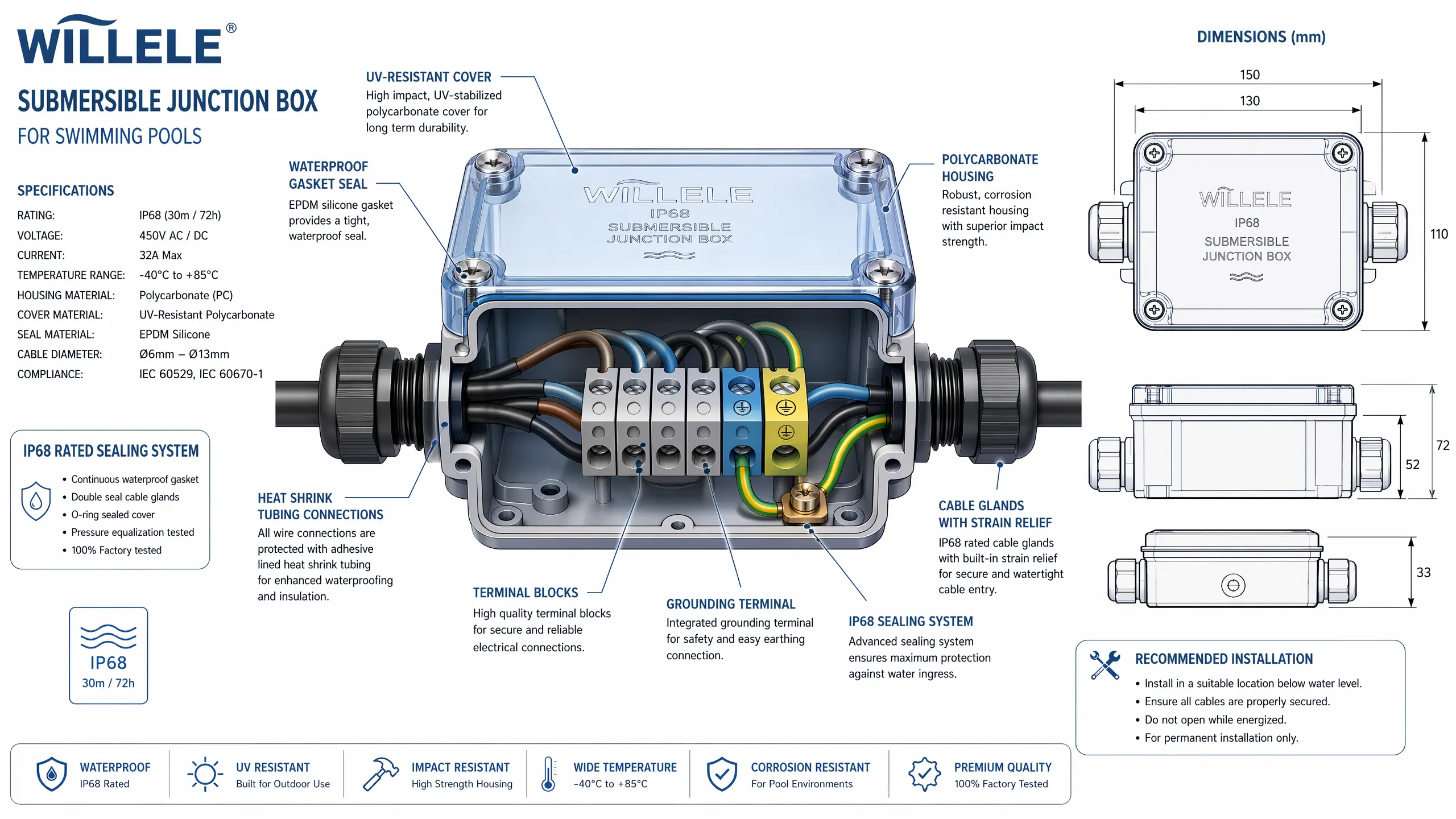
When it comes to electrical safety in aquatic environments, submersible junction boxes represent a critical component that ensures reliable power distribution while maintaining the highest safety standards. As water features and swimming pools become increasingly sophisticated with advanced lighting systems, automated controls, and filtration equipment, the demand for robust, waterproof electrical solutions has never been greater.
Willele Electrical, a leading B2B manufacturer specializing in heat shrink tubing and electrical protection solutions, brings decades of expertise to the design and production of submersible junction boxes engineered specifically for fountain and swimming pool applications. These specialized enclosures provide the essential bridge between above-water power sources and submerged electrical components, protecting connections from water ingress, chemical exposure, and environmental degradation.
Understanding Submersible Junction Boxes
A submersible junction box serves as a protective housing for electrical connections in underwater or wet environments. Unlike standard junction boxes designed for dry indoor applications, submersible variants must withstand continuous water immersion, pressure variations, temperature fluctuations, and exposure to pool chemicals such as chlorine and bromine.
The fundamental purpose of these enclosures is to create a watertight chamber where electrical wires can be safely connected, spliced, or terminated without risk of short circuits, corrosion, or electrical shock hazards. In fountain and pool installations, these boxes typically house connections for underwater LED lighting systems, pump motors, water feature controls, and sensor equipment.
Key Design Features
Modern submersible junction boxes incorporate several critical design elements that distinguish them from conventional electrical enclosures. The housing material typically consists of high-grade polycarbonate or ABS plastic, chosen for its exceptional resistance to UV radiation, impact damage, and chemical corrosion. These thermoplastic materials maintain structural integrity even after years of exposure to chlorinated water and direct sunlight.
The sealing system represents the most crucial aspect of submersible junction box design. Multiple gasket layers, typically manufactured from silicone or EPDM rubber, create redundant barriers against water penetration. Cable entry points feature specialized glands with compression seals that grip individual cables while maintaining the enclosure’s waterproof integrity. When properly installed with heat shrink tubing for additional cable protection, these entry systems can maintain their seal through thousands of thermal cycles and mechanical stress events.
Internal terminal blocks provide organized connection points for multiple circuits, with corrosion-resistant brass or stainless steel contact surfaces that resist oxidation even in humid internal environments. Strain relief mechanisms prevent cable movement from transmitting mechanical stress to electrical connections, a critical feature in applications where water currents or equipment vibration could otherwise compromise connection integrity.
IP Rating Standards for Aquatic Applications
The Ingress Protection (IP) rating system provides a standardized method for classifying the degree of protection electrical enclosures offer against solid particles and liquid intrusion. For submersible junction boxes used in fountains and swimming pools, understanding these ratings is essential for proper specification and installation.
| IP Rating | Solid Particle Protection | Liquid Protection | Suitable Applications |
|---|---|---|---|
| IP65 | Dust tight | Protected against water jets | Splash zones, above-water installations |
| IP67 | Dust tight | Protected against temporary immersion (up to 1m) | Shallow water features, periodic submersion |
| IP68 | Dust tight | Protected against continuous immersion (depth specified by manufacturer) | Fully submerged pool lights, deep fountain installations |
| IP69K | Dust tight | Protected against high-pressure, high-temperature washdown | Industrial pool systems, commercial water parks |
For swimming pool and fountain applications, IP68-rated junction boxes represent the industry standard. However, the “8” designation for liquid protection requires additional specification—manufacturers must declare the maximum depth and duration of submersion the enclosure can withstand. Willele’s submersible junction boxes are typically rated for continuous operation at depths up to 3 meters, suitable for the vast majority of residential and commercial pool installations.
It’s important to note that achieving and maintaining an IP68 rating depends not only on the junction box design but also on proper installation practices. Even the highest-rated enclosure will fail if cable glands are not correctly tightened, if incompatible cables are used, or if the gasket surfaces are damaged during installation.
Material Selection and Chemical Resistance
The aquatic environment presents unique challenges that demand careful material selection. Swimming pool water contains not only chlorine or salt but also pH-adjusting chemicals, algaecides, and dissolved minerals that can aggressively attack unsuitable materials.
Housing Materials
Polycarbonate resin has emerged as the preferred material for submersible junction box housings due to its exceptional balance of properties. This engineering thermoplastic offers impact resistance superior to acrylic or standard ABS, maintaining structural integrity even when subjected to accidental impacts from pool cleaning equipment or falling objects. Its inherent UV stability prevents the yellowing and embrittlement that plague lesser materials after extended sun exposure.
The transparent or translucent covers used on many submersible junction boxes allow visual inspection of internal connections without opening the enclosure—a valuable feature for maintenance personnel. These covers are typically manufactured from the same polycarbonate material as the base, ensuring consistent chemical resistance and thermal expansion characteristics.
Gasket and Seal Materials
Silicone rubber gaskets provide excellent performance across a wide temperature range (-40°C to +200°C) and maintain flexibility even after years of chemical exposure. Their resistance to ozone, UV radiation, and both chlorine and bromine makes them ideal for pool applications. EPDM (ethylene propylene diene monomer) rubber offers similar chemical resistance at a lower cost point, though with a slightly narrower temperature range.
The critical factor in gasket performance is compression set resistance—the material’s ability to return to its original shape after being compressed. High-quality silicone gaskets from reputable manufacturers like Willele maintain their sealing force through hundreds of thermal cycles, while inferior gaskets may develop permanent compression set within months, leading to seal failure.
Internal Components
Terminal blocks and connection hardware must resist corrosion in the humid, potentially contaminated atmosphere inside the junction box. Brass terminals with nickel plating provide excellent conductivity and corrosion resistance. Stainless steel hardware (grade 316 for marine environments) ensures that mounting screws and clamps maintain their integrity indefinitely.
Heat shrink tubing plays a vital role in protecting individual wire connections and cable entry points. Willele’s specialized heat shrink products, manufactured with cross-linked polyolefin materials, provide an additional layer of insulation and environmental protection. When properly applied, heat shrink tubing creates a moisture barrier that prevents water from wicking along cable strands even if the primary seal is compromised.
Installation Best Practices
Proper installation of submersible junction boxes is as important as the quality of the enclosure itself. Even the most robust IP68-rated box will fail prematurely if installation procedures are not followed meticulously.
Site Preparation
Before installation, the mounting location should be carefully selected to minimize mechanical stress and facilitate future maintenance access. In swimming pools, junction boxes are typically mounted on the pool wall at least 1.2 meters below the waterline to ensure they remain submerged even when the pool water level drops slightly. For fountains, mounting locations should avoid areas of high water turbulence that could subject the enclosure to excessive mechanical stress.
The mounting surface must be clean, smooth, and free from sharp protrusions that could damage gaskets or create stress concentration points on the enclosure. In concrete pools, mounting holes should be drilled with appropriate masonry bits, and stainless steel anchors should be used to prevent corrosion-related failure.
Cable Preparation and Entry
Cable preparation represents one of the most critical steps in achieving a reliable waterproof installation. Each cable entering the junction box should be stripped according to manufacturer specifications—typically removing only enough outer jacket to accommodate the cable gland while leaving sufficient length for strain relief.
Cable glands must be sized appropriately for the cable diameter. Oversized glands cannot achieve adequate compression on the cable jacket, while undersized glands may damage the cable or prevent proper insertion. Willele recommends using adjustable cable glands with compression seals that can accommodate a range of cable diameters while maintaining IP68 protection.
After inserting cables through the glands, apply heat shrink tubing to the cable jacket immediately adjacent to the gland entry point. This creates a smooth, enlarged section that enhances the gland’s grip while providing additional water resistance. The heat shrink should extend at least 25mm on either side of the gland for optimal performance.
Connection Techniques
Inside the junction box, connections should be made using appropriate terminal blocks or waterproof connectors. Avoid wire nuts or twist-on connectors in submersible applications—these provide inadequate environmental protection and can loosen over time due to vibration or thermal cycling.
Strip wire insulation to the minimum length required for the terminal block, typically 8-10mm. Excessive bare wire creates unnecessary shock hazards and corrosion points. After making connections, apply dielectric grease to terminal block contact points to displace any residual moisture and provide long-term corrosion protection.
For applications requiring wire splicing within the junction box, use heat shrink solder sleeves or crimp connectors specifically rated for wet environments. Standard crimp connectors, even when covered with heat shrink tubing, may allow water infiltration through capillary action along the wire strands.
Final Sealing and Testing
Before closing the junction box, carefully inspect the gasket seating surface for any debris, damage, or irregularities. Even a small particle trapped between the gasket and housing can create a leak path. Clean the surface with isopropyl alcohol and allow it to dry completely.
Apply a thin layer of silicone grease to the gasket—this aids in achieving uniform compression and extends gasket life by preventing drying and cracking. Position the cover carefully to avoid displacing the gasket, and tighten mounting screws in a cross pattern to ensure even pressure distribution.
After installation and before energizing the circuit, perform a continuity test to verify proper connections and an insulation resistance test to confirm there are no unintended paths to ground. While the junction box is still accessible (before final pool filling or fountain activation), consider performing a submersion test by temporarily submerging the installed assembly in a bucket of water while monitoring for bubble release, which would indicate a seal failure.
Application-Specific Considerations
Swimming Pool Installations
Swimming pools present unique challenges due to their combination of chemical exposure, regulated safety requirements, and accessibility constraints. Junction boxes in pool applications typically serve underwater lighting circuits, which operate at low voltage (12V or 24V) through transformers located in dry areas.
The National Electrical Code (NEC) in the United States and similar regulations in other jurisdictions mandate specific installation requirements for pool electrical systems. Junction boxes must be located at least 1.2 meters (4 feet) from the pool edge when above water, or at least 100mm (4 inches) below the water surface when submerged. These requirements minimize the risk of electrical shock to swimmers.
In saltwater pools, which have become increasingly popular as alternatives to chlorinated systems, the corrosive potential is significantly higher. Saltwater accelerates galvanic corrosion of dissimilar metals and can penetrate seals more readily than freshwater due to its lower surface tension. For these applications, Willele recommends junction boxes with enhanced seal designs and marine-grade internal components.
Fountain Applications
Decorative fountains often feature more complex electrical systems than swimming pools, with multiple circuits controlling pumps, lights, water jets, and control systems. Junction boxes in fountain applications may need to accommodate a larger number of cable entries and provide space for more extensive internal wiring.
Fountain installations frequently involve artistic or architectural considerations that influence junction box placement. In many cases, enclosures must be positioned to remain hidden from view while still maintaining accessibility for maintenance. This may require creative mounting solutions or the use of smaller, distributed junction boxes rather than a single large enclosure.
Water chemistry in fountains can vary widely depending on the water source, treatment methods, and environmental factors. Outdoor fountains may accumulate algae, mineral deposits, or organic debris that can interfere with seal integrity over time. Regular inspection and cleaning schedules should be established to maintain long-term reliability.
Comparison: Submersible vs. Splash-Proof Junction Boxes
| Feature | Submersible (IP68) | Splash-Proof (IP65/IP66) |
|---|---|---|
| Maximum depth | 3+ meters continuous | Not rated for immersion |
| Cable gland type | Compression with multiple seals | Basic strain relief |
| Gasket design | Multi-layer with redundancy | Single gasket |
| Internal coating | Conformal coating optional | Not typically required |
| Cost premium | 40-60% higher | Baseline |
| Maintenance interval | Annual inspection | Quarterly inspection |
| Typical applications | Submerged pool lights, deep fountain equipment | Poolside equipment, splash zones |
| Pressure resistance | Rated for water pressure at depth | Atmospheric pressure only |
Understanding the distinction between submersible and splash-proof junction boxes is essential for proper specification. While splash-proof enclosures cost less and may seem adequate for pool environments, they lack the pressure resistance and redundant sealing required for reliable submerged operation. Using an inadequate enclosure in a submersible application will result in water intrusion, corrosion, and eventual system failure.
Maintenance and Inspection Protocols
Even the highest-quality submersible junction boxes require periodic maintenance to ensure continued reliable operation. Establishing a systematic inspection and maintenance schedule prevents unexpected failures and extends equipment service life.
Annual Inspection Checklist
At least once per year, typically during pool opening or closing procedures, submersible junction boxes should undergo thorough inspection. Begin by de-energizing all circuits and verifying zero voltage with a multimeter. Carefully open the enclosure and examine the interior for any signs of moisture intrusion, which may appear as condensation, water droplets, or corrosion on terminal blocks.
Inspect the gasket for compression set, cracking, or deterioration. A properly functioning gasket should feel pliable and return to its original shape when compressed. If the gasket shows permanent deformation or surface cracking, replace it immediately—gaskets are inexpensive compared to the cost of water damage to electrical systems.
Examine cable glands for tightness and proper compression. Over time, thermal cycling can cause glands to loosen slightly. Retighten according to manufacturer specifications, being careful not to overtighten, which can damage the cable jacket or crack the gland body.
Check all electrical connections for tightness and signs of corrosion. Even in properly sealed enclosures, some internal humidity is inevitable, and over years this can lead to minor corrosion on connection points. Clean any corrosion with a wire brush or contact cleaner, and reapply dielectric grease to all terminals.
Heat Shrink Tubing Inspection
The heat shrink tubing applied at cable entry points serves as a critical secondary barrier against water intrusion. Inspect this tubing for any signs of damage, shrinkage, or separation from the cable jacket. UV exposure can degrade heat shrink tubing over time, particularly on installations where the junction box is located in shallow water with significant sun exposure.
If heat shrink tubing shows signs of deterioration, remove the damaged section and apply new tubing. Willele’s marine-grade heat shrink products include UV inhibitors and adhesive linings that provide superior long-term performance in aquatic environments.
Water Quality Monitoring
While not directly related to the junction box itself, monitoring pool or fountain water chemistry helps predict maintenance needs. Extremely high chlorine levels, pH imbalances, or excessive mineral content accelerate degradation of seals and housing materials. Maintaining water chemistry within recommended parameters extends the service life of all submerged equipment, including junction boxes.
Selecting the Right Junction Box for Your Application
Choosing an appropriate submersible junction box requires consideration of multiple factors beyond simple size and IP rating. The following decision framework helps ensure optimal selection for fountain and swimming pool applications.
Capacity Planning
Determine the number of circuits and cables that will enter the junction box. Count not only current requirements but also potential future additions—installing a slightly larger box initially costs far less than replacing an undersized unit later. Each cable entry requires a dedicated cable gland, and adequate internal space must be available for wire routing and connection without overcrowding.
As a general guideline, the internal volume of the junction box should be at least three times the total volume of cables and connections it will contain. This provides adequate working space during installation and prevents stress on connections due to tight bending radii.
Voltage and Current Ratings
Verify that the junction box and its internal terminal blocks are rated for the voltage and current of your application. Most pool lighting operates at low voltage (12-24V), but pump circuits may operate at 120V or 240V with substantial current draw. Terminal blocks should be rated for at least 125% of the maximum expected current to provide an adequate safety margin.
Environmental Factors
Consider the specific environmental conditions of your installation. Saltwater pools require enhanced corrosion resistance. Installations in direct sunlight need UV-stabilized materials. Fountains in public spaces may require vandal-resistant designs with tamper-proof fasteners.
Temperature extremes also influence material selection. While most submersible junction boxes operate reliably across a wide temperature range, installations in regions with extreme cold or heat may require special consideration. Willele’s engineering team can provide guidance on material selection for challenging environmental conditions.
Regulatory Compliance
Ensure that any junction box selected carries appropriate certifications for your jurisdiction. In North America, UL listing or CSA certification is typically required. European installations require CE marking and compliance with relevant EN standards. These certifications verify that the product has been independently tested and meets established safety standards.
The Willele Advantage: Quality Manufacturing and Technical Support
As a specialized B2B electrical equipment manufacturer, Willele Electrical brings unique advantages to submersible junction box applications. Our core expertise in heat shrink tubing technology directly informs our approach to cable entry systems and environmental sealing—we understand that a junction box is only as reliable as its weakest seal point.
Our manufacturing facilities employ rigorous quality control protocols, with every submersible junction box undergoing pressure testing and electrical safety verification before shipment. We maintain extensive inventory of standard configurations while offering custom solutions for specialized applications that standard products cannot address.
Beyond product quality, Willele provides comprehensive technical support to help customers specify, install, and maintain submersible junction boxes. Our engineering team has decades of combined experience in aquatic electrical systems and can provide guidance on everything from initial design through long-term maintenance planning.
For distributors, contractors, and facility managers seeking reliable submersible junction boxes for fountain and swimming pool applications, Willele represents a trusted partner committed to electrical safety and long-term performance. Our products protect not only electrical connections but also the people who depend on safe, reliable aquatic electrical systems.
Frequently Asked Questions
Q: What is the typical lifespan of a submersible junction box in a swimming pool?
A: With proper installation and regular maintenance, a high-quality submersible junction box should provide 10-15 years of reliable service in a residential swimming pool. Commercial installations with more aggressive water chemistry may require replacement every 7-10 years. The gaskets and seals typically need replacement every 3-5 years, while the housing and internal components last much longer.
Q: Can I use a standard outdoor junction box for a pool application if I seal it with silicone?
A: No. Standard outdoor junction boxes are not designed for submersion and lack the pressure-resistant construction, specialized cable glands, and redundant sealing systems required for underwater use. Attempting to waterproof a standard box with silicone sealant will not achieve reliable IP68 protection and creates serious safety hazards.
Q: How deep can submersible junction boxes be installed?
A: Most submersible junction boxes rated IP68 are certified for continuous operation at depths up to 3 meters (approximately 10 feet). Some specialized models can operate at greater depths. Always verify the manufacturer’s depth rating before installation, as exceeding the rated depth can compromise seals and allow water intrusion.
Q: What maintenance is required for submersible junction boxes?
A: Annual inspection is recommended, including checking for moisture intrusion, inspecting gaskets for deterioration, verifying cable gland tightness, and examining electrical connections for corrosion. Gaskets should be replaced every 3-5 years or immediately if damage is observed. Heat shrink tubing at cable entry points should be inspected and replaced if degraded.
Q: Are submersible junction boxes safe for saltwater pools?
A: Yes, but they must be specifically designed for saltwater applications with enhanced corrosion-resistant materials. Standard submersible junction boxes designed for freshwater chlorinated pools may experience accelerated degradation in saltwater. Willele offers marine-grade submersible junction boxes with stainless steel hardware and enhanced sealing systems specifically for saltwater applications.
Q: Can I install a submersible junction box myself, or do I need a licensed electrician?
A: Electrical codes in most jurisdictions require that pool and fountain electrical systems be installed by licensed electricians. Even if local regulations permit DIY installation, the safety-critical nature of underwater electrical systems and the technical complexity of achieving reliable waterproof connections make professional installation strongly recommended.
