
Terminal Block vs Connector:

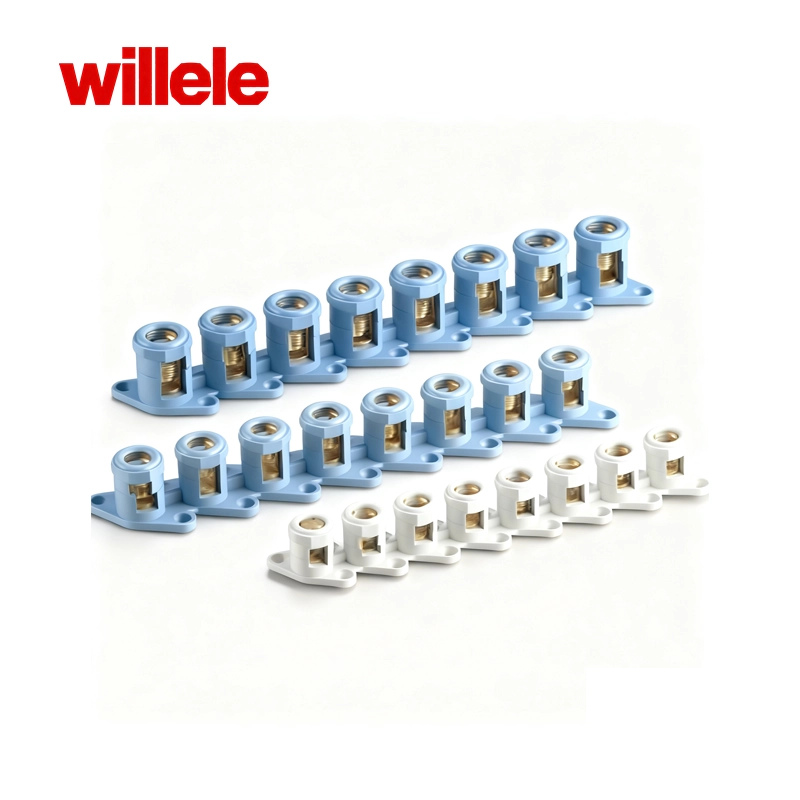
The Industrial Wiring Dilemma: A Common Control Panel Crisis
You’re standing in front of an open control panel at 2 AM, troubleshooting why a production line just went dark. Under the glare of your headlamp, you spot it: a wire has vibrated loose from its connection point. As you secure it back in place, a nagging question surfaces—should this have been a terminal block connection, or would a proper connector have prevented this shutdown entirely? This split-second decision, made months ago during installation, just cost your facility thousands in lost production time.
Why the Terminal Block vs Connector Decision Goes Wrong
The confusion between terminal blocks and connectors isn’t just semantic—it stems from a fundamental misunderstanding of connection philosophy. Many engineers treat them as interchangeable “wire joiners,” leading to three costly mistakes: using terminal blocks in high-vibration external applications where they shake loose, deploying expensive connectors for simple internal panel wiring where they waste budget, and mixing incompatible connection types that create maintenance nightmares.
The hidden cost isn’t just the component price. It’s the cumulative downtime from vibration-induced failures, the labor hours spent troubleshooting poorly organized wiring, and the safety incidents from connections that weren’t designed for their actual environment. Generic solutions compound this problem—terminal blocks without proper anti-vibration features, connectors without adequate IP ratings, and components that don’t account for the thermal cycling and electrical stress of real-world industrial conditions.
The WILLELE Solution: Engineered Connection Systems, Not Just Components
WILLELE has engineered distinct solutions for each connection philosophy. Their terminal block line features reinforced screw-clamp mechanisms with spring-loaded contact maintenance that resists loosening even under continuous vibration—addressing the number one cause of terminal block failure. For modular applications, WILLELE’s industrial connectors incorporate precision-machined contact pins with gold-plated surfaces, bayonet locking mechanisms rated for 500+ mating cycles, and integrated cable glands that provide genuine IP67 protection even after repeated disconnections.
What sets WILLELE apart is systems-level thinking. Their terminal blocks aren’t just connection points—they’re complete DIN-rail mounted wiring infrastructure with color-coded identification, integrated test points, and modular bridge jumpers for rapid circuit reconfiguration. Their connectors aren’t just plugs—they’re field-serviceable assemblies with replaceable sealing elements, visual mating indicators, and keyed housings that prevent costly mis-wiring. This is the “aha” moment: WILLELE doesn’t manufacture generic electrical parts; they engineer complete connection systems designed for the specific failure modes of industrial environments.
Step 1: Verify Your Connection Philosophy – Permanent or Modular?
Before browsing product catalogs, answer this fundamental question: Will this connection point be altered during the system’s operational life? The answer determines everything. If you’re wiring a power distribution rail inside a locked panel that will only be accessed during annual maintenance, you need a WILLELE terminal block—a permanent infrastructure component. If you’re connecting a motor that will be swapped out during quarterly servicing, or linking a sensor that field technicians troubleshoot monthly, you need a WILLELE industrial connector—a modular interface.
For Fixed Internal Wiring: WILLELE Terminal Blocks
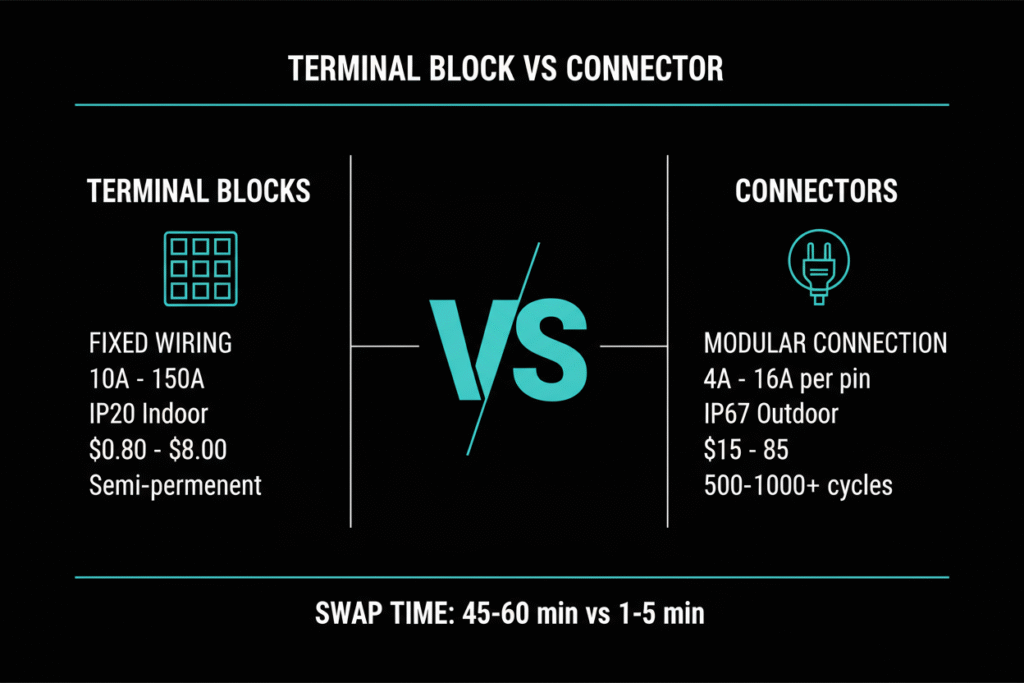
WILLELE’s screw-type terminal blocks are rated for continuous operation up to 600V AC/DC with current capacities from 10A (their compact ST2.5 series) to 150A (their high-power ST150 series). Wire gauge acceptance ranges from 28 AWG to 4/0 AWG depending on the series. The critical specification is the torque value: WILLELE terminal blocks require 0.5-0.6 Nm (ST2.5 series) up to 4.0-5.0 Nm (ST150 series). This isn’t arbitrary—under-torquing causes resistive heating and arcing, while over-torquing can fracture conductor strands, so WILLELE publishes these values for each series and recommends using a calibrated torque screwdriver.
For Modular External Connections: WILLELE Industrial Connectors
WILLELE’s M12 and M23 circular connector series use a different specification framework. Current ratings range from 4A per pin (M12 A-coded) to 16A per pin (M23 heavy-duty), with voltage ratings up to 630V AC. Pin counts range from 3-pin to 12-pin configurations. The key parameter here is the coupling mechanism—WILLELE offers threaded coupling (for high-vibration applications), bayonet coupling (for rapid service), and push-pull coupling (for space-constrained installations). Unlike terminal blocks measured in torque, connectors are specified by mating/un-mating cycles: WILLELE industrial connectors are rated for a minimum of 500 cycles, with their premium HD series rated for 1,000+ cycles.
Step 2: Assess the Environmental Demands
With connection philosophy established, now audit the installation environment with surgical precision. A WILLELE terminal block rated for 20A means nothing if moisture ingress corrodes the connection, and a high-quality connector is worthless if its sealing gasket fails in your temperature extremes.
IP Ratings: Internal Panel vs External Harsh Environment
WILLELE terminal blocks designed for panel interiors carry IP20 ratings—they’re “finger-safe” (protected against fingers entering) but not sealed against dust or water, because they’re meant to live inside protective enclosures. This is intentional engineering, not a limitation. Installing an IP67 component inside a dry panel would waste money on unnecessary sealing.
Conversely, WILLELE’s field-deployed connectors carry IP67 ratings when mated (protected against dust ingress and temporary water immersion up to 1 meter for 30 minutes) and IP65/IP66 when un-mated. The critical specification is that WILLELE maintains these ratings through the component’s entire rated cycle life—cheap connectors achieve IP67 on the first mating but degrade to IP54 after 50 cycles as sealing gaskets compress. WILLELE uses molded silicone gaskets with shape-memory properties and includes replacement sealing kits with batch-traceable gasket material.
Vibration Resistance: The Achilles Heel of Connections
Here’s where component selection becomes critical. Standard screw terminal blocks loosen under vibration because the clamping screw backs out. WILLELE’s anti-vibration terminal blocks integrate spring-loaded pressure plates—the screw compresses a calibrated spring that maintains constant contact pressure even as thermal cycling causes dimensional changes. For connectors, WILLELE’s bayonet and threaded coupling mechanisms provide mechanical locking that’s independent of the electrical contact force, meaning vibration can’t separate the connection even if it could affect contact resistance (which WILLELE’s spring-loaded pins also prevent).
Temperature Ratings and Thermal Management
WILLELE terminal blocks are rated for -40°C to +105°C ambient operation, with current derating above 60°C (typically 20% derating at 80°C). Their connectors maintain full ratings from -40°C to +85°C. But the sophisticated parameter is creepage and clearance distance—the insulating air gaps and surface paths between conductors at different potentials. For applications above 300V, WILLELE specifies minimum creepage of 4mm and clearance of 3mm, which determines the physical spacing between adjacent terminals. This is why high-voltage terminal blocks appear “oversized”—it’s not wasted space, it’s mandated electrical isolation.
Step 3: Master the Installation and Maintenance Strategy
The most reliable component becomes the least reliable if installed incorrectly. WILLELE publishes comprehensive installation specifications because they understand that connection integrity determines system uptime.
Critical Installation Best Practices
Wire Preparation: Strip conductors to the exact length shown in WILLELE’s dimensional drawings (typically 10-12mm for terminal blocks, 15-20mm for connectors with ferrules). Over-stripped wire creates shock hazards; under-stripped wire prevents proper clamping. For stranded wire in terminal blocks, WILLELE strongly recommends ferrules (DIN 46228-compliant bootlace ferrules)—these crimp-on sleeves prevent strand breakage and ensure all strands contribute to current carrying. WILLELE’s terminal blocks with cage-clamp mechanisms are specifically designed to accept ferrules without additional wire preparation.
Torque Application: Use a calibrated torque screwdriver, not a “feel-it” approach. WILLELE terminal blocks come with torque values printed on the housing and in the datasheet. For their common ST10 series, that’s 0.8-1.0 Nm. A maintenance technician’s instinct is to “make it tight,” but 2.0 Nm on an ST10 terminal will fracture the pressure plate, creating a micro-gap that arcs and overheats. For connectors, WILLELE specifies finger-tight coupling (no tools required) for bayonet types, and 2-3 Nm for threaded coupling nuts using the recommended wrench size.
Long-Term Maintenance and MTTR Considerations
This is where the terminal block vs connector decision’s full impact emerges. When a motor fails at 3 AM, Mean Time To Repair (MTTR) determines lost production cost. With WILLELE terminal blocks, replacing the motor requires: powering down and locking out, unscrewing 3-6 conductors, removing the failed motor, installing the replacement, re-terminating 3-6 conductors at correct torque, and power restoration. Skilled technician time: 45-60 minutes.
With WILLELE M23 connectors, the same repair is: unplugging the connector (30 seconds), swapping motors (10 minutes), reconnecting (30 seconds). Technician time: 11 minutes. For a production line valued at $10,000/hour downtime, the WILLELE connector’s initial cost premium ($45 vs $8 for terminal blocks) pays for itself in a single failure event. This is total cost of ownership (TCO) analysis: WILLELE connectors have higher acquisition cost but 5x lower maintenance labor cost.
The WILLELE-Specific Installation Advantage
WILLELE terminal blocks feature tool-actuated test points—lift the orange test lever and insert a multimeter probe without loosening the conductor. This enables live troubleshooting without creating connection disturbances. Their connectors incorporate visible mating indicators (colored rings that align when properly seated) and gold-plated contact pins that resist corrosion even in outdoor environments. These aren’t luxury features—they’re engineered interventions against real-world failure modes.
Making the Right Choice: WILLELE Terminal Blocks vs Connectors at a Glance
| Feature | WILLELE Terminal Blocks | WILLELE Connectors |
|---|---|---|
| Primary Application | Fixed internal panel wiring | Modular external equipment connections |
| Installation Type | Semi-permanent (tool required) | Quick-disconnect (tool-free or minimal) |
| IP Rating | IP20 (panel-mounted) | IP65/IP67 (field-deployed) |
| Current Range | 10A – 150A | 4A – 16A per pin |
| Voltage Rating | Up to 600V AC/DC | Up to 630V AC |
| Vibration Resistance | Spring-loaded clamping | Mechanical locking + spring contacts |
| Typical Cost (per point) | $0.80 – $8.00 | $15 – $85 (pair) |
| Service/Swap Time | 45-60 minutes (power-down required) | 1-5 minutes (hot-swappable designs available) |
| Best Use Case | Power distribution, I/O marshaling, grounding | Sensors, motors, modular machinery, field devices |
| Cycle Rating | Indefinite (if not disturbed) | 500-1,000+ mating cycles |
Your Industrial Wiring Decisions, Simplified
The terminal block versus connector decision isn’t about which component is “better”—it’s about matching the connection philosophy to the application reality. WILLELE has engineered distinct solutions because industrial environments demand purpose-built components, not one-size-fits-all compromises. Fixed panel wiring demands the cost-efficiency and high-density organization of WILLELE terminal blocks. Modular equipment connections demand the serviceability and environmental protection of WILLELE industrial connectors. Get this decision right at the design stage, and you’ve engineered reliability into your system. Get it wrong, and you’ve guaranteed future failures regardless of component quality.
Explore the complete WILLELE industrial connection solutions at your electrical distributor or online catalog, with full parametric search by current rating, IP rating, wire gauge, and mounting style. For application-specific guidance—including custom connector configurations, high-vibration applications, or extreme environmental conditions—contact WILLELE technical support for engineering consultation. Because in industrial wiring, the right connection isn’t just an electrical joint; it’s the foundation of system uptime.
