
Using Cable Lugs in Battery Bank Connections: Best Practices

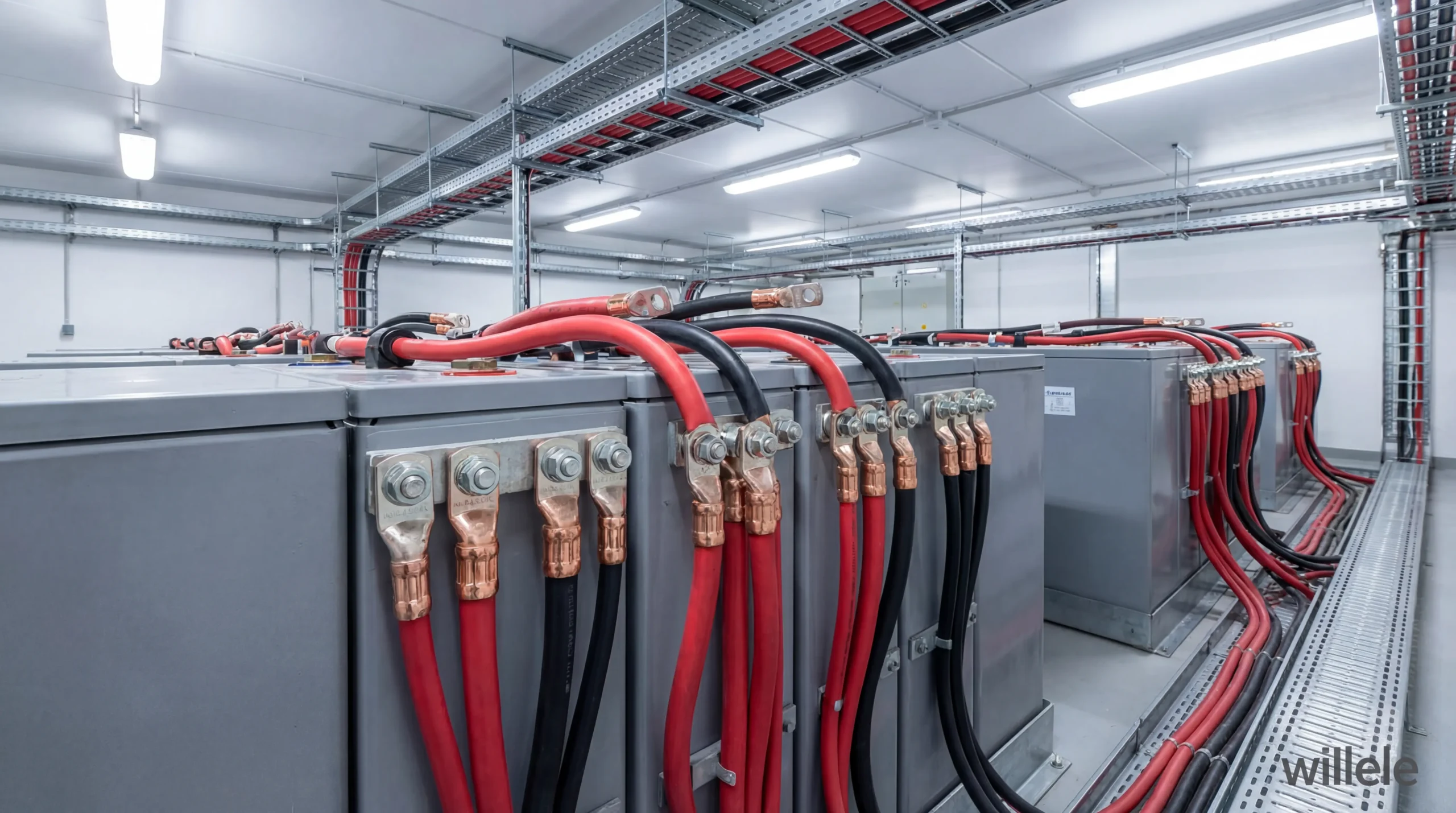
In modern energy storage systems, the reliability of battery bank connections directly impacts system performance, safety, and longevity. Cable lugs serve as the critical interface between power cables and battery terminals, making their proper selection and installation essential for any professional electrical installation. This comprehensive guide explores industry best practices for using cable lugs in battery bank connections, helping engineers, technicians, and facility managers optimize their energy storage infrastructure.
Understanding Cable Lugs in Battery Applications
Cable lugs, also known as cable terminals or compression terminals, are conductive connectors that create secure, low-resistance connections between cables and battery terminals. In battery bank applications, these components must handle substantial current loads while maintaining minimal voltage drop and resisting environmental stresses such as vibration, temperature fluctuation, and chemical exposure.
The fundamental purpose of a cable lug extends beyond simple mechanical connection. A properly installed lug ensures optimal electrical conductivity, prevents hotspots that could lead to system failure, and provides a maintenance-friendly interface that allows for inspection and replacement without compromising the entire system. In large-scale battery installations—from telecommunications backup systems to renewable energy storage arrays—the cumulative effect of properly installed cable lugs significantly influences overall system efficiency.
Types of Cable Lugs for Battery Bank Connections
Selecting the appropriate cable lug type depends on several factors including current capacity, cable size, terminal configuration, and environmental conditions. Understanding the distinctions between lug types enables informed decision-making during system design and installation.
| Lug Type | Best Applications | Advantages | Considerations |
|---|---|---|---|
| Copper Compression Lugs | High-current battery banks, industrial installations | Excellent conductivity, durable, cost-effective | Requires proper crimping tools |
| Tinned Copper Lugs | Marine environments, corrosive atmospheres | Superior corrosion resistance | Slightly higher cost |
| Aluminum Lugs | Large-scale installations with aluminum conductors | Lightweight, economical for large cables | Requires anti-oxidant compound |
| Bi-metal Lugs | Aluminum-to-copper transitions | Prevents galvanic corrosion | Essential for dissimilar metal connections |
| Ring Terminal Lugs | Standard battery post connections | Secure mechanical connection, easy installation | Most common for battery applications |
| Pin/Spade Lugs | Quick-disconnect applications | Fast maintenance access | Lower current capacity |
Copper compression lugs remain the industry standard for most battery bank applications due to their superior electrical properties and proven reliability. The copper’s high conductivity minimizes resistance heating, while proper compression creates a gas-tight connection that resists oxidation over time. For installations in coastal areas or chemical processing facilities, tinned copper lugs provide an additional layer of protection against corrosive elements that could compromise connection integrity.
Critical Factors in Cable Lug Selection
Current Capacity and Cable Sizing
The relationship between cable size, current capacity, and lug selection follows established electrical engineering principles. Undersized lugs create resistance bottlenecks that generate heat, accelerate degradation, and potentially trigger thermal runaway in battery systems. Conversely, oversized lugs may not crimp properly, leading to loose connections with similar consequences.
| Cable Size (AWG/mm²) | Continuous Current Rating | Recommended Lug Barrel Size | Typical Battery Application |
|---|---|---|---|
| 4 AWG / 21 mm² | 85-95A | 4 AWG barrel | Small UPS systems |
| 2 AWG / 33 mm² | 115-130A | 2 AWG barrel | Medium telecom installations |
| 1/0 AWG / 53 mm² | 170-195A | 1/0 AWG barrel | Large backup systems |
| 2/0 AWG / 67 mm² | 195-225A | 2/0 AWG barrel | Industrial battery banks |
| 4/0 AWG / 107 mm² | 260-300A | 4/0 AWG barrel | Utility-scale storage |
| 300 MCM / 152 mm² | 320-375A | 300 MCM barrel | High-capacity installations |
These ratings assume proper installation with appropriate heat shrink tubing and adequate ventilation. In high-temperature environments or applications with limited airflow, derating factors must be applied to prevent thermal stress.
Hole Size and Terminal Compatibility
Battery terminals vary significantly across manufacturers and battery types. Lead-acid batteries typically feature threaded posts ranging from M6 to M12, while lithium-ion battery modules may use proprietary terminal configurations. The lug’s hole diameter must accommodate the terminal stud with sufficient clearance for washers and lock washers, yet remain small enough to prevent the lug from rotating under vibration.
A common installation error involves forcing oversized lugs onto undersized terminals or allowing excessive play between the lug hole and terminal stud. Both scenarios compromise connection reliability and increase maintenance requirements. Professional installations maintain a clearance of 0.5-1.0mm between the lug hole and terminal stud, ensuring proper fit without binding.
Installation Best Practices
Proper Crimping Techniques
The crimping process creates the permanent mechanical and electrical bond between the cable conductor and the lug barrel. This cold-welding process, when executed correctly, produces a connection that often exceeds the tensile strength of the cable itself. However, improper crimping remains one of the most common failure points in battery bank installations.
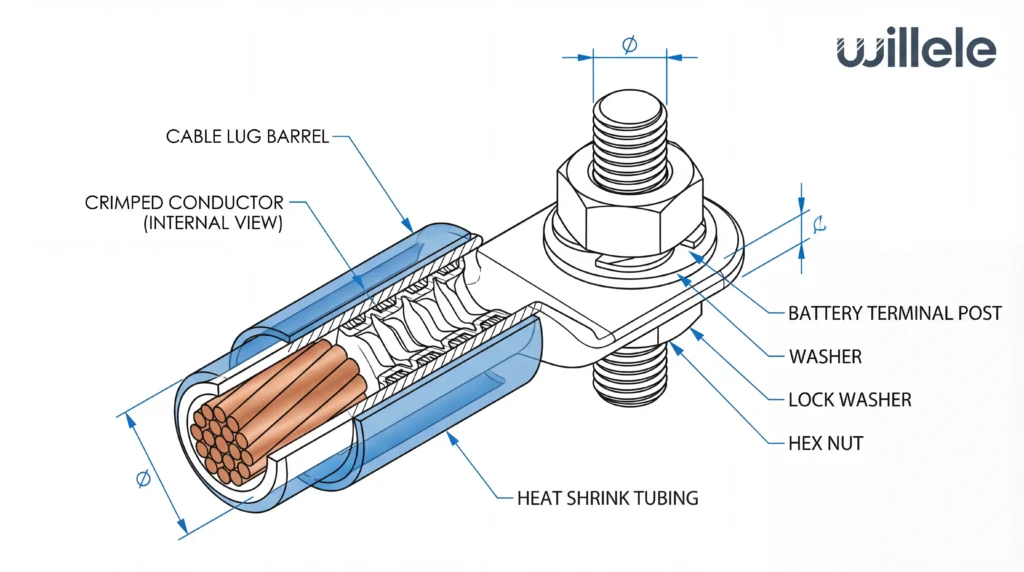
Professional crimping requires calibrated hydraulic or mechanical crimping tools matched to the specific lug and cable size. The crimp should compress the lug barrel uniformly around the conductor, creating multiple points of contact without damaging individual strands. Visual inspection should reveal a slight barrel deformation with no cracks, splits, or incomplete compression. Many professional-grade lugs feature inspection windows that allow verification of proper conductor insertion depth before crimping.
Heat Shrink Tubing Application
Heat shrink tubing provides essential insulation and environmental protection for cable lug connections in battery banks. This protective layer prevents accidental short circuits, resists moisture ingress, and contains any potential arc flash energy within the insulated envelope. For battery applications, adhesive-lined heat shrink tubing offers superior moisture sealing compared to standard heat shrink products.
The heat shrink installation process requires careful attention to positioning and heating technique. The tubing should extend beyond the lug barrel onto the cable insulation by at least 25mm, creating an overlapping seal that prevents moisture migration along the conductor. Similarly, the tubing should cover the lug barrel completely while leaving the connection hole accessible. Applying heat evenly from the center outward prevents air pocket formation and ensures complete adhesive activation.
Torque Specifications and Connection Sequence
Proper torque application ensures optimal contact pressure between the lug and battery terminal without damaging threads or deforming components. Under-torqued connections create high-resistance interfaces that generate heat and accelerate corrosion, while over-torqued connections can strip threads, crack battery posts, or deform lugs.
| Terminal Size | Recommended Torque | Hardware Configuration |
|---|---|---|
| M6 | 4-6 N⋅m (35-53 lb⋅in) | Flat washer + lock washer + nut |
| M8 | 8-12 N⋅m (71-106 lb⋅in) | Flat washer + lock washer + nut |
| M10 | 15-20 N⋅m (133-177 lb⋅in) | Flat washer + lock washer + nut |
| M12 | 20-30 N⋅m (177-265 lb⋅in) | Flat washer + lock washer + nut |
| 3/8″-16 | 15-20 N⋅m (133-177 lb⋅in) | Flat washer + split lock washer + nut |
| 1/2″-13 | 25-35 N⋅m (221-310 lb⋅in) | Flat washer + split lock washer + nut |
The connection sequence matters significantly in battery bank installations. Always connect positive terminals first when installing a battery bank, and disconnect negative terminals first during maintenance. This sequence minimizes the risk of accidental short circuits through tools or conductive surfaces. Use calibrated torque wrenches rather than estimating torque by feel, and apply torque in a smooth, continuous motion rather than impact loading.
Common Installation Mistakes and Prevention
Inadequate Cable Preparation
Cable preparation significantly influences connection quality and longevity. Conductors must be cut cleanly without frayed strands, stripped to the exact insertion depth specified by the lug manufacturer, and cleaned of any oxidation or contamination before insertion. A single strand of conductor extending beyond the lug barrel can create a short circuit path, while insufficient insertion depth reduces the effective contact area and increases resistance.
Professional installations employ cable preparation tools specifically designed for large conductors. These tools produce clean, square cuts without distorting the conductor’s circular cross-section. After stripping, conductors should be wire-brushed to remove oxidation, particularly important for aluminum cables where surface oxide layers significantly impair conductivity.
Mixing Dissimilar Metals
Galvanic corrosion occurs when dissimilar metals contact each other in the presence of an electrolyte, creating an electrochemical cell that accelerates corrosion of the more anodic metal. In battery environments where acid vapors and moisture are present, this phenomenon can rapidly degrade connections. Copper lugs on aluminum cables, or vice versa, require bi-metal transition lugs or appropriate anti-oxidant compounds to prevent galvanic action.
The galvanic series ranks metals by their electrochemical potential. The greater the separation between two metals in this series, the more aggressive the corrosion. Aluminum and copper are sufficiently separated to cause significant problems without proper mitigation. Bi-metal lugs feature a welded or brazed transition zone that eliminates the galvanic interface from the high-moisture environment.
Insufficient Vibration Protection
Battery banks in mobile applications, seismic zones, or facilities with rotating equipment experience continuous or intermittent vibration that can loosen connections over time. Standard hex nuts alone provide insufficient vibration resistance for critical battery connections. Professional installations employ multiple vibration mitigation strategies including split lock washers, thread-locking compounds, or double-nut configurations.
Lock washers function by maintaining spring tension on the connection even as thermal cycling causes slight dimensional changes. However, lock washers lose effectiveness if compressed beyond their elastic limit through over-torquing. Thread-locking compounds provide chemical resistance to loosening but must be selected carefully for battery environments where acid vapors may degrade certain polymer formulations.
Maintenance and Inspection Protocols
Regular inspection and maintenance of cable lug connections prevents unexpected failures and extends battery bank service life. Professional maintenance programs incorporate both visual inspections and quantitative measurements to assess connection health.
| Inspection Item | Frequency | Acceptance Criteria | Corrective Action |
|---|---|---|---|
| Visual corrosion check | Monthly | No visible corrosion products | Clean and apply anti-oxidant |
| Thermal imaging | Quarterly | <10°C above ambient | Investigate and re-torque |
| Torque verification | Annually | Within specification ±10% | Re-torque to specification |
| Resistance measurement | Annually | <1 mΩ for power connections | Clean or replace connection |
| Heat shrink integrity | Annually | No cracks, complete coverage | Replace heat shrink tubing |
| Hardware condition | Annually | No deformation or damage | Replace damaged components |
Thermal imaging provides the most effective non-invasive assessment of connection quality. Properly functioning connections operate at temperatures within a few degrees of ambient, while degraded connections generate measurable heat due to increased resistance. Infrared thermography performed under load conditions reveals problem connections before they cause system failures.
Advanced Considerations for Large-Scale Installations
Parallel Connection Management
Large battery banks often require parallel connections to achieve desired capacity and current handling. Parallel connections introduce current sharing challenges where unequal resistance in different paths causes unbalanced loading. This imbalance accelerates aging in the more heavily loaded batteries while underutilizing others.
Professional parallel connection design ensures equal cable lengths and identical connection hardware across all parallel paths. When physical constraints prevent equal cable lengths, designers compensate by adjusting cable sizes to equalize total path resistance. Advanced installations incorporate current monitoring on individual parallel paths to verify balanced operation and detect developing problems.
Temperature Compensation
Cable and lug resistance varies with temperature, increasing approximately 0.4% per degree Celsius for copper. In battery rooms with significant temperature variation, this resistance change affects system performance and efficiency. While individual connection resistance changes remain small, the cumulative effect across dozens or hundreds of connections in a large battery bank becomes significant.
Temperature-compensated system design accounts for worst-case temperature scenarios, ensuring adequate conductor and lug sizing even at maximum operating temperature. Some advanced installations incorporate temperature monitoring at critical connections, allowing predictive maintenance based on thermal trends rather than fixed schedules.
Documentation and Traceability
Professional battery bank installations maintain comprehensive documentation including cable schedules, lug specifications, torque values, and installation dates. This documentation enables effective troubleshooting, supports maintenance planning, and provides traceability for quality assurance. Digital documentation systems with photographic records of each connection facilitate remote technical support and training.
Safety Considerations
Battery bank work involves multiple hazards including electrical shock, arc flash, and chemical exposure. Cable lug installation and maintenance require appropriate personal protective equipment, lockout/tagout procedures, and adherence to relevant electrical codes and standards. Short-circuit currents in battery banks can reach tens or hundreds of kiloamperes, creating arc flash hazards that exceed those in many utility power systems.
Professional installations follow NFPA 70E guidelines for electrical safety, including arc flash hazard analysis and appropriate PPE selection. Battery work requires face shields, arc-rated clothing, insulated tools, and voltage-rated gloves. Never assume a battery is de-energized—batteries cannot be “switched off” and maintain full voltage even when disconnected from loads.
Frequently Asked Questions
Q: How often should I re-torque battery cable lug connections?
A: Initial re-torque should occur 24-48 hours after installation to compensate for material settling and thermal cycling. Subsequently, annual re-torque verification is standard for stationary installations, while mobile or high-vibration applications may require quarterly checks. Always use calibrated torque wrenches and follow manufacturer specifications.
Q: Can I reuse cable lugs when replacing cables?
A: No. Compression-style cable lugs are designed for single-use installation. The crimping process permanently deforms the lug barrel, and attempting to remove and reuse a crimped lug damages both the lug and conductor. Always install new lugs when replacing cables or reconfiguring connections.
Q: What’s the difference between copper and tinned copper lugs for battery applications?
A: Tinned copper lugs feature a thin tin coating that provides superior corrosion resistance in harsh environments including marine, coastal, or chemically aggressive atmospheres. Standard copper lugs offer excellent performance in controlled indoor environments at lower cost. Choose tinned copper for outdoor installations or corrosive environments.
Q: How do I prevent galvanic corrosion when connecting aluminum cables to copper battery terminals?
A: Use bi-metal cable lugs specifically designed for aluminum-to-copper transitions, or apply anti-oxidant compound rated for dissimilar metal connections. Never directly connect aluminum lugs to copper terminals without proper mitigation, as galvanic corrosion will rapidly degrade the connection.
Q: What size heat shrink tubing should I use for cable lug connections?
A: Select heat shrink tubing with a recovered diameter that fits snugly over the lug barrel and an expanded diameter that fits over the cable insulation. Adhesive-lined heat shrink provides superior moisture sealing for battery applications. The tubing should overlap the cable insulation by at least 25mm and cover the entire lug barrel while leaving the connection hole accessible.
About willele Electric
willele Electric specializes in manufacturing premium heat shrink tubing and cable management solutions for industrial and commercial electrical installations. Our products meet international quality standards and provide reliable protection for critical electrical connections including battery bank installations. For technical specifications and product selection assistance, visit willele.com or contact our engineering support team.
