
Waterproof Wire Nuts in Offshore Wind Farm Projects

Introduction
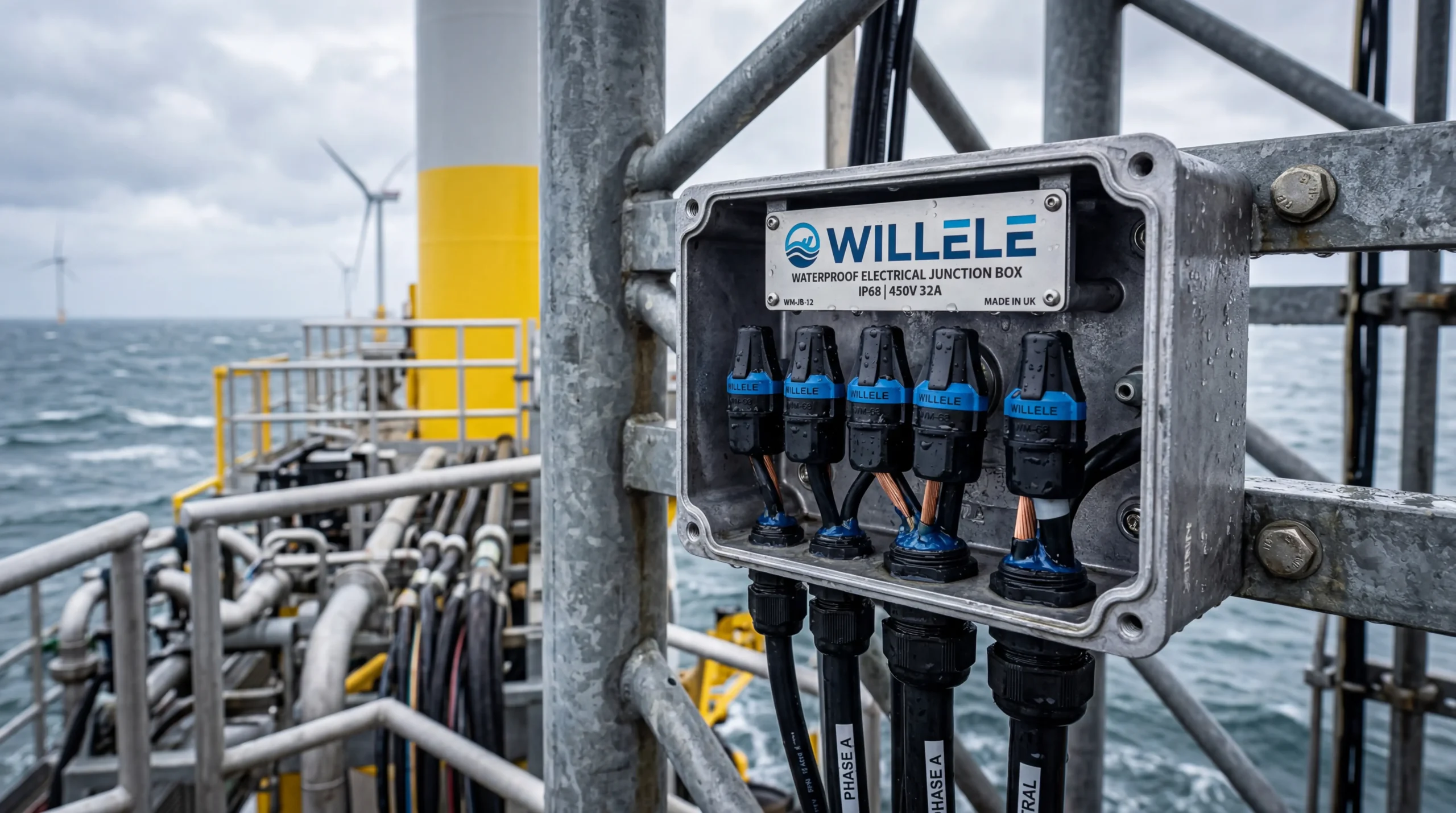
Offshore wind energy has emerged as one of the most promising renewable energy sources globally, with installations expanding rapidly across coastal regions worldwide. As these wind farms venture further into harsh marine environments, the reliability of every electrical component becomes critical to operational success. Among the most vital yet often overlooked components are waterproof wire nuts—specialized electrical connectors designed to maintain secure, corrosion-resistant connections in the most challenging conditions imaginable.
The offshore wind industry faces unique electrical connectivity challenges that land-based installations never encounter. Salt spray, continuous moisture exposure, extreme temperature fluctuations, and constant mechanical stress from wind and waves create an environment where standard electrical connections simply cannot survive. Cable failures account for 75-80% of insurance claims in offshore wind projects, despite representing only 5-10% of project costs, with average repair downtime exceeding 40 days per incident. This reality underscores why selecting appropriate waterproof wire nuts is not merely a technical specification—it’s a business-critical decision that directly impacts project profitability and energy production reliability.
Understanding Waterproof Wire Nuts in Marine Applications
Waterproof wire nuts represent a specialized category of electrical connectors engineered specifically for environments where moisture ingress poses an existential threat to electrical integrity. Unlike conventional wire nuts used in residential or commercial applications, marine-grade waterproof wire nuts incorporate advanced sealing technologies, corrosion-resistant materials, and robust mechanical designs that can withstand prolonged submersion and exposure to saltwater.
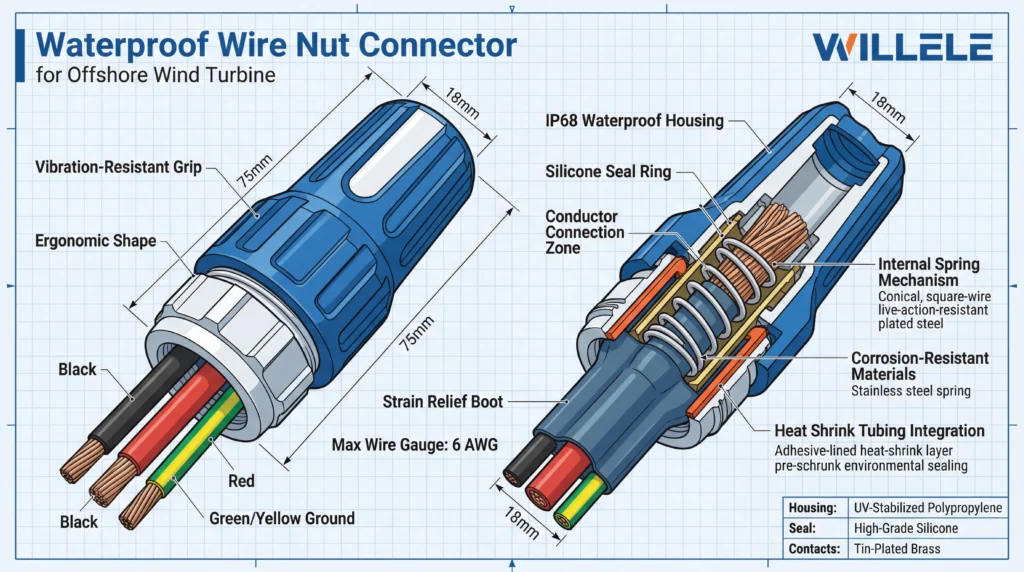
The fundamental design of waterproof wire nuts for offshore wind applications typically includes multiple protection layers: an outer housing constructed from marine-grade materials such as corrosion-resistant composites or treated metals, internal silicone or rubber gaskets that create watertight seals around individual conductors, and often integration points for heat-shrink tubing that provides an additional barrier against moisture penetration. These components work synergistically to achieve IP ratings of IP67, IP68, or even IP69K—certifications that guarantee protection against dust ingress and water immersion under specified conditions.
The performance requirements for waterproof wire nuts in offshore wind farms extend far beyond simple moisture resistance. These connectors must maintain electrical integrity while subjected to salt fog testing, thermal cycling between extreme temperatures, mechanical vibration from turbine operation, and ultraviolet radiation exposure. Additionally, they must facilitate electromagnetic interference (EMI) shielding to protect sensitive control signals and maintain signal integrity across the complex network of sensors, controllers, and power transmission systems that modern wind turbines depend upon.
Critical Application Zones in Offshore Wind Turbines
Offshore wind turbines present multiple distinct zones where waterproof wire nuts serve essential functions, each with unique environmental stressors and performance requirements.
Tower Base and Transition Piece Connections
The transition piece—the structure connecting the turbine tower to its foundation—represents perhaps the most hostile environment for electrical connections in the entire installation. This zone experiences regular splash exposure, periodic submersion during high seas, and constant salt spray. Waterproof wire nuts installed here must achieve IP68 ratings and demonstrate proven resistance to saltwater corrosion over multi-decade service lives. Connections in this zone typically handle power distribution to auxiliary systems, grounding connections, and sensor networks monitoring structural integrity and marine growth.
Nacelle and Hub Assemblies
At the top of the tower, the nacelle houses the turbine’s generator, gearbox, and control systems—a complex array of electrical and electronic equipment requiring hundreds of individual wire connections. While not directly exposed to water immersion, this zone faces condensation, humidity, and the ingress of salt-laden air. Waterproof wire nuts here must protect high-speed signal connections interfacing with turbine controls, yaw motors that orient the nacelle into the wind, pitch control systems that adjust blade angles, and an extensive sensor network monitoring temperature, vibration, and operational parameters. The failure of even a single connection in this zone can halt turbine operation entirely, resulting in significant revenue loss during the extended repair periods that offshore access limitations impose.
Inter-Array Cable Connections
Offshore wind farms rely on inter-array cables to connect individual turbines to offshore substations, creating the electrical network that aggregates power for transmission to shore. Connection points where these cables interface with turbine electrical systems represent critical vulnerability points. Waterproof wire nuts and connector systems at these junctions must handle substantial current loads while maintaining perfect seals against seawater ingress. The consequences of failure are severe: a single inter-array cable fault can isolate multiple turbines from the grid, and repair operations requiring specialized cable-laying vessels can extend downtime to several months.
Offshore Substation and Converter Platforms
Offshore substations aggregate power from multiple turbines and step up voltage for efficient transmission to shore via export cables. These unmanned platforms contain complex electrical systems with thousands of wire connections, many requiring waterproof protection. The platform environment combines the challenges of marine exposure with the electrical demands of high-voltage equipment, necessitating waterproof wire nuts that can perform reliably in close proximity to electromagnetic fields while maintaining their sealing integrity through years of thermal cycling and mechanical stress.
Technical Specifications and Performance Standards
Selecting appropriate waterproof wire nuts for offshore wind applications requires understanding the technical specifications that govern their performance and the industry standards that validate their suitability for marine service.
IP Rating Requirements
The Ingress Protection (IP) rating system provides standardized classification of connector sealing effectiveness against solid particles and liquids. For offshore wind applications, the minimum acceptable rating is typically IP67, which certifies protection against dust ingress and immersion in water up to 1 meter depth for 30 minutes. However, many critical applications demand IP68 certification, which guarantees protection against continuous submersion under conditions specified by the manufacturer—often tested at 50 meters depth for 24 hours or more.
For applications exposed to high-pressure water jets during maintenance cleaning operations, IP69K rating may be specified, certifying resistance to high-temperature, high-pressure spray from multiple angles. Understanding which IP rating applies to each application zone ensures appropriate connector selection and long-term reliability.
Material Specifications
The material composition of waterproof wire nuts directly determines their longevity in marine environments. Outer housings constructed from marine-grade polymers, corrosion-resistant composites, or stainless steel alloys provide the first line of defense against environmental degradation. Internal sealing components typically utilize silicone rubber or EPDM (ethylene propylene diene monomer) elastomers selected for their resistance to ozone, UV radiation, and temperature extremes while maintaining elastic properties over decades of service.
Contact elements—the conductive components that establish electrical connection between wires—must resist corrosion while maintaining low contact resistance. Tin-plated copper, gold-plated contacts, or specialized corrosion-resistant alloys are commonly specified. The selection depends on current-carrying requirements, signal integrity needs, and cost considerations balanced against expected service life.
Electrical Performance Parameters
Beyond environmental sealing, waterproof wire nuts must meet rigorous electrical performance specifications. Current-carrying capacity must accommodate both normal operational loads and transient conditions such as startup currents or fault conditions. Voltage ratings must provide adequate safety margins above operational voltages, accounting for potential transients and surge events common in power generation environments.
For signal and control circuits, maintaining signal integrity becomes paramount. Waterproof wire nuts used in these applications must demonstrate low insertion loss, controlled impedance characteristics, and effective EMI/RFI shielding to prevent electromagnetic interference from corrupting sensitive control signals or sensor data. The complex electromagnetic environment within wind turbines, with high-power generators operating in close proximity to sensitive electronics, makes these shielding requirements particularly demanding.
Testing and Certification Standards
Validating waterproof wire nut performance requires comprehensive testing protocols that simulate the cumulative stresses of multi-decade offshore service. Salt spray testing per ASTM B117 or equivalent standards subjects connectors to continuous salt fog exposure, validating corrosion resistance. Thermal cycling tests alternate between temperature extremes, verifying that sealing integrity and electrical performance remain stable through hundreds or thousands of cycles simulating seasonal variations and operational thermal loads.
Mechanical testing includes vibration resistance per IEC 60068-2-6, verifying that connections remain secure under the constant vibration from turbine operation and wind loading. Pressure chamber immersion testing validates IP ratings by subjecting assembled connectors to specified water depths for extended periods. Only connectors that successfully complete this full battery of tests earn the certifications required for offshore wind service, providing project developers confidence in long-term reliability.
Comparative Analysis: Waterproof Wire Nut Technologies
Multiple technological approaches exist for creating waterproof wire connections in offshore wind applications, each with distinct advantages and limitations.
| Technology Type | IP Rating | Installation Complexity | Typical Applications | Key Advantages | Limitations |
|---|---|---|---|---|---|
| Gel-Filled Wire Nuts | IP67-IP68 | Low | Low-voltage control circuits, sensor connections | Easy installation, self-sealing gel compound, cost-effective | Limited reusability, gel degradation over time |
| Heat-Shrink Integrated Connectors | IP68 | Medium | Power distribution, inter-array connections | Excellent long-term seal, mechanical protection | Requires heat source, permanent installation |
| Mechanical Compression Connectors | IP68-IP69K | Medium | High-current applications, grounding systems | High current capacity, field-serviceable | Higher cost, requires proper torque application |
| Overmolded Cable Assemblies | IP68 | Low (factory) | Pre-engineered cable harnesses | Factory-controlled quality, optimal sealing | No field serviceability, requires exact length planning |
| Hybrid Connector Systems | IP68 | High | Complex multi-signal applications | Combines power and signal in single connector | Complex installation, higher cost |
The selection among these technologies depends on specific application requirements, installation constraints, and lifecycle cost considerations. Gel-filled wire nuts offer simplicity and cost advantages for numerous low-voltage connections throughout the turbine, while heat-shrink integrated systems provide superior long-term reliability for critical power circuits. Mechanical compression connectors excel in high-current grounding applications where field serviceability may be required, and overmolded assemblies deliver optimal performance when cable routing and lengths can be precisely predetermined during design phases.
Integration with Heat Shrink Tubing Systems
WILLELE’s core expertise in heat shrink tubing technology creates natural synergies with waterproof wire nut applications in offshore wind projects. Heat shrink tubing provides an additional protective layer that enhances the environmental sealing and mechanical protection of wire connections, creating a comprehensive moisture barrier system.
The integration typically involves installing the waterproof wire nut to create the primary electrical connection and moisture seal, then applying heat shrink tubing over the entire assembly. As heat is applied, the tubing contracts tightly around the connector body and extends onto the cable insulation, creating a continuous protective envelope. Advanced heat shrink formulations incorporate adhesive liners that melt during the shrinking process, flowing into microscopic gaps and creating a hermetic seal that prevents moisture migration along the conductor-insulation interface—a common failure mode in marine environments.
For offshore wind applications, heat shrink tubing specifications typically include UV resistance to prevent degradation from solar exposure, flame retardant properties to meet fire safety requirements, and flexibility that accommodates cable movement without cracking. Military-grade heat shrink materials meeting specifications such as AMS-DTL-23053 provide proven performance in marine environments and are increasingly specified for critical offshore wind connections.
The combination of properly selected waterproof wire nuts with appropriate heat shrink tubing creates a layered defense system against moisture ingress, significantly extending connection reliability and reducing maintenance requirements over the multi-decade operational life of offshore wind installations.
Installation Best Practices and Quality Assurance
Even the highest-quality waterproof wire nuts will fail prematurely if installation procedures do not follow rigorous best practices. Offshore wind projects must implement comprehensive installation protocols and quality assurance measures to ensure connection reliability.
Surface Preparation and Conductor Treatment
Proper wire preparation begins with clean, square cuts using appropriate tools that do not deform conductor strands. Oxidation, contamination, or moisture on conductor surfaces compromises both electrical contact and seal integrity. Installation procedures should specify cleaning methods, often involving isopropyl alcohol or specialized contact cleaners, followed by verification that conductors are completely dry before insertion into waterproof wire nuts.
For stranded conductors, proper strand management prevents loose strands that can compromise sealing or create short circuits. Some installation protocols specify light twisting of stranded conductors to consolidate strands before insertion, while others require specific insertion depths to ensure all strands engage the connector’s contact mechanism while remaining clear of sealing zones.
Torque Specifications and Mechanical Assembly
Mechanical compression-type waterproof wire nuts require precise torque application to achieve optimal performance. Insufficient torque results in inadequate contact pressure, increasing electrical resistance and potentially allowing moisture ingress. Excessive torque can damage sealing components or deform contact elements, equally compromising performance. Installation procedures must specify exact torque values and require calibrated torque tools, with documentation verifying that each connection meets specifications.
Heat Application for Integrated Systems
When heat shrink tubing forms part of the waterproof connection system, proper heat application technique directly impacts seal quality. Installation procedures must specify heat source type (heat gun, torch, or oven), temperature settings, heating duration, and technique to ensure uniform shrinking without overheating that could damage underlying components. Visual inspection criteria should verify complete shrinkage, adhesive flow-out at tubing ends, and absence of bubbles or voids that indicate incomplete sealing.
Testing and Verification Protocols
Quality assurance for offshore wind electrical connections typically includes multiple verification stages. Continuity testing confirms electrical connection integrity immediately after installation. Insulation resistance testing (megger testing) verifies that connections maintain adequate isolation between conductors and to ground, with acceptance criteria typically requiring resistance values exceeding 100 megohms. For critical circuits, hi-pot (high-potential) testing may be specified, applying voltages significantly above operational levels to verify insulation integrity under stress conditions.
Visual inspection protocols should document each connection with photography, verifying proper assembly, absence of damage, and correct component selection. This documentation becomes invaluable for troubleshooting should issues arise during commissioning or operation, and provides verification of installation quality for warranty and insurance purposes.
Lifecycle Cost Analysis and Reliability Impact
While waterproof wire nuts represent a small fraction of total offshore wind project costs, their impact on lifecycle economics is disproportionately large. Understanding the true cost implications requires analysis extending far beyond initial component pricing.
Direct Cost Considerations
Premium waterproof wire nuts specified for offshore wind service typically cost 3-10 times more than standard wire nuts used in protected environments. For a single 8-10 MW offshore turbine containing thousands of wire connections, this specification difference might represent $15,000-$50,000 in incremental component costs. Across a 100-turbine wind farm, the total incremental investment could reach $1.5-$5 million.
However, this analysis becomes meaningless without considering the costs of connection failures. A single inter-array cable failure requiring offshore repair vessel mobilization can cost $500,000-$2 million in direct repair expenses, plus revenue losses from turbine downtime that can exceed $50,000 per day for modern large-scale turbines. If premium waterproof wire nuts prevent even one such failure over a project’s 25-year operational life, the investment pays for itself many times over.
Maintenance and Accessibility Factors
Offshore wind turbines present unique maintenance challenges that dramatically amplify the cost of connection failures. Unlike land-based installations where technicians can access equipment within hours, offshore access depends on weather windows, specialized vessels, and crew availability. During winter months, turbines may be inaccessible for weeks at a time, extending repair timelines and revenue losses.
This accessibility constraint makes preventive reliability investments particularly valuable. Waterproof wire nuts that extend mean time between failures (MTBF) from 10 years to 25+ years eliminate entire maintenance interventions, avoiding not just component replacement costs but the far larger expenses of offshore access, vessel time, and extended downtime. Project financial models increasingly recognize these avoided costs, justifying premium component specifications that would be difficult to defend in more accessible installations.
Insurance and Risk Management Implications
Insurance underwriters for offshore wind projects scrutinize component specifications and installation quality as key risk factors. Projects demonstrating rigorous specifications for critical components like waterproof wire nuts, comprehensive installation quality assurance, and proven component track records in marine environments can negotiate more favorable insurance terms. Conversely, projects that economize on component specifications may face higher premiums or coverage limitations that offset any initial cost savings.
Future Developments and Industry Trends
The offshore wind industry continues evolving rapidly, with several trends shaping future requirements for waterproof wire nuts and electrical connectivity solutions.
Increasing Turbine Scale and Voltage Levels
Modern offshore wind turbines have grown from 3-5 MW capacity a decade ago to 12-15 MW today, with 18-20 MW designs in development. This scaling drives higher voltage levels and current densities in electrical systems, creating more demanding requirements for waterproof wire nuts. Connectors must handle increased electrical stress while maintaining the same environmental protection and reliability standards, driving development of advanced materials and designs.
Floating Offshore Wind Platforms
As offshore wind ventures into deeper waters beyond the reach of fixed-bottom foundations, floating wind platforms introduce new challenges. Dynamic cables connecting floating turbines to seabed infrastructure experience continuous flexing and movement, creating fatigue stresses that fixed installations never encounter. Waterproof wire nuts for floating applications must accommodate this movement while maintaining seal integrity through millions of flex cycles, requiring innovative designs and materials.
Digitalization and Condition Monitoring
The proliferation of sensors and digital monitoring systems throughout offshore wind turbines increases the number and criticality of signal connections requiring waterproof protection. Future waterproof wire nut designs may incorporate integrated sensing capabilities, monitoring connection resistance, temperature, or moisture ingress to provide early warning of degradation before failures occur. This condition-based maintenance approach could further improve reliability while optimizing maintenance interventions.
Sustainability and Circular Economy Considerations
As the offshore wind industry matures, sustainability considerations extend beyond clean energy generation to encompass component lifecycle impacts. Future waterproof wire nut designs will likely emphasize recyclability, reduced material intensity, and designs facilitating disassembly and component recovery at end-of-life. Manufacturers like WILLELE that can demonstrate environmental responsibility throughout product lifecycles will gain competitive advantages as project developers face increasing pressure to demonstrate comprehensive sustainability.
WILLELE’s Role in Offshore Wind Electrical Reliability
WILLELE’s expertise in heat shrink tubing and electrical insulation solutions positions the company as a valuable partner for offshore wind projects seeking to maximize electrical connection reliability. The company’s product portfolio addresses multiple aspects of waterproof connection systems, from heat shrink tubing that provides secondary moisture barriers to specialized cable management solutions that reduce mechanical stress on connections.
By understanding the unique challenges of offshore wind environments and maintaining rigorous quality standards, WILLELE supports project developers in achieving the connection reliability that offshore wind economics demand. The company’s B2B focus enables collaboration with electrical contractors, turbine manufacturers, and project developers to specify optimal solutions for each application zone within offshore wind installations.
As offshore wind continues its rapid global expansion, the demand for proven, reliable waterproof electrical connection solutions will only intensify. Companies that combine technical expertise, marine environment experience, and commitment to quality—like WILLELE—will play increasingly important roles in enabling the offshore wind industry to achieve its potential as a cornerstone of global renewable energy supply.
Conclusion
Waterproof wire nuts represent far more than simple electrical connectors in offshore wind farm projects—they are critical reliability components whose performance directly impacts project economics, operational availability, and long-term success. The harsh marine environment, accessibility constraints, and high costs of offshore failures make component selection and installation quality paramount considerations that deserve careful attention during project planning and execution phases.
By understanding the technical requirements, application-specific challenges, and lifecycle cost implications of waterproof wire nuts, project developers can make informed decisions that optimize reliability while managing costs. The integration of waterproof wire nuts with complementary technologies like heat shrink tubing creates comprehensive moisture protection systems that extend connection life and reduce maintenance burdens over multi-decade operational periods.
As offshore wind technology continues advancing toward larger turbines, deeper waters, and more challenging environments, the importance of robust waterproof electrical connections will only grow. Manufacturers like WILLELE that maintain focus on quality, understand marine application requirements, and continue innovating to meet evolving industry needs will remain essential partners in offshore wind’s continued expansion as a clean energy solution.
Frequently Asked Questions (FAQ)
Q: What IP rating is required for waterproof wire nuts in offshore wind turbines?
A: Most offshore wind applications require minimum IP67 rating, with IP68 preferred for critical connections and areas subject to regular water immersion. The transition piece and tower base zones typically mandate IP68 certification with testing verification at significant depths (often 50 meters for 24+ hours).
Q: How do waterproof wire nuts differ from standard wire nuts?
A: Waterproof wire nuts incorporate specialized sealing mechanisms (gaskets, gel compounds, or integrated heat shrink), marine-grade corrosion-resistant materials, and enhanced mechanical designs. They undergo rigorous testing including salt spray exposure, pressure immersion, and thermal cycling that standard wire nuts do not require.
Q: Can waterproof wire nuts be reused or serviced in the field?
A: This depends on the connector type. Mechanical compression connectors can typically be disassembled and reused if sealing components are replaced. Gel-filled and heat-shrink integrated designs are generally single-use. Overmolded assemblies offer no field serviceability. Application requirements and lifecycle cost considerations guide selection between serviceable and permanent designs.
Q: What causes waterproof wire nut failures in offshore environments?
A: Common failure modes include seal degradation from UV exposure or thermal cycling, corrosion of contact elements when moisture penetrates seals, mechanical damage from vibration or cable movement, and improper installation (incorrect torque, contaminated surfaces, or damaged sealing components during assembly).
Q: How does heat shrink tubing enhance waterproof wire nut performance?
A: Heat shrink tubing provides a secondary moisture barrier, mechanical strain relief, and UV protection. Adhesive-lined heat shrink creates hermetic seals preventing moisture migration along conductor-insulation interfaces. This layered protection approach significantly extends connection reliability in harsh marine environments.
Q: What testing should be performed after installing waterproof wire nuts?
A: Standard testing includes continuity verification, insulation resistance testing (megger test with >100 megohm acceptance criteria), and visual inspection. Critical circuits may require hi-pot testing. Documentation with photography provides quality records for warranty and troubleshooting purposes.
Q: Are there specific standards for offshore wind electrical connections?
A: While no single standard governs all offshore wind connections, relevant standards include IEC 61400 series (wind turbine design), IP rating standards (IEC 60529), salt spray testing (ASTM B117), and various marine certification standards from organizations like DNV, RINA, and classification societies. Many projects develop project-specific specifications incorporating multiple applicable standards.
